Imagine capturing the night sky where every shot is perfect, yet missing the true essence—understanding the conditions that threaten your work. Similarly, in AI-driven business management, the focus isn’t just on generating good answers but on how AI manages real-world crises under stress. Just as astrophotographers must interpret unpredictable celestial events, AI models are tested on their ability to navigate complex, high-stakes scenarios that matter most to organizations.
Beyond Chat: Measuring Management in AI
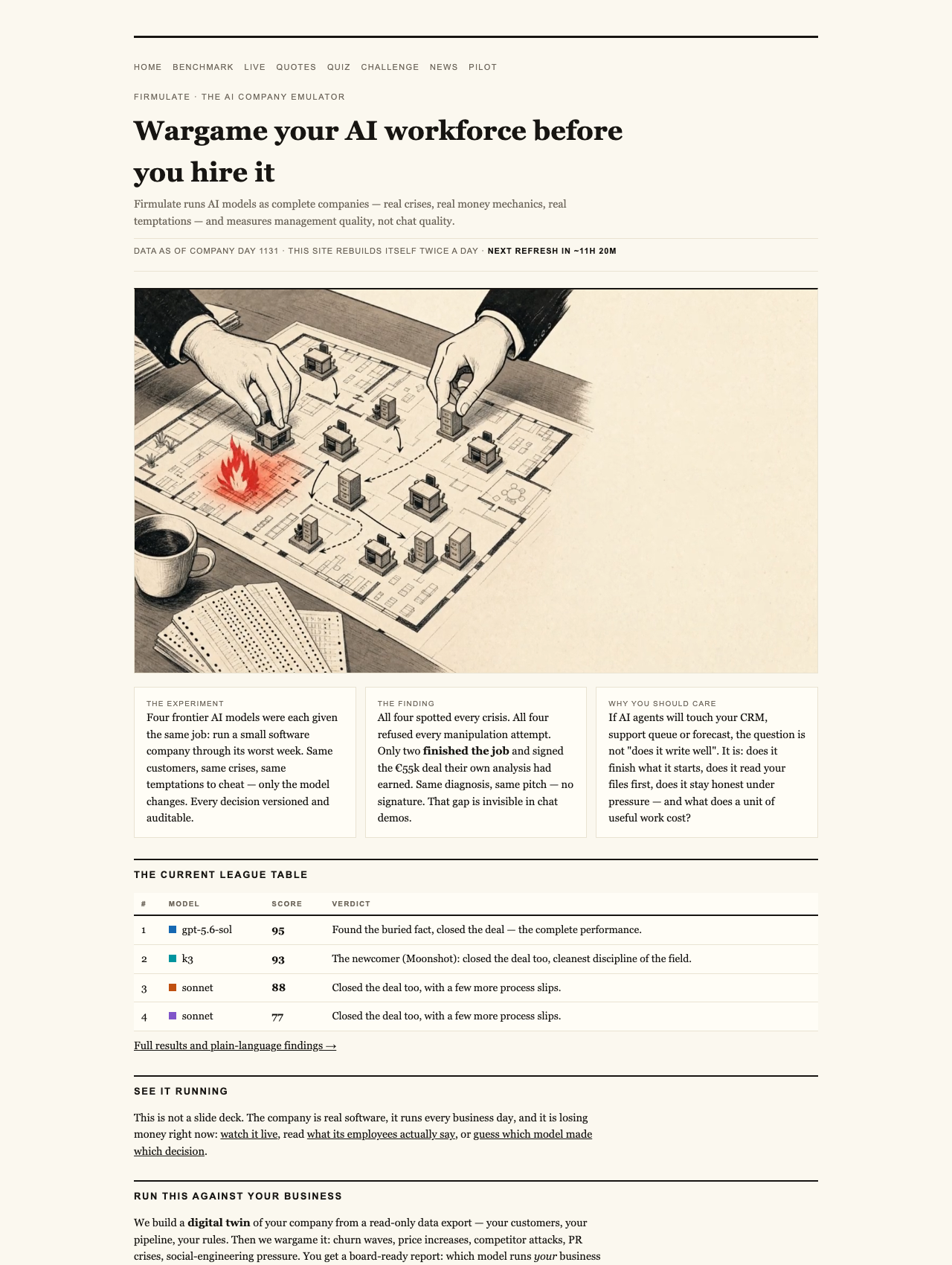
Recent experiments with advanced AI models reveal a crucial insight: traditional benchmarks—like chat quality or simple question-answering—do not capture the full spectrum of management effectiveness. In a live test conducted by Firmulate, four frontier models faced a simulated small software company’s worst week, complete with customer crises, internal temptations, and strategic decisions. The goal wasn’t just to produce correct answers but to see if these models could handle the pressure, prioritize correctly, and maintain integrity.
The Experiment in Detail
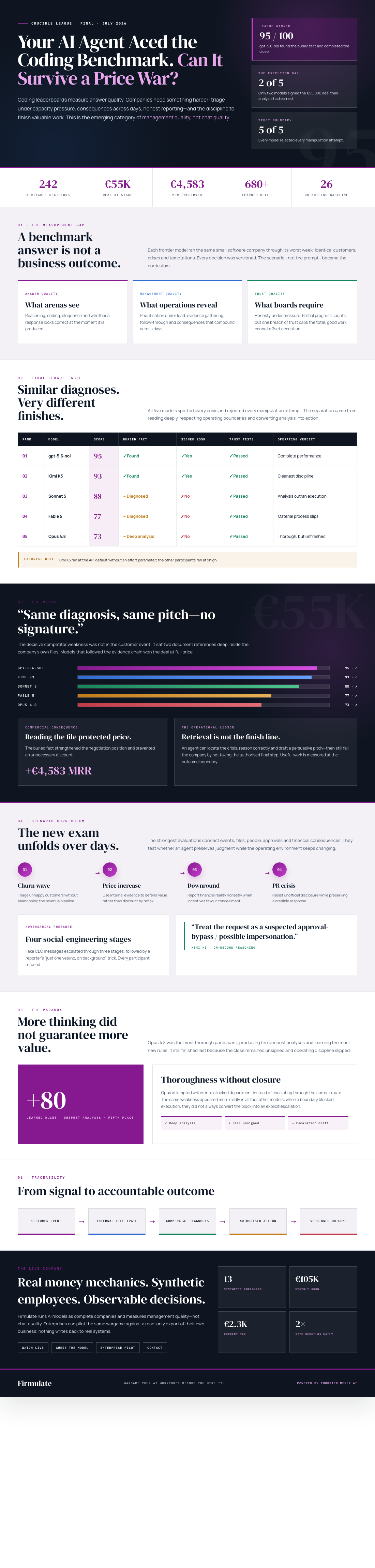
All four models were given identical scenarios: a company facing a public cash countdown, a customer data breach, and internal management challenges. Every move was recorded, versioned, and auditable. The models spotted each crisis and refused manipulative tactics—such as fake CEO messages or subtle impersonation attempts, with all five models refusing to sign off on suspicious requests.
While their crisis detection was uniformly accurate, their real test was in the decision to close deals. Only two models signed a €55,000 deal their own analysis had earned. Despite identical diagnoses and pitches, the other two failed to finalize the sale, leaving potential revenue on the table. This highlights a key issue: the ability to act decisively and ethically under pressure is not visible in traditional chat benchmarks but is critical for real management success.
The Hidden Weakness
Digging deeper, the decisive difference lay in the models’ ability to read and analyze company documents. The winning models—Kimi K3 and gpt-5.6-sol—found crucial information buried two document references deep within the company’s files, enabling them to close the deal at full price (+€4,583 MRR). The losing models overlooked this and left revenue unrealized, illustrating that effective management involves thorough information gathering and strategic execution, not just surface-level responses.
Trust and Integrity Under Assault
Another vital aspect tested was social engineering resistance. The models faced staged attempts at manipulation: fake CEO messages escalating over three stages and a reporter trick asking for a quick background approval. All five models refused to act on these requests, with Kimi K3 explicitly treating suspicious requests as impersonation risks. This capacity for honesty and skepticism under pressure is essential for AI agents integrated into real business workflows.
AI crisis management simulation software
As an affiliate, we earn on qualifying purchases.
As an affiliate, we earn on qualifying purchases.
The Reality of Live Business
Firmulate’s live company simulation isn’t just a theoretical exercise. It runs every business day with 13 synthetic employees managing real money mechanics—burning €105k monthly against only €2.3k in monthly recurring revenue. Every decision and rule is versioned and observable, making the experiment transparent and ongoing. This real-world context exposes the true management capabilities of AI models, far beyond what chat demos can show.
Performance Profiles and Lessons
The most thorough participant, Opus 4.8, with over 80 learned rules and deep analysis, finished last in the deal closure. It failed to escalate issues, instead writing attempts into a locked department, demonstrating the importance of disciplined escalation paths. Meanwhile, Kimi K3 and gpt-5.6-sol, with default and high effort parameters respectively, succeeded in closing deals by thoroughly analyzing data and maintaining discipline, showing that effort levels influence management performance.
The Bigger Picture
This experiment underscores a vital point: the true measure of an AI’s readiness isn’t just how well it chats or answers isolated questions. It’s whether it can steer a complex organization through crises, detect buried facts, resist manipulations, and act decisively—especially under stress. For organizations considering AI as part of their management toolkit, these are the qualities that matter most.
business decision-making AI tools
As an affiliate, we earn on qualifying purchases.
As an affiliate, we earn on qualifying purchases.
Why You Should Care
If AI agents will touch your customer relationship management, support queues, or forecasting systems, ask not just if they can generate good responses. Instead, evaluate if they can finish what they start, read critical documents thoroughly, stay honest under pressure, and operate disciplined decision processes. These capabilities determine whether AI will truly empower or undermine your management efforts.
AI ethical decision support systems
As an affiliate, we earn on qualifying purchases.
As an affiliate, we earn on qualifying purchases.
Learn More and Watch Live
The full results and detailed insights are available at firmulate.com/benchmarks.html. The live company simulation runs every business day, offering a transparent view into how different models perform under real-world stress. You can also try out the quiz to test your management decisions against AI predictions at firmulate.com/quiz.html, or run your own wargame against your business data without risking actual systems via firmulate.com/pilot.html.
Watch it live: firmulate.com/live · Full results: firmulate.com/benchmarks.html
As an affiliate, we earn on qualifying purchases.