
Choosing between a guide scope and an off-axis guider depends on your setup’s focal length and guiding precision needs. A guide scope is easier to set up and offers a wider field for star locking, but it may require accurate polar alignment to avoid drift. An OAG shares the main telescope’s optical path, reducing flexure and offering precise guiding, especially on longer focal length systems. Keep exploring to discover which option suits your astrophotography goals best.

Prime made for students and young adults
- Fast, free delivery for dorm and study essentials
- Prime Video and Amazon Music included
- Member-only deals
Key Takeaways
- Guide scopes are easier to set up and calibrate but may require more precise polar alignment to prevent drift.
- Off-axis guiders share the main telescope’s optical path, reducing differential flexure and improving guiding stability.
- Guide scopes offer a wider field of view for easier star acquisition, especially in sparse star fields.
- OAGs are more suitable for high focal length systems, providing better guiding accuracy with less flexure.
- The choice depends on your setup complexity, desired guiding precision, and focal length considerations.
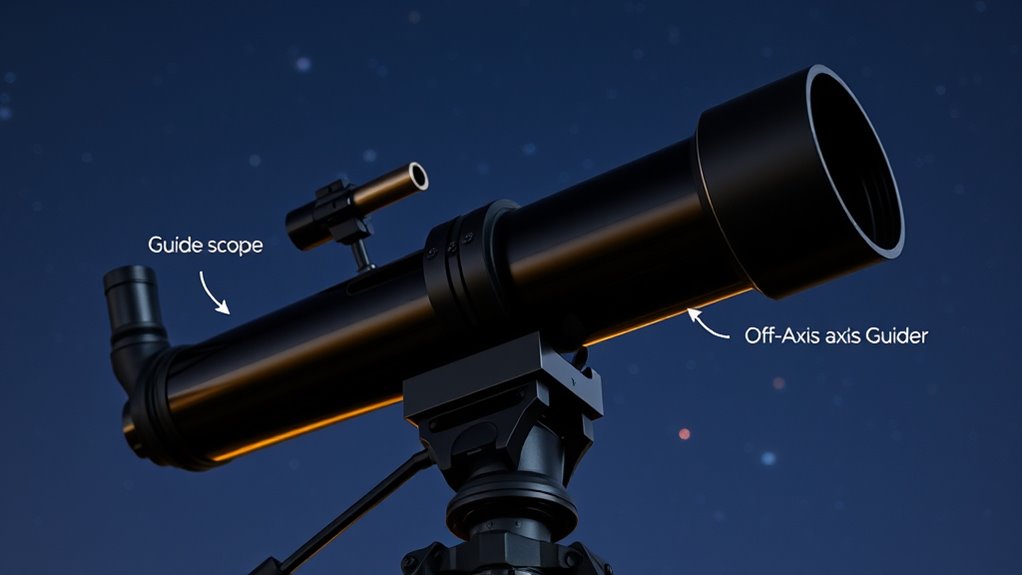
When selecting a guiding system for astrophotography, you need to decide between a dedicated guide scope and an off-axis guider. Both options aim to keep your telescope precisely pointed during long exposures, but they do so in different ways, each with its own set of advantages and challenges. Your choice will influence your polar alignment process, focal length considerations, and overall setup complexity.
A dedicated guide scope is a small, separate telescope mounted alongside your main imaging instrument. It captures guide stars independently, allowing you to perform precise polar alignment and monitor star movement directly. Because the guide scope has its own focal length, it often provides a wider field of view, making it easier to find and lock onto guide stars, especially in less populated star fields. When using a guide scope, accurate polar alignment becomes essential, as any misalignment can introduce drift or errors during long exposures. You need to confirm your mount is well polar aligned because the guide scope’s independent line of sight can reveal even minor errors that might go unnoticed otherwise.
On the other hand, an off-axis guider (OAG) attaches directly to your main telescope’s optical path, diverting a small portion of the light to a compact guide camera. Since it shares the main scope’s focal length and optical path, the system maintains a consistent star image, which reduces differential flexure and simplifies the guiding process. Because the OAG relies on stars within the same optical train, you often need a longer focal length on your main scope to achieve precise guiding. The benefit here is that you don’t need to worry about aligning a separate guide scope or dealing with differential flexure between two instruments, which can be a concern with guide scopes. Additionally, high contrast images provided by the OAG can improve guiding accuracy in challenging conditions.
Choosing between these two depends on your setup and your goals. If you prefer a straightforward setup with easier star acquisition and don’t mind precise polar alignment, a guide scope might be more suitable. It’s often simpler to set up and calibrate initially. Conversely, if you’re working with a high focal length system and want to minimize flexure-related issues, an off-axis guider provides a more robust guiding solution, especially when your main scope’s focal length exceeds a few hundred millimeters. Both systems demand careful polar alignment to guarantee accurate guiding, but the way you approach this task varies based on your guiding choice. Ultimately, your decision should consider your equipment’s focal length, your polar alignment skills, and how much setup complexity you’re willing to manage during your astrophotography sessions.
guide scope for astrophotography
As an affiliate, we earn on qualifying purchases.
As an affiliate, we earn on qualifying purchases.
Frequently Asked Questions
What Is the Cost Difference Between Guide Scopes and Off-Axis Guiders?
Guide scopes typically cost between $100 and $300, making them more budget-friendly, especially if you’re starting out. Off-axis guiders tend to be pricier, ranging from $200 to $500, but they save space and improve compatibility with compact setups. Your budget considerations and equipment compatibility are key—if you need an affordable option that fits easily, a guide scope might be better; for advanced setups, an off-axis guider could be worth the investment.
How Do Guide Scopes Impact Overall Telescope Setup Complexity?
Guide scopes add some complexity to your telescope setup, requiring extra alignment precision and longer setup time. You’ll need to carefully align the guide scope with your main telescope, which can be time-consuming but improves tracking accuracy. While it may seem more involved initially, it also offers flexibility for precise guiding. Expect a slightly more complex setup process, but one that ultimately enhances your imaging quality.
Can Off-Axis Guiders Be Used With All Telescope Types?
Yes, off-axis guiders can be used with many telescope types, but you need to check mount compatibility first. They work well with larger, sturdy mounts that support the added weight and precise guiding. Using an off-axis guider can improve guiding accuracy, especially for long exposures. However, some mounts or scopes might require adapters or specific configurations, so always verify compatibility to guarantee peak performance and avoid damage.
What Maintenance Is Required for Guide Scopes Versus Off-Axis Guiders?
Think of maintenance as tuning a musical instrument. For guide scopes, you’ll perform regular alignment procedures to guarantee they track accurately, and cleaning routines to keep the lens clear of dust and debris. Off-axis guiders require less maintenance—mainly periodic cleaning and checking the optical components. Both need careful handling to sustain maximum performance, but guide scopes generally demand more frequent adjustments and checks for precise guiding.
Are There Specific Astrophotography Scenarios Better Suited for One Option?
If you’re into specialized imaging or wide field astrophotography, a guide scope often works better because it offers a broader view, making star tracking easier. Off-axis guiders excel for deep-sky imaging where compact setups are essential. Choose a guide scope for versatility and ease with larger fields, while an off-axis guider suits tight spaces and detailed, high-precision imaging. Your specific astrophotography scenario will guide the best choice.
As an affiliate, we earn on qualifying purchases.
Conclusion
Ultimately, choosing between a guide scope and an off-axis guider depends on your setup and preferences. Think of it like selecting a vehicle—each has its strengths, and the best choice aligns with your specific needs. A guide scope offers simplicity and flexibility, while an off-axis guider provides a sleek, integrated solution. Consider your equipment, experience level, and shooting goals to make an informed decision—like selecting the perfect instrument for a precise, beautiful journey through the stars.
As an affiliate, we earn on qualifying purchases.
As an affiliate, we earn on qualifying purchases.
Halloween Picks
halloween
As an affiliate, we earn on qualifying purchases.