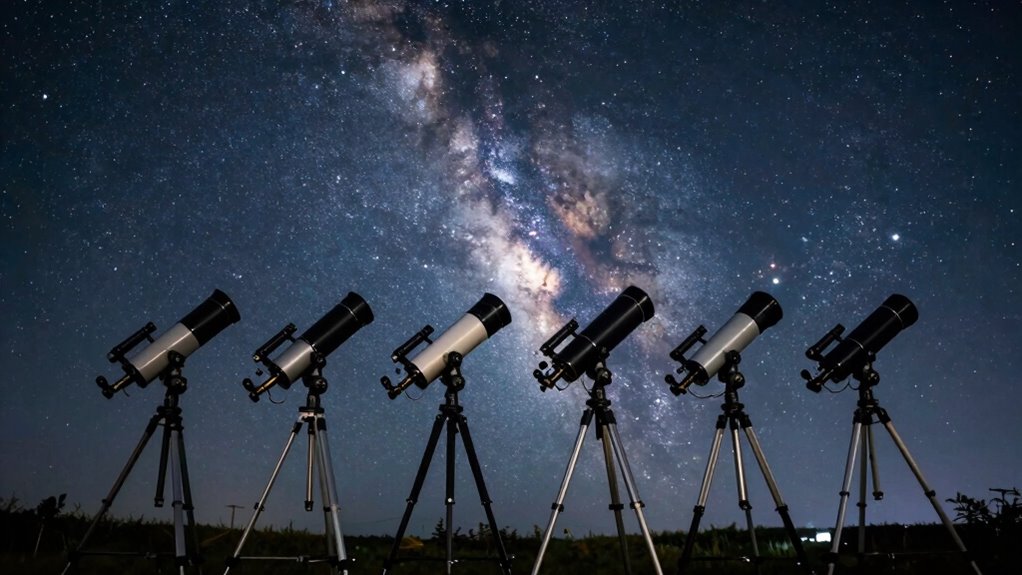

When selecting a short focal length refractor for astrophotography, the goal is to balance wide-field imaging capabilities with ease of use. The Celestron Inspire 100AZ stands out as the best overall for its versatility and user-friendly features. The SVBONY SV530 ED offers excellent optical quality for more serious imaging, while the SVBONY SV503 Upgraded ED provides a compact, high-performance option for those with limited space. Each choice involves tradeoffs: wider fields often come with increased chromatic aberration or complexity. Keep reading for a detailed breakdown of these options and what to consider when choosing your ideal astrophotography refractor.

Prime made for students and young adults
- Fast, free delivery for dorm and study essentials
- Prime Video and Amazon Music included
- Member-only deals
Key Takeaways
- The best overall pick, Celestron Inspire 100AZ, balances affordability, ease of use, and decent optical performance.
- SVBONY models excel in optical quality with ED glass but may require additional accessories for optimal results.
- Field flatteners are critical for sharp, distortion-free images across the frame, especially at short focal lengths.
- Compactness and weight are important for portability but can impact stability and image quality.
- Price often correlates with optical performance; investing more generally yields better astrophotography results.
| Celestron Inspire 100AZ Beginner Refractor Telescope with Phone Adapter |  | Best for Beginners and Casual Astrophotographers | Type: Refractor Telescope | Aperture: 100mm | Mount: AZ (Alt-Azimuth) | VIEW ON AMAZON | See Our Full Breakdown |
| Explore Scientific Field Flattener for Refractor Telescopes f/5 to f/7 |  | Best for Improving Image Quality in Fast Refractors | Focal Ratio Compatibility: f/5 to f/7 | Optics Coating: Fully multi-coated | Connection: T-ring thread | VIEW ON AMAZON | See Our Full Breakdown |
| SVBONY SV530 ED Refractor Telescope with Built-in Field Flattener, 80mm Aperture |  | Best for High-Quality, Compact Astrophotography | Optical Design: Triplet ED | Aperture: 80mm | Focal Length: 480mm | VIEW ON AMAZON | See Our Full Breakdown |
| Celestron AstroMaster 90AZ Refractor Telescope with Adjustable Tripod and Software |  | Best for Entry-Level Enthusiasts and Kids | Optics: 90mm fully coated achromatic | Mount: Alt-azimuth manual | Eyepieces: 20mm and 10mm | VIEW ON AMAZON | See Our Full Breakdown |
| SVBONY SV503 Refractor Telescope, 70mm ED with Field Flattener |  | Best for Compact, High-Quality Astrophotography | Aperture: 70mm | Focal Ratio: F/6.78 | Includes: 2-inch to 1.25-inch adapter | VIEW ON AMAZON | See Our Full Breakdown |
| SVBONY SV503 Upgraded ED Refractor Telescope, 80mm F7 with Field Flattener |  | Best for Portable Deep-Sky Imaging | Focal Length: 560 millimeters | Objective Lens Diameter: 8 centimeters | Mount: Fixed Mount | VIEW ON AMAZON | See Our Full Breakdown |
| short focal length refractor for astrophotography | Aperture | Mount |
|---|---|---|
| Celestron Inspire 100AZ Beginn | 100mm | AZ (Alt-Azimuth) |
| Explore Scientific Field Flatt | — | — |
| SVBONY SV530 ED Refractor Tele | 80mm | — |
| Celestron AstroMaster 90AZ Ref | — | Alt-azimuth manual |
| SVBONY SV503 Refractor Telesco | 70mm | — |
| SVBONY SV503 Upgraded ED Refra | — | Fixed Mount |
More Details on Our Top Picks
Celestron Inspire 100AZ Beginner Refractor Telescope with Phone Adapter
The Celestron Inspire 100AZ stands out for its ease of use and versatility, making it an ideal entry point into astrophotography for those new to the hobby. Its lightweight, stable AZ mount and smartphone adapter allow quick setup and simple capturing of lunar and planetary images. Compared with the SVBONY SV530 ED, it sacrifices some optical precision for user-friendliness, which may limit its appeal for more serious deep-sky work. However, it’s perfect for casual users who want to get started without complex equipment or extensive setup. The lack of included high-quality eyepieces and limited deep-sky capability are tradeoffs, but for beginners, the convenience outweighs these constraints. This pick makes the most sense for hobbyists starting out and wanting a straightforward, portable option.
Pros:- Simple, quick setup ideal for beginners
- Built-in smartphone adapter for easy astrophotography
- Lightweight and stable for portable use
- Includes useful features like red LED flashlight
Cons:- Limited optical performance for advanced astrophotography
- No high-end eyepieces included, restricting image quality
Best for: Beginners or casual astrophotographers seeking an easy-to-operate scope with smartphone imaging
Not ideal for: Advanced astronomers or deep-sky imaging enthusiasts who need higher optical quality and more accessories
- Type:Refractor Telescope
- Aperture:100mm
- Mount:AZ (Alt-Azimuth)
- Features:Smartphone Adapter, Red LED Flashlight, Focus Micrometer, Erect Image Optics
- Warranty:2 Years
Our verdict“This telescope suits newcomers looking for an accessible, portable entry into astrophotography, but it won’t satisfy those seeking advanced imaging capabilities.”
Explore Scientific Field Flattener for Refractor Telescopes f/5 to f/7
The Explore Scientific Field Flattener makes a compelling addition for astrophotographers using fast refractors, especially when paired with scopes like the SVBONY SV503 ED. Its primary advantage is minimizing star distortion caused by field curvature, resulting in sharper, more uniform images across the frame. Compared to the Celestron Inspire 100AZ, which is geared toward beginners, this flattener targets more experienced users seeking high-quality results. Its fully multi-coated optics deliver high contrast, and the precise 55mm spacing ensures optimal performance—though this requires careful setup and may be a barrier for less experienced users. The tradeoff involves limited compatibility; it only works with focal ratios between f/5 and f/7, making it less versatile. This device is best for dedicated astrophotographers who already have a compatible refractor and want to elevate their image quality.
Pros:- Reduces star distortion for clearer astrophotos
- Compatible with f/5 to f/7 scopes
- Fully multi-coated for high contrast images
- Secure T-ring connection for camera attachment
Cons:- Requires precise 55mm spacing, which can be tricky to set correctly
- Limited to specific focal ratios, reducing flexibility
Best for: Astrophotographers with fast refractors (f/5 to f/7) aiming for sharp, distortion-free images
Not ideal for: Beginners or users with slower or different focal ratios who need a more universal solution
- Focal Ratio Compatibility:f/5 to f/7
- Optics Coating:Fully multi-coated
- Connection:T-ring thread
- Spacing Requirement:55mm (+/- 2mm)
Our verdict“This flattener is best suited for astrophotographers who already have a compatible fast refractor and want to improve image quality significantly.”
SVBONY SV530 ED Refractor Telescope with Built-in Field Flattener, 80mm Aperture
The SVBONY SV530 ED offers a highly capable optical package, blending a triplet ED design with a built-in flattener, making it an excellent choice for astrophotographers who want sharp, color-accurate images in a portable setup. Its f/6 focal ratio strikes a balance between light gathering and manageable exposure times, reminiscent of the SVBONY SV503, but with the added benefit of an integrated flattening element that simplifies alignment. While it’s not an APO, the ED glass reduces chromatic aberration better than many standard achromats, giving clearer results. The dual-speed focuser allows precise focusing, essential for astrophotography. The main tradeoff is its weight at 9 pounds, which can make it less convenient for field use, especially without a sturdy mount. This scope appeals most to intermediate users seeking high image quality in a portable form factor.
Pros:- Triplet ED design for sharp, color-corrected images
- Built-in field flattener simplifies setup
- Dual-speed focuser for precise adjustments
- Balanced focal ratio for versatile astrophotography
Cons:- Heavy for portable field use
- Limited aperture size for deep-sky imaging
Best for: Intermediate astrophotographers wanting sharp images with minimal aberration in a compact package
Not ideal for: Beginners or deep-sky enthusiasts needing larger apertures for faint objects
- Optical Design:Triplet ED
- Aperture:80mm
- Focal Length:480mm
- Focal Ratio:f/6
- Focuser:Dual-speed 2.5-inch
- Built-in Flattener:Yes
Our verdict“This refractor is well suited for dedicated amateurs seeking a portable, high-quality astrophotography platform with minimal aberration.”
Celestron AstroMaster 90AZ Refractor Telescope with Adjustable Tripod and Software
The Celestron AstroMaster 90AZ offers a straightforward, reliable platform for newcomers interested in both planetary and terrestrial viewing, with some astrophotography potential. Its 90mm achromatic lens provides bright, detailed images of the Moon and planets, and the adjustable tripod makes setup manageable for beginners and younger users. While it’s not designed for serious deep-sky or astrophotography work, it provides a solid foundation for understanding basic celestial observation. The manual mount requires some practice to track objects accurately, especially for astrophotography, and the scope’s features are limited compared to more advanced options like the SVBONY SV530 ED. This choice is ideal for those starting out or looking for a family-friendly telescope that can also do basic astrophotography.
Pros:- Easy to assemble and operate
- Versatile for both night sky and terrestrial viewing
- Includes essential accessories and astronomy software
- Affordable entry point for new hobbyists
Cons:- Manual mount limits tracking accuracy
- Not suitable for advanced astrophotography or deep-sky imaging
Best for: Beginners, families, or kids interested in exploring the night sky and basic astrophotography
Not ideal for: Experienced astronomers or those seeking high-precision astrophotography capabilities
- Optics:90mm fully coated achromatic
- Mount:Alt-azimuth manual
- Eyepieces:20mm and 10mm
- Finderscope:StarPointer red dot
- Weight:12.3 lbs
- Tripod:Adjustable full-height
Our verdict“This telescope fits newcomers or families wanting an accessible, no-fuss introduction to astronomy and basic astrophotography.”
SVBONY SV503 Refractor Telescope, 70mm ED with Field Flattener
The SVBONY SV503 ED delivers impressive optical performance in a compact package, combining a 70mm ED lens with a built-in field flattener. Its relatively fast f/6.78 focal ratio allows for bright images with minimal chromatic aberration, making it suitable for astrophotographers who prioritize portability without sacrificing image quality. Unlike larger scopes, its smaller aperture limits deep-sky imaging of faint objects, but it excels in planetary and wide-field imaging. The integrated field flattener simplifies setup, and the dual-speed focuser offers precise control—key for capturing sharp images. The main drawback is its weight and the absence of included accessories like eyepieces or mount, which can add to the overall cost. This scope is ideal for enthusiasts looking for a high-quality, portable astrograph at a reasonable price.
Pros:- Built-in field flattener eliminates need for additional accessories
- High-quality ED glass reduces chromatic aberration
- Dual-speed focuser enables precise focusing
- Compact and lightweight for field use
Cons:- Limited aperture for deep-sky objects
- Lacks included accessories like eyepieces or mount
Best for: Intermediate users wanting a compact, high-quality astrophotography scope with minimal aberrations
Not ideal for: Deep-sky astrophotographers needing larger apertures for faint object imaging
- Aperture:70mm
- Focal Ratio:F/6.78
- Includes:2-inch to 1.25-inch adapter
- Material:Aluminum CNC components
Our verdict“This scope works best for astrophotographers who want a portable, high-contrast, distortion-free imaging platform for brighter objects.”
SVBONY SV503 Upgraded ED Refractor Telescope, 80mm F7 with Field Flattener
The SVBONY SV503 80ED stands out for its balance of optical quality and portability, making it a strong choice for astrophotographers who need a lightweight system. Compared with the SV530 ED, which offers a slightly larger aperture, the SV503’s 80mm lens provides a more manageable weight and easier setup without sacrificing much image clarity, thanks to its high-quality ED glass that minimizes chromatic aberration. The inclusion of a 0.8X focal reducer enhances its appeal for wide-field astrophotography, enabling faster exposures and broader sky coverage—crucial for capturing deep-sky objects. Its dual-speed focuser offers precise control, but the fixed mount limits tracking capabilities, requiring additional accessories for long exposures. The absence of a finderscope might slow initial target acquisition for some users. Overall, this pick suits dedicated amateurs who prioritize portability and sharp images over motorized tracking.
Pros:- High-quality ED glass reduces chromatic aberration, ensuring sharp images
- Includes a 0.8X focal reducer for faster imaging and wider field of view
- Lightweight and portable, ideal for outdoor astrophotography
- Dual-speed focuser allows precise and smooth focus adjustments
Cons:- Limited to a fixed mount, requiring additional tracking equipment for long exposures
- No included finderscope, which can slow initial setup and target acquisition
- Requires some assembly and setup for optimal use
Best for: Beginners and intermediate astrophotographers seeking an easily portable, high-quality imaging tool for wide-field deep-sky objects.
Not ideal for: Advanced astrophotographers or those needing motorized mounts for long exposures, as the fixed mount limits tracking and stability.
- Focal Length:560 millimeters
- Objective Lens Diameter:8 centimeters
- Mount:Fixed Mount
- Focus Type:Manual Focus
- Coating:Fully Multi-coated
- Optical Tube Length:46 centimeters
- Weight:2.5kg / 5.51lb
- Exit Pupil Diameter:11.43 millimeters
- Field of View:1.9 degrees
Our verdict“This telescope is perfect for astrophotographers who value portability and sharp wide-field images but are willing to add tracking gear for long exposure work.”

How We Picked
Products were evaluated based on optical quality, ease of setup, build robustness, and value for the price. Special attention was given to how well each scope performs in astrophotography, including how effectively it handles chromatic aberration and field flatness. We also considered user-friendliness for beginners versus advanced users, as well as the availability of accessories like field flatteners and mounts. The final rankings reflect a balance between performance, versatility, and cost, ensuring each option serves a distinct user need.| short focal length refractor for astrophotography | Mount |
|---|---|
| Celestron Inspire 100AZ Beginn | AZ (Alt-Azimuth) |
| Explore Scientific Field Flatt | — |
| SVBONY SV530 ED Refractor Tele | — |
| Celestron AstroMaster 90AZ Ref | Alt-azimuth manual |
| SVBONY SV503 Refractor Telesco | — |
| SVBONY SV503 Upgraded ED Refra | Fixed Mount |
Factors to Consider When Choosing Short Focal Length Refractor For Astrophotography
Selecting the right short focal length refractor for astrophotography involves several considerations beyond specs. Understanding these factors helps avoid common pitfalls, such as choosing a scope with inadequate field correction or one that’s too heavy for your mount. The right choice depends on your experience level, target objects, and portability needs. Here are key factors to keep in mind when making your decision.Optical Quality and Glass Type
Optical clarity is essential for sharp astrophotos, especially when capturing wide fields. ED (extra-low dispersion) glass helps minimize chromatic aberration, a common issue at short focal lengths. While ED optics tend to be pricier, they deliver more accurate color rendition and finer detail. Cheaper scopes may introduce color fringing, which can be mitigated with post-processing but is better avoided upfront.
Field Flattener Compatibility
Since short focal length refractors are often used for wide-field imaging, a field flattener is almost a necessity. It ensures stars remain pinpoint from edge to edge, preventing distortion that can ruin astrophotos. Not all scopes are compatible with standard flatteners, so verify compatibility before purchase. Investing in a scope with a built-in or easily attachable flattener can save time and improve image quality.
Portability and Mount Compatibility
Lightweight, compact scopes are easier to carry and mount but may sacrifice some optical robustness. Ensure your mount can handle the scope’s weight and provide stable tracking. For travel or field work, size and weight become even more critical, so balance portability with optical performance to avoid shaky images or difficulty setting up.
Ease of Use and Accessories
Beginners benefit from scopes that include or support simple accessories like smartphone adapters, easy-to-use mounts, and adjustable tripods. More advanced users may prioritize upgradeability and compatibility with filters or specialized cameras. Consider whether the scope’s design supports your current skill level while allowing room to grow.
Budget and Long-Term Value
Prices vary widely in this category, but investing a bit more often results in better optical performance and durability. Cheaper models may require costly upgrades or frequent replacements, whereas mid-range or premium scopes can provide years of reliable imaging. Think about your long-term goals and whether a higher initial investment will pay off with improved results and less frustration.
Frequently Asked Questions
Can I use a short focal length refractor for deep-sky astrophotography?
Yes, short focal length refractors are well-suited for capturing large, diffuse objects like nebulae and star clusters due to their wide fields. However, they might not be ideal for detailed imaging of smaller objects like galaxies or planets, where higher magnifications are preferred. Pairing them with appropriate cameras and accessories, along with proper tracking mounts, can enhance results for deep-sky imaging.
How important is a field flattener for short focal length refractors?
A field flattener is often essential for wide-field astrophotography because it corrects the curvature and distortion at the edges of the image. Without it, stars near the frame edges may appear elongated or blurred, reducing the overall quality. Many short focal length scopes either include a built-in flattener or support one as an upgrade, so check compatibility before buying.
Is ED glass necessary in a short focal length refractor?
ED glass significantly reduces chromatic aberration, which is especially noticeable in short focal length scopes. While non-ED scopes can still perform adequately for casual astrophotography, ED glass improves color accuracy and sharpness, making it a worthwhile investment for more serious imaging. The tradeoff is usually a higher cost, but the quality gains are often justified.
What mount type is best for short focal length refractors?
For astrophotography, a stable equatorial mount with precise tracking is essential. Short focal length refractors are generally lighter and easier to mount, but the mount’s stability directly impacts image quality. A mount with good tracking accuracy and minimal vibrations will allow longer exposures without star trails, particularly important when working with wider fields.
Should I prioritize portability over optical performance?
It depends on your intended use. If you frequently travel or shoot in the field, portability can be a deciding factor, but it might come at the expense of some optical quality. Conversely, if your focus is on high-quality images from a fixed setup, investing in a slightly heavier, more capable scope makes sense. Balance your needs for convenience with the desire for the best possible images.
Conclusion
For beginners or casual astronomers, the Celestron Inspire 100AZ offers a user-friendly experience with decent optical quality at an accessible price. Enthusiasts seeking better image clarity and minimal chromatic aberration should consider the SVBONY SV530 ED, which balances performance with affordability. For those prioritizing portability and compactness, the SVBONY SV503 Upgraded ED provides a solid, space-saving option. Advanced users or dedicated astrophotographers aiming for high precision and sharpness might prefer scopes with built-in flatteners or premium ED optics, even if that means a higher investment. Understanding your specific imaging targets and setup constraints will help determine the best fit.Halloween Picks

Pumpkin Halloween Fog Machine with 12-Color LED Lights, Bluetooth Speaker, and Remote

Govee Outdoor Halloween Projector Light with 3D Effects

12-Foot Inflatable Pumpkin Halloween Archway with LED Lights
As an affiliate, we earn on qualifying purchases.