
Using LRGB filters with a monochrome camera allows you to capture true, vibrant celestial colors by isolating different spectral regions—red, green, blue, and luminance. This approach enhances image detail, contrast, and color accuracy, resulting in natural-looking, visually appealing images that closely reflect what you see visually. Choosing high-quality filters with sharp cut-offs maximizes detail and minimizes light pollution. Keep exploring to learn how selecting the right filters and proper calibration can elevate your astrophotography results even further.
Key Takeaways
- LRGB filters enable monochrome cameras to capture true celestial colors by isolating specific spectral ranges.
- Proper filter selection and understanding their spectral coverage improve color accuracy and image quality.
- High-quality filters with sharp cut-offs reduce light contamination, enhancing contrast and detail.
- Combining luminance with RGB channels allows for natural, vibrant, and well-balanced full-color astrophotos.
- Accurate color balancing and calibration ensure images reflect the actual hues of celestial objects.
When using monochrome cameras for astrophotography, adding LRGB filters can substantially enhance your imaging capabilities. These filters allow you to capture the true colors of celestial objects, giving your images a natural and vibrant appearance that grayscale imaging alone can’t achieve. By combining luminance data with red, green, and blue filters, you can produce detailed, full-color images that reflect what you see with your eyes. This process hinges on effective filter selection and proper color balancing, both crucial for obtaining accurate and aesthetically pleasing results. Understanding spectral ranges is essential for optimizing your filter choices and capturing the full spectrum of celestial colors. Choosing the right filters is essential. LRGB filters are specifically designed to isolate different parts of the spectrum, with the luminance filter capturing overall brightness and detail, while the red, green, and blue filters record color information. You’ll want high-quality filters with sharp cut-offs to prevent unwanted light contamination and maximize contrast. When selecting filters, consider their bandwidth and optical quality, as these factors influence the clarity and color fidelity of your final image. A well-chosen filter set ensures you gather the maximum amount of detail in each channel, which is vital for a balanced and natural-looking composite.
Color balancing plays a pivotal role in converting raw data into a cohesive, true-to-life image. After capturing each channel separately, you’ll process the images through stacking and calibration, then move on to color balancing. This step adjusts the intensity levels of each color channel to match real-world hues, preventing one color from dominating or appearing washed out. Proper color balancing ensures that the final image isn’t just detailed but also accurately represents the celestial object’s true colors. It’s a delicate process, but with careful attention, you’ll produce images that are both scientifically meaningful and visually stunning.

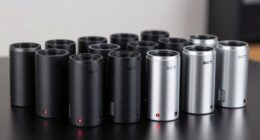
Astromania Deluxe Telescope LRGB 2 Inch Filter Set – Planet Colour Filters for Use with Monochrome CCD Cameras – Give Stunning and Excellent Astrophotographic Results
The Astromania LRGB Filter Set includes four filters; 2" luminance Filter, 2" Red Filter; 2" Green Filter 2"…
As an affiliate, we earn on qualifying purchases.
As an affiliate, we earn on qualifying purchases.
Frequently Asked Questions
Can LRGB Filters Improve Image Contrast?
Yes, LRGB filters can improve your image contrast by selectively blocking unwanted wavelengths. Their spectral transmission enhances the contrast between different features, making details stand out more clearly. When you use filter stacking, you combine multiple filters for better control over spectral transmission, which further boosts contrast. This process allows you to capture images with greater depth and detail, resulting in more natural and striking visuals.
What Is the Optimal LRGB Filter Size?
You should choose an LRGB filter size that matches your camera’s sensor and filter material to guarantee ideal performance. Typically, a filter diameter of 1.25 or 2 inches works well, depending on your setup. Proper filter mounting is vital to avoid vignetting and ensure even light distribution across your sensor. Measure your camera’s sensor dimensions carefully and select a filter size that provides full coverage for the best image quality.
How Do LRGB Filters Affect Exposure Times?
Filters finesse your framing, so understanding their impact is key. LRGB filters influence exposure times because their transmission rates vary; higher transmission filters require less exposure, while lower ones demand longer. You should optimize your exposures by balancing filter transmission with your camera’s sensitivity, ensuring enough light is captured without overexposing. This exposure optimization guarantees vibrant, natural colors, making your images both brilliant and beautifully balanced.
Are LRGB Filters Compatible With Color Cameras?
LRGB filters are typically designed for monochrome cameras and aren’t compatible with color cameras due to sensor compatibility and filter mounting differences. Color cameras have built-in Bayer filters, so adding external LRGB filters can interfere with image quality. Always check your camera’s filter mounting system and sensor compatibility before attempting to use LRGB filters, as using incompatible filters can damage the sensor or produce poor results.
What Maintenance Is Required for LRGB Filters?
You should regularly clean your LRGB filters with a gentle, lint-free cloth and appropriate filter cleaning solution to maintain clear images. Avoid touching the filters directly to prevent scratches. When not in use, store them in a protective case away from dust, moisture, and extreme temperatures. Proper filter storage helps prevent damage and guarantees the best performance. Regular maintenance keeps your filters in top condition for capturing natural colors effectively.

Optolong LRGB Filter Set (2")
Fine-optically polishing for double-sides ensures accurate λ/4 wavefront and <30 seconds parallelism over the both surfaces
As an affiliate, we earn on qualifying purchases.
As an affiliate, we earn on qualifying purchases.
Conclusion
By embracing LRGB filters, you unveil the secret to capturing natural colors with your monochrome camera, much like a painter revealing the full spectrum on a blank canvas. Just as Da Vinci’s mastery brought life to his works, your skill with these filters transforms your astrophotography into a vivid tapestry of the universe’s true hues. With patience and practice, you’ll see your images transcend the ordinary, echoing the timeless beauty of a masterpiece waiting to be discovered.
Optolong LRGB Filter Set (2")
Fine-optically polishing for double-sides ensures accurate λ/4 wavefront and <30 seconds parallelism over the both surfaces
As an affiliate, we earn on qualifying purchases.
As an affiliate, we earn on qualifying purchases.

Celestron – RASA 8 Imaging Filter – H-Alpha, H-Beta, Oxygen III Narrowband Filter – Enhances Emission Nebulae
Enhance imaging of nebulae with your 8” Rowe-Ackermann Schmidt Astrograph (RASA) by blocking light pollution, improving image contrast,…
As an affiliate, we earn on qualifying purchases.
As an affiliate, we earn on qualifying purchases.