
TL;DR

Prime made for students and young adults
- Fast, free delivery for dorm and study essentials
- Prime Video and Amazon Music included
- Member-only deals
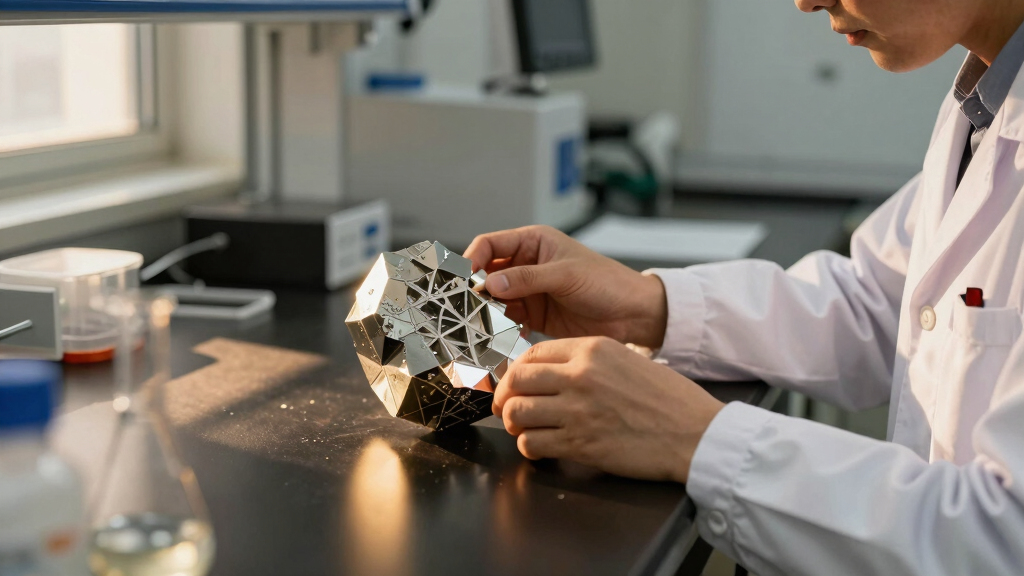
Researchers confirmed the discovery of three naturally occurring quasicrystals in a Russian meteorite and a Nebraska fulgurite. These findings demonstrate that such complex structures can form in nature, not just in laboratories. The discovery could reshape understanding of high-energy natural processes.
Scientists have confirmed the existence of three distinct types of naturally occurring quasicrystals in a meteorite from Khatyrka, Russia, and a fulgurite in Nebraska, marking rare natural formations of these complex, non-repeating crystal patterns. This discovery challenges the previous understanding that quasicrystals are primarily laboratory-created and suggests that extreme natural events can produce such structures.
The three types of quasicrystals confirmed in nature are icosahedrite, decagonite, and i-Phase II. The icosahedrite, with full icosahedral symmetry, was found in the Khatyrka meteorite, which landed in Russia and is notable for being the only meteorite known to contain metallic aluminum. This meteorite is believed to have formed through an ultra-high-velocity asteroid collision.
Decagonite, characterized by tenfold rotational symmetry in two dimensions, was identified in the same meteorite. Its structure was determined using advanced mathematical modeling involving the A₄ lattice in four dimensions. The third, i-Phase II, also with icosahedral symmetry, was discovered in the meteorite and has a different composition, richer in copper and poorer in aluminum, marking the first natural discovery of such a phase before laboratory synthesis.
Additionally, a quasicrystal was found in a fulgurite—rock formed by lightning—near Hyannis, Nebraska. This structure exhibits 12-fold symmetry and was produced during a high-current, high-temperature event caused by lightning hitting sand or possibly a downed power line. Its composition includes manganese, silicon, chromium, aluminum, and nickel, indicating formation under extreme surface conditions on Earth.
Why It Matters
This discovery is significant because it demonstrates that complex, aperiodic crystal structures like quasicrystals can form naturally in high-energy environments, such as asteroid collisions and lightning strikes. Previously, quasicrystals were thought to be primarily laboratory phenomena or extremely rare natural occurrences. The findings could influence fields ranging from planetary science to materials engineering, as they suggest natural processes can produce structures with unique physical properties.
Understanding how these quasicrystals form in natural settings may also shed light on the conditions of early solar system events and the geological history of Earth and meteorites. The findings challenge the assumption that such structures are solely artifacts of human synthesis and open new avenues for studying natural high-energy processes.
As an affiliate, we earn on qualifying purchases.
Background
Since their discovery in the 1980s, quasicrystals have been predominantly synthesized in laboratories, with natural occurrences considered exceedingly rare. The first confirmed natural quasicrystal, icosahedrite, was found in the Khatyrka meteorite in 2012. Subsequent discoveries included decagonite and i-Phase II, also from the same meteorite, indicating that extreme cosmic events can produce these structures.
The meteorite itself is highly anomalous, containing metallic aluminum and believed to have formed through an ultra-high-velocity collision between asteroids. The Nebraska fulgurite’s quasicrystal, meanwhile, was formed by a lightning strike, adding an Earth-based natural example to the rare occurrences of such structures. Prior to this, other suspected natural formations involved lightning or atomic bomb tests, but these were less definitively characterized.
“The confirmed presence of these quasicrystals in natural samples demonstrates that extreme natural events can produce structures previously thought to be exclusive to laboratory synthesis.”
— Dr. L. Bindi, lead researcher
“These findings open new avenues for understanding high-energy processes in space and on Earth, and may lead to new insights in materials science.”
— Dr. P. J. Steinhardt, materials scientist
As an affiliate, we earn on qualifying purchases.
What Remains Unclear
It remains unclear how common natural formation of quasicrystals might be beyond the known samples. The precise natural conditions that lead to their formation, particularly in terrestrial settings, are still not fully understood. Additionally, whether other meteorites or Earth materials contain undiscovered quasicrystals remains unknown.
As an affiliate, we earn on qualifying purchases.
What’s Next
Researchers plan to analyze additional meteorites and geological samples to determine the prevalence of natural quasicrystals. Further studies aim to understand the specific high-energy processes that facilitate their formation and to explore potential applications of these naturally occurring structures in materials science.
As an affiliate, we earn on qualifying purchases.
Key Questions
How rare are naturally occurring quasicrystals?
They are extremely rare; so far, confirmed examples include a few meteorite samples and a fulgurite, with most quasicrystals known from laboratory synthesis.
What conditions lead to the formation of natural quasicrystals?
Extreme high-energy events such as asteroid impacts and lightning strikes appear to be key factors, but the exact processes are still under investigation.
Why is the discovery of natural quasicrystals important?
It challenges the belief that such complex structures are only man-made and suggests that natural processes can produce materials with unique and potentially useful properties.
Could natural quasicrystals have practical applications?
Potentially, yes. Their unique physical properties may inspire new materials, but research is still in early stages.
Are there other places on Earth where natural quasicrystals might be found?
It’s possible, especially in environments involving high-energy events, but more sampling and analysis are needed to identify additional occurrences.
Halloween Picks
halloween
As an affiliate, we earn on qualifying purchases.