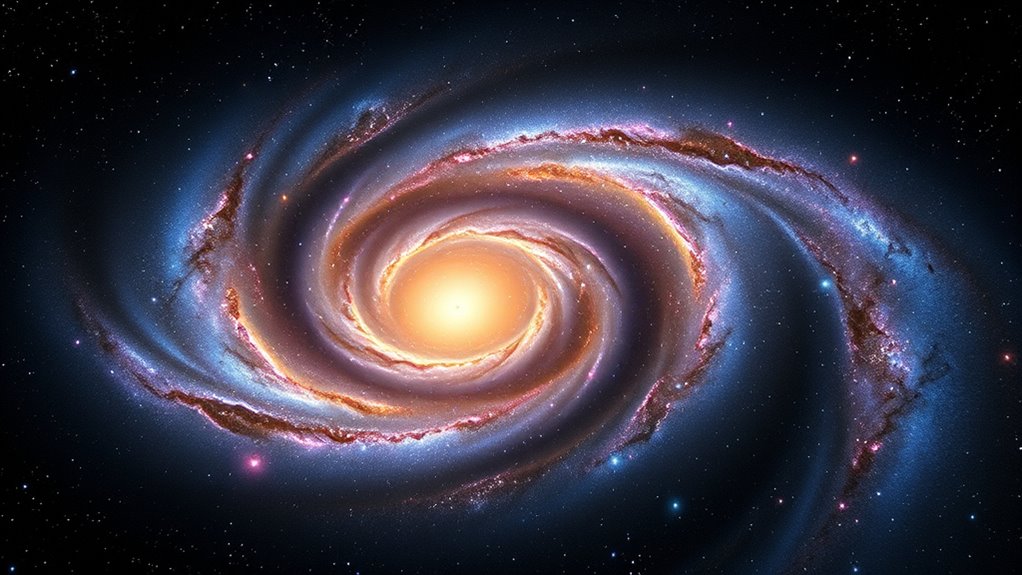

By imaging the Whirlpool Galaxy (M51) and its companion, NGC 5195, you can see stunning details of its spiral arms shaped by gravity. These high-resolution images reveal intricate dust lanes, gas clouds, and star-forming regions sparked by their interaction. The gravitational tug from the companion influences the galaxy’s structure and star formation. If you continue exploring, you’ll discover how these cosmic forces shape galaxy evolution over time.
Key Takeaways
- High-resolution imaging reveals detailed internal structures of M51’s spiral arms, including filaments, knots, and bubbles related to star formation.
- Advanced observational techniques capture the interaction effects between M51 and its companion galaxy NGC 5195.
- Imaging highlights gas clouds organized into dense filaments and clusters, showcasing active star-forming regions.
- Technological improvements enable astronomers to study how gravitational interactions influence galaxy structure and evolution.
- Detailed images help understand the complex processes of star formation and gas dynamics driven by galaxy interactions.
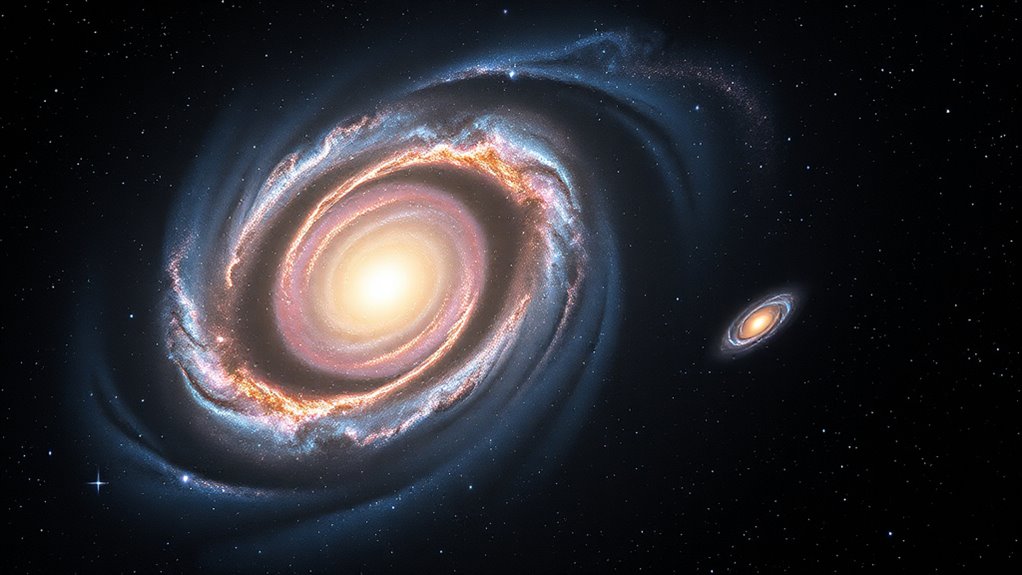
The Whirlpool Galaxy, also known as M51, offers a stunning view of cosmic interaction and structure that astronomers are enthusiastic to capture. When you observe M51, you’re witnessing a grand example of galaxy formation in action, with its sweeping spiral arms shaped by gravitational forces. These arms are more than just visual features; they’re active regions of star formation, where dense clouds of gas and dust collapse to birth new stars. As you focus your telescope on M51, you notice how the galaxy’s structure reveals the dynamic processes that drive stellar evolution. The spiral arms are not static; they are sites of ongoing star formation, energized by the density waves that ripple through the galaxy, compressing gas and igniting stellar nurseries. Furthermore, advances in high-resolution imaging allow astronomers to study these regions in unprecedented detail, uncovering the intricate processes involved in star birth. The interaction with its companion galaxy, NGC 5195, adds another layer of complexity to this cosmic dance. This close encounter has triggered a gravitational tug-of-war, distorting the shape of M51’s arms and fueling bursts of star formation. When you analyze images of M51, you see how the gravitational interaction enhances the galaxy’s overall activity. The tidal forces from NGC 5195 funnel gas toward the core and spiral arms, creating regions where star formation is rapidly accelerating. Observing these features helps you understand how galaxy interactions influence galaxy formation over cosmic timescales. The collision and gravitational effects don’t just reshape the galaxies—they also set the stage for new generations of stars to emerge, enriching the galaxy’s stellar population and fueling further evolution. As you explore more deeply into imaging M51, you recognize how technological advancements have allowed astronomers to capture detailed views of these processes. high-resolution imaging reveals the intricate structures within the spiral arms, pinpointing areas of intense star formation. You can see how the galaxy’s gas clouds are organized into filaments, knots, and bubbles, each representing different stages of star formation. These observations provide essential clues about how stars form and how galaxies grow and evolve through interactions. By studying M51 and its companion, you get a front-row seat to the ongoing story of galaxy formation, driven by gravitational forces, gas dynamics, and stellar feedback. This galaxy’s mesmerizing structure is a testament to the complex, ever-changing nature of the universe, and your images help bring that cosmic story into sharper focus.
Frequently Asked Questions
What Is the Distance Between M51 and Its Companion Galaxy?
The distance between M51 and its companion galaxy is approximately 23 million light-years. When considering galaxy separation, astronomers use distance measurement techniques like redshift and standard candles to estimate how far apart these galaxies are. You can think of this separation as the space that keeps these two galaxies gravitationally linked yet distinct. This measurement helps scientists understand their interaction and the dynamics of galaxy groups in our universe.
How Do Astronomers Differentiate Between Star Formation and Galaxy Interaction?
Think of the cosmos as a busy city where stellar nurseries bloom and galactic collisions shake the streets. You can differentiate star formation from galaxy interaction by analyzing glowing regions and gas movements; star birth happens in stellar nurseries, showing bright, dense clouds. Meanwhile, galaxy interactions cause distortions and tidal tails. By studying these telltale signs, astronomers can tell if new stars are forming or if galaxies are colliding in a cosmic dance.
What Instruments Are Best Suited for Imaging the Whirlpool Galaxy?
You should use high-quality CCD cameras combined with narrowband filters to image the Whirlpool Galaxy effectively. CCD cameras capture detailed, high-resolution images across various wavelengths, while narrowband filters isolate specific emission lines like hydrogen-alpha, revealing star formation regions. Together, these tools allow you to observe the galaxy’s structure, star-forming areas, and interactions in stunning detail, making them ideal for capturing the complexities of M51.
How Does the Interaction With Its Companion Affect M51’s Structure?
You see the interaction with its companion, causing tidal distortion that stretches M51’s structure. This gravitational tug influences its spiral arm dynamics, making them more pronounced and elongated. The galaxy’s shape becomes a dance of forces, with its arms swirling outward, revealing the powerful effects of gravitational interplay. This tidal distortion not only reshapes M51 but also fuels star formation, highlighting the dynamic relationship between galaxy and companion.
Can We Observe the Supermassive Black Hole in M51?
You can’t directly observe the supermassive black hole in M51 through black hole imaging yet, as it’s too distant and faint for current technology. However, black hole detection methods, like observing the galaxy’s active nucleus and the effects of its gravitational pull, provide indirect evidence of its presence. Future advancements in black hole imaging might eventually allow us to capture more detailed images, revealing even more about M51’s central black hole.
Conclusion
As you observe the Whirlpool Galaxy, remember it’s approximately 23 million light-years away, showcasing the vastness of our universe. Its stunning spiral arms contain billions of stars, each contributing to the galaxy’s beauty. Imaging M51 and its companion reveals the dynamic interactions shaping such galaxies. With over 1,000 detected star clusters, you see firsthand how cosmic collisions influence galaxy evolution, reminding you of the incredible scale and complexity beyond our own world.