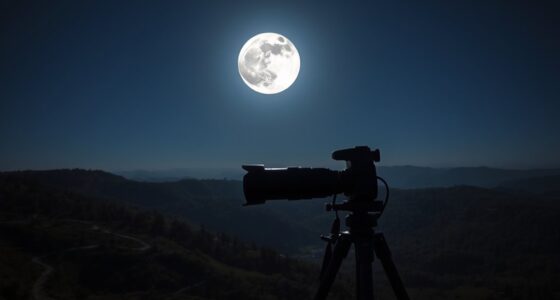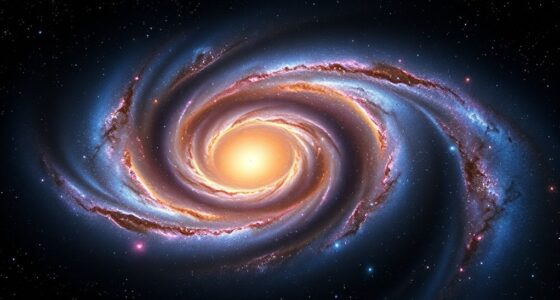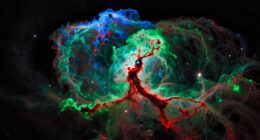
During winter, the Orion Nebula and Horsehead Nebula shine brightly as top deep-sky objects to observe. With your telescope, you can enjoy clear, dark skies that highlight their vivid colors and intricate details. Proper calibration and filters enhance your view, revealing stunning structures and faint features. Learning to navigate using Orion’s belt and nearby stars can make finding these targets easier. Keep exploring, and discover how to make the most of the winter night sky.
Key Takeaways
- Winter offers clearer, darker skies ideal for viewing the Orion and Horsehead nebulae.
- Proper telescope calibration enhances image clarity and reveals detailed structures in both nebulae.
- Use Orion’s Belt as a navigational guide to locate the Orion Nebula and star-hop to the Horsehead Nebula.
- High-quality filters improve contrast and help distinguish the nebulae’s intricate features.
- Longer winter nights provide extended opportunities for deep-sky observation and detailed exploration.

Have you ever wondered which deep-sky objects are best viewed during winter? If so, you’re in for a treat. The colder months offer some of the most spectacular celestial sights, and two standout targets are the Orion Nebula and the Horsehead Nebula. To truly appreciate their beauty, you’ll need to sharpen your skills in celestial navigation and guarantee your telescope is properly calibrated. These steps help you locate and observe these objects with clarity and precision, making your winter stargazing sessions truly rewarding.
Discover the winter sky’s best deep-sky objects—like Orion and Horsehead Nebulae—with proper calibration and celestial navigation skills.
As winter skies grow clearer and darker, you’ll find Orion’s Belt and its surrounding features easier to pinpoint. Before you start, it’s vital to calibrate your telescope correctly. Proper calibration ensures your aiming is accurate, so you can confidently navigate the night sky without wasting time searching aimlessly. Once calibrated, use celestial navigation techniques—like identifying prominent constellations and star patterns—to orient yourself. Orion, with its distinctive hourglass shape, becomes your celestial marker. From there, locating the Orion Nebula, also known as M42, becomes straightforward. It appears as a fuzzy, glowing patch in Orion’s Sword, just below the three belt stars.
With your telescope calibrated and your navigation skills sharp, you can observe the Orion Nebula’s stunning details. Under winter skies, its emission gases glow brightly, revealing intricate structures within the nebula. A low-power eyepiece can help you see the entire nebula at once, while higher magnifications reveal fine filaments and star-forming cores. Proper telescope calibration minimizes image distortions, guaranteeing you capture the nebula’s vibrant colors and complex features clearly. As you explore, remember that steady hands and patience reward you with clearer views. Additionally, using high-quality filters can enhance contrast and reveal more intricate details of these nebulae.
The Horsehead Nebula, located nearby in Orion’s constellation, is a more challenging target but equally worth the effort. Its dark silhouette against the bright emission nebula IC 434 demands a well-aligned telescope and sharp celestial navigation skills. You’ll want to focus on star-hopping techniques, using nearby bright stars as guides. Once located, a narrowband filter can enhance contrast, making the iconic shape of the Horsehead more visible. Calibration plays a key role here too—misaligned optics can obscure its delicate features, so double-check your setup before observing.
In winter, the combination of crisp skies and longer nights gives you excellent conditions to explore these nebulae deeply. With proper telescope calibration and skillful celestial navigation, you’ll reveal the intricate beauty of the Orion and Horsehead Nebulae, making your winter stargazing a memorable adventure.

SVBONY SV48P Telescope for Adults High Powered, 102mm Large Aperture F6.5 Refractor OTA for Adults Beginner Astronomer, Astronomical Telescope for Observation of Deep Space Celestial Objective
The SVBONY SV48P is a 102mm f/6.5 achromatic refractor with fully multi-coated optics; a 2.5-inch dual-speed focuser and…
As an affiliate, we earn on qualifying purchases.
As an affiliate, we earn on qualifying purchases.
Frequently Asked Questions
What Are the Best Months to Observe These Nebulae?
You should observe these nebulae during their prime viewing months, which are typically from late fall to early spring. Their seasonal visibility peaks between November and March, when they are high in the night sky and easier to see in darker conditions. During these months, you’ll have the best chance to enjoy clear views, making it ideal to plan your stargazing sessions around this period.
Can Beginners Easily See the Orion and Horsehead Nebulae?
Picture yourself gazing up at a clear, dark winter sky, stars shimmering like tiny diamonds. With patience, you can spot the Orion Nebula with your naked eye, especially in low light pollution areas, though the Horsehead Nebula remains challenging without binoculars or a telescope. Beginners might find the Orion Nebula easier to locate and enjoy, but seeing the Horsehead requires some extra equipment and a keen eye.
What Equipment Is Recommended for Viewing These Deep-Sky Objects?
You’ll want a good telescope with at least a 4-inch aperture for clear views of these nebulae. Add accessories like a wide-field eyepiece and a sturdy mount to stabilize your view. Using imaging techniques such as long-exposure astrophotography can reveal more details. Consider filters to enhance contrast, and a dew shield prevents moisture buildup. These tools and techniques make observing and capturing stunning images of the Orion and Horsehead Nebulae easier and more rewarding.
Are There Any Safety Tips for Winter Stargazing?
When winter stargazing, you should prioritize hypothermia prevention by dressing warmly, layering your clothing, and wearing insulated gloves and hats. To protect your eyes, use appropriate eye safety tips, like avoiding direct look at bright lights and taking breaks to prevent strain. Keep a flashlight handy for navigation, stay dry, and make certain your equipment is secure to prevent accidents. These steps keep you safe and comfortable during cold, clear nights.
How Long Should I Spend Observing to See These Nebulae Clearly?
You should spend at least 15 to 30 minutes observing these nebulae to see them clearly, allowing your eyes to adapt to the darkness. Use longer exposure times if you’re astrophotographing, but for visual viewing, a steady viewing duration helps your eyes adjust and reveals more detail. Be patient and avoid rushing, as a longer exposure time and extended viewing will enhance your experience and help you appreciate their true beauty.

SVBONY SV220 Telescope Filter, 2" 7nm Dual-Band Nebula Filter, Reduce Stray Light, H-Alpha&O-III Narrowband Filter for One-Shot Color Camera, Telescope Accessories for Deep Sky Astrophotography
Capture Purer Nebula Light: SV220 2" Dual-Band Filter allows high transmission of OIII (500.7nm) and H-Alpha (656.3nm) nebula…
As an affiliate, we earn on qualifying purchases.
As an affiliate, we earn on qualifying purchases.
Conclusion
As you explore the Orion and Horsehead Nebulae this winter, remember you’re gazing into regions where stars are born. Did you know the Orion Nebula spans about 24 light-years across? That means the light from its far edge takes 24 years to reach us. Keep observing and marvel at how these distant celestial nurseries reveal nature’s incredible process of star formation, reminding you of the vastness and wonder of our universe.

Celestial Navigation: A Complete Home Study Course, Second Edition
As an affiliate, we earn on qualifying purchases.
As an affiliate, we earn on qualifying purchases.

Astromania Laser Collimator for Newtonian Dobsonian Marca Telescopes, Telescope Alignment 1.25 Inch with 7 Red Laser Bright Levels, Great Telescope Accessories Laser Alignment Tool for Collimation
Multi-Function: Designed for Reflector telescope; fit for standard 1.25 inch diameter; this sturdy laser unit allows to swiftly…
As an affiliate, we earn on qualifying purchases.
As an affiliate, we earn on qualifying purchases.