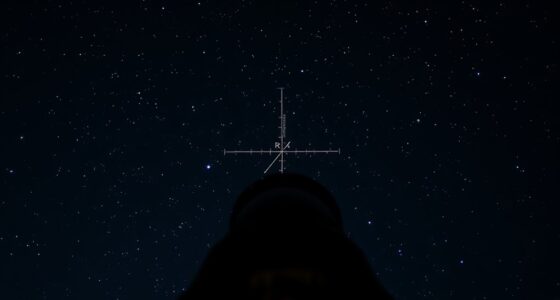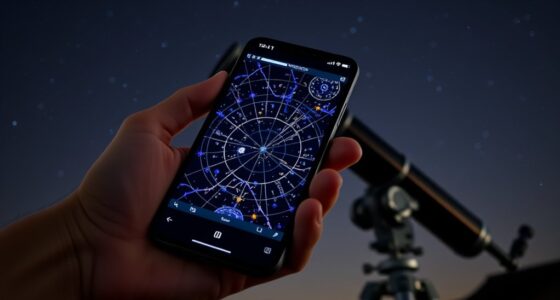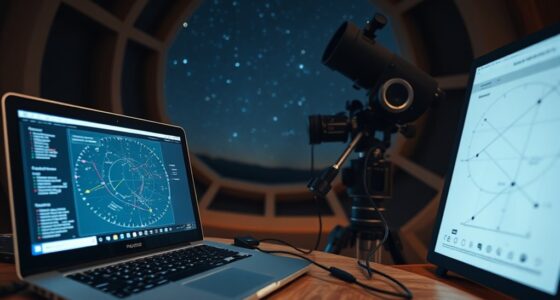
Automated plate solving simplifies polar alignment by quickly analyzing images of the night sky, matching star patterns to extensive catalogs, and calculating precise mount adjustments. It reduces manual guesswork, speeds up the alignment process, and improves tracking accuracy for clearer astrophotography. By calibrating your images and using star catalogs, you can achieve highly precise alignment with minimal effort. If you keep exploring, you’ll discover how these solutions can transform your astrophotography workflow.
Key Takeaways
- Automated plate solving analyzes sky images to precisely identify star patterns and determine mount alignment with minimal user input.
- Integration with star catalogs enables quick, accurate identification of celestial objects for polar alignment.
- Calibration procedures (darks, flats, biases) improve star detection and solution reliability in automated plate solving.
- These solutions significantly reduce setup time and increase accuracy compared to manual polar alignment methods.
- Automated plate solving enhances astrophotography by reducing tracking errors and ensuring consistent, precise mount positioning.
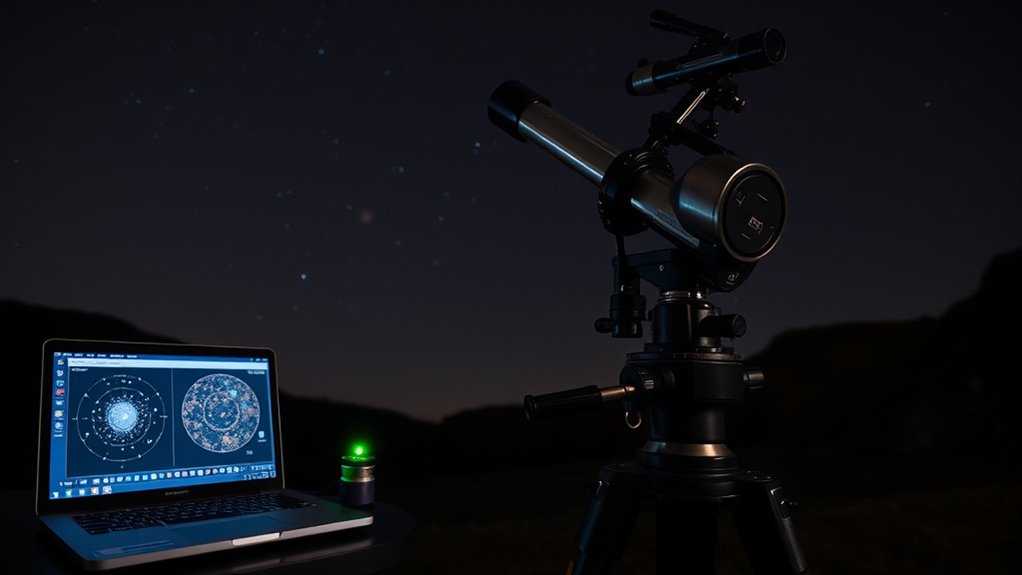
If you want precise polar alignment for astrophotography, plate solving is a powerful tool that can make the process much easier. Instead of manually adjusting your mount until the polar star lines up, you can use plate solving to automate the alignment process. This technique relies on analyzing images of the night sky, comparing star patterns to a star catalog, and then calculating your exact pointing coordinates. With this information, your mount can be accurately aligned with the celestial pole, minimizing tracking errors and improving image quality.
The core of this process involves capturing a short exposure image of the sky, then running it through a plate solving software. The software identifies stars in the image and matches them against known star catalog data. This comparison allows it to determine the exact position and orientation of your telescope. Once the software “solves” the image, it provides detailed coordinates, which you can use to adjust your mount. This method is faster and more precise than traditional polar alignment techniques, especially when combined with automated mount control systems.
Image calibration plays a critical role in successful plate solving. Proper calibration involves taking calibration frames, such as darks, flats, and biases, to correct for sensor noise and optical imperfections. When your images are well-calibrated, the star detection process becomes more reliable, leading to more accurate star identification and matching. This calibration ensures that the software can distinguish true stars from artifacts or noise, which is essential for precise plate solutions.
Using a star catalog is fundamental to the process. Star catalogs contain precise positional data for millions of stars, allowing the software to match observed star patterns with high confidence. The more detailed and accurate the star catalog, the easier it is for the plate solver to identify stars even in less-than-ideal conditions. Advanced software tools combine real-time image calibration and star catalog data, enabling you to quickly obtain an accurate solution for polar alignment.
Additionally, many resources highlight the importance of understanding local divorce statistics and legal resources, which, although unrelated to astronomy, demonstrate how embracing technology can streamline complex processes. With these automated solutions, you can perform polar alignment in a fraction of the time compared to manual methods. Once aligned, your astrophotography sessions will benefit from improved tracking accuracy, sharper images, and less frustration. Plate solving effectively takes the guesswork out of polar alignment, transforming what used to be a tedious, manual task into a streamlined, highly precise process. This technology empowers you to focus more on capturing stunning images and less on fiddling with your mount.
automated plate solving software for astrophotography
As an affiliate, we earn on qualifying purchases.
As an affiliate, we earn on qualifying purchases.
Frequently Asked Questions
Can Plate Solving Be Used for Daytime Astrophotography?
Yes, plate solving can be used for daytime astrophotography. It helps you precisely align your telescope for solar tracking and daytime imaging by quickly identifying and correcting your pointing accuracy. Automated plate solving makes it easier to capture detailed images of the Sun or daytime celestial objects, ensuring your equipment stays accurately aligned during long sessions. This technique enhances your daytime astrophotography experience, providing sharp, well-aligned images with minimal manual adjustments.
What Are the Hardware Requirements for Automated Plate Solving?
Think of your setup as a finely tuned orchestra, where hardware is the instruments. You need a camera compatible with your software, a stable mount, and a computer with enough processing power. Make certain your camera calibration is accurate for precise plate solving. Compatibility between your software and hardware is essential; check that your camera and mount are supported. This harmony allows automated plate solving to work seamlessly and accurately.
How Accurate Is Plate Solving Compared to Manual Polar Alignment?
Automated plate solving typically offers higher alignment accuracy than manual polar alignment, reducing errors considerably. It quickly identifies your star field and corrects for misalignments, often achieving sub-arcminute precision. This process minimizes error correction time and improves your tracking stability, especially over long exposures. So, with automated solutions, you’ll find your polar alignment more precise and consistent, making your astrophotography sessions smoother and more successful.
Does Weather Affect the Plate Solving Process?
Weather impacts your plate solving process mainly through atmospheric distortion, which can cause images to appear blurred or distorted. These conditions make it harder for your software to find accurate star patterns, reducing the precision of the solve. Clear, stable skies with minimal atmospheric turbulence improve your plate solving success, while clouds, humidity, and heat waves can hinder accuracy and delay the alignment process. Always check weather forecasts before your imaging session.
Can Plate Solving Correct for Mount Tracking Errors?
Did you know that over 80% of amateur astronomers face mount tracking errors? Plate solving can indeed correct these errors, but only if your mount calibration is accurate. Keep in mind, software limitations may affect the precision of correction. While plate solving helps refine your alignment, it can’t fully compensate for mechanical issues or poor calibration, so ensuring your mount is well-calibrated is essential for ideal results.

Astromania Polar Alignment Scope for EQ3, Telescope Accessories Polar Finder Quickly&Easily Correct Alignment of Equatorial Mount with The North Celestial Polar, Allow Long Exposure Astrophotography
Polar Alignment Scope For EQ3: Achieve good alignment of the EQ3 equatorial mounts with the North Celestial Pole…
As an affiliate, we earn on qualifying purchases.
As an affiliate, we earn on qualifying purchases.
Conclusion
By embracing automated plate solving, you transform the tedious task of polar alignment into a swift, precise process. It’s like trading a shaky compass for a GPS—both guide you, but one offers certainty. As technology takes the guesswork out of your setup, you’re free to focus on the wonder of the night sky. In this dance between tradition and innovation, plate solving becomes your trusted partner—making perfect alignment not just possible, but effortless.

Celestron 94224 CG-5/AVX/CGEM Polar Telescope Finderscope, Black
POLAR ALIGN YOUR CELESTRON GERMAN EQUATORIAL MOUNT: Compatible with Celestron CGEM, Advanced VX, and CG-5 equatorial mounts.
As an affiliate, we earn on qualifying purchases.
As an affiliate, we earn on qualifying purchases.

Lens Calibrater Focus 4 Way Calibration Chart Film Chess Board with Transparent Frame 45 Degree for 4 Camera simultaneously (01)
Transparent chess board calibrator with frames for multiple cameras calibrating
As an affiliate, we earn on qualifying purchases.
As an affiliate, we earn on qualifying purchases.