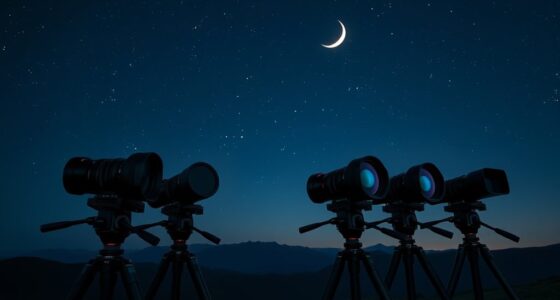
For solar astrophotography, I’d choose a filter that fits the optical instrument securely and is made for direct solar viewing; my best overall pick is the Thousand Oaks Optical 6 x 6 Inch Solar Filter Sheet for its adaptable format. The Urth 82mm ND100000 suits camera lenses with a matching thread, while Celestron’s EclipSmart model matched to your telescope offers a simpler fit for specified scopes. The main tradeoff is between ready-made convenience and the flexibility of sheet material, which may require careful mounting. Camera-lens filters also differ from telescope filters in fit and intended use, so compatibility matters as much as the optical density label. Read on for the full comparison and help choosing the right option for your setup.

Prime made for students and young adults
- Fast, free delivery for dorm and study essentials
- Prime Video and Amazon Music included
- Member-only deals
Key Takeaways
- Sheet material offers the most flexibility: the 6 x 6 inch Thousand Oaks sheet and 8 x 8 inch sheet can suit varied apertures, but the buyer must make a secure holder.
- Matched Celestron filters simplify fitting: the 6-inch, 8-inch, 127/130mm reflector, and AstroMaster 70 models are tied to particular telescope dimensions, so check the exact model before ordering.
- Camera lens filters need a matching thread: the Urth 82mm is a lens-specific choice, while the NiSi 105/95mm bundle adds a step-down ring for compatible smaller threads.
- Sheet size affects how much flexibility you get: larger sheets leave more material for custom holders or multiple instruments; smaller sheets are easier to store but limit cutting options.
- The universal folding filter prioritizes convenience: it may suit a changing set of compatible instruments, while a model-specific filter can provide a more direct fit for one telescope.
| Urth 82mm ND100000 (16.6 Stop) Solar Lens Filter (Plus) |  | Best for Wide-Angle Solar Photography | Brand: Urth | Filter size: 82mm | ND strength: ND100000 (16.6 stops) | VIEW LATEST PRICE | See Our Full Breakdown |
| Thousand Oaks Optical 6 x 6 Inch Solar Filter Sheet |  | Best DIY Value | Brand: Thousand Oaks Optical | Material: Black polymer | Dimensions: 6 x 6 inches | VIEW LATEST PRICE | See Our Full Breakdown |
| Celestron EclipSmart 6″ Solar Safe Eclipse Telescope Filter |  | Best for Celestron 6-Inch SCT Owners | Brand: Celestron | Model number: 94243 | Compatibility: Selected Celestron 6-inch Schmidt-Cassegrain telescopes | VIEW LATEST PRICE | See Our Full Breakdown |
| Celestron EclipSmart Solar Telescope Filter for Select 127mm and 130mm Reflectors |  | Best for Supported 127mm and 130mm Reflectors | Brand: Celestron | Model: 94222 | Compatible telescopes: Select Celestron 127mm and 130mm reflectors | VIEW LATEST PRICE | See Our Full Breakdown |
| NiSi ND5.0 105/95mm Bundle (ND100000 Filter with Step-Down Ring) |  | Best for 105mm Lens Setups | Brand: NiSi | Model: ND5.0 105/95mm Bundle | Filter strength: ND5.0 (16.6 stops) | VIEW LATEST PRICE | See Our Full Breakdown |
| Celestron EclipSmart 8-Inch Solar Telescope Filter |  | Best for Celestron 8-Inch SCT Owners | Brand: Celestron | Model: 94244-CGL | Compatible telescopes: Celestron 8-inch Schmidt-Cassegrain and EdgeHD | VIEW LATEST PRICE | See Our Full Breakdown |
| 8″ x 8″ Solar Filter Sheet for Telescopes, Binoculars and Cameras |  | Best Value for Custom Builds | Material: Black polymer | Dimensions: 8″ x 8″ | Compatible devices: Telescopes, binoculars, and cameras | VIEW LATEST PRICE | See Our Full Breakdown |
| Thousand Oaks Optical 4″x4″ Black Polymer Solar Filter Sheet |  | Best for Small Custom Apertures | Brand: Thousand Oaks Optical | Model: BP-4 | Dimensions: 4″ x 4″ | VIEW LATEST PRICE | See Our Full Breakdown |
| Celestron EclipSmart Solar Filter for AstroMaster 70 Telescopes |  | Best for AstroMaster 70 Owners | Brand: Celestron | Compatible telescopes: AstroMaster 70AZ, AstroMaster 70EQ, AstroMaster LT 70AZ | Safety standard: ISO 12312-2:2015(E) | VIEW LATEST PRICE | See Our Full Breakdown |
| Celestron EclipSmart Universal Folding Solar Filter |  | Best Compact Universal Fit | Brand: Celestron | Model: EclipSmart 44428 | Compatible objective diameter: 75–100 mm | VIEW LATEST PRICE | See Our Full Breakdown |
| solar astrophotography filter | Brand | Warranty | Material | Safety standard |
|---|---|---|---|---|
| Urth 82mm ND100000 | Urth | — | — | — |
| Thousand Oaks Optical 6 x 6 In | Thousand Oaks Optical | Five years | Black polymer | — |
| Celestron EclipSmart 6" Solar | Celestron | 2-year limited warranty | Solar Safe film, made in USA | ISO 12312-2:2015(E) |
| Celestron EclipSmart Solar Tel | Celestron | 2 years in the US | — | ISO 12312-2:2015(E) |
| NiSi ND5.0 105/95mm Bundle | NiSi | 12-month limited warranty | Premium optical glass | — |
| Celestron EclipSmart 8-Inch So | Celestron | 2-year limited warranty | — | ISO 12312-2:2015(E) |
| 8" x 8" Solar Filter Sheet for | — | — | Black polymer | — |
| Thousand Oaks Optical 4"x4" Bl | Thousand Oaks Optical | 5 years | Black polymer | — |
| Celestron EclipSmart Solar Fil | Celestron | 2 years | — | ISO 12312-2:2015(E) |
| Celestron EclipSmart Universal | Celestron | Two-year limited warranty | — | ISO 12312-2:2015(E) |
More Details on Our Top Picks
Urth 82mm ND100000 (16.6 Stop) Solar Lens Filter (Plus)
The Urth 82mm ND100000 is the lens-mounted option here for photographers who want extreme light reduction in a slim frame. Its 16.6-stop strength supports solar-event photography and long exposures in direct sunlight, while the 82mm thread and narrow rim suit compatible wide-angle lenses where vignetting can spoil the frame. Compared with the NiSi ND5.0 105/95mm Bundle, Urth avoids a step-down ring, though it fits only lenses with an 82mm thread. The SCHOTT B270 glass and layered coating are aimed at keeping reflections down and color natural. That convenience has limits: the filter is not water resistant, and its deep light cut can make focusing and composition difficult without auxiliary tools. It is a specialized lens filter, not a substitute for a telescope solar filter.
Pros:- 16.6-stop light reduction for extreme brightness and solar-event photography
- 82mm thread avoids an adapter on compatible lenses
- Ultra-slim 6061 aluminum rim helps limit vignetting
- SCHOTT B270 glass with a 20-layer coating
Cons:- Not water resistant
- Very dark view can make framing and focusing difficult
- Limited to lenses with an 82mm filter thread
Best for: Photographers with an 82mm-thread lens who want a slim filter for solar events or bright-sun long exposures.
Not ideal for: Telescope users and photographers whose lenses lack an 82mm thread; the extreme light reduction can also complicate focusing.
- Brand:Urth
- Filter size:82mm
- ND strength:ND100000 (16.6 stops)
- Glass:German SCHOTT B270
- Coating:20-layer CoraNano
- Frame material:6061 aluminum
- Water resistance:Not water resistant
Our verdict“Choose the Urth if your 82mm lens needs a slim, strongly light-reducing filter and you can manage the difficult focusing.”
Thousand Oaks Optical 6 x 6 Inch Solar Filter Sheet
This 6 x 6 inch black polymer sheet offers the most adaptable starting point for a custom solar filter in this group. I’d choose it when a telescope, binocular, or camera needs a fitted holder that the ready-made Celestron EclipSmart filters do not provide. The sheet is designed for observing sunspots and solar granulation, with a natural orange solar view. That flexibility comes with hands-on work: the buyer must cut the material, build a holder, and secure the finished filter before use. Unlike the Celestron EclipSmart 6-inch filter, it does not arrive shaped for a specific telescope or equipped with attachment straps. Its filtering properties sit within the substrate, but the product data gives no ISO safety standard, so I would not treat the sheet alone as proof of a safely assembled setup.
Pros:- Can be cut for telescopes, binoculars, or cameras
- Designed for observing sunspots and solar granulation
- Shows the Sun in a natural orange color
- Filtering properties are protected within the polymer substrate
Cons:- Requires the buyer to make and securely attach a holder
- No stated ISO safety standard in the supplied product data
- Not water resistant
Best for: DIY astronomers who need to make a fitted solar filter for a telescope, binoculars, or camera and can securely construct its holder.
Not ideal for: Buyers who want a ready-to-attach telescope filter or need a stated ISO safety standard for the complete setup.
- Brand:Thousand Oaks Optical
- Material:Black polymer
- Dimensions:6 x 6 inches
- Compatible devices:Telescopes, binoculars, cameras
- Solar appearance:Natural orange
- Coating:No coating
- Warranty:Five years
Our verdict“Pick this sheet if you need a custom fit and are prepared to build and secure the complete filter assembly.”
Celestron EclipSmart 6″ Solar Safe Eclipse Telescope Filter
For a compatible Celestron 6-inch Schmidt-Cassegrain, this EclipSmart filter is the most direct route in the lineup to a purpose-fitted solar setup. Its specified ISO 12312-2:2015(E) compliance and blocking of 99.999% of visible light, IR, and UV distinguish it from the DIY Thousand Oaks sheet, which requires the buyer to make and secure a holder. The hook-and-loop attachment is designed to keep the filter snug on supported models, and the orange solar tint serves both visual observation and imaging. Compatibility is the main constraint: it is for listed Celestron 6-inch SCT models, not a general 6-inch telescope filter. Like the Celestron 127mm/130mm reflector filter, it depends on careful alignment and attachment; the two models are not interchangeable.
Pros:- Specified to comply with ISO 12312-2:2015(E)
- Blocks 99.999% of visible light, IR, and UV
- Hook-and-loop strap provides a fitted attachment for listed models
- Orange tint supports visual observing and imaging
Cons:- Compatibility is limited to listed Celestron 6-inch SCT models
- Requires careful alignment and secure attachment
- Orange tint changes the Sun’s appearance
Best for: Owners of a listed Celestron 6-inch Schmidt-Cassegrain who want a model-specific filter for solar viewing and imaging.
Not ideal for: Owners of other telescope brands, different apertures, or Celestron reflectors; this filter is built for specified 6-inch SCT models.
- Brand:Celestron
- Model number:94243
- Compatibility:Selected Celestron 6-inch Schmidt-Cassegrain telescopes
- Safety standard:ISO 12312-2:2015(E)
- Light blocked:99.999% of visible light, IR, and UV
- Material:Solar Safe film, made in USA
- Weight:3.2 ounces
- Warranty:2-year limited warranty
Our verdict“Choose this EclipSmart if you own one of the listed Celestron 6-inch SCTs and want a fitted filter for solar observing and imaging.”
Celestron EclipSmart Solar Telescope Filter for Select 127mm and 130mm Reflectors
This EclipSmart is the reflector-specific pick for owners of listed Celestron 127mm and 130mm telescopes. It shares the stated ISO 12312-2:2015(E) standard and 99.999% visible-light blocking of the 6-inch SCT model, but its compatibility is tailored to select reflectors rather than Schmidt-Cassegrains. Two hook-and-loop straps secure the filter, while the included cap covers it in storage. Those practical details make it a more ready-to-fit choice than the Thousand Oaks 6 x 6 inch sheet, which requires a homemade holder. The tradeoff is a narrow telescope list: matching the aperture alone does not establish compatibility. Its orange tint also changes the Sun’s appearance, so buyers seeking a different color presentation should account for that before choosing.
Pros:- Specified to conform to ISO 12312-2:2015(E)
- Blocks 99.999% of visible light and harmful IR and UV
- Two straps secure the filter and a cap protects it in storage
- Orange tint supports visual observing and imaging
Cons:- Fits only select Celestron 127mm and 130mm reflector models
- Orange tint changes the Sun’s appearance
- Requires careful fit and secure attachment
Best for: Owners of a listed Celestron 127mm or 130mm reflector who want a ready-made filter for solar viewing and imaging.
Not ideal for: Owners of unlisted reflector models, other brands, or telescopes outside the specified apertures; aperture alone does not establish fit.
- Brand:Celestron
- Model:94222
- Compatible telescopes:Select Celestron 127mm and 130mm reflectors
- Safety standard:ISO 12312-2:2015(E)
- Filter technology:Solar Safe film
- Visible light blocked:99.999%
- Attachment:Two hook-and-loop straps
- Weight:3.04 ounces
- Warranty:2 years in the US
Our verdict“Choose this model if your telescope appears on its supported reflector list and you want a ready-made solar filter with a protective cap.”
NiSi ND5.0 105/95mm Bundle (ND100000 Filter with Step-Down Ring)
The NiSi bundle pairs a 95mm ND100000 filter with a 105-to-95mm step-down ring, giving photographers with a 105mm lens thread a bundled way to mount extreme light reduction. Like the Urth 82mm filter, it offers 16.6 stops for solar photography and very bright scenes; its stated UV and IR reduction and Nano coating target color neutrality and fewer reflections. The included ring makes this a better match than Urth for the specified 105mm thread, but adds another connection that can complicate fit or cause vignetting. Neither lens filter has the telescope-specific fit of the Celestron EclipSmart models, and this bundle is designed for extreme light reduction rather than general daylight use. Buyers should also verify their lens and ring fit before relying on the setup.
Pros:- 16.6 stops of light reduction for bright solar scenes
- Includes a 105-to-95mm step-down ring
- Stated UV and IR reduction for color-neutral results
- Nano coating is designed to reduce reflections and glare
Cons:- Step-down ring adds a connection that can affect fit or cause vignetting
- Extreme light reduction limits general daylight versatility
- 12-month limited warranty
Best for: Photographers with a 105mm filter-thread lens seeking a bundled step-down ring and 16.6-stop filter for solar or extreme-brightness photography.
Not ideal for: Buyers seeking a telescope-mounted solar filter, broader everyday daylight use, or a setup without an adapter ring.
- Brand:NiSi
- Model:ND5.0 105/95mm Bundle
- Filter strength:ND5.0 (16.6 stops)
- Filter size:95mm
- Adapter:105mm to 95mm step-down ring
- Material:Premium optical glass
- Coating:Nano coating
- Warranty:12-month limited warranty
Our verdict“Choose the NiSi bundle if your 105mm lens can accept the included ring and you want a 16.6-stop filter for solar photography.”
Celestron EclipSmart 8-Inch Solar Telescope Filter
For owners of a compatible Celestron 8-inch Schmidt-Cassegrain or EdgeHD, this fitted filter is a simpler route to white-light solar observing than building a holder around a sheet. Its two hook-and-loop straps help keep it seated, and the orange Solar Safe film is specified to meet ISO 12312-2:2015(E) for direct solar observation. That makes it a practical match for sunspots and eclipse imaging, though the listing does not describe a specialized narrowband view of solar detail. Compared with the Celestron EclipSmart Universal Folding Solar Filter, this one is tailored to a telescope family rather than a 75–100 mm range of barrels and lenses. That fit is its advantage and its limit: owners of other apertures need another option, and the filter still needs a careful attachment check before use.
Pros:- Designed for Celestron 8-inch Schmidt-Cassegrain and EdgeHD telescopes
- Meets ISO 12312-2:2015(E) requirements for direct solar observation
- Two hook-and-loop straps help secure the filter
- Orange tint supports natural-looking solar views
Cons:- Limited to compatible Celestron 8-inch telescopes
- Requires a secure fit check before solar observation
Best for: Owners of compatible Celestron 8-inch Schmidt-Cassegrain or EdgeHD telescopes who want a fitted white-light solar filter for observing or imaging.
Not ideal for: Owners of other telescope brands or apertures, since this filter is designed for specific Celestron 8-inch models.
- Brand:Celestron
- Model:94244-CGL
- Compatible telescopes:Celestron 8-inch Schmidt-Cassegrain and EdgeHD
- Safety standard:ISO 12312-2:2015(E)
- Visible light blocked:99.999%
- Attachment:Two hook-and-loop straps
- Weight:4 ounces
- Warranty:2-year limited warranty
Our verdict“Choose this fitted filter if you own a compatible Celestron 8-inch SCT or EdgeHD; other telescope owners should look at a universal or sheet option.”
8″ x 8″ Solar Filter Sheet for Telescopes, Binoculars and Cameras
This 8-by-8-inch black polymer sheet suits makers who want to cut a solar filter to fit a telescope, binoculars, or camera rather than buy a model-specific frame. Its orange solar image supports white-light viewing of sunspots, eclipses, and transits, while the five-year guarantee adds reassurance for a DIY material purchase. Compared with Thousand Oaks Optical’s smaller 4″x4″ Black Polymer Solar Filter Sheet, this larger sheet gives more room for a wider custom aperture or a different holder design. The tradeoff is that the buyer must make and secure the holder; the product data specifically calls for tape attachment, so fit and retention depend on the build. It is also not water resistant, making damp conditions a poor match.
Pros:- 8-by-8-inch sheet offers room for custom filter shapes
- Works with telescopes, binoculars, and cameras
- Black polymer produces a natural orange solar image
- Five-year guarantee from Thousand Oaks Optical
Cons:- Requires a holder and secure attachment, such as tape
- Not water resistant
- DIY fit and retention depend on the buyer’s construction
Best for: DIY astronomers and camera users who can make a secure holder and need a larger sheet to fit a custom objective.
Not ideal for: Beginners seeking a ready-to-fit filter or anyone who cannot reliably secure a homemade holder to the instrument.
- Material:Black polymer
- Dimensions:8″ x 8″
- Compatible devices:Telescopes, binoculars, and cameras
- Filter image:Natural orange Sun
- Weight:1.6 ounces
- Enclosure material:Polymer
- Water resistance:Not water resistant
- Guarantee:Five years
Our verdict“Pick this sheet for a custom build with a larger aperture; choose a fitted filter if you want a ready-made attachment.”
Thousand Oaks Optical 4″x4″ Black Polymer Solar Filter Sheet
For a compact objective or a small camera setup, this 4-by-4-inch black polymer sheet offers a straightforward way to make a custom white-light solar filter. Thousand Oaks says the material is stronger than Mylar and keeps its filtering properties within the substrate, which helps protect the filter layer from surface scratching. Its orange solar view makes it suited to sunspots and granulation, and the five-year warranty distinguishes it from a generic DIY material listing. Compared with the larger 8″ x 8″ Solar Filter Sheet in this roundup, this sheet is easier to allocate to a small build but gives less material for wide apertures or multiple cuts. You also supply the holder and must attach it securely; its lack of water resistance narrows where a DIY setup is convenient.
Pros:- Black polymer is described as stronger than standard Mylar
- Filtering properties are protected within the material
- Fits custom builds for telescopes, binoculars, or cameras
- Five-year warranty
Cons:- Small 4-by-4-inch sheet may not cover larger apertures
- Requires a holder and secure attachment
- Not water resistant
Best for: DIY solar observers fitting a small telescope, binocular objective, or camera lens who want black polymer material for a custom holder.
Not ideal for: Owners of larger-aperture telescopes or buyers who want a ready-made frame, since the 4-inch sheet may be too small and requires DIY mounting.
- Brand:Thousand Oaks Optical
- Model:BP-4
- Dimensions:4″ x 4″
- Material:Black polymer
- Compatible devices:Telescopes, binoculars, and cameras
- Filter image:Natural orange Sun
- Water resistance:Not water resistant
- Warranty:5 years
Our verdict“Choose this compact sheet for a small custom filter; the 8-by-8-inch sheet is the better fit when your build needs more material.”
Celestron EclipSmart Solar Filter for AstroMaster 70 Telescopes
AstroMaster 70 owners get a purpose-fit filter for the 70AZ, 70EQ, and LT 70AZ, with three safety screws that hold the filter body in place. Its Solar Safe film conforms to ISO 12312-2:2015(E), and the orange tint supports white-light solar observing and imaging. Compared with the Celestron EclipSmart 8-Inch Solar Telescope Filter, this model is sized for a much smaller, specific telescope family and uses screws rather than straps for retention. That specificity makes it a direct fit for the named AstroMaster models, but a poor choice for other instruments. It also provides white-light views, so buyers seeking another solar wavelength will need different equipment. The included protective cap helps shield the filter surface between sessions.
Pros:- Fits three specified AstroMaster 70 telescope models
- Conforms to ISO 12312-2:2015(E)
- Three safety screws secure the filter body
- Includes a protective cap for the filter surface
Cons:- Designed only for the listed AstroMaster 70 models
- Provides white-light solar views rather than other wavelengths
Best for: Owners of a Celestron AstroMaster 70AZ, 70EQ, or LT 70AZ who want a model-specific filter for solar viewing and imaging.
Not ideal for: People using a different telescope model or seeking narrowband solar imaging, since the fit is limited and this is a white-light filter.
- Brand:Celestron
- Compatible telescopes:AstroMaster 70AZ, AstroMaster 70EQ, AstroMaster LT 70AZ
- Safety standard:ISO 12312-2:2015(E)
- Attachment:Three safety screws
- Filter tint:Orange
- Visible light transmission:0.001%
- Included items:Filter body, 3 safety screws, instruction sheet
- Warranty:2 years
Our verdict“Buy this for a named AstroMaster 70 model; for an 8-inch Celestron SCT or EdgeHD, the larger dedicated EclipSmart filter is the relevant fit.”
Celestron EclipSmart Universal Folding Solar Filter
This folding filter stands apart from the telescope-specific Celestron models: adjustable panels and an elastic band let it fit 75–100 mm objective barrels or camera lenses. For solar imaging across a telescope, spotting scope, or DSLR lens in that range, it avoids the custom holder needed by either Thousand Oaks polymer sheet. The fold-flat design and reusable bag also make storage easier between sessions. Its orange film conforms to ISO 12312-2:2015(E) and blocks 99.999% of visible light, according to the supplied specifications. Fit remains the deciding factor: lenses outside the stated diameter range are out, and the product notes that a camera lens sun shade may improve fit. Compared with the AstroMaster 70 filter, this model has broader device compatibility but less model-specific attachment.
Pros:- Fits compatible telescope, spotting scope, and camera objectives
- Adjustable panels and elastic band help secure the filter
- Folds flat and includes a reusable storage bag
- Conforms to ISO 12312-2:2015(E)
Cons:- Limited to 75–100 mm outside diameters
- Camera lenses may need a sun shade to improve fit
- Elastic-band attachment is less model-specific than the AstroMaster filter’s screw mount
Best for: Solar imagers who switch between compatible 75–100 mm telescope, spotting scope, and camera objectives and value a compact filter for storage.
Not ideal for: Owners of objectives outside the 75–100 mm range or anyone who needs a rigid, model-specific mount.
- Brand:Celestron
- Model:EclipSmart 44428
- Compatible objective diameter:75–100 mm
- Safety standard:ISO 12312-2:2015(E)
- Visible light blocked:99.999%
- Attachment:Adjustable panels and elastic band; 2 rubber bands included
- Included items:Folding solar filter and reusable bag
- Warranty:Two-year limited warranty
Our verdict“Choose this if your objectives fall within 75–100 mm and you want one stowable filter across devices; otherwise match a dedicated filter to your telescope.”

How We Picked
I ranked these solar astrophotography filters by how clearly each product matches a real imaging setup: camera lens, named telescope aperture, or adaptable optical instrument. Fit and secure mounting matter because an otherwise suitable filter is not useful if it cannot cover the instrument’s front aperture reliably. I also weighed ease of setup, the flexibility offered by sheet dimensions or included rings, and how much measuring or holder-making the buyer must do.
That puts adaptable sheet material first for its range of possible uses, followed by filters that serve a clear, compatible camera or telescope setup. A dedicated filter can be easier to fit but is less useful outside its stated model or size. I treat listed density and material as product specifications, not as proof of suitability for every solar imaging method; buyers should follow the maker’s instructions and confirm their full optical configuration before use.
| solar astrophotography filter | Brand | Material |
|---|---|---|
| Urth 82mm ND100000 | Urth | — |
| Thousand Oaks Optical 6 x 6 In | Thousand Oaks Optical | Black polymer |
| Celestron EclipSmart 6" Solar | Celestron | Solar Safe film, made in USA |
| Celestron EclipSmart Solar Tel | Celestron | — |
| NiSi ND5.0 105/95mm Bundle | NiSi | Premium optical glass |
| Celestron EclipSmart 8-Inch So | Celestron | — |
| 8" x 8" Solar Filter Sheet for | — | Black polymer |
| Thousand Oaks Optical 4"x4" Bl | Thousand Oaks Optical | Black polymer |
| Celestron EclipSmart Solar Fil | Celestron | — |
| Celestron EclipSmart Universal | Celestron | — |
Factors to Consider When Choosing Solar Astrophotography Filters
Before choosing a filter, I’d start with the instrument that will carry it and the way it will be mounted. These decisions shape whether a ready-made filter or adaptable sheet is the more practical route.
Match the Filter to the Front Aperture
Measure the instrument’s outside diameter where the filter will attach, rather than relying only on the telescope’s advertised aperture. A telescope described as 6 inches across may have a tube or dew shield with a different outer measurement. Camera lenses usually call for the filter thread diameter printed on the lens or cap, and step-down rings introduce their own fit limits. Buying by aperture alone can leave a filter that cannot mount securely. If dimensions sit between common sizes, choose a mounting design that can be adjusted and check how it is retained. The right match is the one that covers the full front opening without shifting.
Decide Whether You Want a Ready-Made Mount
A model-specific filter can save measuring and fabrication when its named telescope is exactly yours. Sheet material gives more freedom across unusual sizes, but the buyer takes responsibility for making a holder that stays put and does not obstruct the opening. A common mistake is to treat a sheet as a complete filter assembly; the sheet alone does not solve mounting. Consider how often you change instruments and whether you are comfortable making and checking a holder. For a permanent single-scope setup, a fitted model can be less fussy. For several instruments, an adaptable format may justify the extra setup work.
Read Density Labels in the Context of the Whole System
Labels such as ND5.0 and ND100000 describe attenuation conventions, but they do not by themselves tell you whether a product suits your entire imaging chain. Check the manufacturer’s stated use, compatibility, and instructions for the filter and instrument. Do not assume that a neutral-density lens filter and a telescope filter are interchangeable just because both are marketed for solar use. Additional optics or accessories can change what is safe or appropriate. Verify each component in the optical path before pointing at the Sun. If the maker does not clearly support your intended configuration, select a product with explicit guidance.
Plan for the Camera and Focal Length You Use
Solar imaging can involve a camera lens, a telescope with a camera attached, or another optical arrangement, and the filter must sit at the correct front opening for that system. A lens-thread filter is convenient when the thread matches, but it may not transfer to a telescope. Ring bundles can extend compatibility to selected lens threads, though they do not make every lens size fit. On telescopes, the filter must cover the objective or entrance aperture as specified by its maker. Think through framing and the focal length you intend to use before buying several adapters. A filter that fits your current setup may not support a later change in optics.
Choose Sheet Dimensions for Your Likely Projects
Large sheets are useful when you need to cut a custom circle or make filters for more than one instrument, but they take more storage and careful handling. Smaller sheets can be easier to keep flat and store, though they leave less room for mistakes or future projects. Before cutting, lay out the intended holder dimensions and allow enough material for the mounting method. Cutting too close to the usable area can complicate attachment even if the opening itself is covered. Keep unused material protected according to the manufacturer’s care guidance. The best sheet size follows your planned holder and instrument list, rather than the assumption that bigger is always better.
Prioritize Inspection and Secure Retention
A filter needs a dependable hold on the instrument and a clear inspection routine before every session. Check for damage, loose edges, or a mount that can be dislodged as the telescope moves. Dust and fingerprints can affect images, but cleaning must follow the material maker’s instructions to avoid damage. Store the filter so its surface is not pressed against hard objects or exposed to avoidable wear. A folding or universal format may make transport easier, while a custom holder may need more frequent checks. Build inspection and secure mounting into setup, rather than treating them as afterthoughts.
Frequently Asked Questions
Can I use a camera lens filter on a telescope?
Only if the manufacturer explicitly supports that use and the filter mounts over the telescope’s full front aperture as directed. A lens filter sized for a threaded camera lens is not automatically a telescope filter. Telescope tubes often lack the matching thread, and an improvised mount may not hold securely. Check the model’s intended use and mounting instructions before adapting it. If compatibility is unclear, choose a filter designed for the telescope.
Should I buy a sheet or a telescope-specific filter?
I’d choose a specific filter when it is made for the exact telescope and you want a simpler fit. A sheet makes more sense when your instrument has an unusual size or you plan to make holders for more than one device. The sheet route involves measuring, cutting, and building a secure mount, so it suits buyers comfortable with that work. Compare the finished holder you can make with the convenience of a ready-made model. Either way, follow the maker’s instructions for mounting and use.
What measurements should I check before ordering?
For a camera lens, check the filter thread diameter, which is usually marked on the lens or cap. For a telescope, measure the outside diameter at the point where the filter will attach and compare it with the product’s stated fit range. Also check whether the filter covers the full opening and how it is retained. Do not use the telescope’s nominal aperture as a substitute for the outer measurement. If the maker lists a particular telescope model, confirm that your exact version is included.
Does an ND5.0 or ND100000 label tell me which filter is safer?
Those labels communicate attenuation specifications, but the label alone does not establish suitability for your instrument or imaging arrangement. Confirm that the product is explicitly intended for the solar use you have in mind and follow its installation directions. Check any other optics in the system against the maker’s guidance as well. Do not combine products or adapt a filter based only on similar-looking specifications. When the instructions do not address your setup, pick a product with clear compatibility information.
Can one universal folding filter work across my telescope and binoculars?
It may cover more than one compatible instrument, but “universal” does not mean every size or shape will fit securely. Check the supported diameter range, the way the filter attaches, and whether it covers each instrument’s full front opening. Telescopes and binoculars can differ in spacing and exterior shape, so verify each separately. A model-specific filter may be easier to fit when you use only one instrument. For shared use, test the fit and retention on every device according to the manufacturer’s directions before observing.
Conclusion
For most buyers seeking flexibility, I’d start with the Thousand Oaks 6 x 6 inch sheet as the best overall pick, provided you can make a secure holder. The 8 x 8 inch sheet is the value choice for buyers who need more material for custom projects, while the NiSi ND5.0 bundle is the premium-leaning camera option when its 105/95mm sizing matches the lens setup. Beginners with a compatible telescope may find a model-specific Celestron EclipSmart easiest to fit; confirm the telescope model first. For changing instruments, consider the Celestron Universal Folding Filter, and for an 82mm camera lens, the Urth is the direct-fit option. Choose by your front aperture, mounting comfort, and intended imaging setup.