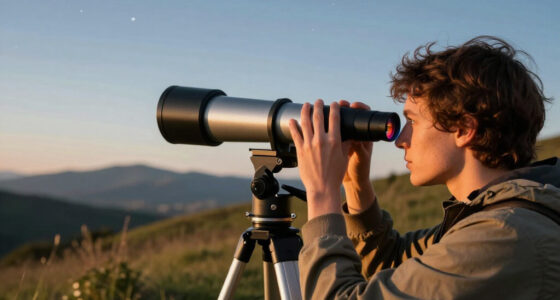

Smart telescope cameras pair optics with imaging and app-based controls, but they differ in how much they automate and how much observing flexibility they offer. I’d put the Seestar S50 Pro first for its balanced 50 mm aperture and integrated smart-telescope approach; the Unistellar Odyssey Pro stands out for its Nikon electronic eyepiece, while the DWARF 3 suits buyers who value a portable setup. The main tradeoff is between hands-off imaging and a more traditional telescope experience, along with differences in portability, optical capability, and setup. Some products here are dedicated smart scopes, while others use a phone to guide a conventional telescope, so the category label alone does not tell the whole story. Read on for the full breakdown and help matching a model to your observing style.

Prime made for students and young adults
- Fast, free delivery for dorm and study essentials
- Prime Video and Amazon Music included
- Member-only deals
Key Takeaways
- The Seestar S50 Pro is the most balanced dedicated smart scope in this group: its 50 mm aperture gives it a clear role for buyers seeking an integrated imaging setup rather than a phone-guided traditional telescope.
- The Odyssey Pro takes a different route from app-first models: its Nikon electronic eyepiece makes it the standout for observers who want an eyepiece-based experience alongside smart features.
- Portability is a real point of separation: the 1.85-pound Dwarf Mini and the DWARF 3 are better fits for compact travel kits than larger or more involved telescope setups.
- Several 4K-labeled refractors are not equivalent to dedicated smart scopes: models from FASHIONARI, JVAXS, and other generic listings emphasize screens, remotes, autofocus, or included storage, so buyers should compare the full imaging and control workflow rather than headline resolution alone.
- Celestron’s StarSense models are smartphone-guided conventional telescopes: the LT 114AZ and DX 130AZ make sense for buyers who want guided visual observing, not the same automated astrophotography workflow as Seestar or DWARF.
| Seestar S50 Pro Smart Telescope with 50 mm Aperture |  | Best Overall for Automated Deep-Sky Imaging | Aperture: 50 mm | Focal length: 260 mm | Field of view: 63 degrees | VIEW LATEST PRICE | See Our Full Breakdown |
| Unistellar Odyssey Pro Smart Telescope with Nikon Electronic Eyepiece – Black |  | Best for Eyepiece-Based Digital Observing | Aperture: 85 mm | Focal length: 320 mm | Mount: Altazimuth | VIEW LATEST PRICE | See Our Full Breakdown |
| Dwarf Mini Smart Telescope – 1.85lb Portable Astronomy Telescope |  | Best Compact Telescope Camera | Aperture: 30 mm | Focal length: 150 mm | Field of view: 2.45 degrees | VIEW LATEST PRICE | See Our Full Breakdown |
| Smart Digital Telescope with Autofocus and 4K Astrophotography |  | Best for Built-In Screen and Video Capture | Optical design: Refractor | Objective aperture: 80 mm | Focal length: 300 mm | VIEW LATEST PRICE | See Our Full Breakdown |
| ZWO Seestar S30 Plus Smart Telescope |  | Best for Wide-Field, Portable Imaging | Objective lens diameter: 30 mm | Focal length: 160 mm | Focal ratio: f/5.3 | VIEW LATEST PRICE | See Our Full Breakdown |
| DWARF 3 Smart Telescope – App-Controlled Astrophotography Camera |  | Best for Travel and Daytime Wildlife | Objective lens diameter: 35 mm | Weight: 2.28 kg | Dimensions: 2.56 × 8.74 × 5.59 in | VIEW LATEST PRICE | See Our Full Breakdown |
| FASHIONARI Smart Refractor Telescope with Autofocus, 4K Camera, App and Remote Control |  | Best for Flexible Viewing and Remote Capture | Telescope type: Refractor | Objective aperture: 80 mm | Focal length: 300 mm | VIEW LATEST PRICE | See Our Full Breakdown |
| JVAXS Smart Digital Telescope with 3-Inch Flip Screen, App Control, Remote, and 64GB Card |  | Best for Beginners Who Want Included Storage | Objective lens diameter: 78 mm | Focus: Manual | Display: 3-inch flip-out screen | VIEW LATEST PRICE | See Our Full Breakdown |
| ZWO Seestar S30 Pro Smart Telescope |  | Best for Automated Deep-Sky Imaging | Mount: Alt-azimuth; supports equatorial mode | Focus: Autofocus and manual focus | Focal length: 160 mm | VIEW LATEST PRICE | See Our Full Breakdown |
| Smart High-Powered Refracting Telescope with 4K Camera for Adults, Kids & Beginners |  | Best for Group Viewing in Daylight | Objective lens diameter: 80 mm | Focal length: 300 mm | Maximum magnification: 350× | VIEW LATEST PRICE | See Our Full Breakdown |
| FASHIONARI 350X Digital Refractor Telescope with 4K Camera |  | Best for On-Telescope Viewing | Telescope type: Digital refractor | Aperture: 80 mm | Focal length: 300 mm | VIEW LATEST PRICE | See Our Full Breakdown |
| Celestron StarSense Explorer LT 114AZ Newtonian Smartphone Guided Telescope |  | Best for Beginner Sky Navigation | Optical design: Newtonian reflector | Aperture: 114 mm | Focal length: 1000 mm | VIEW LATEST PRICE | See Our Full Breakdown |
| Celestron StarSense Explorer DX 130AZ Smartphone Guided Newtonian Telescope |  | Best for Brighter Visual Views | Optical design: Newtonian reflector | Aperture: 130 mm | Focal length: 650 mm | VIEW LATEST PRICE | See Our Full Breakdown |
| smart telescope camera | Focal length | Focus | Mount |
|---|---|---|---|
| Seestar S50 Pro Smart Telescop | 260 mm | Autofocus and manual focus | Alt-azimuth; supports equatorial mode |
| Unistellar Odyssey Pro Smart T | 320 mm | Auto focus | Altazimuth |
| Dwarf Mini Smart Telescope | 150 mm | Manual and automatic | Altazimuth and equatorial |
| Smart Digital Telescope with A | 300 mm | Autofocus | — |
| ZWO Seestar S30 Plus Smart Tel | 160 mm | — | — |
| DWARF 3 Smart Telescope | — | Autofocus | Altazimuth |
| FASHIONARI Smart Refractor Tel | 300 mm | Autofocus | — |
| JVAXS Smart Digital Telescope | — | Manual | — |
| ZWO Seestar S30 Pro Smart Tele | 160 mm | Autofocus and manual focus | Alt-azimuth; supports equatorial mode |
| Smart High-Powered Refracting | 300 mm | Autofocus | — |
| FASHIONARI 350X Digital Refrac | 300 mm | Autofocus | — |
| Celestron StarSense Explorer L | 1000 mm | — | Manual altazimuth with slow-motion altitude adjustment |
| Celestron StarSense Explorer D | 650 mm | Manual | Manual altazimuth with dual slow-motion controls |
More Details on Our Top Picks
Seestar S50 Pro Smart Telescope with 50 mm Aperture
I’d put the Seestar S50 Pro near the top for buyers who want an automated imaging workflow without managing a separate camera and mount. Its app finds and tracks targets, then supports image stacking, mosaics, and time-lapse; the built-in light pollution filter also gives suburban observers a useful tool. Compared with the smaller-aperture Seestar S30 Plus, its 50 mm aperture and 260 mm focal length make it the more substantial choice for focused telescope imaging, while the S30 Plus has a wider field of view and weighs less. The S50 Pro’s 128 GB storage and up to nine-hour battery life suit longer sessions, but its 2.8 kg weight is less grab-and-go. It is an imaging device, not a conventional eyepiece telescope, and the supplied data warns it is not suitable for viewing planets.
Pros:- App-guided target finding and tracking reduce manual setup and star hopping.
- Stacking, mosaics, and time-lapse offer several ways to build and record image sessions.
- 128 GB of storage and up to nine hours of battery life support extended use.
- Includes a tripod, carry case, and sun filter, with equatorial mode support.
Cons:- Requires a smartphone or tablet to control and use its app-based imaging system.
- Eyepieces are not compatible, so it cannot provide conventional visual observing.
- Not suited to planetary viewing and weighs more than the Seestar S30 Plus.
Best for: App-first beginners and returning observers who want automated deep-sky capture, generous onboard storage, and long sessions without adding an external camera.
Not ideal for: Buyers who want to look through eyepieces, prioritize planetary viewing, or need the lightest telescope for hiking.
- Aperture:50 mm
- Focal length:260 mm
- Field of view:63 degrees
- Mount:Alt-azimuth; supports equatorial mode
- Focus:Autofocus and manual focus
- Camera:Dual-camera system
- Storage:128 GB
- Battery life:Up to 9 hours
- Weight:2.8 kg (6.2 lb)
Our verdict“Choose the Seestar S50 Pro if you want an all-in-one automated deep-sky camera with long battery life and can accept app-only viewing.”
Unistellar Odyssey Pro Smart Telescope with Nikon Electronic Eyepiece – Black
The Unistellar Odyssey Pro is the clearest fit here for someone who wants a digital eyepiece experience rather than relying entirely on a phone screen. Its Nikon electronic eyepiece presents digitally enhanced views with live stacking, while the smart star finder and motorized tracking handle target acquisition without polar alignment. That makes it a different proposition from the Seestar S50 Pro, which is more focused on app-based imaging, storage, and longer battery life. Odyssey Pro’s 85 mm aperture is the largest specified among these five, but that capability comes in a 6.5 kg body that is less convenient to carry than the Dwarf Mini or Seestar S30 Plus. Its battery is rated for up to five hours, so it suits prepared observing sessions better than all-night outings. Full functions still depend on a compatible device and the Unistellar app.
Pros:- Nikon electronic eyepiece offers a direct digital viewing option with live image stacking.
- Smart star finder and motorized tracking reduce manual target locating.
- 85 mm aperture gives it the largest listed objective among these five products.
- Auto focus and included tripod support a comparatively straightforward setup.
Cons:- At 6.5 kg, it is much heavier than the Dwarf Mini and less convenient for travel.
- Up to five hours of battery life is shorter than the Seestar S50 Pro’s stated runtime.
- A compatible smartphone or tablet and the Unistellar app are still needed for full functionality.
Best for: Observers who want a tracked, digitally enhanced view through an electronic eyepiece and are comfortable transporting a heavier telescope.
Not ideal for: Hikers, frequent travelers, and buyers seeking the lightest setup or the longest stated battery runtime.
- Aperture:85 mm
- Focal length:320 mm
- Mount:Altazimuth
- Focus:Auto focus
- Electronic eyepiece:Nikon electronic eyepiece with live image stacking
- Field of view:45 arcminutes
- Battery life:Up to 5 hours
- Weight:6.5 kg
- Compatible devices:Smartphone and tablet
Our verdict“Pick the Odyssey Pro if an electronic eyepiece matters more to you than low carry weight or extended battery life.”
Dwarf Mini Smart Telescope – 1.85lb Portable Astronomy Telescope
Portability is the Dwarf Mini’s defining advantage: at about 1.85 lb, it is far easier to pack for a hike or camping trip than the 6.5 kg Unistellar Odyssey Pro. Its app-based sky atlas, Auto GOTO, and 360-degree pivot aim to make finding targets accessible, while EQ mode and exposures up to 90 seconds give more experienced users room to pursue longer deep-sky captures. A built-in light pollution filter and cloud processing add practical imaging tools, though the product information does not specify storage capacity or battery runtime. The 30 mm objective and 150 mm focal length place it in a compact class, not alongside the larger-aperture Seestar S50 Pro for optical reach. I’d choose it for convenient outings and lightweight imaging, not as a substitute for a larger system or an eyepiece telescope.
Pros:- About 1.85 lb, making it substantially easier to carry than the Unistellar Odyssey Pro.
- Auto GOTO, built-in sky atlas, and 360-degree pivot simplify target selection and tracking.
- EQ mode supports single-frame exposures up to 90 seconds.
- Built-in light pollution filter and cloud processing add imaging tools in a compact package.
Cons:- Its 30 mm objective is much smaller than the Seestar S50 Pro’s 50 mm aperture.
- The supplied product information does not state battery runtime or storage capacity.
- The listed manual-and-auto focus and basic anti-reflection coating offer less polished specifications than some alternatives.
Best for: Travelers, campers, and beginners who want a highly portable app-controlled telescope camera with automated target finding.
Not ideal for: Buyers who prioritize a larger aperture, verified long battery runtime, or traditional eyepiece viewing.
- Aperture:30 mm
- Focal length:150 mm
- Field of view:2.45 degrees
- Mount:Altazimuth and equatorial
- Focus:Manual and automatic
- Sensor:Sony IMX662, 1/2.8-inch, 2.9 μm pixels
- Maximum single-frame exposure:Up to 90 seconds
- Weight:About 1.85 lb (840 g)
- Controls:App control with Auto GOTO and 360-degree pivot
Our verdict“Choose the Dwarf Mini if low carry weight and automated travel-friendly imaging matter more than aperture or documented endurance.”
Smart Digital Telescope with Autofocus and 4K Astrophotography
This telescope stands apart from the app-first Seestar S50 Pro and Seestar S30 Plus by offering both a digital eyepiece and a flip-out screen. That gives users more ways to frame or review images without making a phone the only display. The listed 30 MP stills and 4K video also make it the most explicitly video-oriented choice in this group, with remote and app controls helping reduce contact during capture. Its 80 mm objective is substantial on paper, but the advertised 350x zoom comes without conditions or image-quality details, so I would not treat that figure as a dependable measure of useful magnification. The six-hour battery rating is shorter than the S50 Pro’s, and this product’s feature set is less clearly centered on automated sky tracking and stacking. It suits mixed-use digital capture better than a dedicated smart-scope workflow.
Pros:- Digital eyepiece and flip-out screen provide viewing options beyond a phone app.
- Supports 30 MP still photos and 4K video.
- Autofocus, remote control, and app control offer flexible capture methods.
- Up to six hours of stated runtime and external storage support up to 512 GB.
Cons:- The advertised 350x zoom lacks conditions or image-quality information.
- Up to six hours of battery life is shorter than the Seestar S50 Pro’s stated runtime.
- The supplied details do not specify smart target tracking or image stacking.
Best for: Buyers who want an onboard screen and digital eyepiece for capturing both celestial and daytime scenes, including 4K video.
Not ideal for: Astrophotography users seeking clearly specified automated tracking and stacking, or anyone relying on the stated 350x zoom as a guaranteed usable view.
- Optical design:Refractor
- Objective aperture:80 mm
- Focal length:300 mm
- Focus:Autofocus
- Display:Digital eyepiece and flip-out screen
- Still photo resolution:30 MP
- Video resolution:4K
- Battery runtime:Up to 6 hours
- External storage support:Up to 512 GB
Our verdict“Choose this model if its built-in screen and 4K recording are priorities, but favor a Seestar if automated sky imaging is your main goal.”
ZWO Seestar S30 Plus Smart Telescope
The Seestar S30 Plus favors broad framing and easy transport over the larger aperture of its sibling, the Seestar S50 Pro. Its 30 mm apochromatic optics and 3-degree telescope field of view suit expansive sky targets, while a separate wide-angle camera captures a much broader scene. Automated locating, focusing, tracking, and stacking keep the workflow approachable, and the built-in light pollution filters can help city-based observers get more from a session. At 3.6 lb, it is easier to carry than the S50 Pro, but its 2K camera resolution and 160 mm focal length make it the less compelling choice for buyers who want the stronger, more focused imaging setup. Viewing is through the app rather than an eyepiece, and equatorial mode calls for a separately recommended tripod head and tripod. I’d choose it for wide-field convenience, not conventional visual use.
Pros:- A 3-degree telescope field of view and separate wide-angle camera suit broad scenes.
- Four-element apochromatic optics with ED glass support image clarity.
- Automated locating, focus, tracking, stacking, and one-tap processing simplify capture.
- Includes a tripod and carrying case with shoulder strap, at 3.6 lb.
Cons:- The 30 mm aperture and 160 mm focal length offer less reach than the Seestar S50 Pro.
- Images are viewed digitally through the app; there is no eyepiece option.
- Equatorial mode requires a separately recommended tripod head and tripod.
Best for: Mobile beginners and wide-field imaging enthusiasts who want a compact smart telescope for the Moon, Milky Way, and broad deep-sky scenes.
Not ideal for: Buyers seeking an eyepiece view, higher specified camera resolution, or an equatorial setup ready to use without additional mounting gear.
- Objective lens diameter:30 mm
- Focal length:160 mm
- Focal ratio:f/5.3
- Telescope field of view:3 degrees
- Wide-angle camera field of view:43.5 degrees
- Optics:Four-element apochromatic lens with ED glass
- Camera resolution:2K stills and video
- Weight:3.6 lb
- Mounting thread:Standard 3/8-inch thread
Our verdict“Pick the S30 Plus if a portable, wide-field app-controlled camera suits your targets better than the S50 Pro’s larger aperture.”
DWARF 3 Smart Telescope – App-Controlled Astrophotography Camera
The DWARF 3 is the most travel-minded camera in this group: its compact 2.28 kg body combines a telephoto lens for wildlife with a wide-angle camera for night-sky scenes. That versatility sets it apart from the astronomy-focused Seestar S30 Pro, which adds automated GoTo targeting, light-pollution filters, and mosaic stitching but is not intended for daytime wildlife photography. For new astrophotographers, 4K tracking, autofocus, and app-based cloud processing can reduce setup and editing work. The tradeoff is dependence on a phone or computer, with cloud processing requiring internet access. A single included lithium-ion battery may also constrain long field sessions. I’d choose it for mixed daytime and nighttime trips, not for buyers who want an offline-first telescope or extended observing without power planning.
Pros:- Dual-lens setup supports both telephoto wildlife photography and wide-angle night-sky imaging.
- At 2.28 kg, it is more portable than larger screen-equipped refractors such as the FASHIONARI Smart Refractor.
- 4K tracking and autofocus help keep moving subjects steady without constant manual adjustments.
- App-based cloud processing can reduce the need for a separate computer workflow.
Cons:- Cloud processing depends on internet access, limiting convenience in remote locations.
- The single included lithium-ion battery may not suit extended sessions without a charging plan.
- Full operation relies on a smartphone or computer rather than a standalone viewing screen.
Best for: Travelers and wildlife watchers who want one lightweight, app-controlled camera for both daytime subjects and night-sky imaging.
Not ideal for: Observers planning long sessions away from reliable power or internet, since battery capacity is limited in the provided details and cloud processing requires a connection.
- Objective lens diameter:35 mm
- Weight:2.28 kg
- Dimensions:2.56 × 8.74 × 5.59 in
- Mount:Altazimuth
- Focus:Autofocus
- Tracking:4K tracking; Auto GoTo
- Additional mode:EQ mode
- Power:One included lithium-ion battery
Our verdict“Choose the DWARF 3 if a compact camera for both wildlife and astrophotography matters more than offline use or long battery endurance.”
FASHIONARI Smart Refractor Telescope with Autofocus, 4K Camera, App and Remote Control
The FASHIONARI Smart Refractor suits buyers who want more ways to view and trigger a shot than a phone-controlled camera alone provides. Its 80 mm aperture, eyepiece, foldable external screen, app, and wireless remote make it adaptable for solo observing or sharing a view. The remote works from up to 85 feet, and the built-in battery is specified for up to six hours—useful advantages over the DWARF 3, whose supplied details do not state a session runtime. Autofocus and 30 MP stills with 4K video simplify capture, while the 300 mm focal length and f/8.89 ratio describe the optical setup. The main uncertainty is what arrives in the box: the description does not confirm a tripod or memory card. Its 350× maximum magnification also does not, by itself, establish the detail a target will show.
Pros:- An eyepiece and foldable external screen give viewers alternatives to looking at a phone.
- App and wireless remote support touch-free capture, with the remote specified to work up to 85 feet.
- Built-in 4500 mAh battery is rated for up to six hours of operation.
- 30 MP photos and 4K video cover both still and moving-image capture.
Cons:- The product details do not confirm that a tripod is included.
- A memory card is not stated as included, despite support for external storage.
- The listed 350× maximum magnification does not indicate how much useful detail is available at that setting.
Best for: Beginners and families who want an 80 mm refractor with an eyepiece, screen, app, and remote for shared viewing and hands-off capture.
Not ideal for: Buyers who need confirmed tripod and memory-card inclusion, or who want clearly documented GoTo tracking and deep-sky automation.
- Telescope type:Refractor
- Objective aperture:80 mm
- Focal length:300 mm
- Focal ratio:f/8.89
- Focus:Autofocus
- Image capture:30 MP stills; 4K video
- Controls:Mobile app and wireless remote; remote range up to 85 ft
- Battery:4500 mAh; up to 6 hours
- Display and viewing:Eyepiece and foldable external screen
Our verdict“Pick the FASHIONARI if shared viewing, remote capture, and a specified operating runtime matter more than confirmed out-of-box accessories or automated sky tracking.”
JVAXS Smart Digital Telescope with 3-Inch Flip Screen, App Control, Remote, and 64GB Card
The JVAXS Smart Digital Telescope makes a practical entry point for buyers who want to start recording without sourcing a card first: a 64 GB card is included, and the telescope also supports larger cards up to 512 GB. Its 3-inch flip-out screen and electronic eyepiece make sharing a live view easier than on the DWARF 3, which relies on a connected phone or computer for its interface. App viewing and transfers, plus an 85-foot wireless remote, add useful control options. The key compromise is manual focus; buyers must turn the focus ring themselves rather than rely on the FASHIONARI model’s autofocus. JVAXS also omits focal length and magnification from the supplied details, making it harder to judge its reach for specific targets. It is a straightforward screen-and-storage pick, not the clearest choice for shoppers comparing optical capability.
Pros:- Included 64 GB card lets buyers begin saving captures without buying storage separately.
- The 3-inch flip-out screen and electronic eyepiece support shared viewing without a traditional eyepiece.
- App control supports live viewing, transfers, and video recording on a phone.
- Wireless remote works from up to 85 feet.
Cons:- Manual focus requires hands-on adjustment, unlike the autofocus FASHIONARI Smart Refractor.
- The supplied details do not state focal length or magnification, limiting optical comparisons.
- App compatibility is listed for smartphones, with no computer or tablet compatibility specified.
Best for: First-time buyers who want a built-in screen, phone transfers, remote capture, and a memory card included for getting started.
Not ideal for: People who want autofocus or need stated focal length and magnification to compare performance for particular celestial targets.
- Objective lens diameter:78 mm
- Focus:Manual
- Display:3-inch flip-out screen
- Eyepiece:Electronic; ±6 diopter adjustment
- Photo resolution:30 MP
- Video resolution:4K
- Remote range:Up to 85 ft
- Included storage:64 GB card; supports cards up to 512 GB
- Dimensions:15.9 × 5.19 × 7.62 in
Our verdict“Choose the JVAXS for beginner-friendly screen viewing and included storage if you are comfortable focusing manually and can accept sparse optical specifications.”
ZWO Seestar S30 Pro Smart Telescope
The Seestar S30 Pro is the clearest fit here for buyers who want the telescope to handle much of the locating, tracking, and image assembly. Automatic GoTo and tracking work alongside AI processing and mosaic stitching, while apochromatic optics and built-in light-pollution filters target cleaner deep-sky results. That makes it more specialized than the DWARF 3, whose dual-purpose design also caters to daytime wildlife photography, and more automated than the manually focused JVAXS. Its 4.6-degree field of view and one-tap Milky Way imaging give it options beyond individual deep-sky targets. This is not a planetary telescope, though, so buyers focused on detailed planetary observation should look elsewhere. It also needs to remain stationary for stable tracking. The 3.64 lb body and anti-dew protection help with field use, but do not remove the need for a steady setup.
Pros:- Automatic GoTo targeting and tracking reduce the manual work of finding and following objects.
- Apochromatic optics and built-in light-pollution filters are aimed at clearer imaging.
- AI processing and automatic mosaic stitching can simplify post-capture work.
- At 3.64 lb, it is portable and includes anti-dew protection for field sessions.
Cons:- The product is not intended for planetary observation.
- Stable deep-sky tracking requires the telescope to remain stationary.
- The included battery is described as nonstandard, which may complicate replacement planning.
Best for: Astrophotographers who prioritize automated deep-sky targeting, tracking, image processing, and mosaic creation in a portable system.
Not ideal for: Buyers whose main goal is planetary imaging, or anyone who cannot keep the telescope stationary during tracked exposures.
- Mount:Alt-azimuth; supports equatorial mode
- Focus:Autofocus and manual focus
- Focal length:160 mm
- Field of view:4.6 degrees
- Imaging:Dual-camera, 4K-quality imaging
- Weight:3.64 lb
- Optics:Fully multi-coated; apochromatic optics
- Imaging features:AI processing, automatic tracking, GoTo targeting, mosaic stitching
- Power:Battery powered; one included nonstandard battery
Our verdict“Choose the Seestar S30 Pro for automated deep-sky imaging and mosaics, but skip it if planetary viewing is your priority.”
Smart High-Powered Refracting Telescope with 4K Camera for Adults, Kids & Beginners
This YOTOMIGUO refractor is the group-viewing choice: its foldable 3-inch screen and built-in sunshade are designed to keep the view usable in bright conditions, while one-touch capture makes it approachable for family use. The 80 mm aperture and 300 mm focal length match the basic optical figures of the FASHIONARI Smart Refractor, but the YOTOMIGUO description emphasizes daylight viewing and a stated 64 GB card rather than a six-hour battery runtime and remote range. It offers autofocus, 4K capture, and support for external storage up to 512 GB. However, its power source and battery life are not specified, so I would not pick it for a long session without confirming how it is powered. The listed 350× magnification is not a guarantee of useful detail, and the one-year warranty is shorter than JVAXS’s stated two-year term.
Pros:- Foldable 3-inch screen supports shared viewing without passing around a phone.
- Built-in sunshade is intended to improve viewing in bright daylight.
- Autofocus and one-touch capture simplify operation for beginners.
- Supports external storage up to 512 GB and is described as including a 64 GB card.
Cons:- Battery life and power source are not specified, complicating planning for longer sessions.
- The listed 350× magnification does not explain the practical detail available at that setting.
- The one-year warranty is shorter than the two-year warranty specified for the JVAXS.
Best for: Families and beginner groups who want a screen for shared viewing, daylight observation, and simple one-touch photo or video capture.
Not ideal for: Observers planning extended sessions who need documented battery life or a clearly specified power system before buying.
- Objective lens diameter:80 mm
- Focal length:300 mm
- Maximum magnification:350×
- Focus:Autofocus
- Display:Foldable 3-inch external screen
- Imaging:4K camera
- Storage:Supports up to 512 GB external storage; 64 GB card described as included
- Warranty:1 year
- Dimensions:14 × 5 × 3 in
Our verdict“Pick this YOTOMIGUO model for shared screen viewing and daylight use, but choose a telescope with documented power details for longer outings.”
FASHIONARI 350X Digital Refractor Telescope with 4K Camera
The FASHIONARI 350X is the most screen-centered choice here: its dual displays, diopter adjustment, app control, and wireless remote give you several ways to frame or view a target without relying on a traditional eyepiece setup. Its 30 MP stills and 4K video also make it more camera-oriented than the Celestron StarSense Explorer DX 130AZ, which uses a smartphone to guide visual observing rather than capture images itself. Setup is presented as alignment-free, a practical plus for casual daytime wildlife watching or quick looks at the sky. The tradeoff is that its 350x maximum magnification comes without detail about image quality at that level, so I would not choose it on that number alone. It also uses a nonstandard battery, despite offering up to six hours per charge.
Pros:- Dual-screen viewing includes diopter adjustment and a foldable external screen.
- App and wireless remote control support remote observation and image capture.
- Records 30 MP still images and 4K video.
- Rechargeable battery is rated for up to six hours of operation.
Cons:- The battery is a nonstandard type, which may make replacement less convenient.
- The listed 350x maximum magnification is not accompanied by image-quality guidance.
- Its camera-and-screen approach is less suited to buyers seeking a conventional telescope with smartphone-guided sky navigation like the Celestron StarSense Explorer LT 114AZ.
Best for: Casual observers who want built-in screens, remote framing, and photo or video capture for both wildlife and astronomy.
Not ideal for: Buyers prioritizing documented high-magnification image quality, or anyone who wants an easily replaceable standard battery.
- Telescope type:Digital refractor
- Aperture:80 mm
- Focal length:300 mm
- Maximum magnification:350x
- Focus:Autofocus
- Image capture:30 MP stills; 4K video
- Battery:4500 mAh; up to 6 hours
- Remote control range:Up to 85 feet
- External storage support:Up to 512 GB
Our verdict“Choose the FASHIONARI 350X if built-in displays and remote-controlled photo or video capture matter more than proven performance at extreme magnification.”
Celestron StarSense Explorer LT 114AZ Newtonian Smartphone Guided Telescope
The StarSense Explorer LT 114AZ earns its place through smartphone-guided object finding, not camera automation: the app uses on-screen arrows to help beginners locate stars, planets, and deep-sky targets, while the telescope itself remains manually operated. Its 114 mm mirror and reflective coatings give it a larger light-gathering aperture than the 80 mm FASHIONARI 350X, making the Celestron the more astronomy-focused pick for visual observing. Slow-motion altitude adjustment helps refine aim once the app points you in the right direction. The distinction matters for buyers searching specifically for smart telescope cameras: this model does not list a built-in imaging camera or motorized tracking. Compared with the StarSense Explorer DX 130AZ, it has a shorter 1000 mm focal length and smaller aperture, but keeps the same guided approach in a beginner-oriented package.
Pros:- App-guided sky navigation helps beginners locate celestial objects.
- 114 mm mirror aperture and reflective coatings support bright visual views.
- Slow-motion altitude adjustment allows more precise manual aiming.
- Includes 25 mm and 10 mm eyepieces, a red-dot finder, tripod, and phone dock.
Cons:- No built-in imaging camera or motorized tracking is specified.
- Requires a compatible smartphone running Android 12+ or iOS 18+.
- Manual focus and an altazimuth mount limit its usefulness for long-exposure astrophotography.
Best for: New stargazers with a compatible smartphone who want app-assisted help finding visual targets through a traditional telescope.
Not ideal for: Astrophotographers seeking built-in camera capture, motorized tracking, or long-exposure capability; the manual altazimuth mount is not designed for that use.
- Optical design:Newtonian reflector
- Aperture:114 mm
- Focal length:1000 mm
- Eyepieces:25 mm and 10 mm
- Mount:Manual altazimuth with slow-motion altitude adjustment
- Finderscope:Red-dot finderscope
- Field of view:2.04 degrees
- Smartphone compatibility:Android 12+ and iOS 18+
Our verdict“Pick the LT 114AZ if your priority is finding and viewing celestial targets with smartphone guidance, not capturing them with a smart telescope camera.”
Celestron StarSense Explorer DX 130AZ Smartphone Guided Newtonian Telescope
Among these two StarSense models, the DX 130AZ is the stronger visual-observing choice: its 130 mm aperture gathers more light than the LT 114AZ’s 114 mm mirror, while StarSense app guidance keeps object finding approachable. The 650 mm focal length is shorter than the LT’s 1000 mm, so the DX is the more wide-field-oriented option on the listed specifications; its 2° field of view also supports scanning broader patches of sky. Dual slow-motion controls help make small manual corrections, but they do not replace tracking. Like the LT 114AZ, this is a smartphone-guided telescope rather than a smart camera with built-in imaging. It makes more sense for visual sky tours than the camera-equipped FASHIONARI 350X, but buyers who want automated capture should choose a different kind of product.
Pros:- 130 mm mirror aperture gathers more light than the StarSense Explorer LT 114AZ’s 114 mm aperture.
- StarSense smartphone guidance helps users find celestial objects.
- Dual slow-motion controls support precise manual aiming.
- Includes 25 mm and 10 mm eyepieces, a red-dot finderscope, tripod, and smartphone dock.
Cons:- No built-in camera or motorized tracking is specified.
- Sky guidance requires a compatible smartphone and the included lithium metal battery.
- Manual altazimuth operation means targets drift out of view and long-exposure imaging is limited.
Best for: Beginners and visual observers who want smartphone-guided target finding, a larger mirror than the LT 114AZ, and manual control over broad sky views.
Not ideal for: Buyers who need built-in astrophotography, hands-free tracking, or telescope operation without a compatible smartphone.
- Optical design:Newtonian reflector
- Aperture:130 mm
- Focal length:650 mm
- Eyepieces:25 mm and 10 mm
- Mount:Manual altazimuth with dual slow-motion controls
- Field of view:2 degrees
- Focus:Manual
- Smartphone compatibility:Android 12+ and iOS 18+
- Mirror coating:Aluminum and SiO₂
Our verdict“Choose the DX 130AZ over the LT 114AZ for its larger mirror and shorter focal length, but choose a camera-equipped model if imaging is your main goal.”
How We Picked
I ranked these products by how well they serve the specific promise of a smart telescope camera: combining telescope optics, imaging, and useful digital assistance into a coherent observing experience. I gave the most weight to the clarity of the product’s role, the balance between optical capability and portability, and how directly its controls support imaging or locating targets. I also separated dedicated app-controlled imaging systems from digital refractors with screens and from smartphone-guided telescopes, since those designs solve different problems.
The order reflects buyer fit, not a claim that every specification is directly comparable. Models with a clear, integrated use case rank ahead of options whose listings foreground a camera feature without making the wider observing workflow as clear. I also weighed practical tradeoffs—such as carrying size, reliance on a phone or app, and whether a buyer wants live eyepiece viewing—so the list includes credible alternatives rather than treating every product as a substitute for the top pick.
| smart telescope camera | Mount | Focus |
|---|---|---|
| Seestar S50 Pro Smart Telescop | Alt-azimuth; supports equatorial mode | Autofocus and manual focus |
| Unistellar Odyssey Pro Smart T | Altazimuth | Auto focus |
| Dwarf Mini Smart Telescope | Altazimuth and equatorial | Manual and automatic |
| Smart Digital Telescope with A | — | Autofocus |
| ZWO Seestar S30 Plus Smart Tel | — | — |
| DWARF 3 Smart Telescope | Altazimuth | Autofocus |
| FASHIONARI Smart Refractor Tel | — | Autofocus |
| JVAXS Smart Digital Telescope | — | Manual |
| ZWO Seestar S30 Pro Smart Tele | Alt-azimuth; supports equatorial mode | Autofocus and manual focus |
| Smart High-Powered Refracting | — | Autofocus |
| FASHIONARI 350X Digital Refrac | — | Autofocus |
| Celestron StarSense Explorer L | Manual altazimuth with slow-motion altitude adjustment | — |
| Celestron StarSense Explorer D | Manual altazimuth with dual slow-motion controls | Manual |
Factors to Consider When Choosing Smart Telescope Cameras
Before choosing among smart telescope cameras, decide what you want the camera to do in your observing routine. The biggest differences are not just aperture or resolution: they include how the telescope finds and tracks targets, where you view the image, and how much setup you are willing to manage.
Decide whether you want imaging automation or guided visual observing
A dedicated smart scope combines imaging and app control as one system, while a smartphone-guided telescope uses your phone primarily to help locate objects through a conventional optical design. These approaches can both feel “smart,” but they are not interchangeable. If saving and processing images is your main goal, check that the camera and software workflow are central to the product rather than an added feature. If you mainly want to look through an eyepiece and learn the sky, guided optics may suit you better. A common mistake is buying by the word “smart” without checking whether the product is designed for imaging or for helping you point a telescope. Choose the workflow first, then compare the hardware within that group.
Read aperture and camera claims as a system, not a contest
Aperture affects how much light the telescope can collect, but it does not tell you on its own what your saved images will look like. Camera sensor, optics, tracking, exposure controls, software, and target choice all shape the result. Likewise, a 4K label describes a video resolution claim, not a guarantee of detailed astronomical images or a better deep-sky workflow. Compare specifications only when they describe the same kind of device and capture method. For products with sparse or broad claims, look for clear information about supported imaging modes and how files are captured or transferred. Avoid choosing by the largest number on a product page without checking what that number measures.
Match portability to the places you will actually observe
A compact telescope is easier to bring along, but portability includes more than the instrument’s listed weight. Think about the mount, tripod, power needs, phone, storage, and any accessories you will carry with it. A small model is a strong choice if you expect to travel or set up in limited space; a less portable design may be a better fit for a stable observing spot. Buyers sometimes focus on the telescope body and overlook the time and gear needed to get a complete setup running. Consider where you will store the equipment and whether you can set it up without help. If you observe mostly from home, a little more size may be a worthwhile trade for the features you want.
Check how much of the experience depends on an app
With an app-controlled telescope, the software is part of the observing system, not a minor extra. Before buying, check which devices are supported, whether the app covers the tasks you care about, and how image saving and sharing work. Also think about whether you want to watch a screen throughout an observing session or prefer an eyepiece view. An electronic eyepiece, a flip screen, and phone-based controls offer different ways to interact; none is automatically best for everyone. A common oversight is treating remote control as a substitute for clear targeting and imaging controls. Prioritize the interface you will use in the dark, when small buttons and confusing menus can make a session less enjoyable.
Choose for your main targets and observing conditions
Not every telescope-camera combination suits every target equally well. Wide-field imaging, bright planetary views, and faint deep-sky objects place different demands on optics, tracking, and capture software. Your local sky also matters: light pollution, obstructions, and the time you can spend outside may shape results more than a small specification difference. Before paying for features, identify the objects you hope to observe and check whether the product’s stated capabilities match them. Do not assume an automated scope removes the need for a clear view of the sky or a suitable observing location. A sensible match to your targets usually matters more than a broad promise of “high-powered” performance.
Pay more only for a feature you will use
A higher-end model can make sense when it adds a meaningful difference to your routine, such as a more capable integrated imaging system or a viewing method you specifically want. It is less compelling if the extra features duplicate tools you already own or do not match your preferred style of observing. For beginners, simple setup and a clear app workflow may matter more than a long feature list. For experienced users, useful control over capture and a suitable optical design may justify a more specialized choice. Compare what is included—such as storage or a screen—with the parts of the system that drive actual observing. Treat bundles and accessory claims as convenience, not proof of better telescope-camera performance.
Frequently Asked Questions
Are smart telescope cameras better than a telescope with a phone adapter?
They are better suited to different jobs. A dedicated smart telescope camera combines imaging and digital controls into a single system, while a phone adapter lets you use a separate phone with a conventional telescope. The dedicated route can reduce the number of parts and steps involved in capture, but it may offer less flexibility than choosing your own telescope and camera accessories. A phone adapter can be a practical starting point for casual snapshots, though phone-camera alignment and exposure control can take patience. Pick the integrated system if you want imaging to be central; pick a conventional telescope if visual observing matters more.
Can I use a smart telescope camera if I have never found objects in the sky before?
Yes, but the amount of guidance depends on the design. App-controlled smart scopes are intended to make target selection and capture more approachable, while smartphone-guided models help you point a conventional telescope using a sky map. Those are different kinds of assistance, so check the setup process and app functions rather than assuming every model automates the same tasks. You will still need a usable view of the sky, a stable setup, and time to learn the controls. If you want the simplest path, prioritize clear instructions and an interface that matches your preferred way to observe.
Does a 4K label mean a telescope camera will take better astronomy photos?
No. A 4K label usually refers to a stated video resolution, and it does not by itself describe sensor quality, optical sharpness, tracking, or performance on dim objects. Astronomy images depend on the whole imaging chain, including exposure options and the telescope’s ability to stay on target. Check whether a listing explains how still images are captured and what software processes or saves them. Compare those details with your intended targets instead of treating resolution as a quality score. This distinction matters especially when comparing consumer digital refractors with purpose-built imaging systems.
Should I choose an app-controlled smart scope or a smartphone-guided Celestron?
Choose based on whether you want the phone to guide viewing or to control imaging. The Seestar and DWARF-style products are dedicated smart imaging systems, while the StarSense Explorer LT 114AZ and DX 130AZ use a smartphone to assist with pointing a conventional telescope. The latter may suit someone who wants a more traditional visual observing experience and does not need an integrated astrophotography workflow. A smart scope is the closer match for automated image capture and app-based observing. Check each model’s intended workflow before comparing aperture or other specifications.
Is a smaller, lighter smart telescope a good choice for my first setup?
It can be, especially if you will carry the telescope to different observing sites or have limited storage space. A lighter body does not automatically mean a simpler complete setup, so check what support gear and power arrangements are needed. Also weigh portability against the optical and imaging capabilities required for your main targets. For a first setup used mostly at home, a somewhat larger model may be easier to live with if it better matches your observing goals. For travel, the likelihood that you will actually bring a compact instrument can outweigh a modest difference in capability.
Conclusion
For the best overall balance in this lineup, I’d choose the Seestar S50 Pro. The best premium fit is the Unistellar Odyssey Pro for buyers who specifically want its Nikon electronic eyepiece and a different style of interaction. If portability is the priority, compare the Dwarf Mini with the DWARF 3; the lighter Mini makes a strong case for a compact kit. Beginners who want guided visual observing rather than an automated imaging system should look at the Celestron StarSense Explorer LT 114AZ, while the DX 130AZ is the alternative to examine if you want the larger listed Newtonian. For value, I’d compare the Seestar S30 Plus and the other S30 model against the features you will actually use, rather than paying for a label alone. The right choice depends on whether you want integrated astrophotography, a portable camera scope, an eyepiece-based experience, or phone-guided traditional viewing.