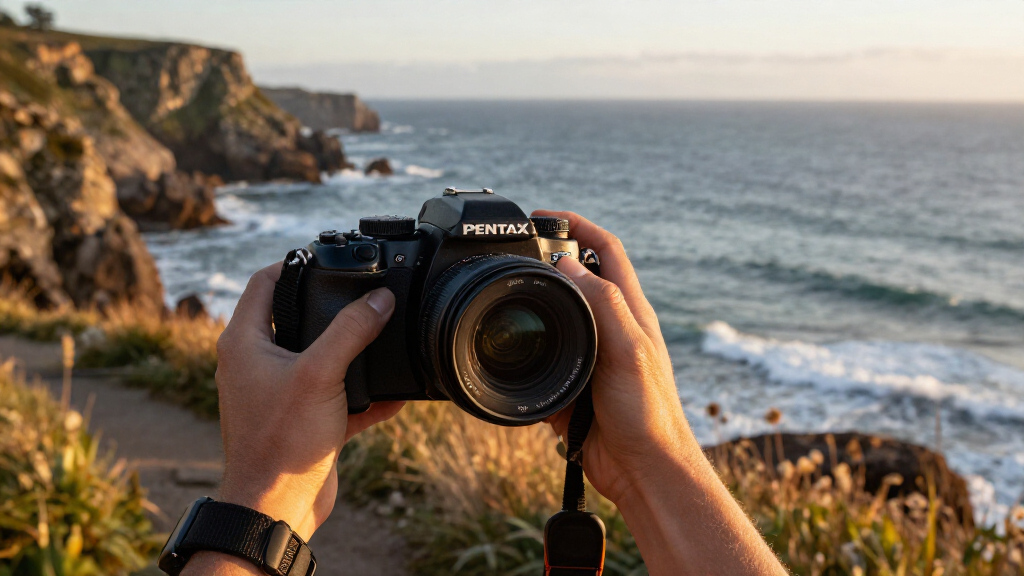

The Pentax K-5 II is my best overall pick for a versatile digital camera, pairing a weather-resistant body with an all-purpose zoom lens. For outdoor use, the WG-8 offers a purpose-built waterproof compact, while the PENTAX 17 is a distinctive choice for half-frame film photography. These options serve very different needs: DSLR control and lens flexibility, compact durability, or the slower, film-based process. Condition, lens compatibility, and the availability of support matter especially when comparing older and renewed models. Read on for the full breakdown of all 15 cameras and how I’d match each one to a buyer.

Prime made for students and young adults
- Fast, free delivery for dorm and study essentials
- Prime Video and Amazon Music included
- Member-only deals
Key Takeaways
- The K-5 II is the most balanced digital DSLR pick in this lineup because its weather-resistant design and included 18-135mm lens make it more versatile out of the box than body-only options.
- The WG-8, WG-90, and WG-1000 serve the rugged-compact niche; compare their specific feature sets and intended use rather than treating them as interchangeable waterproof cameras.
- The PENTAX 17 is a current-style film choice, while the K1000 and Spotmatic are manual-focus classics that ask for more hands-on operation and careful condition checks.
- The 645D and 645N represent different medium-format commitments: one is digital and high-resolution, while the other is a film body that requires compatible lenses and a film workflow.
- Several cameras are sold as bodies or renewed gear, so lens fit, battery availability, repair options, and included accessories can matter as much as the camera model.
| Pentax K-5 II DSLR Camera with DA 18-135mm WR Lens |  | Best Overall for Rugged DSLR Photography | Sensor: 16.3MP APS-C CMOS | Included lens: Pentax DA 18-135mm WR | Mount: Pentax K | VIEW LATEST PRICE | See Our Full Breakdown |
| Pentax WG-1000 Waterproof Digital Compact Camera, Olive |  | Best Value for Basic Waterproof Use | Sensor: 16MP CMOS, 1/2.3-inch | Optical zoom: 4× | Lens coverage: 27mm wide-angle | VIEW LATEST PRICE | See Our Full Breakdown |
| Asahi Pentax Spotmatic 35mm SLR Film Camera with Honeywell Lens |  | Best for Classic M42 Film Photography | Film format: 35mm | Lens mount: M42 screw mount | Included lens: Honeywell-branded; specifications depend on the included lens | VIEW LATEST PRICE | See Our Full Breakdown |
| Pentax K1000 Manual Focus 35mm SLR Film Camera with 50mm f/2 Lens (Renewed) |  | Best for Learning Manual Film Photography | Camera type: 35mm SLR film camera | Included lens: 50mm f/2 prime | Lens mount: Pentax K | VIEW LATEST PRICE | See Our Full Breakdown |
| PENTAX WG-90 Waterproof Compact Camera, Blue |  | Best Waterproof Compact for Macro and Cold Conditions | Sensor: 16MP back-illuminated CMOS, 1/2.3-inch | Optical zoom: 5× | Focal length: 5–25mm | VIEW LATEST PRICE | See Our Full Breakdown |
| PENTAX 17 Half-Frame 35mm Film Camera |  | Best for Roll-Stretching Film Shooters | Film format: 35mm half-frame | Image orientation: Vertical | Images per roll: Up to 72 | VIEW LATEST PRICE | See Our Full Breakdown |
| Pentax Q7 12.4 MP Mirrorless Camera with 5–15mm Lens, Silver |  | Best Pocketable Digital System | Sensor: 12 MP, 1/1.7-inch BSI CMOS | ISO range: 100–12800 | Lens: 5–15mm, maximum aperture f/2.8 | VIEW LATEST PRICE | See Our Full Breakdown |
| Pentax K-50 DSLR Camera with 18-55mm WR and 55-300mm Lenses |  | Best Weather-Sealed DSLR Kit | Sensor: 16.3 MP APS-C CMOS | Processor: PRIME M | Included lenses: 18–55mm WR and 55–300mm | VIEW LATEST PRICE | See Our Full Breakdown |
| Pentax 645N Medium-Format SLR Camera Body |  | Best for Large Film Negatives | Camera type: Medium-format SLR | Included item: Camera body only | Film formats: 120 and 220 | VIEW LATEST PRICE | See Our Full Breakdown |
| PENTAX WG-8 Green Waterproof Compact Adventure Camera |  | Best for Water and Rough Conditions | Effective still resolution: Approximately 20 MP | Sensor: 1/2.3-inch CMOS | Optical zoom: 5× | VIEW LATEST PRICE | See Our Full Breakdown |
| Pentax ME Super 35mm SLR Film Camera with 50mm Manual Focus K-Mount Lens (Renewed) |  | Best for Hands-On Film Beginners | Camera type: 35mm SLR film camera | Lens: 50mm manual-focus Pentax K-mount | Exposure modes: Aperture priority and manual | VIEW LATEST PRICE | See Our Full Breakdown |
| Pentax Zoom 105 R/Super 35mm Point-and-Shoot Film Camera with 38–105mm Zoom Lens |  | Best for Easy Film Snapshots | Film format: 35mm | Lens: 38–105mm, 2.8× power zoom | Focus: Active infrared autofocus with focus lock | VIEW LATEST PRICE | See Our Full Breakdown |
| Pentax Q Black Mirrorless Camera Kit with 02 Standard Zoom Lens |  | Best Pocketable Digital Interchangeable-Lens Pick | Sensor: 12.4 MP backlit CMOS, 1/2.3-inch | Lens: 02 Standard Zoom, 3×, 27.5–83mm equivalent | Lens mount: Pentax Q | VIEW LATEST PRICE | See Our Full Breakdown |
| Pentax 17 Half-Frame Film Camera Bundle with Kodak Gold 200 Film |  | Best for Stretching Film Rolls | Camera: 35mm half-frame film camera | Lens: 25mm f/3.5 fixed lens, 37mm equivalent | Focus: Six-zone focus, 0.25m to infinity | VIEW LATEST PRICE | See Our Full Breakdown |
| Pentax 645D 40MP Medium Format Digital SLR Camera (Body Only) |  | Best Premium Medium-Format DSLR | Sensor: 40 MP CCD, medium format | Image formats: Pentax PEF and Adobe DNG, 14-bit RAW | ISO range: 100–1600 | VIEW LATEST PRICE | See Our Full Breakdown |
| pentax camera | Weight | Sensor |
|---|---|---|
| Pentax K-5 II DSLR Camera with | 2.1 lb | 16.3MP APS-C CMOS |
| Pentax WG-1000 Waterproof Digi | 7.68 ounces | 16MP CMOS, 1/2.3-inch |
| Asahi Pentax Spotmatic 35mm SL | 1.8 pounds | — |
| Pentax K1000 Manual Focus 35mm | 1.7 pounds | — |
| PENTAX WG-90 Waterproof Compac | — | 16MP back-illuminated CMOS, 1/2.3-inch |
| PENTAX 17 Half-Frame 35mm Film | — | — |
| Pentax Q7 12.4 MP Mirrorless C | 7.2 ounces | 12 MP, 1/1.7-inch BSI CMOS |
| Pentax K-50 DSLR Camera with 1 | 5.1 lbs | 16.3 MP APS-C CMOS |
| Pentax 645N Medium-Format SLR | — | — |
| PENTAX WG-8 Green Waterproof C | — | 1/2.3-inch CMOS |
| Pentax ME Super 35mm SLR Film | 1.5 pounds | — |
| Pentax Zoom 105 R/Super 35mm P | — | — |
| Pentax Q Black Mirrorless Came | 6.4 ounces | 12.4 MP backlit CMOS, 1/2.3-inch |
| Pentax 17 Half-Frame Film Came | — | — |
| Pentax 645D 40MP Medium Format | 3.3 pounds | 40 MP CCD, medium format |
More Details on Our Top Picks
Pentax K-5 II DSLR Camera with DA 18-135mm WR Lens
I’d put the Pentax K-5 II first for buyers who want one camera for varied outdoor still photography. Its weather-sealed, cold-resistant body and included 18-135mm WR zoom make it more ready for changing conditions than the film-based K1000, while in-body stabilization helps steady shots with compatible lenses. The 16.3MP sensor, 11-point autofocus, and burst rate of up to 7 fps suit action and general-purpose shooting better than the compact WG-90. The tradeoff is an older DSLR experience: its fixed rear screen cannot tilt for awkward angles, and the supplied data does not specify built-in wireless features. At 2.1 pounds, it is also a heavier carry than either WG compact. I’d choose it for flexible digital shooting, not pocketable travel.
Pros:- Weather-sealed, dustproof, and cold-resistant body
- In-body image stabilization works with compatible lenses
- 7 fps continuous shooting supports action and moving subjects
- Included 18-135mm WR lens covers a broad range of everyday scenes
Cons:- Fixed LCD limits framing from high or low angles
- At 2.1 pounds, it is substantially heavier than the WG-90 and WG-1000
- Built-in wireless capability is not specified in the provided details
Best for: Outdoor photographers who want a weather-sealed digital Pentax DSLR, stabilization, and a versatile zoom in one kit.
Not ideal for: Travelers who prioritize a light, pocketable camera or buyers who need a tilting screen and clearly specified wireless connectivity.
- Sensor:16.3MP APS-C CMOS
- Included lens:Pentax DA 18-135mm WR
- Mount:Pentax K
- Image stabilization:In-body optical
- Autofocus:SAFOX X phase detection, 11 points
- Continuous shooting:Up to 7 fps
- Display:3-inch fixed LCD, 921,000 dots
- Video:Full HD 1080p
- Weight:2.1 lb
Our verdict“Choose the K-5 II if you want a rugged, flexible digital DSLR kit; pick a WG compact instead if portability and waterproof compact-camera handling matter more.”
Pentax WG-1000 Waterproof Digital Compact Camera, Olive
The Pentax WG-1000 is the straightforward pick for buyers who want a digital camera they can take into wet, dusty, or rough settings without carrying a DSLR. It is waterproof to 15 meters for up to one hour, dustproof, and rated to survive a two-meter fall; its included protector jacket and carabiner strap add practical protection and carrying options. Compared with the WG-90, it reaches slightly deeper underwater, but the WG-90 offers a longer 5× zoom, freezeproofing, and dedicated macro lighting. The WG-1000’s 4× zoom and 16MP sensor cover casual snapshots, though its digital stabilization is a less capable approach than the K-5 II’s in-body system. Its one-hour underwater limit also makes it less suited to extended submersion.
Pros:- Waterproof to 15 meters for up to one hour
- Dustproof body with shock protection for falls up to two meters
- Protector jacket and carabiner strap are included
- 4× optical zoom starts at a 27mm wide-angle equivalent
Cons:- Underwater operation is limited to one hour at a time
- Digital image stabilization is less capable than the K-5 II’s in-body system
- The 4× zoom is shorter than the WG-90’s 5× range
Best for: Casual outdoor users, families, and field workers who need a compact camera for wet or dusty outings and value the included protective accessories.
Not ideal for: Underwater photographers planning longer sessions or close-up shooters who want the WG-90’s macro LEDs and microscope mode.
- Sensor:16MP CMOS, 1/2.3-inch
- Optical zoom:4×
- Lens coverage:27mm wide-angle
- Video:1080p
- Display:2.7-inch LCD
- Weight:7.68 ounces
- Included accessories:Protector jacket and carabiner strap
Our verdict“Choose the WG-1000 for simple, accessory-ready waterproof snapshots, but favor the WG-90 for longer underwater use, macro work, or cold-weather outings.”
Asahi Pentax Spotmatic 35mm SLR Film Camera with Honeywell Lens
The Asahi Pentax Spotmatic suits film photographers who want deliberate, fully manual control and access to the M42 screw-mount lens system. Its mechanical shutter and manual focus make exposure choices direct, while the TTL stop-down meter provides an in-camera exposure reference. Unlike the digital K-5 II, it asks you to work with 35mm film and accept the wait and ongoing effort of film processing; in return, it offers a classic optical SLR experience rather than digital convenience. The included Honeywell-branded lens is a caveat: its exact model and capabilities may vary, so this kit is less predictable than the K1000 bundle with its specified 50mm f/2 lens. The Spotmatic is also not water resistant, making it a poor match for rough-weather assignments.
Pros:- Mechanical 35mm SLR with manual shutter, aperture, focus, and exposure controls
- Built-in TTL stop-down light meter
- M42 screw mount supports a range of compatible lenses
- Optical viewfinder offers 0.95× magnification
Cons:- Requires 35mm film and separate processing rather than digital capture
- Included Honeywell lens model and specifications may vary
- Not water resistant, unlike the WG-1000 and WG-90
Best for: Film learners and experienced analog shooters who want manual exposure control and an M42-mount camera for compatible vintage lenses.
Not ideal for: Buyers who need immediate digital results, dependable autofocus, weather protection, or a clearly specified included lens.
- Film format:35mm
- Lens mount:M42 screw mount
- Included lens:Honeywell-branded; specifications depend on the included lens
- Metering:TTL stop-down
- Viewfinder:Optical, 0.95× magnification
- Shutter:Mechanical
- Maximum shutter time:60 seconds
- Weight:1.8 pounds
- Warranty:90-day limited warranty
Our verdict“Choose the Spotmatic for manual M42 film photography, while the K1000 is the more predictable bundled-lens choice and the K-5 II is far more practical for digital work.”
Pentax K1000 Manual Focus 35mm SLR Film Camera with 50mm f/2 Lens (Renewed)
The Pentax K1000 is the clearest choice here for someone learning how shutter speed, aperture, and focus work together on a film SLR. Its 50mm f/2 lens is specified, which makes the kit easier to understand than the Spotmatic’s variable Honeywell lens bundle. The camera’s mechanical operation does not depend on a battery, though its built-in meter does need an LR44 or A76 cell. Its Pentax K mount also gives it a different lens path from the Spotmatic’s M42 system. This is a teaching-oriented camera, not a convenient all-purpose alternative to the digital K-5 II: there is no autofocus, no built-in flash, and no water resistance. Buyers should also account for film and processing as part of using it.
Pros:- Mechanical operation works without a battery
- Included 50mm f/2 prime lens has specified focal length and maximum aperture
- Manual controls offer a direct way to learn exposure
- Pentax K mount supports a range of compatible lenses
Cons:- Built-in light meter requires a separate LR44 or A76 cell
- No built-in flash
- Not water resistant and requires film processing
Best for: Students and first-time film SLR buyers who want a simple manual camera with a known 50mm prime lens and a Pentax K mount.
Not ideal for: Photographers who need autofocus, weather protection, a built-in flash, or digital capture and quick file transfer.
- Camera type:35mm SLR film camera
- Included lens:50mm f/2 prime
- Lens mount:Pentax K
- Operation:Manual, mechanical
- Light meter battery:One LR44 or A76 cell
- Shutter speed range:1/1000 second to 30 seconds
- Viewfinder:Optical, 1.0× magnification
- Flash:No built-in flash
- Weight:1.7 pounds
Our verdict“Choose the K1000 for a more clearly specified, approachable manual film kit than the Spotmatic; choose the K-5 II if you want digital capture and autofocus.”
PENTAX WG-90 Waterproof Compact Camera, Blue
The Pentax WG-90 is the more versatile adventure compact for buyers who want close-up capability as well as protection from water and cold. It can operate underwater to 14 meters for up to two hours, withstand falls up to 1.6 meters, and work down to -10°C. Six Macro LEDs, a Digital Microscope mode, and focusing as close as 1cm with the included stand make tiny subjects easier to illuminate and frame than with the WG-1000. Its 5× optical zoom also reaches farther than that model’s 4× zoom, though the WG-1000 has a slightly greater stated waterproof depth and higher fall tolerance. The WG-90 remains a compact with a small 2.7-inch screen and digital stabilization, not a substitute for the K-5 II’s DSLR handling or in-body stabilization.
Pros:- Waterproof to 14 meters for up to two hours and freezeproof to -10°C
- Six Macro LEDs illuminate close-up subjects
- Digital Microscope mode and 1cm focusing support detailed macro work
- 5× optical zoom extends farther than the WG-1000’s 4× zoom
Cons:- The 2.7-inch LCD offers limited viewing area
- Digital image stabilization is specified rather than in-body stabilization
- Waterproof depth and drop rating are slightly lower than the WG-1000’s stated limits
Best for: Hikers, snorkelers, and nature photographers who want a rugged compact with dedicated lighting for close-up subjects and freezeproof operation.
Not ideal for: Buyers who need a large viewing screen, DSLR-level handling, or the greatest stated waterproof depth and drop resistance in this lineup.
- Sensor:16MP back-illuminated CMOS, 1/2.3-inch
- Optical zoom:5×
- Focal length:5–25mm
- Operating temperature:Down to -10°C
- Macro lighting:Six LED Macro Lights
- Minimum macro focusing distance:1cm with included Macro Stand
- Video:Full HD, H.264
Our verdict“Pick the WG-90 for rugged close-ups and cold-weather outings, but choose the WG-1000 if its greater stated depth and drop ratings matter more.”
PENTAX 17 Half-Frame 35mm Film Camera
The PENTAX 17 makes each standard 35mm roll go further: its half-frame format captures up to 72 vertical images, a distinctive advantage over the full-frame Pentax 645N, which uses larger 120 or 220 film for bigger negatives rather than more shots per roll. Its 25mm f/3.5 lens gives a 37mm-equivalent view, while automatic exposure keeps operation approachable for people who want film without managing every setting. Focus is less hands-off: the six-zone system asks you to choose a distance mark, so close subjects and quick moments demand a little attention. A manual winding lever adds tactile involvement, and the magnesium-alloy body stays light, but this camera has no weather protection. I’d pick it for everyday film carry, not for large negatives or rough-weather outings.
Pros:- Half-frame capture allows up to 72 images on a standard 35mm roll.
- Automatic exposure lowers the barrier for casual film photography.
- Light magnesium-alloy body and manual advance lever give it a portable, tactile feel.
- Six-zone focus offers choices for different subject distances.
Cons:- Zone focusing requires estimating subject distance and selecting the matching mark.
- The camera is not water resistant.
- Vertical half-frame framing is less suited to photographers who prefer conventional horizontal 35mm compositions.
Best for: Film newcomers and everyday shooters who want a compact 35mm camera that stretches each roll to as many as 72 vertical frames.
Not ideal for: Photographers who need weather protection, full-frame 35mm composition, or the larger negatives and interchangeable-lens flexibility of a medium-format SLR.
- Film format:35mm half-frame
- Image orientation:Vertical
- Images per roll:Up to 72
- Lens:25mm f/3.5 (37mm equivalent), HD-coated
- Focus system:Six-zone zone focus
- Exposure control:Automatic
- Film advance:Manual lever
- Maximum shutter speed:1/2000 second
- Body material:Magnesium alloy
Our verdict“Choose the PENTAX 17 if you want an approachable, lightweight film camera that yields many frames per roll and are comfortable with vertical half-frame images.”
Pentax Q7 12.4 MP Mirrorless Camera with 5–15mm Lens, Silver
The Pentax Q7 is the lineup’s small digital option, weighing just 7.2 ounces and pairing a 12 MP sensor with RAW capture and sensor-shift stabilization. That combination gives a small-camera owner more editing latitude and steadier handheld stills than a basic compact might offer, while the 5–15mm f/2.8 lens keeps the kit self-contained. Compared with the APS-C Pentax K-50, though, the Q7’s 1/1.7-inch sensor is a clear limit for low-light image quality and shallow depth of field. Its fixed, modest-resolution LCD also makes framing less flexible than a tilting screen would. I’d choose it for portability and RAW-friendly casual shooting, not as a substitute for a larger-sensor DSLR or a modern video-focused camera.
Pros:- Very light 7.2-ounce body is easy to carry throughout the day.
- Sensor-shift stabilization helps reduce blur in handheld stills.
- 12-bit DNG RAW and RAW plus JPEG options support later editing.
- Built-in flash and 1080p video make it a versatile compact kit.
Cons:- The 1/1.7-inch sensor is much smaller than the K-50’s APS-C sensor.
- Fixed 460,000-dot LCD cannot tilt for low or high-angle framing.
- Continuous shooting tops out at 5 fps.
Best for: Travelers and casual digital shooters who prioritize a very light interchangeable-lens-style kit, RAW files, and stabilization over large-sensor image quality.
Not ideal for: Photographers who often shoot in dim light, want a tilting display, or expect DSLR-level image quality and subject separation.
- Sensor:12 MP, 1/1.7-inch BSI CMOS
- ISO range:100–12800
- Lens:5–15mm, maximum aperture f/2.8
- Image stabilization:Sensor-shift
- Continuous shooting:Up to 5 fps
- Video:1080p at 30 fps, MPEG-4/H.264
- Display:3-inch fixed TFT LCD, 460,000 dots
- File formats:12-bit DNG RAW, JPEG
- Weight:7.2 ounces
Our verdict“Pick the Q7 for a lightweight, RAW-capable Pentax digital kit, but choose an APS-C model such as the K-50 when image quality matters more than size.”
Pentax K-50 DSLR Camera with 18-55mm WR and 55-300mm Lenses
For buyers who want a conventional Pentax DSLR with broad reach straight away, the K-50 two-lens kit covers an equivalent 27–460mm range and pairs its 16.3 MP APS-C sensor with a weather-sealed body. That makes it a more practical outdoor all-rounder than the tiny Pentax Q7: the K-50 offers a larger sensor, a longer telephoto option, and lenses suited to everything from wide scenes to distant subjects. Its 11-point autofocus and burst rate up to 6 fps also support action, though neither makes it a specialist sports body. The tradeoff is substantial carry weight at 5.1 pounds, plus a fixed screen and Full HD rather than 4K video. I’d rank it as the strongest all-purpose DSLR choice here for outdoor stills, provided the buyer accepts the bulk.
Pros:- Weather-sealed body and WR standard zoom are suited to challenging outdoor conditions.
- Two included lenses cover an equivalent 27–460mm range.
- APS-C sensor offers a larger imaging area than the Pentax Q7’s 1/1.7-inch sensor.
- Up to 6 fps continuous shooting and 11-point autofocus support moving subjects.
Cons:- At 5.1 pounds, the camera and kit are cumbersome for extended travel.
- The fixed LCD limits framing from unusual angles.
- Video is Full HD, not 4K.
Best for: Outdoor photographers who want an APS-C DSLR, weather-sealed construction, and two lenses spanning landscapes, everyday scenes, and distant subjects.
Not ideal for: Travelers seeking a light kit, vloggers who need an articulating screen, or buyers whose priority is 4K video.
- Sensor:16.3 MP APS-C CMOS
- Processor:PRIME M
- Included lenses:18–55mm WR and 55–300mm
- 35mm-equivalent focal length:27–460mm
- Autofocus:11 points, including nine cross-type sensors
- Continuous shooting:Up to 6 fps
- Video:Full HD 1080p up to 30 fps
- Body:Weather-sealed polycarbonate with stainless steel chassis
- Weight:5.1 lbs
Our verdict“Choose the K-50 kit for weather-sealed outdoor still photography and wide focal-length coverage if you can live with a heavy DSLR setup.”
Pentax 645N Medium-Format SLR Camera Body
The Pentax 645N serves a different purpose from the PENTAX 17: it uses 120 or 220 film to create 6 × 4.5 cm negatives, favoring detailed enlargements over the 17’s high frame count on a standard 35mm roll. Auto and manual focus and exposure modes give the photographer room to choose between convenience and direct control, while the optical viewfinder keeps the experience rooted in SLR shooting. This is the pick for deliberate portrait, landscape, or studio work—not casual pocket carry. The main catch is that this listing is a body only, so buyers need a compatible lens before making photographs. It is also not water resistant, and medium-format film brings a slower, more considered workflow than the K-50’s digital capture.
Pros:- 120 and 220 film produce large 6 × 4.5 cm negatives.
- Auto and manual focus modes accommodate different shooting preferences.
- Auto and manual exposure modes offer a choice between convenience and control.
- Optical viewfinder supports a direct SLR-style shooting experience.
Cons:- Camera body only; a compatible lens is not included.
- Film workflow is less convenient for high-volume shooting than the digital K-50.
- Not water resistant.
Best for: Film photographers who already have access to compatible lenses and want medium-format negatives for detailed portraits, landscapes, or enlargements.
Not ideal for: Beginners who need a complete camera kit, fast high-volume shooting, weather protection, or the convenience of digital capture.
- Camera type:Medium-format SLR
- Included item:Camera body only
- Film formats:120 and 220
- Negative size:6 × 4.5 cm
- Focus modes:Auto and manual
- Exposure modes:Auto and manual
- ISO range:100–3200
- Viewfinder:Optical
- Water resistance:Not water resistant
Our verdict“Choose the 645N if large medium-format film negatives are your priority and you already have a compatible lens; skip it if you need a ready-to-shoot kit.”
PENTAX WG-8 Green Waterproof Compact Adventure Camera
The PENTAX WG-8 is the clear choice for adventures where a camera needs protection more than a large sensor. Its waterproof rating to 20 meters, resistance to falls up to 2.1 meters, and operation down to -10°C make it more suited to wet, cold, and rough outings than the weather-sealed K-50, though the DSLR offers a larger APS-C sensor and interchangeable lenses. The WG-8 instead keeps things simple with a 5× optical zoom, approximately 20 MP stills, 4K video, and a six-bulb macro ring light for close-ups. Its 1/2.3-inch sensor is a notable image-quality compromise, especially compared with the K-50, and its webcam feature requires a computer connection. I’d choose it for outdoor documentation and underwater use, not for low-light work or maximum detail.
Pros:- Waterproof to 20 meters, shock-resistant to falls up to 2.1 meters, and rated for operation down to -10°C.
- Records 4K video and captures approximately 20 MP stills.
- 5× optical zoom starts at a 28mm wide-angle view.
- Six-bulb macro ring light helps illuminate close subjects.
Cons:- The 1/2.3-inch sensor is small compared with the K-50’s APS-C sensor.
- Webcam functionality requires a connection to a computer.
- The compact zoom system does not offer the lens flexibility of the K-50.
Best for: Hikers, snorkelers, and outdoor workers who need a compact camera that can handle submersion, impacts, cold weather, and close-up subjects.
Not ideal for: Photographers prioritizing low-light performance, shallow depth of field, interchangeable lenses, or the larger sensor of the K-50.
- Effective still resolution:Approximately 20 MP
- Sensor:1/2.3-inch CMOS
- Optical zoom:5×
- Wide-angle coverage:28mm
- Video:4K (2160p)
- Waterproof depth:20 meters
- Shock resistance:Falls up to 2.1 meters
- Operating temperature:Down to -10°C
- Special features:Six-bulb variable-brightness LED ring light, webcam function, GPS, and digital compass
Our verdict“Pick the WG-8 when waterproofing, impact resistance, and cold-weather operation matter more than large-sensor image quality.”
Pentax ME Super 35mm SLR Film Camera with 50mm Manual Focus K-Mount Lens (Renewed)
The Pentax ME Super is a sensible entry into manual-focus 35mm photography for someone who wants control without giving up every convenience. Its included 50mm K-mount lens and aperture-priority mode let you choose depth of field while the camera handles shutter speed; switch to manual when you want fuller control. Compared with the automatic Pentax Zoom 105 R, this SLR asks more of the photographer but gives a more direct connection to exposure and lens handling. It is also a more straightforward choice than the half-frame Pentax 17 if standard 35mm framing and interchangeable K-mount lens compatibility matter. The tradeoff is film-era friction: you need to buy and process 35mm film, and the camera is not weather-resistant. This renewed example also calls for checking condition and sourcing its batteries.
Pros:- Includes a 50mm manual-focus Pentax K-mount lens
- Aperture-priority mode offers a gentler start than fully manual exposure
- Manual controls allow adjustment of shutter speed, ISO, and aperture
- Compact 1.5-pound body is easier to carry than the Pentax 645D
Cons:- Requires 35mm film and separate development or scanning
- Not water resistant
- Alkaline batteries are not included, and renewed condition may vary
Best for: New film photographers who want a compact SLR, a standard 50mm lens, and a gradual path from aperture-priority shooting to manual exposure.
Not ideal for: People who want digital previews, autofocus, weather protection, or a ready-to-shoot setup without sourcing film and batteries.
- Camera type:35mm SLR film camera
- Lens:50mm manual-focus Pentax K-mount
- Exposure modes:Aperture priority and manual
- Film format:35mm
- Weight:1.5 pounds
- Viewfinder:Optical, 0.95× magnification
- Condition:Renewed
- Water resistance:Not water resistant
Our verdict“Choose the ME Super if you want a relatively light, standard-format film SLR with both aperture-priority and manual exposure control.”
Pentax Zoom 105 R/Super 35mm Point-and-Shoot Film Camera with 38–105mm Zoom Lens
The Pentax Zoom 105 R/Super suits film shooters who would rather frame and shoot than manage exposure or focus. Its 38–105mm power zoom covers wider everyday scenes through tighter portraits, while autofocus, built-in flash, and motorized film handling reduce the number of decisions between moments. That makes it simpler to pick up than the manual-focus Pentax ME Super, but the convenience comes with less creative control: exposure is automatic, and the ISO range tops out at 400. Dedicated macro and super-macro modes add close-up options the ME Super does not provide out of the box, though this compact is not a substitute for an interchangeable-lens system. Like the Pentax 17, it keeps film photography approachable, but uses standard full-frame 35mm frames rather than half-frame economy. It is not water-resistant, so keep it dry.
Pros:- 38–105mm zoom covers wide-to-telephoto everyday framing
- Active infrared autofocus includes focus lock
- Built-in flash offers multiple settings
- Automatic loading, advance, and rewind simplify film use
Cons:- Automatic exposure gives less direct control than the Pentax ME Super
- ISO range is limited to 100–400
- Not water resistant
Best for: Casual film photographers who want autofocus, a useful zoom range, built-in flash, and automatic film advance for family outings and travel.
Not ideal for: Manual-control enthusiasts, photographers who need a broad film-speed range, or anyone seeking a weather-resistant camera.
- Film format:35mm
- Lens:38–105mm, 2.8× power zoom
- Focus:Active infrared autofocus with focus lock
- Exposure control:Automatic
- ISO range:100–400
- Flash:Built-in, multiple settings
- Film transport:Automatic loading, motorized advance and rewind
- Additional features:Macro and super-macro modes, self-timer, exposure compensation
- Water resistance:Not water resistant
Our verdict“Pick the Zoom 105 R/Super for straightforward full-frame film photography when autofocus and a built-in zoom matter more than manual control.”
Pentax Q Black Mirrorless Camera Kit with 02 Standard Zoom Lens
For buyers who want a tiny digital camera rather than another film body, the Pentax Q stands apart in this group. At 6.4 ounces, it is far easier to carry than the 3.3-pound Pentax 645D, and its interchangeable Q-mount system gives it more lens flexibility than a fixed-lens compact. The included 02 zoom spans a 27.5–83mm equivalent range, while sensor-shift stabilization can help steady handheld shots. It also records DNG RAW and 1080p video, adding flexibility the film-based Pentax ME Super and Pentax 17 cannot offer. The main compromise is its 1/2.3-inch sensor, which is much smaller than the 645D’s medium-format sensor and limits the case for demanding image quality. Its fixed rear screen and modest kit zoom range also keep it from being a broad-purpose system camera.
Pros:- Exceptionally light 6.4-ounce body
- Interchangeable Pentax Q-mount lenses offer expansion beyond the kit zoom
- Sensor-shift image stabilization supports steadier handheld shooting
- Records DNG RAW files and 1080p video
Cons:- Small 1/2.3-inch sensor is less suited to demanding image-quality needs than the Pentax 645D
- Fixed display does not tilt for low- or high-angle framing
- Included zoom has a limited 3× range
Best for: Travelers and casual digital shooters who prioritize a very small interchangeable-lens camera with RAW capture and basic Full HD video.
Not ideal for: Photographers prioritizing large-sensor image quality, a tilting screen, extensive lens reach, or serious action shooting.
- Sensor:12.4 MP backlit CMOS, 1/2.3-inch
- Lens:02 Standard Zoom, 3×, 27.5–83mm equivalent
- Lens mount:Pentax Q
- Image stabilization:Sensor-shift
- Image formats:DNG, JPEG, RAW
- Video:1080p at 30 fps
- Display:3-inch fixed display, 460,000 dots
- Weight:6.4 ounces
Our verdict“Choose the Pentax Q if carrying a tiny digital interchangeable-lens camera matters more to you than large-sensor performance.”
Pentax 17 Half-Frame Film Camera Bundle with Kodak Gold 200 Film
The Pentax 17 is the clearest pick here for photographers who want a current-style film experience and more frames from each roll. Its half-frame format fits two vertical images in the space of one standard 35mm frame, giving up full-frame image area to make a roll go further. The fixed 25mm f/3.5 lens, six-zone focus, and six shooting modes keep operation more approachable than the manual-focus Pentax ME Super, while ISO settings from 50 to 3200 and exposure compensation provide room to adapt. Unlike the automatic Zoom 105 R/Super, it offers hands-on exposure adjustments, but no zoom or autofocus. This bundle includes Kodak Gold 200 film and a CR2 battery, which makes setup easier than with the renewed ME Super; the fixed lens and lack of weather protection remain real limits.
Pros:- Half-frame design can provide about 48 exposures from a 36-exposure roll
- Six shooting modes and zone focus offer a simpler start than fully manual SLR operation
- ISO range of 50–3200 and ±2 EV exposure compensation provide useful control
- Bundle includes Kodak Gold 200 film and a CR2 battery
Cons:- Fixed 25mm lens cannot zoom or change focal length
- Half-frame negatives are smaller than standard 35mm frames
- Not water resistant
Best for: Film-curious travelers and everyday shooters who want a compact camera, straightforward focusing zones, and more exposures per 35mm roll.
Not ideal for: Photographers who need interchangeable lenses, autofocus, weather sealing, or standard full-frame 35mm images.
- Camera:35mm half-frame film camera
- Lens:25mm f/3.5 fixed lens, 37mm equivalent
- Focus:Six-zone focus, 0.25m to infinity
- ISO range:50–3200
- Exposure compensation:±2 EV
- Shutter speeds:1/350 to 4 seconds
- Shooting modes:6
- Viewfinder:Optical Albada bright-frame
- Included film and battery:Kodak Gold 200 color negative film, 3-pack; CR2 3V lithium battery
Our verdict“Pick the Pentax 17 if you want a compact, approachable film camera that makes each roll last longer and do not need lens changes.”
Pentax 645D 40MP Medium Format Digital SLR Camera (Body Only)
The Pentax 645D is the specialist choice for deliberate, detail-focused photography, not the general-purpose body for most buyers. Its 40MP medium-format CCD sensor, 14-bit RAW support, and weather-sealed, coldproof construction favor landscape, studio, and field work where large files and rugged handling matter more than speed. Compared with the compact Pentax Q, it is a much larger and more serious system; compared with the film-based Pentax 645N, it brings digital capture and dual SD/SDHC slots. But the body weighs 3.3 pounds, shoots at only 1.1 frames per second, and has a fixed rear LCD. It is sold body-only, so buyers need a compatible 645AF2 lens. For action, casual travel, or anyone wanting a lightweight camera, the Q or a smaller Pentax DSLR is a more practical fit.
Pros:- 40MP medium-format CCD sensor supports detailed image capture
- Weather-sealed, coldproof body suits challenging field conditions
- Two SD/SDHC card slots provide additional storage flexibility
- Supports PEF and DNG 14-bit RAW formats and compatible 645 lenses
Cons:- Heavy 3.3-pound body is far less portable than the Pentax Q
- Continuous shooting tops out at 1.1 frames per second
- Body-only package requires a separate compatible lens
Best for: Landscape, studio, and fine-art photographers who want high-resolution medium-format digital files, rugged construction, and compatibility with Pentax 645 lenses.
Not ideal for: Action photographers, frequent travelers seeking a light kit, or buyers without a compatible 645AF2 lens.
- Sensor:40 MP CCD, medium format
- Image formats:Pentax PEF and Adobe DNG, 14-bit RAW
- ISO range:100–1600
- Autofocus:11-point SAFOX IX+
- Continuous shooting:Up to 1.1 fps
- Shutter speed:1/4000 to 30 seconds
- Memory card slots:2 SD/SDHC
- Mount:Pentax 645AF2
- Weight:3.3 pounds
Our verdict“Choose the 645D for considered medium-format work where resolution and ruggedness outweigh portability and shooting speed.”
How We Picked
I ranked these 15 Pentax cameras by how well each serves a clear buyer need, not by treating unlike formats as direct substitutes. My main criteria were practical image-making capability, handling, durability, lens or film flexibility, and how much a buyer needs to source separately. I also weighed the role of each camera: a waterproof compact should be judged on its rugged-use fit, while a medium-format body must make sense for a buyer prepared for a larger, more specialized system.
The K-5 II leads as the most balanced digital option because it arrives with a versatile weather-resistant zoom and suits a broad range of photography. The WG compacts rank as specialized choices rather than DSLR replacements; film cameras are separated by their shooting style and format, and the 645 models rank for dedicated medium-format users. I treat body-only, renewed, and vintage listings with extra caution: the camera’s potential is only part of the decision when condition, compatible accessories, and ongoing support affect whether it is practical to use.
Factors to Consider When Choosing Best Pentax Cameras
Before choosing among Pentax cameras, decide what kind of photography you want to make and what work you are willing to do around the camera. The lineup spans digital DSLRs, small-sensor mirrorless models, waterproof compacts, 35mm film cameras, and medium format, so a familiar model name does not mean a similar experience.
Choose the format before comparing individual models
A DSLR, a waterproof compact, and a film camera solve different problems, so start with the process you want rather than a single specification. Digital bodies give you immediate image review and avoid the recurring task of buying and developing film. Film models can suit a deliberate, tactile approach, but the cost and availability of film, processing, and repair support belong in the total ownership plan. Medium format is a more specialized commitment, with larger files or film negatives and a workflow that can demand more storage, scanning, or editing time. A common mistake is choosing a film camera for its appeal without checking whether you want manual exposure and focus. Match the format to your real shooting habits, not just the camera’s reputation.
Check the lens system and what the listing includes
Lens compatibility shapes what a camera can do long after the first purchase. A kit zoom offers a simple start, while a body-only listing may leave you needing to find a compatible lens, cap, charger, or other parts. Older Pentax bodies can work with particular K-mount or other system lenses, but compatibility and available functions vary, so verify the exact lens and body pairing before buying. Do not assume that every lens in a mount family will autofocus or meter in the same way on every body. If you already own lenses, check the camera’s mount and the functions you need; if not, compare the included lens against the subjects you shoot. That can make a less feature-rich kit a more practical choice than a bare body.
Treat condition and support as part of the camera choice
Vintage and renewed cameras need a different buying checklist from current-use digital gear. Ask about shutter operation, meter accuracy, light seals, battery compartment condition, fungus, and whether the seller has tested the camera’s key functions. Film cameras can appear usable while still needing a light-seal replacement or service, and those repairs may be difficult to arrange locally. For a digital body, check that batteries, chargers, cards, and any proprietary accessories are available and included as promised. A renewed label does not by itself explain what was repaired or tested, so seek clear condition details and a return option. When reliability matters more than collecting, a well-documented camera is often a safer choice than a more famous model with unknown history.
Pay for ruggedness only when your shooting calls for it
Waterproof compacts make sense when you want a camera for wet, dusty, or active settings without carrying a lens kit. Their sealed construction and compact form trade away the sensor size, lens flexibility, and direct control available on a DSLR. Think about how the camera will be used: casual travel, water activities, and work in rough conditions are not the same demand, and a waterproof rating does not remove the need to follow care instructions. Do not buy a rugged model simply because it sounds more durable if most pictures will be made in controlled settings. Conversely, a standard interchangeable-lens camera is a poor substitute when you need a small camera that can go into wet environments. The right choice depends on the conditions you will actually face.
Compare ownership burden, not just image-making potential
A camera’s full commitment includes lenses, film, storage, processing, maintenance, and how easy it is to carry. The 645 options suit buyers who have a specific reason to work in medium format, not someone seeking the simplest everyday camera. A small mirrorless model or compact may be easier to bring along, though older systems can still require extra research into batteries and accessories. Digital DSLRs provide a more flexible route for varied subjects, but a second lens adds weight and cost beyond the camera body. Before choosing, list the equipment and services you will need in the first year. This keeps a tempting body-only or vintage purchase from becoming an incomplete setup.
Frequently Asked Questions
Which Pentax camera is the safest all-around choice in this lineup?
I’d start with the Pentax K-5 II with the DA 18-135mm WR lens if you want one digital camera for varied subjects. The included zoom covers a useful range, and the weather-resistant pairing suits outdoor use better than a bare body with no lens. It is still an older DSLR, so check the camera’s condition and confirm that its battery, charger, and other included items are in working order. Choose a WG compact instead if waterproof portability matters more than lens choice, or a film camera if the analog process is the main draw.
Should I buy a Pentax DSLR kit or a waterproof WG compact?
Choose a DSLR kit when you want interchangeable lenses, more room to shape your setup, and a camera for a wider range of subjects. A WG compact makes more sense when a small, rugged camera is the priority and you expect wet or rough conditions. The tradeoff is that a compact cannot match a DSLR’s lens flexibility, while a DSLR kit is bulkier and is not a replacement for a waterproof camera. Compare the exact WG model and its stated capabilities rather than assuming all three WG options are identical. If you rarely shoot near water, the DSLR may be the more versatile everyday tool.
Is the PENTAX 17 a better first film camera than a vintage K1000?
It depends on whether you prefer a more modern half-frame film experience or a classic manual-focus SLR approach. The PENTAX 17 gives you a distinctive format, while the K1000 asks you to take a more hands-on role and needs a suitable lens. Half-frame changes how many exposures you get from a roll and affects how images are framed and viewed, so it is not simply a smaller version of standard 35mm shooting. A vintage K1000 may also need service or new light seals, especially if its condition is unclear. Pick based on the shooting process you want, and confirm what accessories and testing are included.
What should I check before buying a used or renewed Pentax camera?
Ask for a clear description of working condition, including shutter, focusing, metering, controls, ports, and any signs of moisture or impact damage. On film models, check the light seals, film advance, rewind, and battery compartment; on digital models, check battery health, card compatibility, screen condition, and included charger. Confirm the lens mount and whether the listing includes a usable lens, since several choices here are body-only or depend on older system accessories. For renewed equipment, ask what was serviced and what testing was completed rather than relying on the label alone. A return policy and a seller who can answer specific questions reduce the risk of a camera that needs immediate repair.
Does a Pentax 645 camera make sense for general travel and everyday photography?
For most everyday travel, I would choose a more portable DSLR, compact, or mirrorless option from this lineup. The 645N is a film medium-format body, while the 645D is a digital medium-format body, so each brings a distinct workflow and accessory needs. Their appeal is strongest when you have a clear reason to work in medium format and are prepared for a larger, more specialized setup. A body-only 645 listing also means you must verify compatible lenses and other required equipment before you can shoot. If portability and quick, casual use lead your priorities, these models are likely more camera than you need.
Conclusion
For most buyers seeking one versatile digital Pentax, I recommend the K-5 II with the 18-135mm WR lens as the best overall choice. The K-50 two-lens kit is my best value-style option for someone who wants a broader focal range in the box, provided the used camera and included gear check out. For a premium, specialized direction, choose the 645D if digital medium format fits your work; the 645N is the film alternative for dedicated medium-format photographers. Beginners drawn to film should compare the PENTAX 17 with the K1000 and pick the shooting style they are ready to learn, while buyers who want a simple rugged camera should look at the WG-8, WG-90, or WG-1000. The best Pentax camera is the one whose format, condition, and accessory needs fit the way you actually plan to shoot.