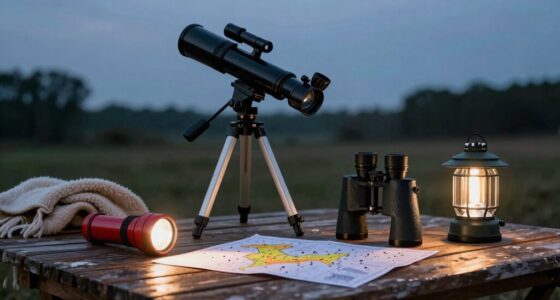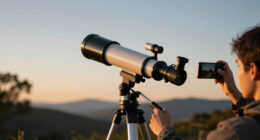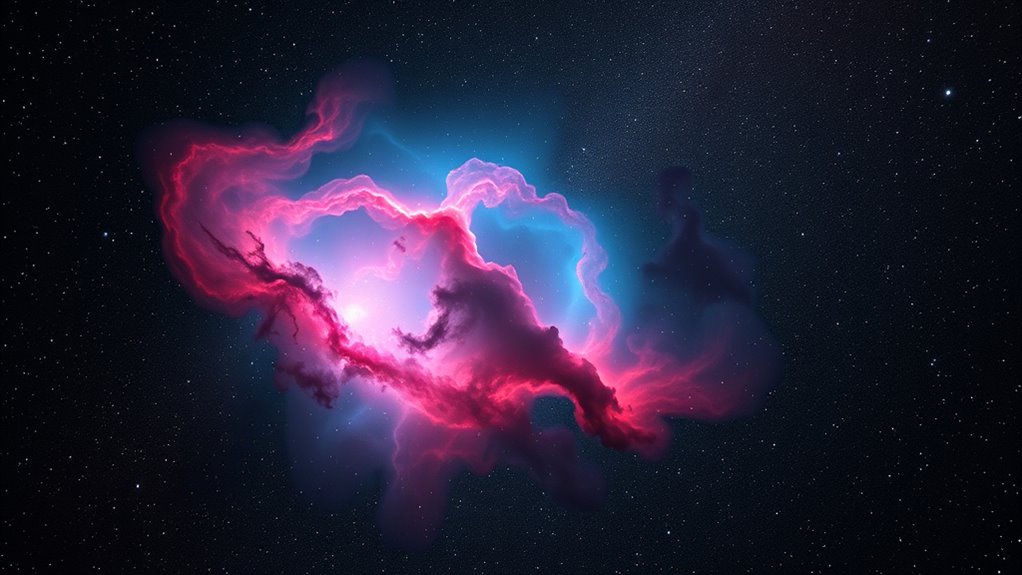
To capture stunning images of the Lagoon and Trifid Nebulae, you need precise equipment calibration, ensuring your mount is accurately aligned with the celestial pole and your focus is sharp. Use long exposures with proper tracking, possibly aided by autoguiding, and take multiple frames to increase detail. Don’t forget calibration frames like darks and flats for cleaner images. Mastering these steps will help you reveal their vibrant colors and intricate structures—what’s next could take your astrophotography even further.

Prime made for students and young adults
- Fast, free delivery for dorm and study essentials
- Prime Video and Amazon Music included
- Member-only deals
Key Takeaways
- Properly align your mount’s polar axis with the celestial pole for accurate long-exposure imaging.
- Use star alignment routines and autoguiding to maintain precise tracking during imaging sessions.
- Take multiple long exposures with calibration frames (dark, flat, bias) to enhance faint nebula details.
- Focus carefully with tools like a Bahtinov mask to ensure sharp images of the nebulae.
- Post-process stacked images to bring out the vibrant colors and intricate structures of the Lagoon and Trifid Nebulae.

Capturing the Lagoon and Trifid Nebulae offers a rewarding challenge for amateur astrophotographers enthusiastic to explore the depths of the night sky. These stunning objects, located in Sagittarius, are perfect targets for deep sky imaging, which involves capturing faint, distant celestial features that require careful planning and precise equipment setup. To get the best results, you’ll need to start with thorough telescope calibration. Proper calibration ensures your images are sharp, free of artifacts, and accurately represent the nebulae’s intricate details. It involves aligning your mount precisely, balancing your telescope, and ensuring your camera settings are optimized for low-light conditions.
Calibrate your telescope thoroughly for sharp, artifact-free images of the Lagoon and Trifid Nebulae.
Before you even begin imaging, you must calibrate your telescope to account for all mechanical and optical imperfections. This process includes aligning the mount’s polar axis with the celestial pole, which is essential for long exposures. Use a star alignment routine to fine-tune your mount’s tracking accuracy. When your mount is aligned correctly, it can follow the stars smoothly across the sky, minimizing star trails and blurring in your images. Calibration also involves focusing your camera precisely, often using a Bahtinov mask, to achieve pinpoint stars across your frame—crucial for high-quality deep sky imaging. Additionally, understanding your imaging scale helps you choose the right focal length and camera sensor combination for capturing detailed nebula structures.
Once your equipment is calibrated, you’re ready to set up your camera for capturing the Lagoon and Trifid Nebulae. These objects emit faint light, so you’ll need to use long exposure times to gather enough photons. During your session, keep an eye on your calibration and guiding accuracy—any drift can compromise your image quality. Using autoguiding systems can help maintain precise tracking over extended periods, which is essential for capturing detailed structures within these nebulae.
Additionally, take multiple exposures to improve your signal-to-noise ratio. Stacking these images during post-processing will reveal the nebulae’s vibrant colors and complex structures more clearly. Remember to also take calibration frames—dark frames, flat fields, and bias frames—to correct for sensor noise, vignetting, and dust on your lens or sensor. These steps are essential in deep sky imaging and help produce clean, professional-looking results.
Bahtinov mask for telescope focusing
As an affiliate, we earn on qualifying purchases.
As an affiliate, we earn on qualifying purchases.
Frequently Asked Questions
What Equipment Is Best for Astrophotography of These Nebulae?
For astrophotography of the Lagoon and Trifid Nebulae, your equipment selection should include a good-quality telescope. Refractors or reflector telescopes with a fast focal ratio (around f/4 to f/6) work best, as they gather more light. Pair it with a sturdy mount, preferably equatorial, to track objects accurately. Use a DSLR or dedicated astro camera, and consider filters to enhance details and reduce light pollution.
When Is the Optimal Time to Observe the Lagoon and Trifid Nebulae?
You’ll find the Lagoon and Trifid Nebulae best visible from late spring to early fall, when their seasonal visibility peaks. Avoid bright moon phases, especially full moons, as they wash out the faint details. Aim for a new moon or a thin crescent moon for clearer skies. Clear, dark nights maximize your chances—so plan your observations around moon phases and the most suitable seasons for stunning astrophotography.
How Can I Improve My Astrophotography Results in Low Light Conditions?
To improve your astrophotography results in low light conditions, focus on reducing light pollution by choosing dark sky locations or using light pollution filters. Adjust your camera ISO settings carefully—start with a moderate ISO to prevent noise, then increase it if needed. Use longer exposures to gather more light, and keep your camera steady with a tripod. Post-processing can also enhance faint details in your images.
Are There Any Specific Filters Recommended for Capturing These Nebulae?
For capturing these nebulae, narrowband filters like H-alpha, OIII, and SII are highly recommended, as they isolate specific emission lines and reduce light pollution. You should also consider using color enhancement filters to bring out vivid details and improve contrast. These filters help you capture more accurate colors and intricate structures in low light conditions, resulting in stunning astrophotography of the Lagoon and Trifid Nebulae.
What Post-Processing Techniques Enhance Images of Emission Nebulae?
To enhance images of emission nebulae, you should focus on image stacking to improve signal-to-noise ratio and bring out faint details. Then, apply curve adjustments to enhance contrast and highlight structures within the nebula. Carefully balance these edits to preserve natural colors and details, ensuring your final image reveals the vibrant beauty of the Lagoon and Trifid Nebulae without overprocessing.
astrophotography autoguiding system
As an affiliate, we earn on qualifying purchases.
As an affiliate, we earn on qualifying purchases.
Conclusion
By capturing the Lagoon and Trifid Nebulae, you unlock a glimpse into the universe’s most breathtaking masterpieces—artworks that put even the greatest painters to shame. Your images become more than just photos; they’re windows into cosmic wonder, reminding you that you’re part of something infinitely vast and beautiful. Keep exploring, because every shot you take is a step closer to touching the stars—an achievement that echoes through eternity.
deep sky astrophotography camera
As an affiliate, we earn on qualifying purchases.
As an affiliate, we earn on qualifying purchases.
telescope mount with polar alignment
As an affiliate, we earn on qualifying purchases.
As an affiliate, we earn on qualifying purchases.
Fall Picks
fall essentials
As an affiliate, we earn on qualifying purchases.