
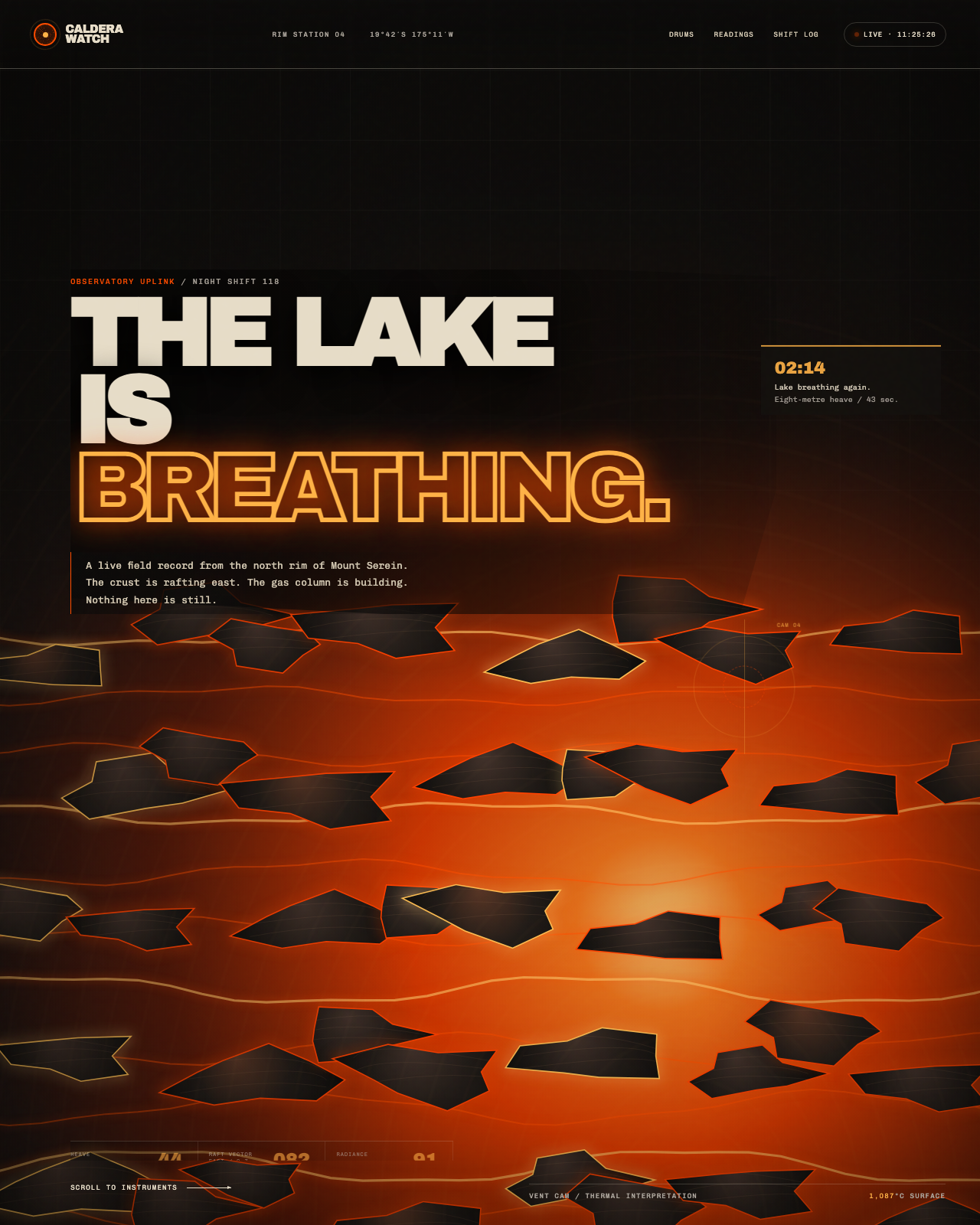
Imagine a digital night observatory, crafted entirely by artificial intelligence, where volcanic activity and seismic data translate into an immersive, animated lava field. This site acts as a virtual monitoring station, with its signature feature being a responsive interaction system that visualizes seismic events and atmospheric telemetry in real-time, mimicking the look and feel of a night watch in a volcanic caldera. Its core achievement lies in transforming static data into a dynamic, atmospheric landscape that reacts precisely to user actions, creating a sense of being inside an active volcanic environment.

Prime made for students and young adults
- Fast, free delivery for dorm and study essentials
- Prime Video and Amazon Music included
- Member-only deals
The development followed a streamlined three-stage pipeline: initial construction of the lava visualization and seismic recording layers, critical review to refine visual clarity and interaction responsiveness, and final certification by an art director to ensure both scientific plausibility and aesthetic coherence. Throughout, an AI guide—modeled as a built-in design mentor—oversaw adherence to technical and artistic standards, ensuring that each element from the heat seams to the seismic spikes aligned with the fictional but operationally detailed environment described in the guide.
The full build notes live in the room’s design guide.
The site employs a carefully curated palette inspired by volcanic geology—deep basalt black, glowing lava orange, glowing amber, cool ash gray, and paper cream—each color serving a specific purpose in the visualization and interface. The core visual technique is a full-bleed <canvas> element that renders a layered, drifting lava field with offset crust rafts, textured cooling seams, and incandescent shear zones. Overlaid are three cylindrical canvases that simulate helicorders, which visually record seismic activity with stacked, scrolling data rows. Interactivity is achieved through precise event handling: each user contact triggers visual spikes, marks the epicenter, and logs timestamped events, all synchronized with animated seismic waves and heat haze effects. The interface employs a compact, instrument-like typographic style with self-hosted fonts, reinforcing the technical and experimental atmosphere. Reduced motion settings are respected to ensure accessibility, while CSS and JavaScript coordinate to cap rendering density and maintain performance across devices.
Want this? Paste this into your AI coding agent
Build a single-page showcase website from this art-direction brief. Work like an elite creative frontend engineer; commit totally to the direction.
BRIEF (room 64 of 175, “caldera”):
CALDERA WATCH — a volcano observatory on the rim. Aesthetic: instrument shed above a glowing vent; night shift. Palette: basalt black #141210, lava glow gradient (#ff4d00→#ffb347), ash grey, seismo-paper cream. Fonts: archivo-black (display), chivo-mono (instruments). SIGNATURE: a living LAVA LAKE — canvas/shader crust that cracks into drifting plates with incandescent seams (heat-driven flow field), spatter bursts, heat shimmer rising over the whole hero; and SEISMOGRAPH DRUMS that never stop — three rotating drum recorders drawing live traces which SPIKE when you interact anywhere on the page (your clicks are earthquakes). Alert-level dial, gas readings, the night-shift log (“2:14 — lake breathing again”). Unforgettable: the page registering you on the seismograph.STACK: pure HTML/CSS/JS, no build step, no frameworks, no CDNs or external requests of any kind; self-hosted fonts only; every visual is code (CSS/SVG/canvas/WebGL) — no image assets required.
QUALITY BAR: flawless at 390px, 834px and 1440px with zero horizontal overflow; tap targets >= 44px; semantic landmarks, focus-visible styles, body-text contrast >= 4.5:1; prefers-reduced-motion pauses or simplifies heavy animation; rAF loops pause when the tab is hidden; hold 60fps (cap particle counts, avoid layout thrash); rich invented content everywhere — real-sounding names, numbers and program notes, never lorem ipsum; orchestrate one beautiful staggered load moment plus scroll and hover surprises. FORBIDDEN: Inter/Roboto/Arial/system-ui, purple-gradient-on-white, and cookie-cutter hero+cards+footer layouts.
PROCESS: iterate in three documented passes — (1) build plus builder self-critique, (2) merciless external critique finding and fixing at least ten real problems, (3) art-director elevation from good to unforgettable. Screenshot at all three widths every pass and fix everything you can see.
— Original brief by Claude Fable 5 (art director), executed by the FABLE/175 pipeline.
— This room lives at https://fable-25-830.netlify.app/sites/caldera/
This is the verbatim art-direction brief that produced the room — exposed by the exhibition itself via the “Prompt” link in the room’s footer.
Experience the full immersive environment at the live Night Observatory 04 site, and explore all 175 sites in the collection at our dedicated hub—each built with the same AI-driven precision and artistic sensibility. Dive into a virtual volcanic world where data visualization becomes a visceral experience, and see how AI can craft environments that blend science, art, and interaction seamlessly.
Visit the live room → · Browse all 175 rooms
Previously in Wing III
- Room 51: Casa Azulejo — A Lisbon Tile-Painter’s Workshop
- Room 58: The Atlantic Cable Company — Race the Signal
- Room 59: The Meridian Carousel — After Dusk, Since 1908
FABLE / 175 is a finished exhibition of 175 fundamentally different websites, each built end-to-end by an AI. This article is part of our series walking through it room by room.
volcanic seismic activity monitor
As an affiliate, we earn on qualifying purchases.
As an affiliate, we earn on qualifying purchases.
interactive lava lamp with seismic visualization
As an affiliate, we earn on qualifying purchases.
As an affiliate, we earn on qualifying purchases.
digital caldera observatory display
As an affiliate, we earn on qualifying purchases.
As an affiliate, we earn on qualifying purchases.
real-time seismic data visualization device
As an affiliate, we earn on qualifying purchases.
As an affiliate, we earn on qualifying purchases.
Halloween Picks
halloween
As an affiliate, we earn on qualifying purchases.