
TL;DR
The Large Magellanic Cloud is a nearby dwarf galaxy, about 163,000 light-years away, visible from the Southern Hemisphere. Recent advances in telescopes have deepened our understanding of its star-forming regions and dynamic relationship with the Milky Way. It’s a cosmic neighbor that reveals how galaxies grow and collide.
Imagine peering into the night sky and spotting a faint, cloudy patch that’s not a cloud. That’s the Large Magellanic Cloud, a neighbor so close it’s practically in our backyard. For centuries, skywatchers in the Southern Hemisphere have admired this cosmic cloud, but recent telescope breakthroughs are revealing its secrets like never before.
In this story, you’ll learn what makes the LMC special, how to see it, and why astronomers are obsessed with it right now. This isn’t just about a pretty sky—it’s about understanding how galaxies grow, collide, and give birth to new stars. Let’s dive into the universe’s stellar nursery that’s been hiding in plain sight.
You can see the LMC with the naked eye from dark skies in the Southern Hemisphere or low northern latitudes.
Recent telescope tech like JWST and Gaia has revealed new star-forming regions and refined the LMC’s orbit, helping us understand galaxy interactions.
The LMC’s future collision with the Milky Way in about 2 billion years will reshape both galaxies, offering a glimpse into cosmic evolution.
Using simple gear like binoculars or a wide-field telescope makes observing the LMC accessible for dedicated hobbyists.
Studying the LMC’s star formation and dynamics informs broader theories about galaxy growth and the universe’s structure.
What exactly is the Large Magellanic Cloud—and why should you care?
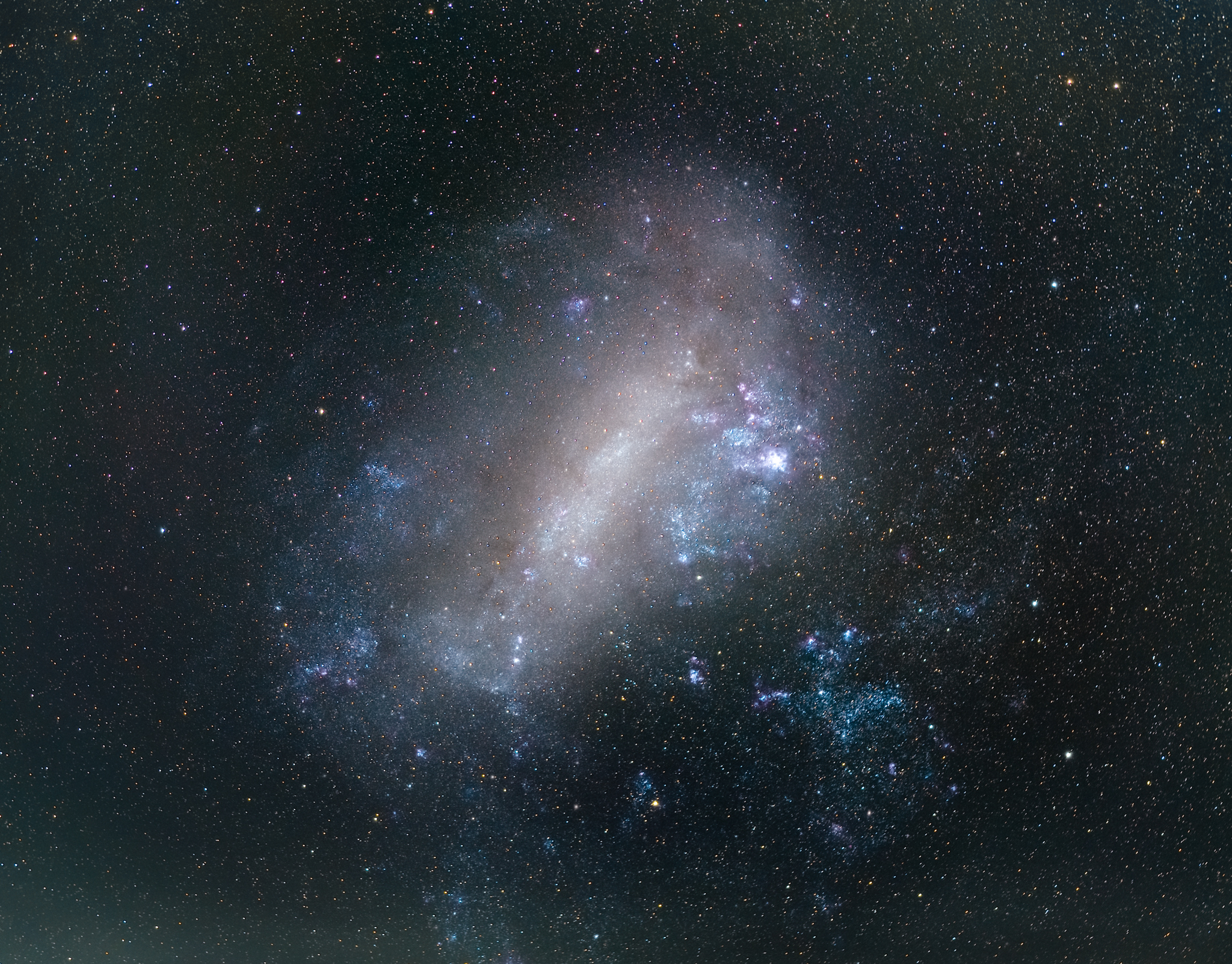
The LMC is a small, irregular galaxy orbiting our Milky Way, about 163,000 light-years away. Its shape isn’t the smooth, elegant swirl of the Milky Way but a ragged, starry cloud—roughly 14,000 light-years across. To put that into perspective, it’s like looking at a distant city skyline, just in the sky.
This galaxy is packed with star-forming regions, supernova remnants, and dense star clusters. Because it’s so close, astronomers can study its individual stars and gas clouds in detail—something that’s impossible for more distant galaxies. Understanding these features helps us grasp the processes that shape galaxies and trigger star formation. For instance, interactions like gravitational pulls can compress gas clouds, setting off a chain reaction of star birth. These insights are crucial because they tell us how galaxies evolve over cosmic time, including our own Milky Way.
Back in the day, explorers like Magellan spotted this cloud during their voyages, calling it a “cloud in the southern sky.” Today, telescopes like the James Webb Space Telescope peel back its layers, showing how new stars ignite amid swirling gas and dust, revealing the complex interplay of forces that create stellar nurseries and influence galaxy growth.

Night Sky With the Naked Eye: How to Find Planets, Constellations, Satellites and Other Night Sky Wonders Without a Telescope
As an affiliate, we earn on qualifying purchases.
As an affiliate, we earn on qualifying purchases.
How recent tech breakthroughs are revealing new secrets in the LMC
Recent advances in space-based telescopes, especially the James Webb Space Telescope, have transformed what we know about the LMC. High-resolution imaging uncovers star nurseries and supernova remnants with stunning clarity—think of upgrading from a blurry photo to a 4K masterpiece. These detailed images allow scientists to see how massive clouds of gas collapse under gravity, forming new stars, and how stellar feedback—like supernova explosions—can trigger or hinder further star formation. This is akin to understanding how a wildfire spreads or is contained, depending on local conditions.
Data from missions like Gaia have mapped the LMC’s orbit around the Milky Way more precisely. This helps scientists understand how close the galaxies really are and how their gravitational dance influences star formation and galaxy shape. For example, as the LMC approaches our galaxy, its gravitational pull can disturb the Milky Way’s disk, leading to ripples and star streams—similar to how a pebble creates waves when dropped into a pond.
One of the biggest surprises? The discovery of new star-forming regions in the Tarantula Nebula, a massive stellar nursery that churns out thousands of stars each year. This is comparable to a cosmic factory operating at full throttle, showing us how galaxy interactions act as catalysts for stellar birth. These insights help us understand the triggers behind star formation and how galaxy collisions can accelerate the process, affecting the evolution of entire systems.
And with every new image, researchers refine models of the LMC’s future—predicting it’ll collide with the Milky Way in about 2 billion years, merging into one giant galaxy. This collision isn’t just a cosmic spectacle; it impacts the future of our galactic neighborhood, potentially reshaping star formation patterns and the distribution of dark matter.

Celestron Cometron 7x50mm Astronomy Binoculars
- Easy-to-Use for Beginners: Ideal for learning astronomy
- 7x Magnification: Provides a wide field of view
- Large 50mm Objectives: Gathers more light for bright images
As an affiliate, we earn on qualifying purchases.
As an affiliate, we earn on qualifying purchases.
What makes the LMC a perfect target for backyard astronomers?
The LMC is a treasure for stargazers, especially if you’re in the Southern Hemisphere or low northern latitudes. On a clear, dark night—away from city lights—you can see it as a faint, ghostly smudge without any fancy equipment.
Using binoculars enhances the view, revealing a cloudy patch that’s actually millions of stars and glowing gas clouds. For serious hobbyists, a small telescope with a wide field of view helps you take in the whole galaxy at once, like observing a cosmic cloudscape.
Timing matters. The LMC is best visible during certain months when it’s high in the sky, usually from late fall to early spring in the southern hemisphere. Check local star charts, and avoid nights with a bright moon to see it at its best.
Pro tip: Use a star app to locate the LMC in the sky—once you spot its position, it’s a sight that’s worth a 15-minute setup and patience.

Celticbird Telescope for Adults High Powered, 80mm Aperture 600mm AZ Mount Refractor Telescope for Kids Beginners – Portable Telescopes for Adults Astronomy with Backpack, Phone Adapter, Moon Filter
- Optical Aperture: 80mm aperture for bright images
- Focal Length: 600mm focal length for clear viewing
- Portability: Includes backpack and travel accessories
As an affiliate, we earn on qualifying purchases.
As an affiliate, we earn on qualifying purchases.
How does the LMC influence our galaxy’s future—and what’s next?
The LMC isn’t just a pretty sky object—it’s a gravitational partner that affects the Milky Way. Its orbit pulls on our galaxy’s dark matter halo, subtly shaping the Milky Way’s spiral arms and possibly sparking new star formation in its outskirts. Think of it as a cosmic partner whose gravitational influence stirs the galactic pot, leading to regions of increased star birth and structural changes that ripple through the galaxy’s disk.
Scientists estimate that in about 2 billion years, the LMC will collide with the Milky Way, merging into a larger galaxy. This process is similar to two soap bubbles merging into a bigger, more complex bubble—an event that will drastically alter the structure and star distribution of both galaxies.
For now, the LMC’s gravitational tug influences the motion of stars in our galaxy’s outer regions. Studying this interaction helps astronomers understand the long-term evolution of galaxies, including how they grow larger through mergers and accretion. It also provides insight into dark matter distribution and how galaxy pairs influence each other’s development over cosmic timescales.
Future observations aim to refine models of this interaction. As telescopes get better, we’ll see more details about how such collisions shape the universe itself, revealing the delicate balance of forces that govern galaxy evolution and the cosmic web.

The Night Sky (Small) Southern Hemisphere Star Finder
As an affiliate, we earn on qualifying purchases.
As an affiliate, we earn on qualifying purchases.
3 quick facts that make the LMC a must-know for sky lovers
- The Tarantula Nebula in the LMC is the most active star-forming region in our Local Group, producing thousands of new stars each year. Its intense activity offers a glimpse into how massive stellar nurseries influence their host galaxies and contribute to their evolution over cosmic time.
- Distance from Earth is about 163,000 light-years—close enough for detailed study, far enough to see as a faint glow. This proximity allows astronomers to resolve individual stars and gas clouds, making the LMC a natural laboratory for understanding star formation and galaxy dynamics.
- Size is roughly 14,000 light-years across, smaller than the Milky Way but packed with cosmic activity. Its irregular shape and rich stellar populations exemplify how smaller galaxies can be dynamic and influential in the cosmic ecosystem, especially when interacting with larger neighbors.
Conclusion
The Large Magellanic Cloud isn’t just a cloud in the sky; it’s a nearby cosmic factory and a future galactic partner. Its shimmering presence offers a direct link to the grand dance of galaxies—one we can glimpse with modest gear under the right conditions.
Next clear night, set aside those city lights, find a dark spot, and scan the southern sky. That faint, cloudy patch isn’t just pretty—it’s a window into the universe’s ongoing story of creation, collision, and transformation. Remember, the universe is always in motion—your next skywatching session could be part of that story.


![Navier-Stokes – Tristan Buckmaster [Pdf]](https://astrophotographyhq.com/wp-content/uploads/2026/09/navier-stokes-tristan-buckmaster-pdf-featured-260x140.jpg)