TL;DR

Prime made for students and young adults
- Fast, free delivery for dorm and study essentials
- Prime Video and Amazon Music included
- Member-only deals
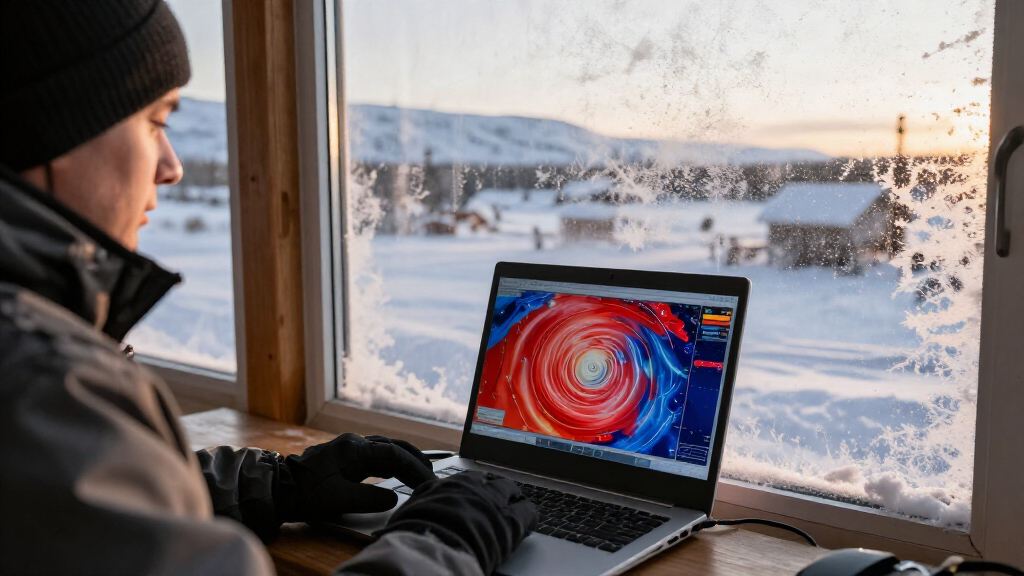
Scientists say the Arctic polar vortex is undergoing a disruption unusually early in the Northern Hemisphere winter, potentially the earliest on record. It could influence the jet stream and bring colder weather to parts of North America, but its eventual strength, timing and regional effects are not yet known.
Atmospheric scientists say the Arctic polar vortex is being disrupted unusually early in the Northern Hemisphere winter, a development that could affect the jet stream and later weather in North America. The event may be the earliest such disruption on record, but forecasters do not yet know whether it will produce a major warming or where any resulting cold weather might occur.
The polar vortex is a circulation of winds in the stratosphere above the Arctic. It typically strengthens as winter approaches, reaching peak intensity in December and January, according to Andrea Lopez Lang, an atmospheric and oceanic sciences professor at the University of Wisconsin–Madison. Its rotation helps keep very cold air near the pole, climatologist Judah Cohen of the Massachusetts Institute of Technology told Scientific American.
Atmospheric waves called Rossby waves can disturb the vortex, causing it to wobble, stretch, drift, split into separate circulations or even reverse direction. A particularly large disruption is known as a sudden stratospheric warming. The disturbance can indirectly affect the polar jet stream in the lower atmosphere, where most weather occurs, but that connection does not translate into a precise local forecast by itself.
According to Scientific American’s report, November is unusually early for this kind of disruption: the previous earliest recorded date was November 28, 1968. The source describes the current event as potentially the earliest, rather than establishing a new record. Its date and the eventual classification of its strength are not specified in the supplied report.
Possible Effects on Winter Weather
The development matters because changes high in the atmosphere can, under some conditions, alter the circulation patterns that influence winter weather closer to the ground. A disrupted vortex may help shift the jet stream and allow colder air to move into parts of North America or Europe. That possibility could complicate expectations for the winter, but it does not mean a cold outbreak is certain or that all regions would experience the same conditions.
The timing is striking, but early does not automatically mean severe. Cohen told Scientific American that disruptions vary in scale: a minor event might have little lasting effect, while a major one could become historically significant. The practical consequences depend on how the vortex evolves and how atmospheric circulation responds over the following weeks.
Forecasters had expected a relatively mild North American winter because this is an El Niño year, the report says. The vortex disruption adds uncertainty to that expectation; it does not, on the evidence provided, replace it with a reliable forecast of cold conditions. Readers should distinguish a possible large-scale influence from a specific prediction for their town or region.
Popular right now

Dyson Car+Boat Cordless Handheld Vacuum

Breville Bambino Espresso Machine, Brushed Stainless Steel

KitchenAid Artisan 5-Qt Tilt-Head Stand Mixer – Almond Cream (KSM150PS)
As an affiliate, we earn on qualifying purchases.
How the Vortex Affects Forecasts
The Arctic polar vortex forms in the stratosphere, roughly 10 to 30 miles above Earth’s surface, while the polar jet stream circulates in the troposphere, the atmospheric layer where most weather takes place. They are different features at different altitudes. A stratospheric disruption can influence the jet stream indirectly, which is one reason its eventual surface effects are difficult to pin down immediately.
In the Northern Hemisphere, the vortex usually develops in late summer and strengthens into midwinter. Rossby waves can disturb it, and larger disturbances are called sudden stratospheric warmings. Such events are not inherently unprecedented; the reported unusual feature here is their exceptionally early timing. The previous earliest date cited in the report was November 28, 1968.
The report draws on comments from Lopez Lang and Cohen, who describe both the early timing and the uncertainty over the event’s eventual effects. It does not provide a detailed forecast map, a measured temperature change, or a confirmed prediction for particular locations. Those limits matter when interpreting broad claims about the vortex and upcoming weather.
“As a weather fan, this is a big event because it’s so unprecedented.”
— Judah Cohen, climatologist at the Massachusetts Institute of Technology, speaking to Scientific American
Strength and Regional Effects
The report does not establish whether the developing event will be classified as a minor or major sudden stratospheric warming. It also leaves open whether the vortex will split, how its circulation will evolve, and whether the disturbance will lead to a meaningful shift in the jet stream.
For North America, where and when colder conditions might develop remain uncertain, as does whether they will develop at all. The supplied material gives no location-specific temperature forecast, event probability, or date for possible impacts. It also does not specify the year of the November event, so the timing here is reported as stated in the source rather than independently date-stamped.
Watching the Vortex Develop
Scientists and forecasters will need to track whether the disruption strengthens, how the vortex’s structure changes, and whether atmospheric patterns below it respond. Those developments will help clarify whether this is a relatively minor disturbance or a major sudden stratospheric warming with a stronger potential influence on winter weather.
For the public, the next useful signal will be updated regional forecasts rather than the vortex headline alone. The report does not identify a specific forecast release or milestone. Until more is known about the event’s evolution, its possible effects should be treated as a developing forecast question, not a promise of colder weather.
Key Questions
What is happening to the polar vortex?
Scientists say the Arctic polar vortex is being disrupted unusually early in the Northern Hemisphere winter. The source does not yet establish how strong the disruption will become.
Does this mean colder weather is certain?
No. A disruption can influence the jet stream and may help bring colder air to some areas, but the report says it is still unclear whether, where or when that will happen.
Why is the timing unusual?
The polar vortex typically reaches peak intensity in December and January, and disruptions usually occur deeper into winter. The earliest previous date cited in the report was November 28, 1968.
Is this a major sudden stratospheric warming?
That has not been determined in the supplied report. Scientists describe a range of possible event strengths, from minor to major, with different potential effects.
How does the polar vortex affect weather?
The vortex is in the stratosphere and can indirectly influence the polar jet stream in the lower atmosphere. That influence may affect weather patterns, but it does not by itself provide a specific local forecast.
Source: scientificamerican.com