
TL;DR

Prime made for students and young adults
- Fast, free delivery for dorm and study essentials
- Prime Video and Amazon Music included
- Member-only deals
Asteroid Torifune is a peanut-shaped, double-lobed asteroid that recently revealed its structure through advanced observations. Its unique form helps scientists understand asteroid origins and planetary history, all while reminding us of the dynamic space neighborhood near Earth.
Imagine a space rock shaped like a giant peanut, slowly drifting through the solar system. That’s asteroid Torifune, a near-Earth object with a double-lobed structure that’s caught scientists’ attention. Recent images from Japan’s Hayabusa2 spacecraft peeled back the layers of its mystery, revealing a shape that’s both familiar and intriguing.
Today, we’re exploring what makes Torifune special, how its shape hints at the early days of our solar system, and why studying such objects matters for planetary defense and future space missions. Think of it as uncovering a cosmic puzzle piece that tells us about the building blocks of planets and possibly even the origins of life.
Asteroid Torifune’s double-lobed shape arises from gentle collisions, offering clues about early solar system processes.
Close-up images from Hayabusa2 confirmed its contact binary structure, transforming previous assumptions based on distant observations.
Its rubble pile surface suggests a fragile, loosely held-together composition, important for impact mitigation strategies.
Studying such objects helps refine planetary defense and informs future asteroid exploration missions.
For amateur astronomers, high-quality long focal length telescopes and dark skies improve chances to observe these cosmic shapes firsthand.
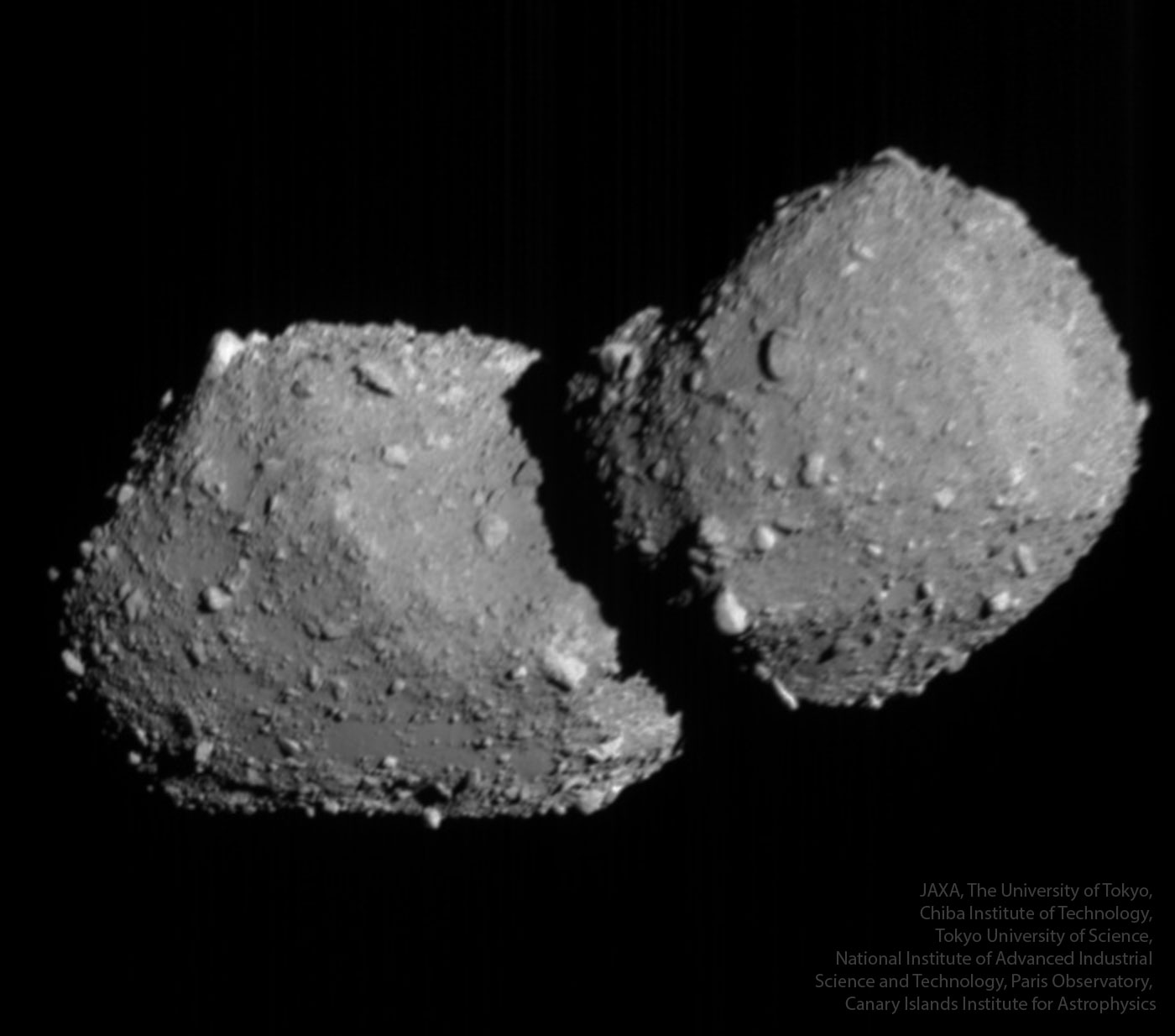
What exactly is asteroid Torifune, and why does its shape matter?
Asteroid Torifune is a near-Earth object that measures about four soccer fields long. Its most striking feature? Two rounded lobes joined by a narrow neck, resembling a peanut or a contact binary. This shape isn’t just eye-catching — it’s a clue to its past.
Scientists believe double-lobed asteroids form when two smaller bodies gently collide and stick together, rather than smashing apart. This process preserves their original shapes, offering a peek into the early days of the solar system when planets and asteroids were still taking shape.
Understanding this shape is crucial because it reveals the asteroid’s formation history and internal structure, which in turn informs us about the conditions in the early solar system. If many asteroids share this shape, it suggests that gentle accretion and mergers were common, shaping the diversity of objects we see today. Recognizing these processes helps scientists refine models of planetary formation, but it also raises questions about how such fragile structures survive over millions of years amidst constant space weathering and impacts.
high focal length telescope for astronomy
As an affiliate, we earn on qualifying purchases.
As an affiliate, we earn on qualifying purchases.
How did Hayabusa2 reveal Torifune’s true shape? The story behind the images.
Japanese spacecraft Hayabusa2 swooped past Torifune earlier this month, capturing detailed photos and radar images. Previously, astronomers thought it was just an oblong rock, based on distant observations. But close-up imaging showed something more complex: two distinct lobes joined at a narrow neck.
This is a bit like guessing a peanut’s shape from afar and then seeing it up close — the true structure becomes clear only with detailed images. The spacecraft’s radar technology was especially helpful, revealing features hidden to optical telescopes.
Imagine zooming in with a camera lens and discovering a hidden sculpture — that’s what happened here. The images confirmed that Torifune isn’t a single, smooth pebble but a contact binary, formed from two separate bodies that gently collided and merged. This discovery is significant because it provides concrete evidence of contact binary formation in near-Earth space, which influences how we assess the structural integrity and potential hazard of such objects. It also helps refine models of asteroid evolution, showing that even small bodies can have complex, layered histories that impact how they respond to forces like gravity and solar radiation.
As an affiliate, we earn on qualifying purchases.
What do we know about Torifune’s surface and composition?
Initial spectral data suggests Torifune is mainly made of carbon-rich material, possibly containing organic compounds and water-bearing minerals. Its surface looks like a messy jumble — lots of large boulders, ridges, and surprisingly, no visible craters.
This craterless surface indicates a rubble pile structure, where loose rocks and dust are loosely held together. Think of a pile of gravel more than a solid rock — it keeps reshaping over time as small impacts hit, erasing clear scars.
Understanding this surface composition is vital because it influences how the asteroid interacts with forces like solar radiation and impacts. A rubble pile’s fragility means that even small collisions can cause shifts in shape or position, affecting long-term orbit predictions. Recognizing these features helps scientists develop better mitigation strategies for potential impact threats, as the physical response of rubble pile asteroids to deflection techniques can differ drastically from more solid bodies. Moreover, their composition offers clues about the distribution of organic materials and water in the early solar system, shedding light on the potential for life-building elements to be distributed across different celestial bodies.
night sky binoculars for stargazing
As an affiliate, we earn on qualifying purchases.
As an affiliate, we earn on qualifying purchases.
Why is studying double-lobed asteroids like Torifune so important?
Objects like Torifune aren’t just pretty shapes — they’re real clues to our cosmic past. By understanding how they formed, we learn about the early solar system’s collisional environment and how planets grew from smaller bodies.
Plus, studying their structure helps improve planetary defense. Knowing whether a space rock is a loose rubble pile or a solid chunk affects how we might deflect or mitigate an impact threat.
For example, if a future asteroid threat is a contact binary like Torifune, a deflection mission would need to account for its loose, fragile structure, which could break apart or change course unpredictably. This knowledge influences mission design, risk assessment, and the development of technologies tailored to different asteroid types. It emphasizes that not all asteroids pose the same threat, and understanding their internal makeup is essential for effective planetary defense strategies. Furthermore, these studies can inform future resource extraction missions by identifying which asteroids could be mined for water or metals, shaping the future of space industry and exploration.
As an affiliate, we earn on qualifying purchases.
How do scientists plan to study objects like Torifune in the future?
Future missions aim to visit and study double-lobed asteroids up close. Concepts include orbiters that can map the surface in detail, sample-return spacecraft, or even in-situ analysis tools. These missions will give us direct insights into shape, composition, and internal structure.
For instance, NASA’s upcoming missions could target similar contact binaries, helping us compare different shapes and make informed decisions for planetary defense or resource extraction.
Imagine a drone-like spacecraft gently orbiting a peanut-shaped asteroid, collecting samples, and returning them to Earth — that’s the future of asteroid science. Such missions will also help us understand how these bodies respond to gravitational and impact forces, which is crucial for developing effective mitigation techniques and harnessing their resources for future space endeavors.
What practical tips can help you observe or understand Asteroid Torifune?
If you want to see Torifune or similar asteroids, use a telescope with a long focal length — at least 8 inches (20 cm) aperture. Clear, dark skies make a huge difference, and patience is key.
Timing is everything: check the asteroid’s pass time in your region, often provided by space agencies or observatory websites. During its closest approach, it will appear as a faint point of light, slowly moving against the starry background.
Pro tip: use a high-quality star chart or astronomy app to track its path. Long exposure photos with stacking techniques can sometimes reveal the asteroid’s movement, giving you a tiny glimpse of this cosmic peanut. Observing these objects not only satisfies curiosity but also helps amateur astronomers contribute valuable data to ongoing tracking efforts, supporting scientific research and planetary defense initiatives.
How does shape affect an asteroid’s behavior in space?
Shape influences rotation, surface gravity, and how the asteroid responds to solar radiation. Double-lobed objects like Torifune often rotate slowly because of their uneven mass distribution, and their surfaces can shift or reshape over time.
For example, the way sunlight heats their surfaces can cause tiny pushes called the Yarkovsky effect, gradually nudging their orbits. A contact binary’s complex shape makes predicting these movements trickier.
Understanding these dynamics helps us anticipate future paths and potential impact risks. Recognizing how shape impacts physical behavior enables scientists to better model asteroid trajectories and develop more accurate impact predictions, which are vital for planetary defense planning. It also informs us about the internal cohesion and structural integrity of these bodies, influencing how we might attempt to deflect or redirect them in future mitigation efforts.
Comparison: Contact Binary vs. Single-Shaped Asteroids
| Feature | Contact Binary (e.g., Torifune) | Single-Shaped (e.g., Spherical or Elongated) |
|---|---|---|
| Shape | Two lobes joined by a narrow neck | One unified shape, round or elongated |
| Formation | Gently collided or merged bodies | Single body from accretion or fragmentation |
| Surface features | Ridges, boulders, no craters | Cratered or smooth, depending on history |
| Structural integrity | Fragile, rubble pile | More solid or fractured, but less likely to break apart |
Conclusion
Asteroid Torifune isn’t just a quirky space rock — it’s a window into the past, a puzzle piece revealing how small bodies form and evolve. Its peanut shape reminds us that even in the chaos of space, gentle mergers can create beauty and complexity.
As we develop better tools and missions to explore these objects, they’ll continue to surprise and teach us about our solar system’s hidden stories. Keep an eye on the sky — the universe’s secrets are waiting just above, in the faint glow of a distant peanut-shaped asteroid.
Halloween Picks
halloween
As an affiliate, we earn on qualifying purchases.