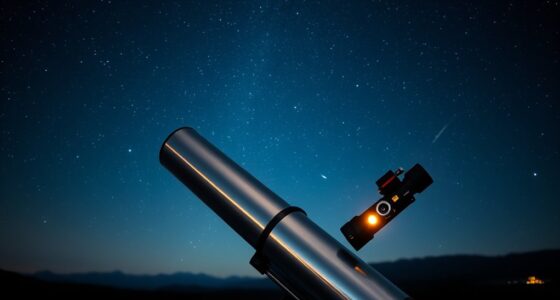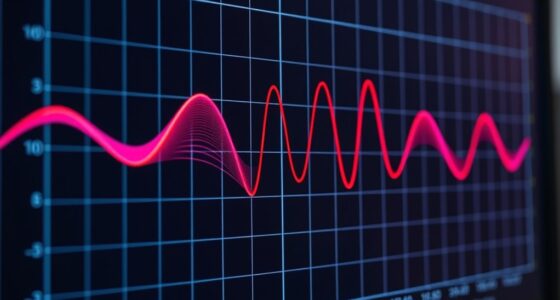

To understand tracking rates—sidereal, solar, and lunar—you need to contemplate Earth’s rotation and orbit. The sidereal rate matches Earth’s rotation relative to distant stars, helping you follow stars accurately. Solar tracking is slightly faster, compensating for Earth’s orbit around the Sun, which is essential for solar observations. Lunar tracking adjusts for the Moon’s orbit, ensuring precise lunar observations. If you explore further, you’ll discover how these rates help you keep celestial objects centered in your telescope.

Prime made for students and young adults
- Fast, free delivery for dorm and study essentials
- Prime Video and Amazon Music included
- Member-only deals
Key Takeaways
- Sidereal rate tracks Earth’s rotation relative to distant stars, enabling precise star tracking.
- Solar rate is slightly faster than sidereal, accounting for Earth’s orbit around the Sun for solar observations.
- Lunar rate considers the Moon’s orbital motion, requiring adjustments to keep the Moon centered during observations.
- Differing tracking modes compensate for Earth’s rotation and orbital movements to maintain accurate object positioning.
- Understanding these rates improves telescope alignment and accuracy across various celestial observing modes.
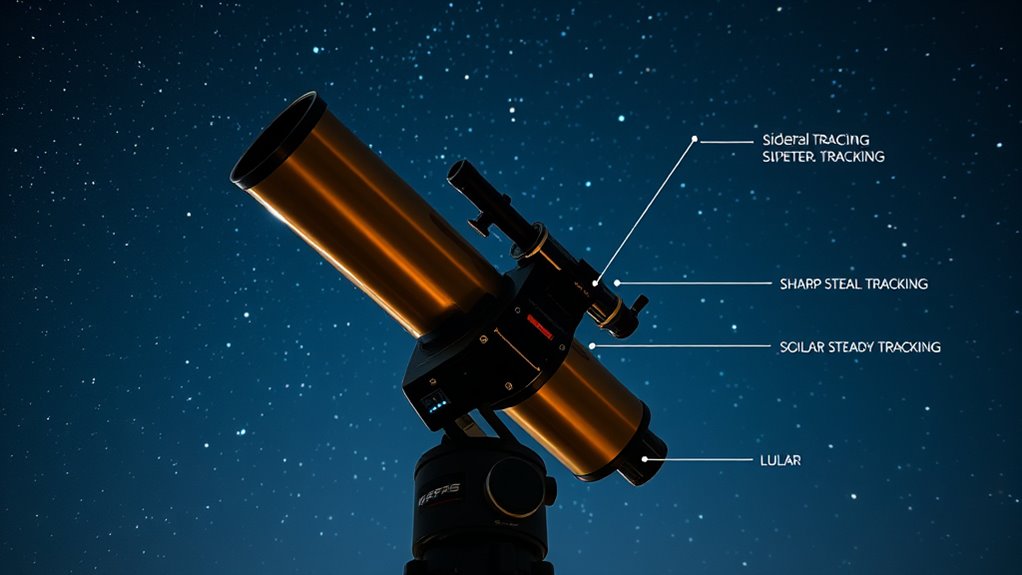
Have you ever wondered how astronomers keep track of celestial objects as they move across the sky? It all comes down to understanding the different tracking rates used to observe stars, planets, and moons accurately. These rates are closely tied to the apparent motion of objects caused by Earth’s rotation and orbit, which are explained through celestial mechanics. By grasping these concepts, you can appreciate how astronomers align telescopes and interpret the positions of celestial bodies with precision. The most fundamental tracking rate is the sidereal rate. This rate corresponds to Earth’s rotation relative to distant stars, not the Sun. Since Earth completes one full rotation relative to the stars in approximately 23 hours, 56 minutes, and 4 seconds, the sidereal rate allows astronomers to follow stars as they appear to move across the sky. This rate accounts for the celestial mechanics behind Earth’s rotation, providing a basis for accurately tracking celestial objects over time. When you set a telescope to the sidereal rate, you’re essentially compensating for Earth’s rotation with respect to the stars, guaranteeing that the celestial objects stay centered in your view. Next, there’s the solar tracking rate, which is slightly different from the sidereal rate. Because Earth orbits the Sun, the Sun appears to move across the sky at a slightly faster pace than the stars. To keep the Sun centered in your telescope, you need to adjust your tracking to this solar rate. This is particularly useful for solar observations or solar imaging, where you want to follow the Sun’s apparent motion caused by Earth’s orbit, not just Earth’s rotation. The difference between sidereal and solar rates is about 4 minutes per day, a subtle shift that accumulates over time, necessitating adjustments if you’re observing over extended periods. Additionally, understanding celestial mechanics can help you better predict the movement of other celestial bodies, improving your observational accuracy. The lunar tracking rate is another integral parameter, especially when studying the Moon or planning lunar imaging. Unlike stars and the Sun, the Moon’s apparent motion is influenced by both Earth’s rotation and the Moon’s orbit around Earth. As a result, the lunar rate differs slightly from both the sidereal and solar rates. To accurately track the Moon’s movement, you need to take into account its specific rate, which accounts for its orbital speed and position relative to Earth. This guarantees your telescope stays aligned with the Moon’s position, avoiding drift during observation sessions.
telescope tracking motor for sidereal solar lunar modes
As an affiliate, we earn on qualifying purchases.
As an affiliate, we earn on qualifying purchases.
Frequently Asked Questions
How Do Tracking Rates Affect Astrophotography Image Quality?
Tracking rates directly impact your astrophotography image quality by ensuring your telescope stays aligned with celestial objects. If your polar alignment isn’t precise, star trails appear, ruining the shot. Adjusting for the correct tracking rate allows longer exposure durations without star trails, capturing more detail and brightness. Using the right tracking mode helps maintain sharpness, making your images clearer and more professional-looking.
Can Tracking Rates Be Adjusted Manually on All Telescopes?
You can manually adjust tracking rates on many telescopes, especially those with advanced mounts, allowing for precise tracking calibration. While some basic models lack this feature, most modern computerized telescopes let you fine-tune manual adjustments to match sidereal, solar, or lunar modes. This flexibility helps you optimize astrophotography results, ensuring your telescope accurately follows celestial objects, reducing star trails, and enhancing image quality.
What Are Common Errors When Setting Sidereal, Solar, or Lunar Tracking?
When setting sidereal, solar, or lunar tracking, common errors include poor polar alignment and inaccurate clock settings. If your polar alignment isn’t precise, your telescope won’t track objects smoothly, causing blurring. Similarly, if your clock isn’t accurate, your tracking rate may be off, especially for sidereal mode. Always double-check your polar alignment and synchronize your clock regularly to make certain of accurate tracking across all modes.
How Do Tracking Rates Influence Long-Exposure Observations?
Tracking rates directly impact your long-exposure observations by ensuring your mount remains precisely aligned with celestial objects. Proper mount alignment and accurate tracking calibration keep stars sharp and clear, preventing trails and blurring. When you select the correct mode—sidereal, solar, or lunar—you optimize your mount’s movement, reducing errors and enhancing image quality. This way, your astrophotography sessions yield stunning, detailed images without the need for excessive post-processing.
Are There Special Considerations for Tracking During Planetary Imaging?
Think of planetary imaging like capturing a fleeting moment in a busy marketplace—you need perfect focus and stability. When you track planets, pay special attention to image stabilization, because even tiny vibrations can blur details. Adjust your tracking to match the planet’s movement, ensuring sharp contrast and clarity. Using high-quality mounts and gentle adjustments helps you freeze planetary motion, giving you clear, crisp images that reveal every mesmerizing detail.
astronomy telescope motor drive for celestial tracking
As an affiliate, we earn on qualifying purchases.
As an affiliate, we earn on qualifying purchases.
Conclusion
Understanding the nuances of sidereal, solar, and lunar tracking rates empowers you to optimize your observations and astrophotography. By mastering these modes, you make your mount more mindful of the universe’s movements, minimizing misalignments. Remember, meticulous measurement and mindful management matter most. With this knowledge, you’ll confidently calibrate, capture, and comprehend celestial cycles, creating a cosmic connection that’s clear, consistent, and enthralling. Immerse yourself in discovery, and let your passion propel your planetary pursuits.
equatorial mount with adjustable tracking rates
As an affiliate, we earn on qualifying purchases.
As an affiliate, we earn on qualifying purchases.
solar lunar star tracking telescope accessories
As an affiliate, we earn on qualifying purchases.
As an affiliate, we earn on qualifying purchases.
Columbus Day / Indigenous Peoples' Day Picks
long weekend sales
As an affiliate, we earn on qualifying purchases.