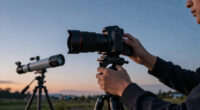
TL;DR
The right accessories—mounts, filters, guide scopes—are key to clear, sharp astrophotos. Compatibility and recent tech advances make astrophotography easier and more stunning than ever.
Ever stared at a starry sky and wondered if your camera could do it justice? The secret isn’t just the camera itself, but the accessories you pair with it. These tiny but mighty tools can turn a basic DSLR shot into a vibrant, detailed galaxy portrait.
In this guide, you’ll learn about essential gear, recent tech breakthroughs, and practical tips to elevate your astrophotography. Whether you’re shooting from a backyard or a remote mountain top, these accessories are your secret weapons for capturing the universe’s beauty.
A sturdy, precise mount is the backbone of sharp, long-exposure astrophotos.
Choosing compatible adapters and T-rings prevents focus and image issues.
Filters, especially narrowband, unlock details missed by the naked eye.
Guide scopes and autoguiders are essential for tracking accuracy during lengthy exposures.
Latest tech like wireless gear and auto-focus simplifies setup and improves results.
Why Your Mount and Tripod Matter More Than You Think
Your mount isn’t just a stand — it’s the foundation of every sharp image. Long-exposure astrophotography demands a stable, precise tracker that follows celestial objects smoothly. Imagine trying to take a clear photo of a fast-moving comet with a shaky camera — impossible.
High-quality equatorial mounts, like the Sky-Watcher EQ6-R or Celestron CGX, use motors that counter Earth’s rotation, keeping stars pin-sharp over hours. For casual shooting, a sturdy tripod with vibration dampers can do the trick, but for serious deep-sky work, dedicated mounts are worth every penny.
Example: A recent upgrade from a basic tripod to a motorized equatorial mount improved the clarity of my nebula shots from streaky to crisp, revealing intricate filaments invisible to the naked eye.

Equatorial Mount Star Tracker with Latitude Adjustment Base for Astrophotography
- Material: PETG and carbon fiber shell
- Control Chip: EESP32S dual-core processor
- Rotation Support: Stellar, moon, custom speeds
As an affiliate, we earn on qualifying purchases.
As an affiliate, we earn on qualifying purchases.
The Must-Have Camera Adapters and T-Rings
Attaching your camera to a telescope isn’t as simple as plugging it in. You need the right adapter and T-ring specific to your camera brand and model. These adapters act as a bridge, ensuring your DSLR or mirrorless camera aligns perfectly with your telescope’s eyepiece holder.
For example, a Canon T-ring combined with a C-mount adapter can connect your Canon DSLR to most telescopes. Proper fit prevents vignetting and image distortion, saving you hours of troubleshooting.
Pro tip: Always check compatibility charts before buying. A universal T-ring might seem convenient but can introduce issues like uneven focus or light leaks, ruining your shot.
Choosing the right adapters is crucial because improper fit or incompatible parts can lead to vignetting—darkening around the edges of your images—or focus problems, which compromise the detail and clarity of your astrophotos. Investing in quality, compatible adapters ensures that your camera’s sensor captures the maximum amount of light with minimal distortion, making your post-processing easier and your images sharper.
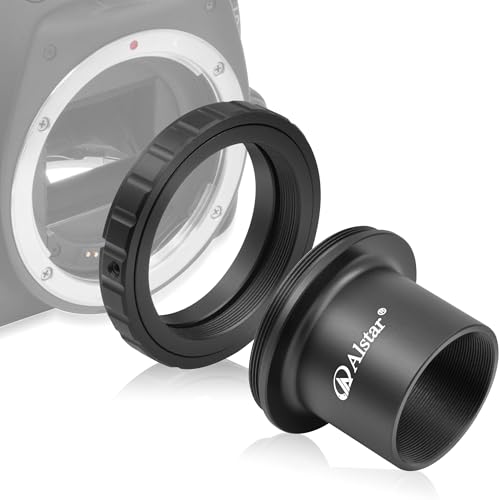
Alstar Telescope Photo Adapter for Nikon SLR/DSLR Cameras
- Wide Camera Compatibility: Fits various Nikon SLR/DSLR models
- Includes T Ring and Mount: Allows attachment to telescopes with 1.25 inch eyepiece port
- Rotatable Inner Ring: Ensures proper camera orientation
As an affiliate, we earn on qualifying purchases.
As an affiliate, we earn on qualifying purchases.
Filters That Turn Night Sky Blobs Into Stunning Details
Filters are the secret sauce for revealing nebulae, galaxies, and star clusters. Light pollution filters cut down on city glow, letting faint objects shine through. Narrowband filters isolate specific wavelengths, like H-alpha at 656 nm, revealing delicate filaments in emission nebulae.
Imagine capturing the Orion Nebula from downtown—without filters, it’s a faint smudge. With a narrowband filter, suddenly bright reds and greens pop out, filling the image with rich detail.
Recent innovations include ultra-narrowband filters with over 90% light transmission, making deep-sky objects more vibrant even in less-than-ideal conditions.
However, it’s essential to understand the tradeoffs. Narrowband filters often require longer exposure times because they block out most light, which can be a challenge in terms of tracking accuracy and noise management. They are most effective when paired with stable mounts and proper calibration, especially in light-polluted areas. Choosing the right filter depends on your target objects and observing conditions, but their ability to unlock hidden details makes them invaluable for serious astrophotographers.

SVBONY SV220 Telescope Filter, 2" 7nm Dual-Band Nebula Filter for Deep Sky
- High Transmission of Nebula Lines: Allows 94%+ light transmission for nebula emissions
- Reduces Light Pollution: Blocks artificial light and skyglow effectively
- Enhances Image Contrast and Detail: Improves deep-sky astrophotography quality
As an affiliate, we earn on qualifying purchases.
As an affiliate, we earn on qualifying purchases.
Guide Scopes and Autoguiders: Your Long-Exposure Best Friends
Long exposures require your mount to track the sky flawlessly. Autoguiders and guide scopes act like a second pair of eyes, constantly correcting tiny errors in tracking. Think of them as a GPS for your telescope, ensuring your stars stay pinpoints.
For instance, installing a small guide scope with a dedicated guide camera like the ZWO ASI120MM can reduce star trailing in 10-minute exposures. This means more detail, less mess.
Calibration is key: before each session, calibrate your autoguider to understand how it responds to tracking errors. A well-tuned autoguiding system can cut your star trails by half or more, significantly increasing image sharpness and reducing post-processing time. The tradeoff is added complexity and cost, but for deep-sky imaging, the payoff is clear: sharper images with finer details and less time spent fixing errors afterward.
Choosing the right guide scope and camera combination depends on your target objects and exposure times. Proper autoguiding setup ensures your equipment works harmoniously, resulting in stunning, trail-free images of distant galaxies and nebulae.

SVBONY SV905C Guide Camera Telescope Eyepiece, 1.23MP CMOS Sensor, 1.25Inch
- High-Resolution Sensor: 1.23MP CMOS sensor for detailed imaging
- Compact and Sensitive: Small size with high sensitivity for astrophotography
- High Peak QE: 80% quantum efficiency for better light capture
As an affiliate, we earn on qualifying purchases.
As an affiliate, we earn on qualifying purchases.
Focus Like a Pro With Motorized and Electronic Focusers
Achieving perfect focus is the hardest part of astrophotography. Manual focusing can be a game of guesswork, especially in the dark. Motorized focusers and electronic aids like Bahtinov masks make it easy to nail focus every time.
Imagine adjusting your focus remotely via software while watching a live image on your laptop. That’s the power of motorized focusers like the MoonLite or Pegasus Astro.
Auto-focus features analyze star diffraction patterns to determine the optimal focus point, saving time and preventing frustration during critical imaging sessions. This automation reduces the risk of focus drift during long exposures, which can cause blurry images. The tradeoff is increased equipment cost and setup complexity, but the payoff is consistently sharp images and more efficient sessions. Proper focusing is essential because even slight misalignments can ruin hours of imaging — investing in good focusers ensures your data is as sharp as possible from the start.
Cables, Power, and Connectivity: Keep the Session Running Smoothly
Nothing kills an astrophotography session faster than a dead battery or a loose cable. Reliable power supplies and sturdy data cables are essentials. Using a portable 12V power bank designed for astrophotography gear ensures your setup stays alive through long nights.
Wireless options are emerging, like Wi-Fi-enabled mounts and cameras, making setup less cluttered. For example, controlling your camera remotely via an app reduces vibrations and saves time. However, wireless connections can sometimes be less stable, especially in areas with interference or weak signals, so having backup wired options is wise.
Investing in high-quality, weatherproof cables and a dedicated power source minimizes the risk of disconnections or power failures. These issues can cause data loss or equipment shutdown at critical moments. The tradeoff is added expense and setup time, but the reliability they offer is invaluable for long, uninterrupted imaging sessions.
What’s New? Cutting-Edge Accessories for 2024
Astrophotography gear keeps evolving. Wireless guide cameras with built-in GPS and auto-align features now simplify setup. Ultra-narrowband filters with higher transmission rates make capturing faint nebulae easier from city rooftops.
Motorized focusers with seamless software integration and smart mounts with Wi-Fi and auto-polar alignment are becoming standard. These innovations reduce setup time and increase success rates.
For example, a recent review highlighted a mount that auto-calibrates in 5 minutes, freeing up time for imaging and less frustration. These advancements mean that more amateurs can achieve professional-quality results without extensive experience or equipment complexity, though they often come at a higher price point.
Frequently Asked Questions
Do I really need an autoguider for beginner astrophotography?
While not mandatory, an autoguider greatly improves tracking accuracy during long exposures. If you plan to shoot deep-sky objects for more than a few minutes, it’s a worthwhile investment to reduce star trails and improve detail.Can I use my DSLR with just a tripod for astrophotography?
You can start with a tripod and a wide-angle lens for beginner shots of the Milky Way. However, for deep-sky objects or longer exposures, a proper mount or tracker is essential to avoid star trails and get sharp images.What filters should I buy first?
Begin with a light pollution filter if you shoot from an urban area. For more advanced work, narrowband filters like H-alpha or OIII are game-changers for revealing nebulae in stunning detail.Are wireless accessories reliable enough for serious astrophotography?
Recent wireless gear has improved a lot, offering stable connections and remote control capabilities. They’re especially helpful for reducing vibration and streamlining setup, but always keep backup cables and power sources handy.What’s the biggest recent tech breakthrough in astro accessories?
Ultra-narrowband filters with over 90% transmission efficiency and smart, auto-align mounts are among the latest advances, making deep-sky imaging easier and more accessible for amateurs.Conclusion
Investing in the right accessories turns a decent night shot into a stunning, detailed glimpse of the cosmos. They’re the secret ingredients behind crisp stars and vibrant nebulae.
Next time you set up under the stars, remember: the better your gear, the more you’ll see. Your universe is waiting—equip yourself accordingly.