

TL;DR

Prime made for students and young adults
- Fast, free delivery for dorm and study essentials
- Prime Video and Amazon Music included
- Member-only deals
Cometary knots in the Helix Nebula are tiny gas and dust structures shaped like mini comets. They form from stellar material ejected by dying stars and help us understand planetary nebulae and cosmic recycling. Recent high-res imaging continues to uncover their secrets.
Imagine gazing into a cosmic eye—the Helix Nebula—its swirling gases and tiny, comet-like structures dancing in space. This celestial spectacle, just 650 light-years away, is more than a pretty picture. It’s a laboratory for understanding how stars die and seed the universe with building blocks for new worlds. Today, we’re zooming in on the curious cometary knots that make this nebula a cosmic art gallery, revealing secrets about the final acts of Sun-like stars.
These small, dense gas clumps aren’t just pretty features; they’re clues. Their intricate shapes, chemical makeup, and evolution tell a story about stellar winds, radiation, and the cycle of matter. Plus, recent telescope breakthroughs are peeling back layers of mystery, giving us a closer look than ever before. Buckle up—this is a story about tiny structures with big implications.
Cometary knots are tiny, dense gas and dust structures shaped like mini comets, formed from stellar ejection and radiation shaping.
Their sizes can be several times the orbit of Pluto, with masses comparable to Earth, making them surprisingly hefty for their small size.
High-resolution telescopes like Webb and Hubble reveal the knots’ complex textures and chemical signatures, advancing our understanding of stellar death.
These structures are temporary, gradually eroded by radiation, dispersing into space and enriching the galaxy with molecules essential for life.
Future missions will clarify how these knots form, evolve, and influence the cosmic recycling of matter—key to understanding our universe’s lifecycle.
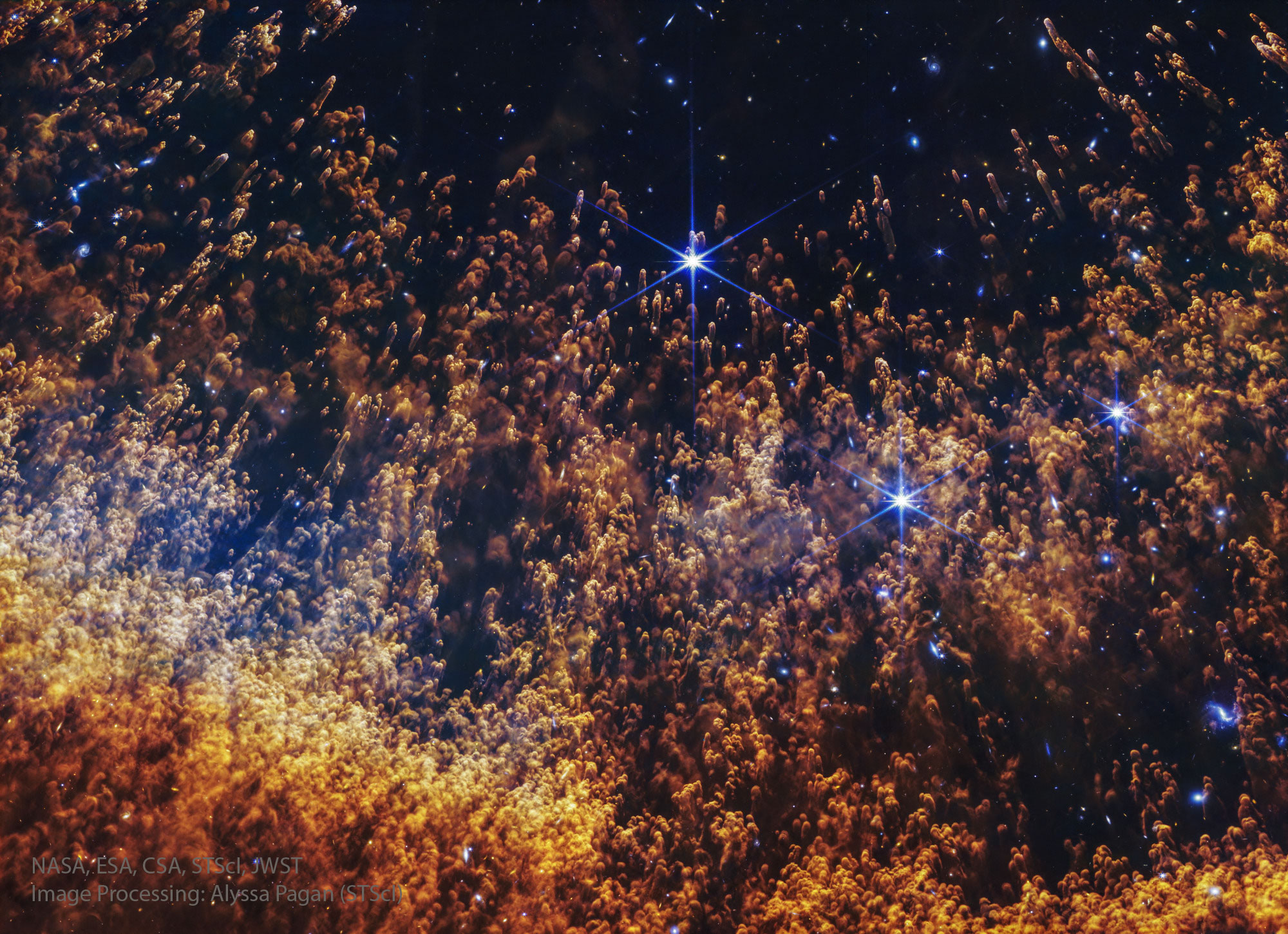
What Exactly Are These Tiny ‘Comets’ in Space?
Cometary knots are dense blobs of gas and dust that look like miniature comets floating in the nebula. Their ‘heads’ are packed with material, often several times the size of Pluto’s orbit, while their tails point away from the central star—shaped by intense radiation and stellar winds. Imagine tiny, cosmic jellybeans with wispy tails, drifting in space. They’re formed from the nebula’s ejected gas, compressed and sculpted by the star’s radiation over thousands of years.
Recent infrared images from the James Webb Space Telescope show these knots in stunning detail, revealing their complex textures and chemical signatures. These detailed observations are vital because they allow astronomers to analyze the composition and physical conditions within the knots directly. Understanding their appearance helps us decipher the processes that shape them, which in turn sheds light on how stars shed their mass and influence their surrounding environment. The knots’ small sizes contrasted with their massive masses challenge our understanding of how such dense structures can survive in the harsh radiation environment, prompting questions about their internal stability and longevity. These insights matter because they inform models of stellar evolution and the lifecycle of planetary nebulae, illustrating how mass loss shapes the final stages of a star’s life and influences the chemical enrichment of space.
As an affiliate, we earn on qualifying purchases.
How Do These ‘Mini Comets’ Form in the Nebula?
- Gas ejection: The dying star releases layers of gas and dust into space, creating an expanding shell. This process is crucial because it marks the transition of the star into its final evolutionary stages, dispersing enriched material that will seed future generations of stars and planets.
- Density fluctuations: Variations in the ejected material cause some regions to be denser than others. These density differences are not just random; they are influenced by the star’s pulsations, magnetic activity, and the uneven ejection of material, which create a patchwork of density that sets the stage for knot formation.
- Shaping by radiation: Ultraviolet light from the central star heats and ionizes the gas, causing the dense spots to become more resistant to erosion initially, while the less dense regions are more easily dispersed. The radiation pressure pushes material away, shaping the knots and forming their characteristic tails. This process is a delicate balance: too much radiation can destroy the knots quickly, while too little may allow them to grow or persist longer, influencing their size and density.
- Erosion: Over thousands of years, radiation gradually wears down these knots, dispersing them into space. This erosion is not uniform; some knots are more resilient, which suggests they have internal structures or compositions that help them withstand the harsh environment longer. Their eventual dispersal contributes complex molecules to the interstellar medium, influencing future star and planet formation.
This formation process is more than a simple sequence; it reflects a complex interplay of physical forces—gravity, radiation pressure, magnetic fields—that determine the size, shape, and lifespan of these knots. Modern computer simulations incorporate these factors to produce virtual models that match the observed complexity, helping astronomers understand not just how these structures form, but why they have the particular characteristics they do. These tiny knots are therefore not just passive remnants but active participants in the ongoing cycle of stellar death and cosmic recycling, with their formation and erosion telling us about the delicate balance of forces at play during a star’s final acts.
high-resolution space telescope models
As an affiliate, we earn on qualifying purchases.
As an affiliate, we earn on qualifying purchases.
Why Are These Knots So Important for Astronomers?
These tiny knots aren’t just beautiful; they’re vital clues. They help scientists understand how stars shed their outer layers, which is crucial for piecing together stellar evolution. The way these knots form, evolve, and disperse reveals the physical processes at play during the star’s final stages, including how radiation and stellar winds shape the nebula. Moreover, because they are dense and chemically rich, they serve as natural laboratories for studying complex chemical reactions in space—reactions that can lead to the formation of organic molecules essential for life. The presence of such molecules within the knots suggests that planetary systems may inherit these complex chemicals from the nebula, influencing the potential for life on planets that may form later. By analyzing their physical properties and chemical composition, astronomers can infer the conditions of the nebula’s environment and how matter cycles through different phases—from stellar ejecta to interstellar medium and eventually into new star systems. These insights are fundamental because they connect the death of stars to the broader context of cosmic evolution, illustrating how matter is recycled and enriched over cosmic timescales. The study of these knots thus bridges stellar astrophysics, astrochemistry, and planetary science, making them key targets for understanding our cosmic origins and future.
astronomy binoculars for stargazing
As an affiliate, we earn on qualifying purchases.
As an affiliate, we earn on qualifying purchases.
What Will Future Telescopes and Missions Reveal About These Knots?
Future observations, especially around 2026, are poised to unravel more mysteries. The James Webb Space Telescope, with its infrared eye, is already peering deeper into these knots, revealing their detailed chemistry and structure. These observations will help determine how the chemical composition varies within the knots and how that affects their stability and evolution. Upcoming missions will likely map how these structures change over time, providing a dynamic picture of their lifecycle. For example, by tracking the dispersal of knots, scientists can estimate their lifespans and understand the physical processes that lead to their erosion. This can reveal how radiation influences their chemical makeup and internal structure, offering clues to how complex molecules survive or are destroyed during the nebula’s evolution. Furthermore, combining observational data with advanced computer models will allow researchers to simulate the conditions that produce different types of knots, helping to predict their future behavior and their role in enriching the interstellar medium. These insights are critical because they link small-scale processes to the larger picture of galaxy evolution, star formation, and the distribution of organic molecules across the cosmos. As technology advances, the potential to uncover new molecules, understand their formation pathways, and see how these tiny structures influence cosmic recycling will markedly increase, deepening our understanding of the universe’s lifecycle.
As an affiliate, we earn on qualifying purchases.
Comparing the Helix’s Knots to Other Nebulae: What’s Unique?
| Feature | Helix Nebula | Ring Nebula | Dumbbell Nebula |
|---|---|---|---|
| Proximity | ~650 light-years | ~2,300 light-years | ~1,200 light-years |
| Number of Knots | Thousands | Fewer, less studied | Few, larger structures |
| Size of Knots | Several times Pluto’s orbit | Similar but less detailed | Larger, less dense |
| Chemical Composition | Rich in PAHs, complex molecules | Less detailed data | Less chemical complexity |
The Helix stands out because it’s so close, so detailed, and teeming with tiny knots that tell detailed stories. Its proximity allows astronomers to resolve individual structures with remarkable clarity, which is often impossible for more distant nebulae. This level of detail uncovers variations in chemical composition and physical conditions that are hidden elsewhere, giving us a more complete understanding of the processes shaping planetary nebulae. Other nebulae, like the Ring and Dumbbell, are valuable in their own right but lack the proximity and resolution to reveal the intricate complexity of their internal structures. This makes the Helix a natural laboratory—an accessible cosmic workshop—where scientists can test theories about star death, matter recycling, and molecule formation. Its unique combination of proximity, richness in detailed features, and chemical diversity makes it an essential reference point for comparative studies, helping us understand the diversity and commonality among planetary nebulae and the lifecycle of stars across the galaxy.
Frequently Asked Questions
Are cometary knots unique to the Helix Nebula?
No, similar structures have been observed in other planetary nebulae like the Ring Nebula and Dumbbell Nebula. However, the Helix is close enough and bright enough to provide the most detailed views, making it a key object for study.
How long do these knots last?
They are gradually eroded by the star’s radiation. Depending on their size and location, they can last thousands to tens of thousands of years before dispersing into space.
What chemicals are found inside the knots?
Recent spectroscopic studies reveal complex molecules like polycyclic aromatic hydrocarbons (PAHs), which are important precursors to organic chemistry and possibly life-building compounds.
Can we see these knots from Earth?
Yes, with large amateur or professional telescopes, especially in the infrared spectrum. The James Webb Space Telescope is providing unprecedented detail of their structure and chemistry.
Conclusion
These tiny cometary knots are more than just cosmic eye candy—they’re vital clues in understanding how stars end their lives and seed the universe with the ingredients for new worlds. As technology advances, the secrets they hold will become clearer, shaping our picture of the universe’s ongoing story.
Next time you look up at the night sky, remember: even the smallest structures can carry the biggest stories—reminding us that in space, size isn’t everything, but detail is everything.
Fall Picks
fall essentials
As an affiliate, we earn on qualifying purchases.