
TL;DR

Prime made for students and young adults
- Fast, free delivery for dorm and study essentials
- Prime Video and Amazon Music included
- Member-only deals
Lunar eclipses reveal Earth’s shadow as a curved, dark circle stretching across the Moon. Combining multiple images shows Earth’s size, shape, and atmospheric effects, making it a natural spectacle worth capturing tonight.
Imagine a giant, dark circle stretching across the Moon’s face, slowly swallowing its glow. That’s Earth’s shadow at work during a lunar eclipse, a cosmic shadow puppet show happening far above us. It’s one of the clearest visual clues we have that Earth is round, and it offers a stunning opportunity to see our planet’s shape in action.
Tonight’s lunar eclipse isn’t just a celestial spectacle; it’s a chance to see the universe’s geometry at work. With the right gear and a little patience, you can capture the shifting dance of light and shadow. This article will walk you through what makes Earth’s shadow so fascinating, how scientists and photographers visualize it, and practical tips for making your own images shine.
Earth’s shadow during a lunar eclipse is always a perfect circle, directly proving Earth’s spherical shape.
Composite images of eclipses reveal the size, curvature, and atmospheric effects of Earth’s shadow in stunning detail.
Photographing lunar eclipses involves planning, steady gear, and timing to create meaningful visual stories.
The red hue during totality results from Earth’s atmosphere filtering sunlight, turning the Moon into a ‘Blood Moon.’
Lunar eclipses serve as natural demonstrations of planetary science, connecting visual beauty with fundamental Earth facts.
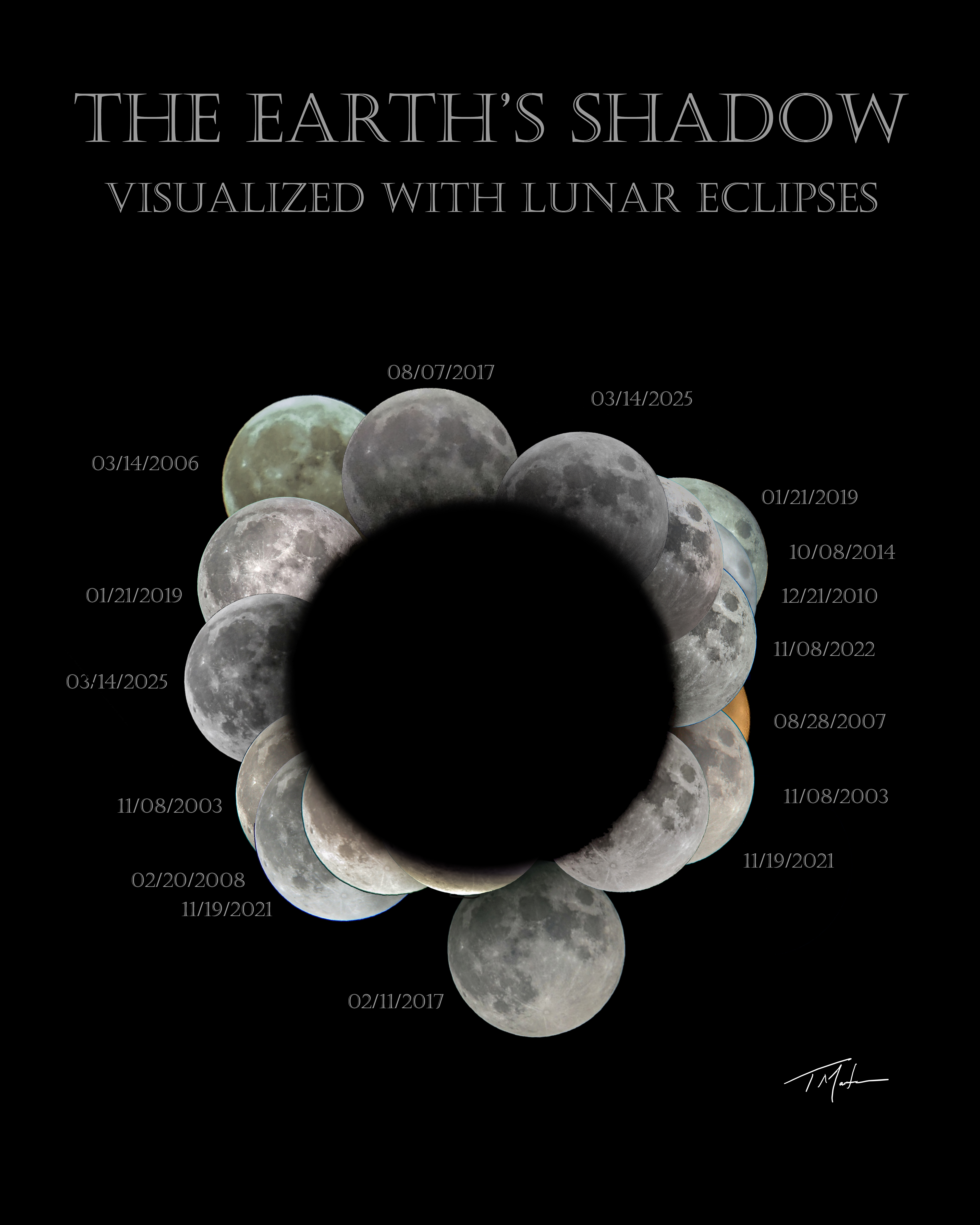
Why the Curved Shadow of Earth Is a Clear Sign of Its Round Shape
When Earth blocks sunlight during a lunar eclipse, the shadow it casts on the Moon is always a perfect circle. This isn’t a coincidence. Because Earth is spherical, its shadow naturally forms a curved, circular outline. From the Moon’s perspective, this circle remains consistent regardless of where the eclipse happens.
Picture shining a flashlight on a ball in a dark room. The shadow cast on the wall behind is always round, no matter how you tilt the ball. Similarly, Earth’s shadow is a direct, visual confirmation of its roundness, proven over centuries by astronomers and amateur skywatchers alike.
For example, during an eclipse, composite images can show the shadow’s edge as a smooth, curved arc. These images often combine exposures taken over hours, revealing how the shadow slowly moves across the lunar surface. The consistent curvature across different events is a powerful, observable fact that Earth is indeed spherical.
digital camera for astrophotography
As an affiliate, we earn on qualifying purchases.
As an affiliate, we earn on qualifying purchases.
How Modern Photography Turns Lunar Eclipses Into Stunning Visual Stories
Thanks to digital cameras and smartphones, capturing a lunar eclipse is easier than ever. Photographers often take multiple exposures over several hours, then stitch these together to create a composite image. This technique reveals the full extent of Earth’s shadow, turning a fleeting event into a detailed visual story.
Imagine a series of photos showing the Moon gradually slipping into Earth’s shadow, then emerging again. When combined, they form a vivid map of the shadow’s size and shape—something your eye might not catch in real-time. The key is to keep your camera steady, use manual settings, and plan for the different phases of the eclipse.
For instance, setting your camera on a tripod with a wide-angle lens allows you to capture the entire sky and the Moon’s movement. Using a consistent exposure ensures the sequence looks seamless. Later, software can help align and combine the images, revealing the complete picture of Earth’s shadow projected into space.
tripod for lunar eclipse photography
As an affiliate, we earn on qualifying purchases.
As an affiliate, we earn on qualifying purchases.
The Science Behind the Shadow’s Size and Shape
Earth’s shadow isn’t just a dark circle; it’s a three-dimensional cone stretching away from the Sun. At lunar distance, this cone’s width is about 2.5 to 3 times the diameter of the Moon, which means the shadow is enormous—large enough to swallow the Moon whole during totality.
Think of the shadow as a giant, dark pillowcase draping over the Moon, with the edge curved because of Earth’s spherical shape. The shadow’s size and shape also depend on the Sun’s apparent size, which is about 0.5 degrees across. During a total lunar eclipse, the Moon passes through this cone, providing a perfect silhouette of Earth’s form.
Scientists use composite images to measure this curve precisely, confirming Earth’s round shape. The consistent circular boundary of the shadow across many eclipses serves as a natural, astronomical proof of our planet’s spherical nature.
As an affiliate, we earn on qualifying purchases.
Practical Tips for Viewing and Photographing Tonight’s Lunar Eclipse
If you want to catch tonight’s eclipse, here’s what you need to do:
- Plan ahead: Know the local time of the eclipse phases. Use astronomy apps or websites to track the event.
- Gear up: A sturdy tripod, a camera with manual controls, and a wide-angle lens are ideal. Binoculars can help you see the progression more clearly.
- Set your camera: Use manual focus, a low ISO (100-400), and exposure times between 1/10 to 1 second depending on lighting. Experiment during the partial phases.
- Capture the sequence: Take interval shots every few minutes during the eclipse. This creates a rich timeline of Earth’s shadow moving across the Moon.
- Stay patient: Conditions may vary—clouds, light pollution, or equipment limitations. Focus on steady shots, and don’t rush the timing.
Picture yourself on a clear night, tripod steady, camera pointed at the Moon. As the shadow creeps across its face, you press the shutter button repeatedly. Later, with some editing, you turn that sequence into a stunning visual of Earth’s shadow—proof that our planet’s shape is written in the sky.
As an affiliate, we earn on qualifying purchases.
What You’ll See and Why It Matters—The Bigger Picture
Beyond the visual beauty, lunar eclipses serve as a reminder of Earth’s place in the cosmos. The curved shadow you see isn’t just a pretty picture—it’s a window into planetary science. It shows Earth’s spherical shape, its atmosphere filtering sunlight, and how celestial mechanics work in harmony.
During totality, the Moon glows with a reddish hue—sometimes called a ‘Blood Moon.’ This color results from sunlight passing through Earth’s atmosphere, scattering blue and green light, while red and orange light bend into the shadow. It’s a vivid, living demonstration of how our atmosphere shapes what we see.
Imagine standing under a clear night sky, witnessing a giant, dark arc move across the Moon. That giant shadow is a visual echo of Earth’s spherical form, a reminder that our home planet is a round, vibrant world with a thick atmosphere that colors its shadow red during eclipses.
Frequently Asked Questions
Why does Earth’s shadow always appear as a circle during a lunar eclipse?
Because Earth is spherical, its shadow naturally forms a perfect circle when cast into space. This shape is consistent regardless of the eclipse’s timing or location, providing a clear, visual proof of Earth’s roundness.Can I photograph a lunar eclipse with my smartphone?
Yes, with a steady hand and a tripod, you can capture surprisingly good images. Use your phone’s manual or pro mode, increase exposure time, and focus carefully on the Moon. For best results, try to keep the camera steady and take multiple shots during different eclipse phases.Why is the Moon sometimes red during an eclipse?
The red color, often called a ‘Blood Moon,’ comes from sunlight passing through Earth’s atmosphere. Blue and green light scatter out, leaving the red and orange hues to illuminate the Moon during totality. The amount of red varies depending on atmospheric conditions like dust, pollution, or volcanic ash.How long does a total lunar eclipse last?
Totality can last up to about 100 minutes, but the entire eclipse—partial and total phases—can stretch over several hours. The duration depends on the relative positions of Earth, Moon, and Sun, as well as atmospheric factors.Is it safe to look directly at a lunar eclipse?
Absolutely. Unlike solar eclipses, lunar eclipses pose no risk to your eyes and can be watched with the naked eye, binoculars, or a telescope without protection.Conclusion
Tonight’s lunar eclipse isn’t just a fleeting celestial event; it’s a giant, natural proof of Earth’s roundness and atmosphere. With a little preparation, you can turn a moment of cosmic shadow into a vivid, educational spectacle that reminds us of our planet’s unique place in the universe.
So, set up your camera, find a clear view, and watch as Earth’s shadow dances across the Moon. It’s a simple, beautiful way to see science in action—an everyday miracle written in the sky.
Columbus Day / Indigenous Peoples' Day Picks
long weekend sales
As an affiliate, we earn on qualifying purchases.