
TL;DR

Get school and study supplies delivered free — and shop member deals
- Fast, free delivery on millions of items
- Access to Prime Big Deal Days deals on October 6–7
- Prime Video, Amazon Music and more included
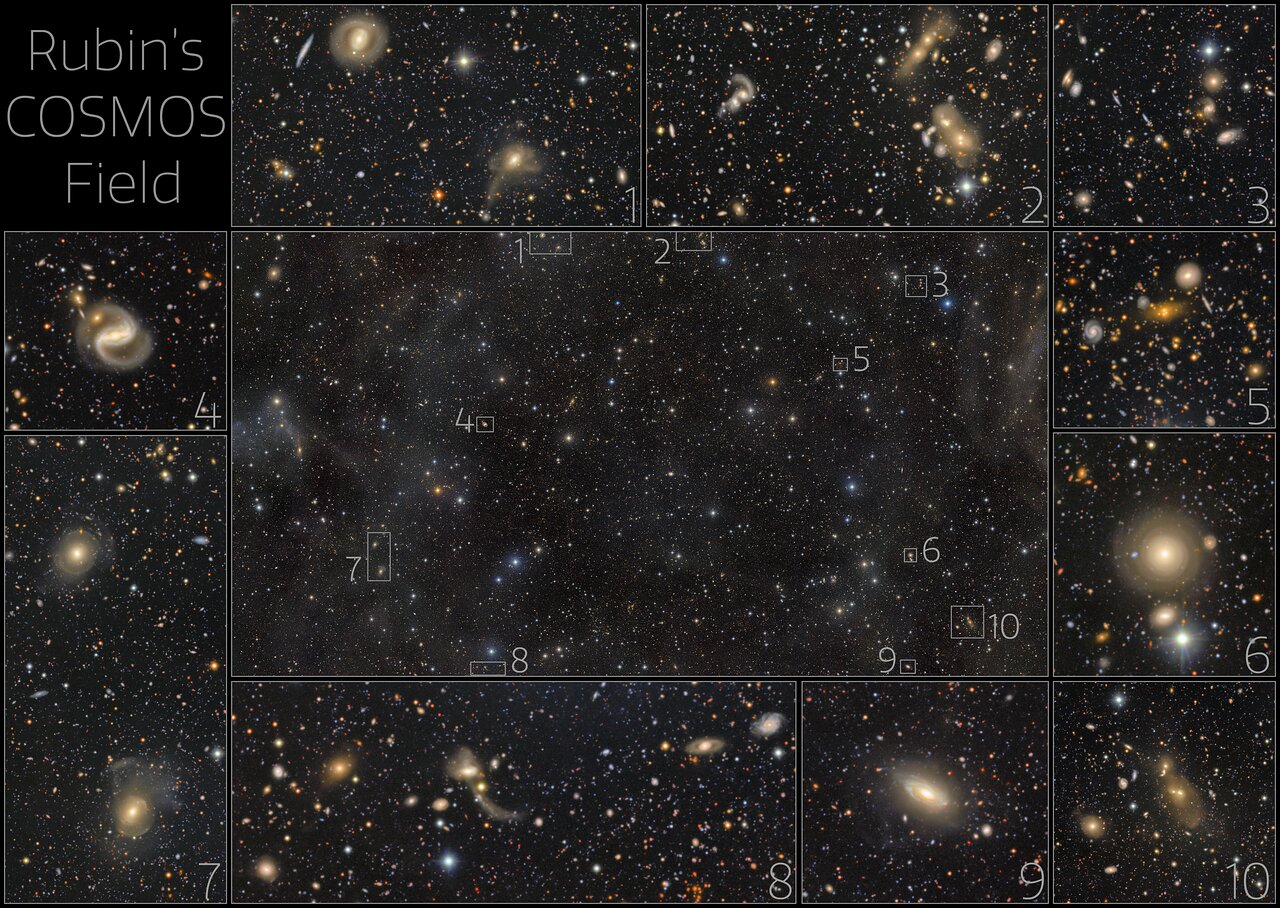
Rubin Observatory’s recent image of the COSMOS field reveals over half a million galaxies in a sky patch larger than the full moon. This deep view helps us understand galaxy growth, dark matter, and cosmic expansion, thanks to multi-wavelength data and ongoing surveys.
Imagine gazing at the night sky and realizing that, in just a tiny patch of space, there are more than half a million galaxies shimmering in distant light. That’s the essence of Rubin’s recent image of the COSMOS field—a vast, detailed map of the universe’s grand tapestry. This isn’t just a pretty picture; it’s a window into cosmic history, revealing how galaxies form, evolve, and cluster over billions of years.
With Rubin’s cutting-edge survey, we’re witnessing a revolution in our understanding of the universe’s structure. Every couple of nights, Rubin returns to this same patch, capturing the dance of galaxies, the flicker of supernovae, and the subtle influence of dark matter. Today, we’ll explore what makes the COSMOS field so fascinating, what recent discoveries tell us, and how you can connect with this cosmic story from your own backyard.
Rubin’s COSMOS field reveals over 500,000 galaxies, offering a snapshot of cosmic history spanning billions of years.
The survey’s repeated imaging over ten years provides a dynamic view of galaxy evolution, transient events, and dark matter effects.
Compared to Hubble and Webb, Rubin offers a wide-field, time-lapse perspective, key for understanding large-scale structure.
Recent findings include distant galaxy clusters and numerous supernovae, refining our understanding of cosmic acceleration.
You can connect with this universe story by using simple gear and dark skies, turning your backyard into a window to the cosmos.
What makes Rubin’s COSMOS image a cosmic treasure trove?
Rubin’s recent image shows over 500,000 galaxies in a patch of sky larger than the full moon. That’s like seeing a city skyline made of billions of stars and galaxies, all packed into a tiny, dark window. What’s special? The COSMOS field is designed to be a clear window—containing few bright stars from our own Milky Way—so we see distant galaxies without bright foreground clutter.
Scientists use this field to study galaxy shapes, sizes, and how they cluster over time. It’s a cosmic time machine: some galaxies are so far away that their light has traveled for over 10 billion years before reaching Earth. Rubin’s imaging captures this history, showing the universe when galaxies were still forming and merging.
For amateur astronomers, the practical tip is simple: use a wide-field camera on a stable mount, and target dark, clear skies. While you won’t see individual galaxies with a backyard telescope, knowing their scale and diversity adds a new layer of wonder to your night.
beginner telescope for galaxy viewing
As an affiliate, we earn on qualifying purchases.
As an affiliate, we earn on qualifying purchases.
How does Rubin’s survey deepen our cosmic understanding?
Rubin’s Legacy Survey of Space and Time (LSST) is like giving scientists a superpower: the ability to watch the sky every few days for ten years. This means tracking how galaxies move, collide, and change over cosmic time. The COSMOS field becomes a dynamic storybook, revealing not just static images but the universe in motion.
Recent advances include identifying new galaxy clusters, mapping dark matter through gravitational lensing, and catching transient events like supernovae. For example, Rubin has detected over 1,000 supernovae in just a few months, helping refine measurements of the universe’s expansion.
For you, this means every clear night could hold a new surprise—an exploding star, a shifting galaxy, or a faint ripple of dark matter’s influence. The key is patience and curiosity, knowing that each observation adds a new piece to the cosmic puzzle.
wide-field astrophotography camera
As an affiliate, we earn on qualifying purchases.
As an affiliate, we earn on qualifying purchases.
Compare Rubin’s COSMOS insights with other cosmic surveys
| Feature | Rubin’s COSMOS Survey | Hubble & Webb Observations |
|---|---|---|
| Coverage Area | 2 square degrees, deep multi-wavelength | Focused regions, high detail |
| Wavelengths | Optical, infrared, radio | Optical, near-infrared, infrared |
| Depth & Resolution | Moderate, wide-field | High resolution, narrower fields |
| Primary Goal | Galaxy evolution, dark matter, cosmic expansion | Detailed galaxy morphology, early universe |
This comparison shows Rubin’s strength: wide, repeated coverage that captures the universe’s evolution over time, complementing Hubble’s sharp, detailed snapshots and Webb’s infrared eye on the early universe.
As an affiliate, we earn on qualifying purchases.
What recent discoveries from Rubin’s COSMOS observations are changing our view?
Recent observations have uncovered galaxy clusters so distant that their light took over 10 billion years to reach us. These clusters act like cosmic anchor points, helping scientists measure how the universe’s expansion accelerates. For example, Rubin’s data suggests that dark energy’s influence might be more complex than previously thought.
Another breakthrough is spotting hundreds of transient supernovae—stellar explosions that give clues about the universe’s expansion rate and dark energy. These fleeting events, captured every few nights, fill in critical gaps in our cosmic timeline.
Imagine catching a supernova and realizing it’s from a galaxy so far away that its light left when dinosaurs roamed Earth. Rubin’s ability to find these distant explosions in real time is like having a cosmic surveillance camera—except instead of crime, it’s cosmic fireworks.
As an affiliate, we earn on qualifying purchases.
How can you see the universe’s story from your own backyard?
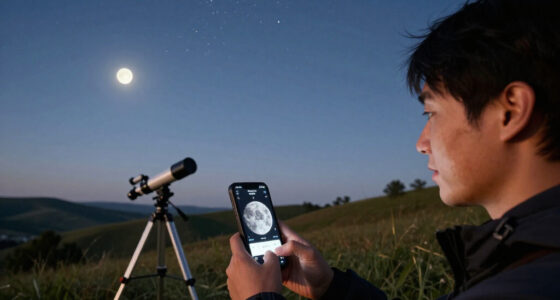
While Rubin’s survey uses advanced tech, you can start exploring these themes with binoculars or a small telescope. Choose a dark, clear night, and aim for a wide, unobstructed view of the sky. Look for the faint glow of the Milky Way, then imagine the billions of galaxies beyond that glow.
To connect more deeply, try astrophotography. Use a camera with a wide-angle lens mounted on a sturdy tripod, and shoot for 30 seconds to a few minutes. Even in city skies, long exposures can reveal star trails and faint patches—reminders of how much universe is hiding in plain sight.
Follow space agencies’ updates, and look for announcements of new deep-sky images. Your backyard might not capture galaxies like Rubin, but it offers a front-row seat to the universe’s ongoing story.
Frequently Asked Questions
What makes the COSMOS field special compared to other sky regions?
The COSMOS field is carefully chosen for its low foreground brightness, allowing astronomers to see distant galaxies clearly across multiple wavelengths. It acts like a clean window into the universe’s past, making it ideal for studying galaxy formation and cosmic evolution.
How does Rubin’s survey help measure dark energy?
By mapping how galaxies cluster and observing supernovae over time, Rubin’s survey measures the universe’s expansion rate. These data points help scientists understand how dark energy accelerates the universe’s growth, refining our cosmological models.
Can I see any of these galaxies with a backyard telescope?
Not individual galaxies like those in Rubin’s deep images, but you can glimpse the Milky Way and some brighter star clusters. Long-exposure astrophotography can reveal faint patches and star trails, giving a taste of the universe’s vastness right from your yard.
What upcoming discoveries might Rubin make in the COSMOS field?
Rubin will continue tracking changes, likely discovering new distant galaxy clusters, transient events, and refining measurements of cosmic acceleration. Each observation brings us closer to understanding dark matter, dark energy, and the universe’s ultimate fate.
Conclusion
Rubin’s COSMOS field isn’t just a picture; it’s a cosmic storybook, filled with galaxies, explosions, and mysteries waiting to be understood. Every night, the universe writes a new page—accessible to anyone with curiosity and a bit of patience.
Remember: the universe is vast, but its story is ours to explore. Grab a flashlight, look up, and wonder—your own journey into the cosmos has just begun.
Halloween Picks
halloween
As an affiliate, we earn on qualifying purchases.