

TL;DR

Prime made for students and young adults
- Fast, free delivery for dorm and study essentials
- Prime Video and Amazon Music included
- Member-only deals
Iapetus, Saturn’s moon, shows a stunning contrast between dark and bright hemispheres, with a mysterious equatorial ridge. Recent NASA data from Cassini helps explain its origins and ongoing mysteries, making it a key piece in understanding planetary moons.
Imagine a moon so striking that it looks like it’s been painted in two entirely different colors. That’s Iapetus for you. One hemisphere is as dark as coal, the other as bright as fresh snow. It’s a visual puzzle that has fascinated scientists for decades, and recent NASA imagery continues to peel back its secrets.
In this story, you’ll learn what makes Iapetus so unique, how its surface got its contrasting colors, and what recent discoveries from the Cassini spacecraft reveal about its mysterious features. If you’ve ever wondered how moons can be so dramatically different on each side, stick around.
Iapetus’s dark and bright hemispheres form one of the most dramatic contrasts in the Solar System, driven by external dust and organic deposits.
The massive equatorial ridge is a key feature that might have formed from rapid rotation, tectonic activity, or impact processes—still under study.
NASA’s Cassini spacecraft provided detailed data confirming the surface’s organic compounds and revealing the moon’s complex geological history.
Unlike moons with subsurface oceans, Iapetus’s surface tells a story of external influences and ancient surface processes.
Understanding Iapetus helps scientists piece together how moons evolve in planetary systems, especially regarding surface weathering and external material depo…
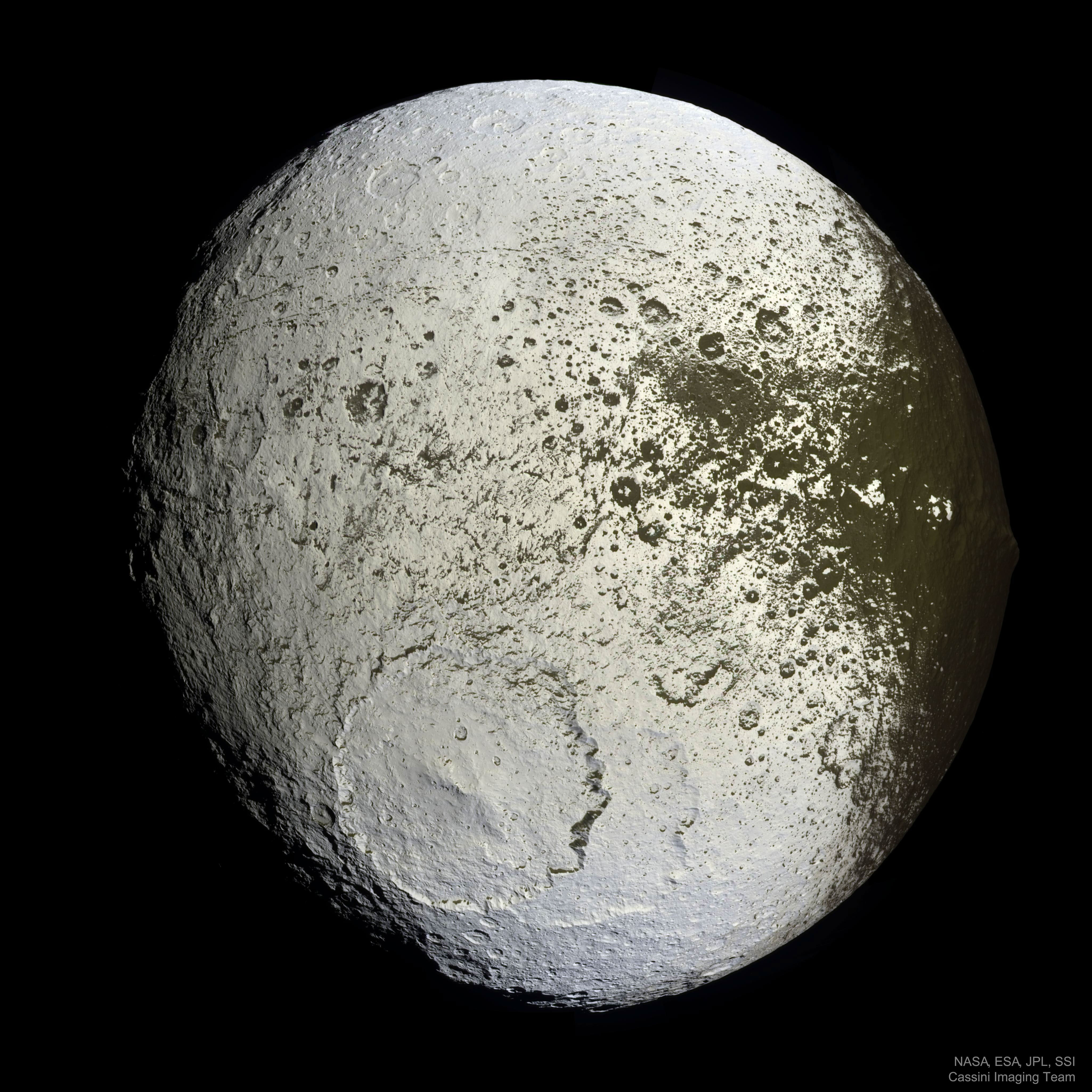
Why does Iapetus look like a moon painted in two colors?
Iapetus’s surface is a stark split between its dark and bright hemispheres. The dark side is coated with carbon-rich material, giving it a reddish-brown hue, while the bright side is icy and reflective. This contrast is so sharp that it’s visible even in low-resolution images from Earth.
Scientists believe the dark material is organic compounds, possibly tholins, deposited by tiny dust particles from Saturn’s rings or from external sources. The bright side remains largely water ice, reflecting sunlight like a mirror. This difference creates a visual effect that’s both beautiful and scientifically puzzling.
Understanding this contrast is crucial because it reveals the dynamic processes shaping moon surfaces. The deposition of organic-rich dust on one side indicates external influences—such as dust influx from planetary rings—and highlights how surface composition can evolve rapidly in space. Recognizing these processes helps scientists piece together the history of not just Iapetus but other moons subjected to similar external factors. This knowledge informs models of surface aging, the role of external material in surface chemistry, and the potential for similar processes on exoplanetary moons.
As an affiliate, we earn on qualifying purchases.
How did Iapetus get its massive equatorial ridge?
The giant ridge running along Iapetus’s equator is one of its most distinctive features. It stretches nearly 20 kilometers high and wraps around the moon like a bulky belt. The origin of this ridge is still debated, but recent theories point to a few exciting possibilities.
One idea is that the ridge resulted from the moon’s early rotation—perhaps it spun so fast that material piled up along its equator, like water swirling into a whirlpool. Another suggests tectonic stretching or a giant impact that caused the surface to buckle and uplift.
Recent observations from Cassini have shown that the ridge’s structure varies in height and shape, indicating a complex formation history. These variations suggest multiple processes might be at play—initial rapid rotation could have created a stress field that uplifted material, while subsequent impacts or tectonic activity could have further modified its form. Understanding these mechanisms is important because it sheds light on the internal and external forces acting on icy moons. If the ridge formed through rapid rotation, it implies a very different evolutionary path than if it resulted from impact or tectonics. Knowing which process dominates affects how we model moon formation and the stability of such features over geological time.
astronomy binoculars for planetary viewing
As an affiliate, we earn on qualifying purchases.
As an affiliate, we earn on qualifying purchases.
What recent NASA discoveries tell us about Iapetus’s surface and history
While no new missions have recently visited Iapetus, NASA’s Cassini spacecraft provided a treasure trove of data from 2004 to 2017. High-resolution images, spectral data, and gravity measurements have deepened our understanding of this moon’s history.
Spectral analysis confirms that the dark coating contains complex organic molecules, supporting the idea that external dust and organics accumulate over time. Meanwhile, studies of the ridge suggest it’s a remnant of the moon’s early life—possibly a tectonic scar or a feature formed by rapid rotation.
These discoveries are significant because they allow scientists to reconstruct Iapetus’s evolutionary timeline. The presence of organic molecules indicates ongoing external deposition, which could impact the moon’s surface chemistry and future geological activity. The ridge’s formation hints at a dynamic past involving rapid spin or impact events, which could influence models of moon stability and tectonics. Recognizing these insights enables scientists and space enthusiasts to better understand the processes that shape planetary bodies, informing the search for similar features on other moons and exoplanets. Practical takeaway: studying Iapetus’s history emphasizes the importance of external forces in planetary surface evolution, guiding future exploration priorities and surface analysis techniques.
As an affiliate, we earn on qualifying purchases.
What makes Iapetus different from other moons in our Solar System?
Most moons are either uniformly icy or rocky, but Iapetus stands out with its dramatic two-tone surface and towering ridge. It’s like a moon that’s been painted with a broad brush—half dark, half icy.
This contrast isn’t just pretty; it offers clues about the moon’s past, including external dust deposition, surface weathering, and tectonic forces. Its size and features also make it a key piece in understanding how moons evolve around giant planets.
Compared to Europa or Enceladus—moons with subsurface oceans—Iapetus’s icy shell and surface features tell a different story, one of external influences and ancient formation processes. Recognizing these differences helps scientists develop better models for moon evolution, which can influence how we interpret data from other planetary systems. For example, understanding the external dust accumulation on Iapetus can inform us about the potential surface chemistry of moons orbiting exoplanets, where direct observation is challenging. Additionally, the presence of a massive ridge and stark surface contrast serve as a reminder of the diverse geological histories moons can have, emphasizing the importance of tailored exploration strategies for each unique world.
| Feature | Iapetus | Enceladus | Europa |
|---|---|---|---|
| Surface Appearance | Dark and bright hemispheres, massive ridge | Cracked icy surface, geysers | Smooth icy shell, possible ocean beneath |
| Main Composition | Water ice, organics, dark carbon-rich material | Water ice, salts, organic molecules | Water ice, rocky core, subsurface ocean |
| Key Feature | Contrasting surface, equatorial ridge | Active geysers, cryovolcanoes | Subsurface ocean, surface cracks |
space-themed educational kits for kids
As an affiliate, we earn on qualifying purchases.
As an affiliate, we earn on qualifying purchases.
Frequently Asked Questions
Why does Iapetus have such a sharp surface contrast?
The dark side accumulates carbon-rich dust and organic molecules from external sources, while the icy bright side reflects sunlight, creating a stark contrast that’s visible even from Earth.
Is Iapetus’s equatorial ridge a sign of tectonic activity?
It could be, but scientists are still debating its origins. Theories include tectonic stretching, impact remnants, or formation-related processes, with ongoing research trying to pinpoint the cause.
Has Iapetus been explored up close?
No new missions have targeted Iapetus since Cassini, but its detailed data has provided a wealth of information. Future missions might revisit this painted moon to unlock more of its mysteries.
Could Iapetus support life?
No, its surface is extremely cold, and it lacks an atmosphere or liquid water. Its focus remains on understanding surface processes and moon formation, not habitability.
What makes Iapetus different from other Saturn moons?
Its stark surface contrast, the massive equatorial ridge, and its role in understanding moon evolution set Iapetus apart from moons like Enceladus or Tethys.
Conclusion
Iapetus’s painted face and towering ridge make it a natural wonder and a window into the moon’s turbulent past. Its contrasting surfaces aren’t just a visual spectacle—they’re clues to a dynamic history shaped by external dust, tectonics, and ancient impacts.
As future missions plan to revisit Saturn’s system, Iapetus’s secrets might finally be fully uncovered—adding new chapters to our understanding of planetary moons. Until then, it remains a stunning reminder of the universe’s artistic flair.
Columbus Day / Indigenous Peoples' Day Picks
long weekend sales
As an affiliate, we earn on qualifying purchases.