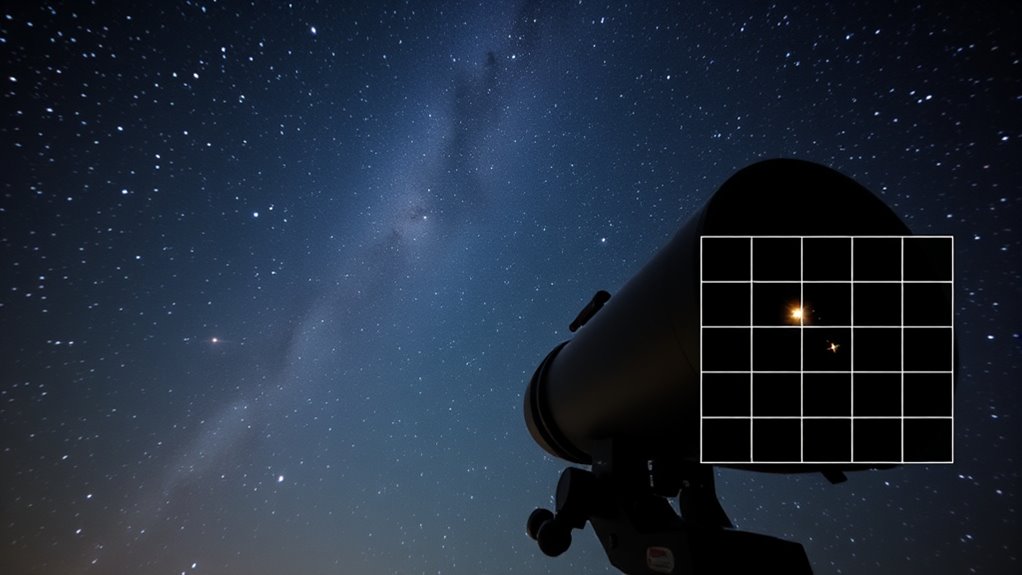
To select the right pixel size, you need to match your camera sensor’s resolution with your telescope’s focal length. Smaller pixels capture more detail but can oversample if your focal length is too long, leading to unnecessary noise. Larger pixels produce coarser images but are easier to manage. Finding the right balance ensures your images are sharp and detailed without star bloating or excessive noise. Keep exploring, and you’ll discover how to optimize your entire astrophotography setup.

Prime made for students and young adults
- Fast, free delivery for dorm and study essentials
- Prime Video and Amazon Music included
- Member-only deals
Key Takeaways
- Match your sensor’s pixel size to your telescope’s focal length to achieve an optimal imaging scale around 1-2 arcseconds per pixel.
- Use the formula: Imaging Scale (arcsec/pixel) = (Pixel Size in microns × 206.265) / Focal Length in mm.
- Smaller pixels require longer focal lengths for proper sampling, while larger pixels suit shorter focal lengths.
- Aim for a balance that prevents star bloating from undersampling or excessive noise from oversampling.
- Consider your target objects (planets, deep-sky) to determine the ideal pixel size and focal length combination.
Selecting the right pixel size is essential for guaranteeing your digital images meet your quality and detail requirements. When choosing a pixel size, you need to consider your sensor resolution and how it interacts with your telescope’s focal length. These factors directly influence your imaging scale—the relationship between the size of the celestial object and how it appears on your camera sensor. A proper match ensures your images are sharp, detailed, and accurately represent the night sky.
Choosing the right pixel size ensures sharp, detailed astrophotos that accurately capture celestial objects.
Sensor resolution plays a crucial role in determining your pixel size. Higher resolution sensors have more pixels packed into the same sensor area, allowing for finer detail capture. But if your pixels are too small relative to your telescope’s focal length, you might end up with oversampled images, which can introduce unnecessary noise and reduce your signal-to-noise ratio. Conversely, larger pixels may result in undersampling, causing stars to appear bloated or blurry. Striking a balance between sensor resolution and pixel size enables you to optimize the imaging scale, capturing the finest details without sacrificing image quality.
Imaging scale is the key to matching your sensor with your telescope. It’s typically measured in arcseconds per pixel, indicating how much of the sky each pixel covers. A smaller imaging scale means each pixel captures a narrower field of view, revealing more detail but requiring precise tracking to avoid star trails. Larger pixels and a coarser imaging scale might be easier to work with but won’t capture as much detail. To get the best results, you need to match your pixel size to your telescope’s focal length, considering your desired imaging scale. For example, if you’re aiming for high-resolution planetary imaging, smaller pixels and a shorter focal length are preferable. For deep-sky astrophotography, where you want to capture faint details over a larger area, larger pixels and a longer focal length might be more appropriate.
Ultimately, selecting the right pixel size is about finding the sweet spot where sensor resolution, imaging scale, and your specific goals align. If your pixels are too small, you risk oversampling and noise; if they’re too large, you lose detail. By understanding how sensor resolution influences pixel size and how that, in turn, affects your imaging scale, you can make an informed decision. Understanding sensor resolution and its impact on pixel size can help you optimize your imaging setup for the best results. This guarantees your images are sharp, detailed, and true to the celestial objects you’re capturing. Taking the time to match these factors carefully will improve your astrophotography results and help you get the most out of your telescope and camera setup.
Popular right now

Bose QuietComfort Ultra Earbuds (2nd Gen), Deep Plum

Ninja Foodi Air Fryer 10 Qt DualZone 6-in-1 Black DZ302

KitchenAid Artisan 5-Quart Tilt-Head Stand Mixer, KSM150PS, Almond Cream
As an affiliate, we earn on qualifying purchases.
Frequently Asked Questions
How Does Pixel Size Affect Image Noise in Astrophotography?
Pixel size impacts your image noise and light sensitivity considerably. Larger pixels gather more light, reducing sensor noise and making your images clearer, especially in low-light conditions. Smaller pixels, however, may increase sensor noise because they collect less light, which can lead to grainy images. Choosing the right pixel size helps balance light sensitivity and noise, ensuring you capture sharper, cleaner astrophotography shots with less interference.
Can Larger Pixels Compensate for Shorter Focal Lengths?
Larger pixels can help compensate for shorter focal lengths, but only to a point. They increase sensor resolution and enable pixel binning, which reduces noise and improves image quality. However, bigger pixels don’t fully replace the benefits of longer focal lengths for detailed astrophotography. You still need to balance pixel size with your telescope’s focal length to optimize image clarity and signal collection.
What Is the Impact of Pixel Size on Planetary Imaging Detail?
Larger pixels decrease resolution trade offs, meaning you get brighter images but less detail, while smaller pixels capture finer planetary features. Bigger pixels boost sensor sensitivity, helping you see faint details in low-light conditions, but they might limit the overall resolution. Conversely, smaller pixels enhance detail but require more precise focusing and stable conditions. Balancing pixel size ensures you optimize both detail and sensitivity for sharper planetary images.
How Do Sensor Size and Pixel Size Influence Field of View?
You’re playing with fire if you ignore sensor size and pixel size, as they directly influence your field of view. Larger sensors with bigger pixels offer a wider view, while smaller sensors and pixels focus on detail but narrow your scope. To get the best results, make certain your sensor resolution and pixel size are compatible with your telescope’s focal length. This way, you strike a balance between detail and coverage, no matter the mission.
Are There Optimal Pixel Sizes for Deep-Sky Versus Planetary Imaging?
For deep-sky imaging, opt for larger pixels, around 4-9 microns, to maximize sensor resolution and capture faint details, often using pixel binning to improve signal-to-noise ratio. For planetary imaging, smaller pixels, about 2-4 microns, are ideal as they provide higher resolution for fine detail. Adjust pixel binning based on your target, ensuring your sensor’s pixel size complements your telescope’s focal length for superior results.
Conclusion
In the end, selecting the right pixel size is like finding the sweet spot on your vintage radio—balance is key. Match your sensor to your telescope’s focal length, and you’ll capture crisp, detailed images without sacrificing sensitivity. Remember, even in this digital age, some principles, like the importance of proper matching, remain timeless. So, take your time, do your homework, and avoid turning your astrophotography efforts into a total “Black Hole” of wasted effort.