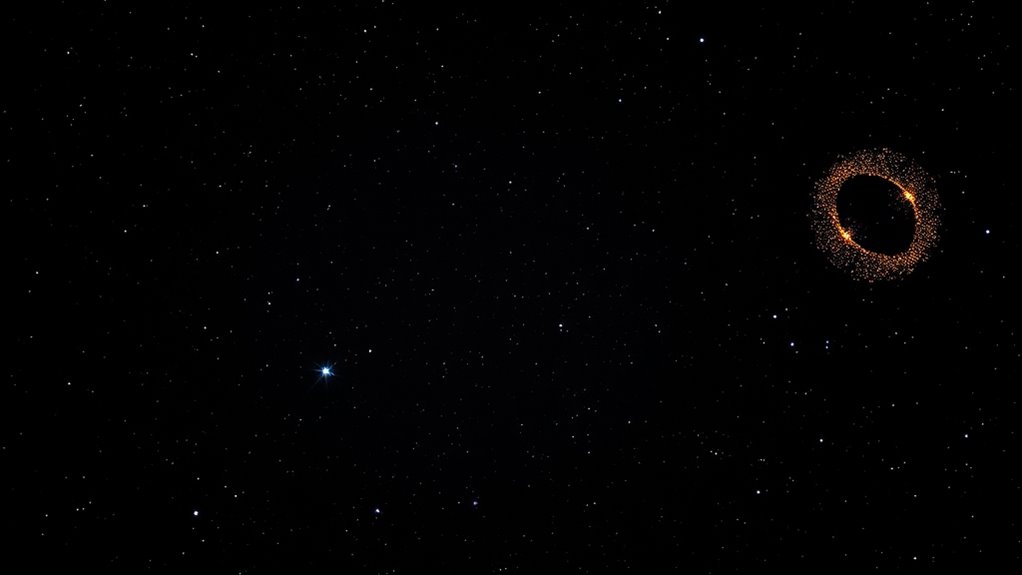
Seasonal star clusters like the Pleiades, Beehive, and Double Cluster offer spectacular views at different times of the year, helping you explore stellar life cycles and how stars evolve. The Pleiades shine with bright blue stars, while the Beehive shows a dense gathering of many stars, and the Double Cluster provides an impressive pair of stellar groups. Observing these clusters with binoculars or a telescope reveals fascinating details that deepen your understanding of our galaxy. Keep exploring to uncover more about their secrets.
Key Takeaways
- The Pleiades, Beehive, and Double Cluster are prominent seasonal star clusters visible at specific times of the year.
- These clusters showcase diverse stellar populations at various stages of stellar evolution.
- Observing them with binoculars or telescopes reveals detailed features like dust clouds and faint stars.
- They provide valuable insights into cluster formation, stellar life cycles, and gravitational interactions.
- Seasonal viewing allows repeated observations to study changes and deepen understanding of stellar development.
Seasonal star clusters are breathtaking groups of stars that appear at specific times of the year, offering skywatchers a chance to observe them in particular seasons. These clusters aren’t just beautiful; they also provide insights into stellar evolution, revealing how stars form, develop, and change over millions of years. When you observe a star cluster, you’re witnessing a snapshot of stellar life cycles, from youthful, bright stars to more mature, dimmer ones. To truly appreciate these clusters, you’ll want to use effective observational techniques, such as binoculars or telescopes, and learn how to interpret their structures and compositions. Understanding the stages of stellar evolution helps you grasp why these clusters look the way they do, with some stars still forming and others nearing the end of their life cycle. Additionally, studying their stellar populations can help astronomers determine the age and origin of each cluster.
The Pleiades, also known as the Seven Sisters, is one of the most famous seasonal star clusters. Visible to the naked eye, it appears as a shimmering collection of bright blue stars. Using binoculars or a small telescope, you can see dozens more stars within the cluster, each at different stages of stellar evolution. This variation is what makes the Pleiades so intriguing—some stars are still young and hot, while others have slightly aged. As you observe, you’ll notice that the cluster’s appearance changes with the seasons, offering a perfect opportunity to study how star groups evolve over time. By employing observational techniques, such as long-exposure astrophotography, you can reveal even fainter stars and dust clouds surrounding the cluster, enriching your understanding of its dynamic environment.
The Beehive Cluster, or Messier 44, is another seasonal star cluster that shines brightly during certain months. Its densely packed stars resemble a swarm of bees, hence the name. When you look at it through binoculars or a telescope, you see a rich tapestry of stars at various stages of stellar evolution, from youthful to more mature stars. Observing the Beehive can also teach you about the gravitational interactions within a cluster, as stars influence each other’s paths over millions of years. Using observational techniques like star counts and spectroscopy, you can analyze the chemical composition and age of these stars, gaining a deeper understanding of how such clusters form and change over time.
Finally, the Double Cluster in Perseus is a striking sight during the winter months. Its two nearly identical groups of stars sit close together, creating a mesmerizing view. As you observe this cluster, you can study how stellar populations differ within the same region, offering clues about their shared origins and stellar evolution pathways. Techniques like detailed imaging and spectral analysis help you decipher the physical properties of each star, revealing the ongoing processes that shape their life cycles. Engaging with these clusters during their seasonal appearances enriches your appreciation of stellar evolution and sharpens your observational skills, making each viewing session a learning experience.
Top picks for "cluster seasonal star"
Open Amazon search results for this keyword.
As an affiliate, we earn on qualifying purchases.
Frequently Asked Questions
How Do Seasonal Star Clusters Form and Evolve Over Time?
You see star clusters form when gas and dust in space collapse under gravity, igniting star formation. Over time, these clusters evolve as stars interact and drift apart due to gravitational influences. Their appearance changes, sometimes dispersing into the galaxy or remaining as tight groups. You can observe this process by studying different clusters at various stages, which reveals how cluster evolution shapes their structure and longevity in the cosmos.
What Are the Best Viewing Conditions for Observing These Clusters?
To get the best view of these star clusters, you should use a telescope with good specifications, like a moderate aperture of 4-8 inches, to enhance detail. Find a dark sky away from light pollution to improve visibility. You’ll see more stars and cluster features when you minimize ambient light, especially during clear, moonless nights. Patience and proper equipment will give you the clearest, most stunning view of these celestial groups.
Are There Any Mythologies Associated With Each of These Star Clusters?
You’ll find rich mythological origins and cultural significance behind these star clusters. The Pleiades symbolize mythic daughters of Atlas and Pleione, representing beauty and mystery in many cultures. The Beehive, or Praesepe, is linked to fertility and community myths, while the Double Cluster often symbolizes pairs in stories across different traditions. Exploring these mythologies enhances your appreciation, revealing how ancient peoples saw these clusters as more than just stars—they were stories in the sky.
Can These Clusters Be Observed From the Southern Hemisphere?
Imagine these star clusters as shimmering jewels in the night sky. You can indeed observe them from the Southern Hemisphere, especially during their peak viewing seasons. Their visibility varies with seasons, so plan your observation for clear, dark nights when the sky is most receptive. With a good telescope or binoculars, you’ll enjoy seasonal star cluster observation, revealing their beauty as if you’re gazing at glittering treasures in the cosmic vault.
What Future Scientific Discoveries Are Expected Related to These Clusters?
Future discoveries about these clusters will deepen your understanding of stellar composition and cluster lifespan. Advances in telescopes and imaging technology will help you learn how stars form and evolve within these groups. You might also uncover details about their ages and how long they stay bound together. These insights could reveal new aspects of star development, informing broader theories about galaxy evolution and the lifecycle of stellar clusters.
Conclusion
As you gaze upon the Pleiades, Beehive, and Double Cluster, you’ll realize these stellar gatherings are nothing short of cosmic marvels that ignite wonder in every stargazer’s soul. Each cluster offers a glimpse into the universe’s grandeur, reminding you that the night sky is a vast, celestial masterpiece. These seasonal treasures are more than stars; they’re luminous symphonies that stir the imagination and connect you to the infinite cosmos.