
TL;DR

Prime made for students and young adults
- Fast, free delivery for dorm and study essentials
- Prime Video and Amazon Music included
- Member-only deals
Messier 24 is a vast, star-rich region in Sagittarius, not a single object. It’s a window into the Milky Way’s dense center, visible with binoculars or small telescopes. Modern surveys have refined its distance and structure, helping us understand our galaxy better.
Imagine peering into a glowing, cosmic tapestry, bursting with stars and swirling dust, all packed into a seemingly tiny patch of sky. That’s Messier 24—the Sagittarius Star Cloud. It’s neither a single star nor a galaxy, but a sprawling star field nestled near the center of our galaxy, visible to anyone with a dark enough sky.
Tonight, you can look through binoculars or a small telescope and see this dense stellar neighborhood stretch across the sky, offering a direct peek into the Milky Way’s bustling core. It’s a scene filled with mystery, beauty, and stories of billions of stars forming and evolving right above us.
Messier 24 is a massive star cloud, not a single object, spanning over 1.5 degrees in the sky and packed with thousands of stars.
You can see M24 with binoculars or small telescopes, especially on a dark, moonless night in Sagittarius during summer.
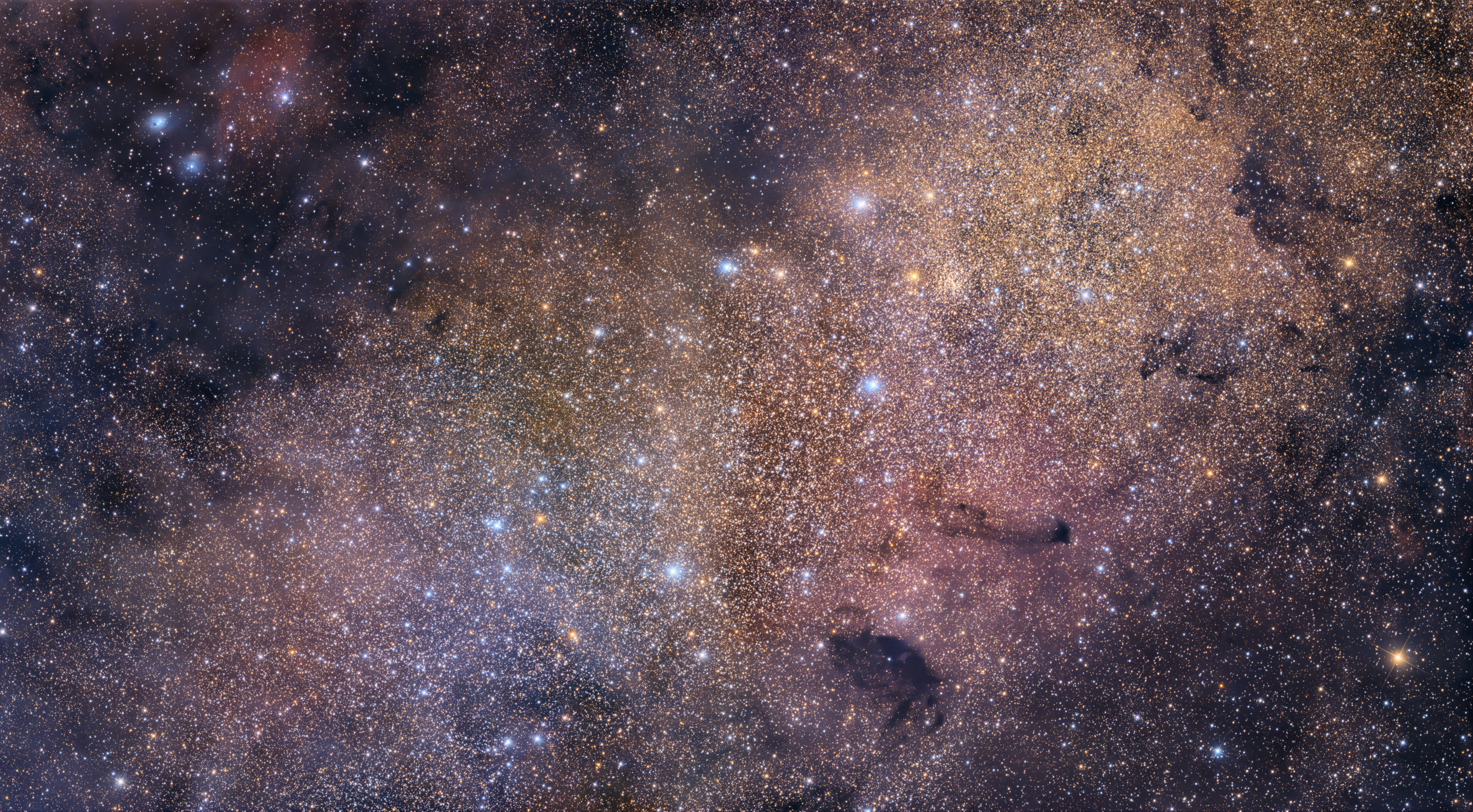
Dark nebulae within M24, like B92 and B93, add contrast, making it a stunning target for astrophotography.
Recent missions like Gaia help pin down M24’s distance at about 19,000 light-years, deepening our understanding of the galaxy’s core.
Compared to other star clusters or nebulae, M24 offers a rare, wide-angle view into the dense, dusty heart of the Milky Way.
What Exactly Is Messier 24 And Why Should You Care?
Messier 24 is a vast, luminous cloud of stars in the constellation Sagittarius. Unlike most objects in Charles Messier’s catalog, it’s not a bright galaxy or a star cluster. Instead, it’s a gigantic window through the dust clouds that usually hide the galaxy’s heart.
Picture looking through a foggy window and suddenly seeing a crowded street on the other side. That’s what M24 does—it pierces through the dark interstellar dust, revealing thousands of stars, some over 10,000 light-years away. It spans roughly 1.5 degrees across in the sky, which is about three times the size of the full moon.
Understanding M24’s structure and composition helps astronomers piece together how our galaxy’s core is built and evolves. It offers clues about star formation in dense environments, revealing how dust and gas condense into new stars amid a crowded stellar neighborhood. Recognizing its importance also highlights the delicate balance in observing such objects; the dust clouds that make M24 visible also obscure other features, forcing astronomers to develop specialized methods to study these regions. For amateur observers, appreciating this complexity enhances the wonder of what you’re seeing and underscores the importance of dark skies and proper equipment for revealing these cosmic secrets.
As an affiliate, we earn on qualifying purchases.
How To Spot M24 From Your Backyard Tonight
- Find Sagittarius in the evening sky during summer in the Northern Hemisphere. Look for its distinctive teapot shape—this asterism is a reliable guide to locate the galaxy’s heart region.
- Use binoculars or a wide-field telescope to scan the area near the teapot’s spout—this is where M24 lies, about a finger’s width above the center of Sagittarius.
- Choose a dark, moonless night, free from city lights. The richer the darkness, the more stars you’ll see within M24, allowing you to appreciate its true extent and complexity.
- Patience pays off—allow your eyes to adapt to darkness for at least 20 minutes. Then, slowly sweep across the star cloud for the best view. This patience is vital because the faint structures and dust lanes become more apparent when your eyes are fully dark-adapted, revealing intricate details that are otherwise hidden.
Imagine the rich, dark aroma of fresh pine in the woods—your eyes need to adjust to the darkness just like your nose adjusts to a new scent. When you do, M24 will reveal a tapestry of pinpricks of light, dark nebulae, and dust lanes. Recognizing these features deepens your appreciation for the dynamic environment of our galaxy’s core, where dust and stars coexist in a delicate, ever-changing balance. The ability to see these subtle structures connects you firsthand with the processes shaping our galaxy, making your observation not just a visual experience but a window into cosmic evolution.
small telescope for astrophotography
As an affiliate, we earn on qualifying purchases.
As an affiliate, we earn on qualifying purchases.
Why M24 Is a Goldmine for Astrophotographers
Capturing M24 on camera is all about the right gear and conditions. Use a wide-angle lens or a small telescope with a camera capable of long exposures. A tracking mount helps because even with short exposures, the star field can drift if you’re not stable.
Choose a night with minimal moonlight and good transparency. The best shots reveal not just the stars, but the dark nebulae B92 and B93 weaving through the star cloud—these shadows add depth and drama.
Pro tip: Take multiple 2-4 minute exposures and stack them. This technique enhances faint details and reduces noise, bringing out the intricate dance of dust and stars. The process of stacking and processing images allows astronomers and astrophotographers to uncover features that are invisible to the naked eye, emphasizing the importance of patience and technical skill in astrophotography. It also demonstrates how modern technology extends our ability to study the universe, revealing structures that are millions of light-years away in unprecedented detail. Mastering these techniques transforms simple captures into detailed cosmic portraits, enriching our understanding of galactic environments.
As an affiliate, we earn on qualifying purchases.
What Modern Science Tells Us About M24 and Our Galaxy
Recent data from the Gaia mission confirms that M24 sits about 19,000 light-years from Earth, nestled in the Sagittarius arm of the Milky Way. Its stars are part of a bustling stellar neighborhood, illustrating how crowded our galaxy’s core region truly is.
Scientists use this star cloud to study star formation and the distribution of interstellar dust. The dark nebulae within M24 act like cosmic filters, telling us about the composition of the gas and dust that form new stars. These regions help astronomers understand the lifecycle of matter in our galaxy—how raw material is recycled and redistributed in dense environments, influencing subsequent generations of stars and planetary systems. By analyzing how dust lanes obscure or reveal different features, researchers can develop models of galactic evolution, shedding light on the processes that shape not only our galaxy but also others in the universe.
Compared to the sprawling, faint regions of the galaxy, M24’s brightness and density make it an ideal natural laboratory for understanding the galactic environment near the center. This insight is crucial because the core regions are the most dynamic and least understood parts of the galaxy. Studying M24 helps scientists piece together how galaxies grow, evolve, and sustain star formation amid intense gravitational and energetic environments, offering a microcosm of galactic life cycles.
As an affiliate, we earn on qualifying purchases.
Frequently Asked Questions
Can I see Messier 24 with just my naked eye?
Yes, in a dark sky away from city lights, M24 appears as a faint, cloudy patch in Sagittarius. Binoculars or a small telescope will reveal much more detail and stars within it.When is the best time to observe M24?
The best viewing window is during summer evenings in the Northern Hemisphere, when Sagittarius is high in the sky, especially around July and August.What equipment do I need to photograph M24?
A wide-angle lens or small telescope with a camera capable of long exposures works well. Use a tracker mount if possible, and shoot during clear, moonless nights for the best results.How deep into space can I see with M24?
M24’s stars are over 10,000 light-years away, but the dust and dark nebulae within it reveal the complex structure of the Milky Way’s core, shaping our understanding of galactic evolution.Are there other similar star clouds nearby?
Yes, regions near the galactic center are rich with star clouds, nebulae, and clusters, but M24 stands out for its size and density, making it a prime target for both visual and photographic observation.Conclusion
The Sagittarius Star Cloud isn’t just a pretty picture—it’s a cosmic treasure chest revealing how crowded and complex our galaxy’s core really is. With modest gear and a dark sky, you can peer through the dust and see the galaxy’s bustling heart, full of stories waiting to be uncovered.
Next clear night, set your sights on Sagittarius and let M24 remind you: the universe’s greatest wonders often hide right in plain sight, waiting for you to look up.
Columbus Day / Indigenous Peoples' Day Picks
long weekend sales
As an affiliate, we earn on qualifying purchases.