
To accurately align your telescope using celestial coordinates, you need to understand both equatorial and horizontal systems. The equatorial system uses right ascension and declination, which stay fixed relative to the stars, making tracking easier. The horizontal system relies on altitude and azimuth, aligning with your local horizon for quick, practical pointing. Mastering these systems helps you find objects precisely, boosting your confidence and observation success. Keep exploring to uncover more tips for perfect alignment.
Key Takeaways
- Familiarize yourself with equatorial (RA and Dec) and horizontal (altitude and azimuth) coordinate systems.
- Use celestial coordinates to precisely locate and align telescopes with target objects.
- Understand how Earth’s rotation affects the apparent positions of celestial bodies over time.
- Convert between coordinate systems to improve accuracy in telescope setup and tracking.
- Regularly update your local sidereal time and observer location for optimal alignment.
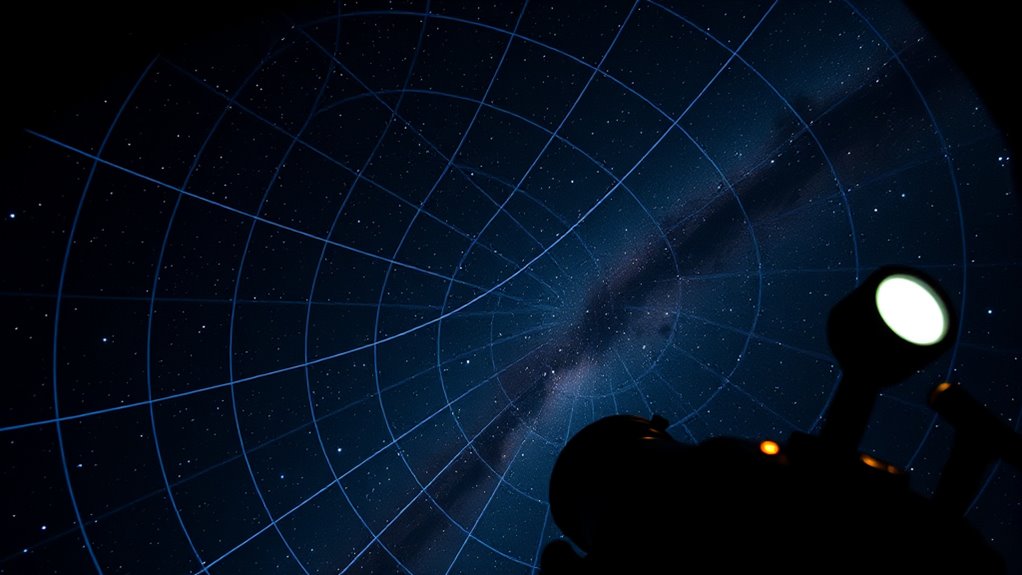
Celestial coordinates are essential tools that help you locate objects in the night sky with precision. Without them, finding planets, stars, or deep-sky objects would be like searching for a needle in a haystack. These coordinates are part of coordinate systems that astronomers and stargazers use to map the heavens accurately. Think of celestial mapping as your celestial GPS, guiding you to celestial bodies no matter where you are on Earth. By understanding how these systems work, you can substantially improve your ability to align your telescope and observe your targets with confidence. Recognizing how coordinate systems interact enhances your overall understanding of celestial navigation. There are several types of coordinate systems, but the most common ones are the equatorial and horizontal systems. The equatorial coordinate system is like Earth’s latitude and longitude but projected onto the celestial sphere. It uses two main coordinates: right ascension (RA) and declination (Dec). Right ascension measures how far an object is along the celestial equator, while declination indicates how far above or below the celestial equator the object is located. This system remains fixed relative to the stars, making it ideal for tracking celestial objects over time. When you use celestial mapping tools, you’re essentially translating these coordinates into visual positions, making it easier to plan your night sky observations. The horizontal coordinate system, on the other hand, is based on your specific location on Earth. It uses altitude and azimuth to pinpoint objects relative to your horizon. Altitude measures how high an object is in the sky, while azimuth indicates the direction along the horizon, usually expressed in degrees from north. This system is more intuitive for casual stargazing because it aligns with what you see when looking up. To achieve the most accurate alignment, you often switch between these coordinate systems, translating celestial mapping data into practical pointing commands for your telescope. Mastering celestial coordinates isn’t just about knowing the numbers; it’s about understanding how they work together to give you a clear picture of the night sky. When you grasp the relationship between coordinate systems, you can better plan your sessions and make precise adjustments to your telescope’s alignment. This knowledge guarantees your equipment tracks objects smoothly, reducing frustration and maximizing your observing time. Whether you’re a beginner or an experienced astronomer, knowing how to use celestial mapping and coordinate systems effectively transforms your stargazing experience from guesswork into precise exploration. By doing so, you’ll reveal the secrets of the universe, one coordinate at a time.
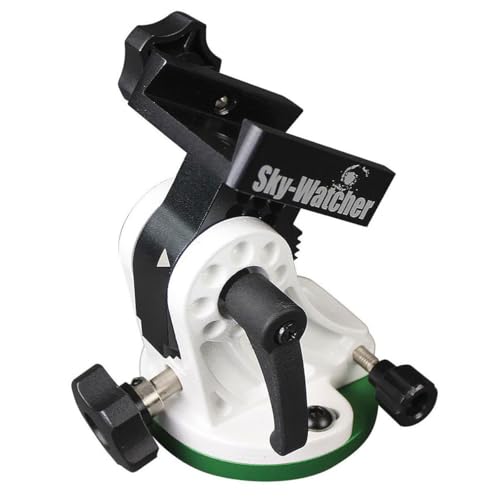
Sky Watcher S20530 Star Adventurer Latitude (EQ) Base, Telescope Accessory, Black
Star Adventurer accessory
As an affiliate, we earn on qualifying purchases.
As an affiliate, we earn on qualifying purchases.
Frequently Asked Questions
How Do Celestial Coordinates Change Over Time?
Celestial coordinates change over time due to Earth’s axial precession, nutation, and orbital motion. You need to perform proper coordinate transformations to account for these shifts and maintain celestial coordinate stability. By updating your calculations regularly with current data, you guarantee your telescope aligns accurately. This awareness helps you track objects precisely, compensating for the slow but continuous celestial movements that affect your observations over days, months, and years.
What Tools Are Best for Measuring Celestial Coordinates?
Did you know that over 88,000 stars are visible to the naked eye? To measure celestial coordinates accurately, you should use star charts for visual reference and digital encoders for precise alignment. Star charts help identify objects, while digital encoders track your telescope’s movement with high accuracy. Combining these tools guarantees your setup stays aligned, even over long observation sessions, enhancing your stargazing experience.
How Do Coordinate Systems Differ Across Hemispheres?
In different hemispheres, coordinate systems vary due to hemisphere variations, affecting how you align your telescope. You need to make coordinate adjustments, such as flipping the declination or right ascension, to account for your location. This guarantees accurate tracking of celestial objects. By understanding these hemisphere variations, you can properly adjust your equipment, making celestial navigation more precise and improving your overall stargazing experience.
Can Celestial Coordinates Be Used for Deep-Sky Object Tracking?
Yes, celestial coordinates are essential for deep-sky object tracking. You use star cataloging to identify objects precisely, then apply coordinate transformations to account for Earth’s rotation and position. This process helps you locate and follow deep-sky objects accurately over time. By understanding how coordinates shift with time and location, you improve your tracking precision, making your astrophotography and observations more successful.
How Precise Do Alignment Procedures Need to Be Using These Coordinates?
Your alignment procedures should be very precise to ensure accurate tracking. Proper telescope calibration and high alignment accuracy are essential, especially for deep-sky objects. Slight errors in celestial coordinates can cause noticeable drift over time. Use star alignment methods and refine your calibration regularly to improve accuracy. The more precise your alignment, the better your telescope will follow celestial objects, making deep-sky imaging and observation more successful.
celestial coordinate finder
As an affiliate, we earn on qualifying purchases.
As an affiliate, we earn on qualifying purchases.
Conclusion
By mastering celestial coordinates, you’ll enhance your stargazing accuracy and uncover the universe’s secrets. Did you know that over 200 billion stars are estimated to be in our galaxy alone? With this knowledge, your observations become more precise, making each night under the stars even more mesmerizing. Keep practicing, and you’ll find yourself steering the cosmos with confidence and wonder, appreciating the vastness and detail of the universe like never before.

FANAUE SkyGuider Pro Base Mount for Star Tracker – Low Latitude Version, Precision CNC Aluminum Base, Stable Polar Alignment Platform for Astrophotography & Star Tracking
Designed for Low-Latitude Star Tracking: Specifically engineered for low-latitude regions, this base mount provides a more suitable adjustment…
As an affiliate, we earn on qualifying purchases.
As an affiliate, we earn on qualifying purchases.

Astromania Laser Collimator for Newtonian Dobsonian Marca Telescopes, Telescope Alignment 1.25 Inch with 7 Red Laser Bright Levels, Great Telescope Accessories Laser Alignment Tool for Collimation
Multi-Function: Designed for Reflector telescope; fit for standard 1.25 inch diameter; this sturdy laser unit allows to swiftly…
As an affiliate, we earn on qualifying purchases.
As an affiliate, we earn on qualifying purchases.