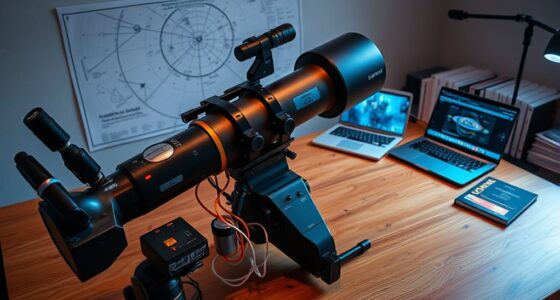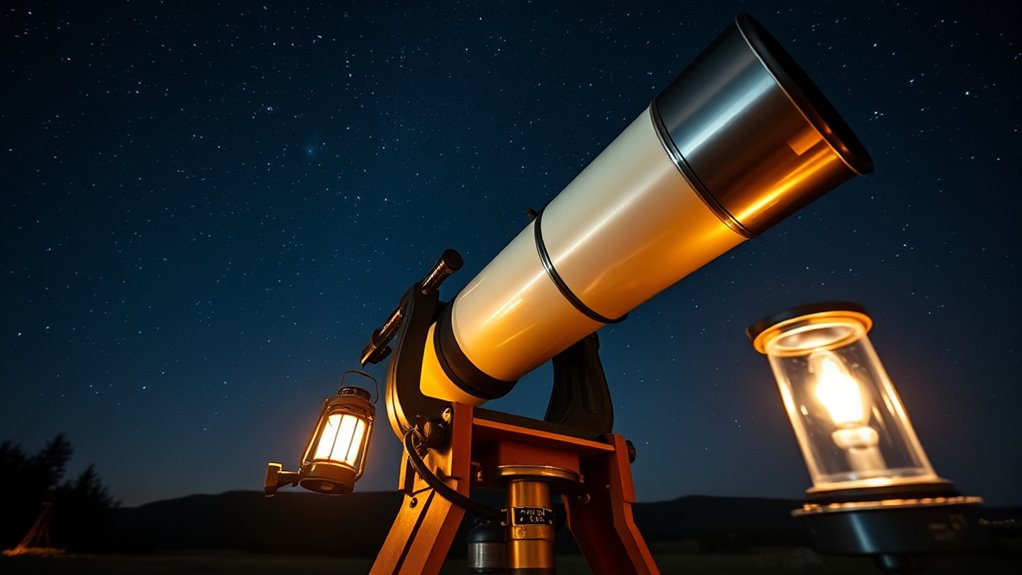

To polar align an alt-azimuth mount using a wedge, start by attaching the wedge securely to your mount on a stable surface. Adjust the wedge’s tilt angle to match your local latitude, ensuring the mount’s axis points toward the celestial pole (north or south). Fine-tune the alignment using a polar scope or known stars, and make small adjustments as needed. Continuing will reveal more tips to improve your tracking accuracy and astrophotography results.

Prime made for students and young adults
- Fast, free delivery for dorm and study essentials
- Prime Video and Amazon Music included
- Member-only deals
Key Takeaways
- Attach the wedge securely to the mount on a stable surface before mounting your telescope.
- Adjust the wedge’s tilt angle to match your geographic latitude for proper polar alignment.
- Point the mount’s axis toward the celestial pole (North or South) after tilting the wedge.
- Use a polar scope or known celestial objects for fine-tuning the alignment.
- Perform periodic adjustments during observing sessions to maintain accurate tracking.
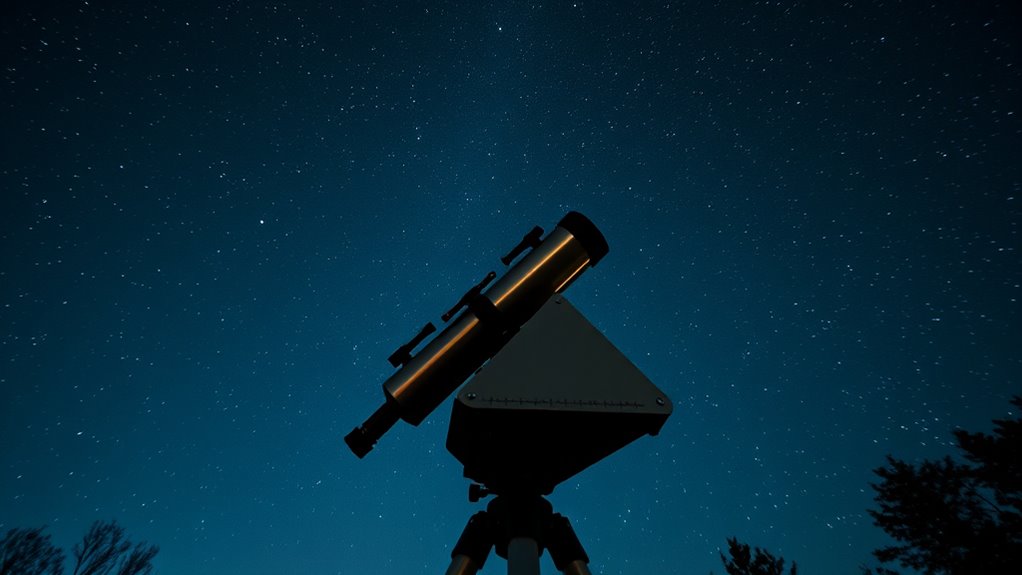
Ever wonder if you can achieve accurate tracking with an alt-azimuth mount? While these mounts are user-friendly and ideal for visual observing, they don’t naturally support equatorial tracking, which is essential for astrophotography and long-exposure imaging. However, by using a wedge, you can modify your alt-azimuth mount to approximate an equatorial setup. This process involves polar alignment, which aligns your mount’s axis with Earth’s rotational axis, allowing for smoother tracking of celestial objects. With proper mount calibration and the right adjustments, you can markedly improve your tracking accuracy, making astrophotography more feasible with an alt-azimuth mount.
The key to effective polar alignment using a wedge is understanding how to set it correctly. The wedge tilts your mount, so its axis points roughly toward the celestial pole—either the North Celestial Pole or the South Celestial Pole, depending on your hemisphere. To start, you position your mount on a stable surface, attach the wedge securely, and then adjust the tilt angle based on your geographic latitude. This tilt ensures that the mount’s axis aligns with Earth’s axis, facilitating near-equatorial tracking. Once the wedge is set correctly, you need to perform mount calibration, which involves fine-tuning the mount’s position to minimize tracking errors. This process often includes aligning the mount with a known celestial object or using a polar scope if available.
Achieving good equatorial tracking with a wedge-mounted alt-azimuth involves more than just initial setup. You’ll need to make periodic adjustments during your session to compensate for any minor misalignments. Many amateur astronomers use software or apps that help with polar alignment by guiding you through the calibration process, ensuring your mount’s axis remains aligned with Earth’s rotation over time. With consistent mount calibration, you’ll notice that celestial objects stay centered longer, and your tracking becomes more precise, reducing star trails and blurring in your images.
As an affiliate, we earn on qualifying purchases.
Frequently Asked Questions
Can I Polar Align an Alt-Azimuth Mount Without a Wedge?
Yes, you can polar align an alt-azimuth mount without a wedge, but it’s less precise. You’ll need to perform a rough mount alignment first, then adjust your mount’s azimuth and altitude to match the celestial pole as closely as possible. A wedge adjustment helps improve accuracy by tilting the mount to match your latitude, but without it, your polar alignment will be less stable, especially for long exposures.
How Does Polar Alignment Improve Astrophotography With Alt-Azimuth Mounts?
Polar alignment improves your astrophotography with an alt-azimuth mount by enabling better star tracking and enhancing image clarity. When your mount is precisely aligned with the celestial pole, stars stay fixed in your camera’s view, reducing star trails. This steady tracking results in sharper images and allows for longer exposures, which is essential for capturing faint deep-sky objects and achieving professional-looking astrophotography results.
What Tools Are Essential for Precise Wedge-Based Polar Alignment?
Imagine capturing sharp, long-exposure images; precise wedge-based polar alignment is essential. You’ll need a good polar scope to align with Polaris accurately and a leveling tool to guarantee your wedge is perfectly horizontal. These tools help you set your mount correctly, reducing star trails. When you combine a reliable polar scope with a precise leveling tool, you considerably improve your alignment, leading to clearer, more detailed astrophotographs.
How Often Should I Recalibrate My Wedge Setup?
You should recalibrate your wedge setup whenever you notice alignment issues or after significant changes in your observing environment. Regular alignment maintenance is key, so consider checking calibration frequency every few months or before important observing sessions. Environmental factors like temperature shifts can impact accuracy, so staying vigilant and performing periodic recalibrations ensures your setup remains precise for ideal tracking and imaging.
Is Wedge Polar Alignment Suitable for Beginner Astronomers?
Imagine steering a ship through calm waters; wedge polar alignment is like that steady hand guiding you. For beginners, this technique simplifies mount alignment, making it accessible and effective. It’s a reliable method that helps you learn the basics without overwhelming complexity. Using wedge polar alignment with beginner techniques offers a gentle start, allowing you to focus on your observations and enjoy the journey of astronomy as you master your mount setup.
astrophotography polar alignment kit
As an affiliate, we earn on qualifying purchases.
As an affiliate, we earn on qualifying purchases.
Conclusion
Now that you’ve set up your wedge and aligned your alt-azimuth mount, imagine gazing upward as the stars begin to trace their paths across the sky. With each precise adjustment, you’ll feel the universe slowly reveal its secrets, just waiting for you to discover them. Keep your focus, stay patient, and soon, the night will unfold its mysteries. The cosmos is within your reach—are you ready to open its hidden wonders?
polar scope for alt-azimuth mount
As an affiliate, we earn on qualifying purchases.
As an affiliate, we earn on qualifying purchases.
As an affiliate, we earn on qualifying purchases.
Halloween Picks
halloween
As an affiliate, we earn on qualifying purchases.