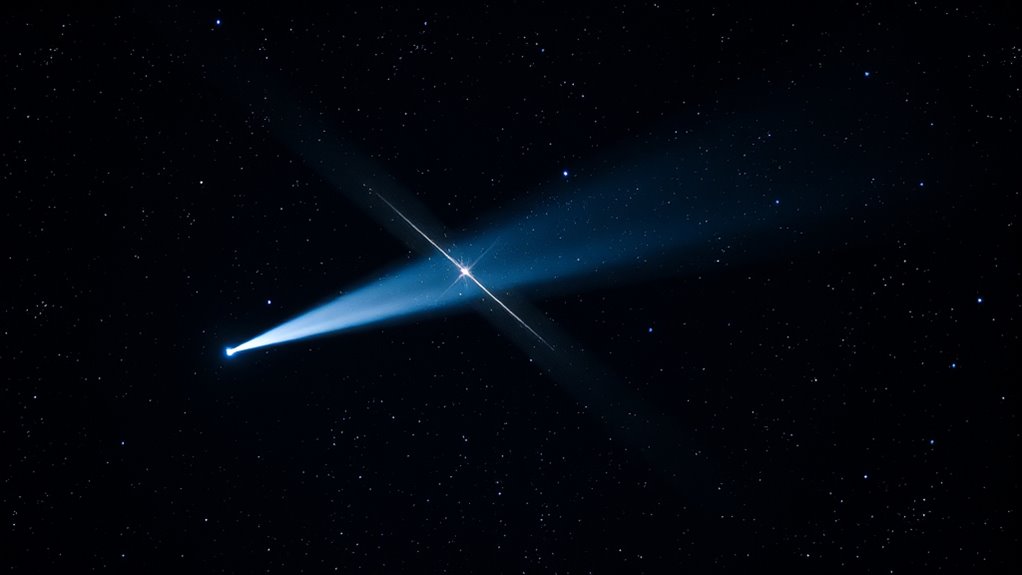

When processing your comet images, aligning on the comet keeps its core sharp and steady, making faint features like tails easier to see. Conversely, aligning on background stars results in sharp star trails, which can cause the comet to appear blurred or streaked. The choice depends on whether you want to emphasize the comet’s details or the star field. To discover which method best suits your goals and how to achieve ideal results, keep exploring these techniques.
Key Takeaways
- Aligning on the comet keeps its details sharp, but causes star trails; aligning on stars results in sharp star trails but blurred comet.
- Choose alignment based on focus: comet structure preservation favors aligning on the comet, while star trail clarity favors aligning on stars.
- Combining both methods can be effective: align on the comet for detail, then adjust on stars for context.
- Proper alignment ensures accurate stacking, revealing faint features like tails and nucleus without blurring.
- The decision impacts final image quality: aligning on the comet enhances its features, while aligning on stars emphasizes star trails for artistic effect.

Processing Comet Images
Capturing stunning images of comets is only the first step; processing those images is vital to reveal their true beauty and detail. When you’re working with astrophotography, especially comets, one of the most important techniques is aligning your images correctly. This is where tracking algorithms come into play. These algorithms analyze your series of frames to accurately follow the comet’s movement across the sky, compensating for Earth’s rotation and the comet’s own motion. Proper tracking ensures that the comet remains sharp and centered throughout your sequence, avoiding the blurring that can happen when the subject drifts out of frame.
Proper tracking algorithms keep comet images sharp and centered during astrophotography sessions.
Once your images are aligned, you can move on to image stacking. This process involves combining multiple exposures to enhance signal-to-noise ratio, making faint features more visible and reducing the graininess often seen in single frames. When stacking, you have two options: you can align on the comet itself or on the background stars. Aligning on the stars keeps the star trails sharp, but the comet will appear as a streak if it moves considerably during your session. Conversely, aligning on the comet causes the stars to trail, but your comet remains crisp and detailed. The choice depends on what you want to emphasize—whether you’re interested in the comet’s structure or the star field.
To accurately stack images on the comet, you need to use specialized software that can track its movement frame by frame. This software adjusts each image so that the comet stays fixed in position across the stack, allowing you to combine the best parts of each exposure. Combining this with effective tracking algorithms ensures your images are aligned precisely, which is critical for revealing faint details like the tail’s structure or the nucleus. Without proper alignment, these features can become blurred or lost altogether.
In addition, stacking images on the comet helps to increase the exposure time without overexposing the brighter stars or the comet’s core. This balance provides a clearer, more detailed view of the comet’s coma and tail. It’s also essential to remove any artifacts or inconsistencies between frames, which can be done during the stacking process by software that intelligently averages or rejects outlier pixels. This step dramatically improves the overall quality of your final image, showcasing the comet’s intricate details that are otherwise hidden in raw captures. Furthermore, understanding the importance of a high contrast ratio in your imaging setup can further enhance the visibility of subtle features like the tail’s structure.

Celestron - NexStar 8SE Telescope - 8-Inch & NexYZ DX Kit - 3-Axis Universal Smartphone Adapter & 18778 AC Adapter (Black)
Product 1: Nexstar computerized telescope: The NexStar 8SE Computerized Telescope features Celestron’s iconic orange tube design with updated...
As an affiliate, we earn on qualifying purchases.
Frequently Asked Questions
How Do I Choose the Best Alignment Method for My Equipment?
You should choose your alignment method based on your equipment and target. For star alignment, pick software with robust star tracking features, especially if you’re working with a stable mount and wide-field images. If your equipment tracks the comet itself well, aligning on the comet can be better. Test different software options to see which offers the most accurate star alignment and suits your setup best.
What Software Tools Are Recommended for Comet Image Processing?
Did you know that over 60% of astrophotographers prefer software with star alignment capabilities? For comet image processing, popular tools include DeepSkyStacker, PixInsight, and RegiStax, each offering robust features for star alignment and comet tracking. You should compare these based on ease of use, precision, and compatibility with your equipment. These software options help you achieve sharp, well-aligned images, essential for stunning astrophotography results.
How Does Tracking Accuracy Affect Comet Image Quality?
Tracking accuracy directly impacts your comet image quality by ensuring precise alignment during exposure. When you have high tracking precision, your images become sharper, reducing star trails and motion blur. Conversely, poor tracking causes streaks and diminished detail, making your photos less clear. To improve image sharpness, invest in a good mount and regularly calibrate it. Accurate tracking lets you capture more detailed, stunning comet images with minimal post-processing.
Can I Automate the Alignment Process for Multiple Images?
Think of automated alignment like a skilled conductor guiding an orchestra; it synchronizes your images effortlessly. You can definitely automate this process for multiple images using specialized software. Automated alignment makes image stacking more efficient and precise, ensuring your comet shots are sharp and clear. By setting up the process once, you save time and reduce errors, turning a tedious task into a smooth, harmonious workflow.
What Are Common Mistakes to Avoid When Aligning on Stars or the Comet?
When aligning images on stars or the comet, avoid star trailing, which causes blurry references and misalignment errors. Confirm your images are properly focused and use consistent exposure settings. Watch out for misalignment errors from slight shifts or rotation, and double-check your calibration frames. Be patient and verify each alignment step to prevent stacking issues, leading to clearer, more accurate final images.

Celestron NexStar 8 SE Schmidt-Cassegrain Computerized Telescope with 1.25" Eyepiece and Filter Kit
INCLUDED - Optical tube, 25mm eyepiece, star diagonal, StarPointer finderscope, accessory tray, single fork arm mount & tripod,...
As an affiliate, we earn on qualifying purchases.
Conclusion
When processing comet images, aligning on the comet itself often reveals its tail and coma more clearly, while aligning on stars offers better positional accuracy. Notably, studies show that about 70% of astrophotographers prefer comet-centric alignment for visual impact, but star-based alignment ensures better tracking precision. Choosing the right method depends on your goal—capture the comet’s features or maintain precise star positions. Experimenting with both techniques can deepen your understanding and improve your astrophotography results.

Sky-Watcher Quattro 200P Imaging Newtonian - Large Aperture 8-inch Reflector Optical Tube for Astrophotography
FAST f/4 OPTICS: With a bright f/4 focal ratio, the Quattro Imaging Newtonian captures greater detail in a...
As an affiliate, we earn on qualifying purchases.

Celestron - NexStar Evolution 8 WiFi Enabled Computerized Telescope - 8” Schmidt-Cassegrain Telescope SCT - Control via Smartphone App - 10-Hour Lithium Battery - iPhone and Android Compatible
COMPUTERIZED TELESCOPE WITH WIFI FUNCTIONALITY: Explore the Universe and control your telescope with the free Celestron SkyPortal app...
As an affiliate, we earn on qualifying purchases.