The best beginner astrophotography telescope depends on whether you want a guided, all-in-one imaging experience or a traditional telescope that leaves more setup and camera choices to you. My best overall pick is the DWARFLAB Dwarf 3 for accessible automated imaging, while the ZWO Seestar S30 is a strong alternative for a compact smart system and the SVBONY SV503 102mm F7 ED suits beginners who want a more hands-on optical setup. Smart telescopes simplify finding and capturing targets, but offer less control over the imaging chain; optical tubes can offer more flexibility, though they need a suitable mount, camera, and careful setup. Aperture, focal length, mount tracking, portability, and how much you want to learn all affect the choice. Read on for the full comparison and guidance on matching a telescope to your first astrophotography goals.

Get school and study supplies delivered free — and shop member deals
- Fast, free delivery on millions of items
- Access to Prime Big Deal Days deals on October 6–7
- Prime Video, Amazon Music and more included
Key Takeaways
- Smart telescopes reduce setup friction: The DWARFLAB Dwarf 3 and ZWO Seestar S30 combine imaging and automated operation, making them the most direct route to capturing deep-sky targets without assembling a separate camera system.
- An optical tube alone is not a complete imaging kit: The SVBONY SV503 102mm F7 ED, SV48P, and SV555 still need a suitable mount, camera, and supporting accessories, so their flexibility comes with more planning.
- Mount and tracking choices matter as much as aperture: Computerized GoTo models such as the Celestron NexStar 5SE and 127SLT help locate targets, but beginners should distinguish target finding from the tracking and imaging needs of long exposures.
- Newtonians offer aperture at the cost of setup demands: Options such as the MEEZAA 150EQ, AstroMaster 130EQ, and StarSense Explorer 150mm tabletop Dobsonian put more light-gathering capability within reach, but mounts, collimation, and camera access can complicate imaging.
- Visual-first beginner scopes are not automatic astrophotography solutions: The Gskyer 70mm, Koolpte 80mm, and StarSense Explorer LT 114AZ can support early observing and phone snapshots, but their supplied mounts and accessories are not equivalent to a dedicated tracking imaging rig.
| SVBONY SV503 102mm F7 ED Refractor Telescope OTA |  | Best for Camera-Ready Optics | Aperture: 102mm | Focal length: 714mm (f/7) | Glass: S-FPL51 ED | VIEW LATEST PRICE | See Our Full Breakdown |
| DWARFLAB Dwarf 3 Smart Telescope |  | Best Portable Smart Telescope | Weight: 3 lb (1.35kg) | Resolution: 4K | Lens system: Dual lens: telephoto and wide-angle | VIEW LATEST PRICE | See Our Full Breakdown |
| Celestron StarSense Explorer LT 114AZ Newtonian Smartphone Guided Telescope |  | Best for Learning the Night Sky | Aperture: 114mm | Optical type: Newtonian reflector | Mount: Altazimuth | VIEW LATEST PRICE | See Our Full Breakdown |
| Smart Telescope with 4K Astrophotography Camera and Dual Screens |  | Best for Shared Viewing | Aperture: 78mm | Focal length: 300mm (f/8.89) | Maximum magnification: 350× | VIEW LATEST PRICE | See Our Full Breakdown |
| Koolpte 80mm Aperture 600mm Focal Length Telescope for Adults & Beginners with Tripod, Phone Adapter, and Wireless Control | 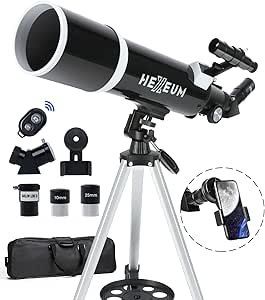 | Best Complete Starter Kit | Aperture: 80mm | Focal length: 600mm | Eyepieces: 25mm and 10mm | VIEW LATEST PRICE | See Our Full Breakdown |
| Celestron NexStar 5SE Schmidt-Cassegrain Computerized Telescope |  | Best for Guided Tracking | Aperture: 5 inches | Optical design: Schmidt-Cassegrain | Optical coating: StarBright XLT | VIEW LATEST PRICE | See Our Full Breakdown |
| SVBONY SV48P Telescope, 90mm Aperture F5.5 Refractor OTA |  | Best for Wide-Field Learning | Aperture: 90mm | Focal length: 500mm | Focal ratio: f/5.5 | VIEW LATEST PRICE | See Our Full Breakdown |
| Gskyer 70mm Aperture 400mm AZ Mount Astronomical Refracting Telescope for Kids and Beginners | 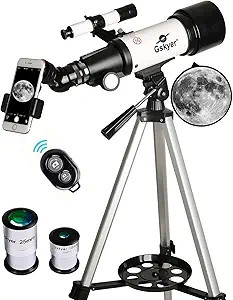 | Best Starter for Families | Aperture: 70mm | Focal length: 400mm | Mount: AZ mount | VIEW LATEST PRICE | See Our Full Breakdown |
| MEEZAA 150EQ Newtonian Reflector Telescope for Adults and Beginners |  | Best for Aperture on a Manual Mount | Aperture: 150mm | Optical design: Newtonian reflector | Focal length: 650mm | VIEW LATEST PRICE | See Our Full Breakdown |
| Celestron NexStar 127SLT Maksutov-Cassegrain Computerized GoTo Telescope |  | Best Compact Planetary GoTo | Aperture: 127mm | Optical design: Maksutov-Cassegrain | Object database: 40,000+ celestial objects | VIEW LATEST PRICE | See Our Full Breakdown |
| ZWO Seestar S30 All-in-One Smart Digital Telescope |  | Best Smart Scope for Casual Imaging | Objective lens diameter: 30mm | Focal length: 150mm | Mount: Altazimuth | VIEW LATEST PRICE | See Our Full Breakdown |
| SVBONY SV555 APO Astrophotography Telescope |  | Best Dedicated Camera-Imaging Upgrade | Optical design: APO triplet with Petzval structure | Aperture range: F4.5–F22 | Sensor compatibility: Full-frame, 44mm | VIEW LATEST PRICE | See Our Full Breakdown |
| Celestron AstroMaster 130EQ Telescope for Beginners |  | Best Traditional Starter for Visual Astronomy | Aperture: 130mm (5.1 inches) | Optical type: Newtonian reflector | Mount: German equatorial | VIEW LATEST PRICE | See Our Full Breakdown |
| Celestron StarSense Explorer 150mm App-Enabled Tabletop Dobsonian Telescope |  | Best Beginner Scope for App-Guided Star Hopping | Aperture: 150mm | Optical type: Newtonian reflector | Mount: Tabletop Dobsonian, manual altazimuth | VIEW LATEST PRICE | See Our Full Breakdown |
| Celestron Astro Fi 130 Reflector Telescope for Beginners with Built-in WiFi |  | Best WiFi-Controlled Visual Starter | Aperture: 130mm | Optical type: Newtonian reflector | Optics: Fully coated glass | VIEW LATEST PRICE | See Our Full Breakdown |
| beginner astrophotography telescope | Aperture | Mount | Focal length |
|---|---|---|---|
| SVBONY SV503 102mm F7 ED Refra | 102mm | — | 714mm (f/7) |
| DWARFLAB Dwarf 3 Smart Telesco | — | — | — |
| Celestron StarSense Explorer L | 114mm | Altazimuth | — |
| Smart Telescope with 4K Astrop | 78mm | — | 300mm (f/8.89) |
| Koolpte 80mm Aperture 600mm Fo | 80mm | AZ mount | 600mm |
| Celestron NexStar 5SE Schmidt- | 5 inches | Computerized GoTo | — |
| SVBONY SV48P Telescope | 90mm | — | 500mm |
| Gskyer 70mm Aperture 400mm AZ | 70mm | AZ mount | 400mm |
| MEEZAA 150EQ Newtonian Reflect | 150mm | German equatorial | 650mm |
| Celestron NexStar 127SLT Maksu | 127mm | Computerized GoTo | — |
| ZWO Seestar S30 All-in-One Sma | — | Altazimuth | 150mm |
| SVBONY SV555 APO Astrophotogra | — | — | — |
| Celestron AstroMaster 130EQ Te | 130mm (5.1 inches) | German equatorial | — |
| Celestron StarSense Explorer 1 | 150mm | Tabletop Dobsonian, manual altazimuth | — |
| Celestron Astro Fi 130 Reflect | 130mm | — | Not specified |
More Details on Our Top Picks
SVBONY SV503 102mm F7 ED Refractor Telescope OTA
The SV503 is the strongest fit here for a beginner who wants to build a dedicated astrophotography setup rather than buy a complete starter kit. Its 102mm aperture and S-FPL51 ED glass help produce brighter views with less color fringing, while the 714mm focal length suits a range of lunar, planetary, and deep-sky subjects. The dual-speed focuser and 360° rotator make fine focus and camera framing easier than on the Koolpte 80mm, which is packaged for simpler visual use. The tradeoff is that this is an optical tube only: a suitable mount, camera, and other accessories are separate purchases. It also lacks a finderscope, so locating targets may take extra setup. Choose it for optical capability and control, not out-of-the-box convenience.
Pros:- S-FPL51 ED glass reduces color fringing in bright targets
- Dual-speed focuser supports more precise focusing with imaging accessories
- 360° field rotator helps align a camera without turning the optical tube
- Retractable hood helps block stray light and reduce dew exposure
Cons:- Optical tube only; mount, tripod, and eyepieces are not included
- No finderscope is supplied, making initial target acquisition less convenient
Best for: Beginners ready to assemble a camera-focused setup around an equatorial tracking mount and who value reduced color fringing and precise focusing.
Not ideal for: First-time buyers seeking a complete, immediately usable telescope kit, or anyone unwilling to source a mount, eyepieces, and camera separately.
- Aperture:102mm
- Focal length:714mm (f/7)
- Glass:S-FPL51 ED
- Focuser:Dual-speed (1:10)
- Focus travel:90mm
- Field rotator:360°
- Optical tube length:63cm
- Item weight:3.95kg
Our verdict“Choose the SV503 if you want better-controlled optics for a camera-based rig and are prepared to buy the supporting equipment separately.”
DWARFLAB Dwarf 3 Smart Telescope
The Dwarf 3 takes a different route from the SVBONY SV503: instead of asking a beginner to assemble a telescope, mount, and camera, it combines a dual-lens system with app control and automated imaging features in a 3 lb portable unit. That makes it the most appealing pick here for casual observing, travel, and switching between night-sky targets and daytime wildlife. Its 4K capture and app-based processing lower the barrier to getting shareable images, though that convenience is not the same as the flexibility of a separate telescope-and-camera rig. The compact design also means a smaller sensor, which can limit low-light results compared with larger traditional optics. Cloud processing may depend on a reliable internet connection. Pick it for portability and an assisted workflow; skip it if you want hands-on control over a dedicated imaging setup.
Pros:- Lightweight 3 lb design is easy to carry and store
- Dual-lens system supports both telephoto and wide-angle use
- App control and cloud processing simplify image capture and enhancement
- Includes a carrying bag, magnetic filters, and USB-C cable
Cons:- Small sensor can limit low-light performance compared with larger telescope systems
- Cloud-powered processing may rely on stable internet access
Best for: Beginners who want a lightweight, app-controlled telescope for casual astrophotography, travel, and daytime wildlife imaging.
Not ideal for: Imagers seeking larger traditional optics, extensive manual control, or dependable cloud processing where internet access is limited.
- Weight:3 lb (1.35kg)
- Resolution:4K
- Lens system:Dual lens: telephoto and wide-angle
- Control method:App-controlled
- Connectivity:USB-C
- Included accessories:Carrying bag, magnetic filters, filter pouch, wipe cloth, USB-C cable
Our verdict“Choose the Dwarf 3 for portable, app-assisted imaging, but choose the SV503 if you want a more customizable traditional optics setup.”
Celestron StarSense Explorer LT 114AZ Newtonian Smartphone Guided Telescope
The StarSense Explorer LT 114AZ is the most educational choice in this group: its app helps beginners find celestial objects, while the Newtonian optics keep the experience grounded in using a conventional telescope. With a 114mm aperture, it offers more light-gathering capacity than the Koolpte 80mm, which can help when viewing dimmer objects visually. But its manual altazimuth mount is a meaningful limit for astrophotography: it does not provide the tracking needed for long exposures, so this is better for learning targets and capturing simple lunar or planetary images than pursuing long-exposure deep-sky work. The Dwarf 3 is easier for automated image capture, while this Celestron offers a more hands-on observing experience. It also depends on a compatible smartphone and app for its guided navigation.
Pros:- StarSense app guidance helps newcomers locate celestial targets
- 114mm aperture gathers more light than the 80mm Koolpte
- Newtonian design offers a hands-on introduction to traditional astronomy
- Manual altazimuth mount keeps basic setup and movement straightforward
Cons:- Manual mount does not support long-exposure astrophotography tracking
- Guided navigation depends on a smartphone and app
- Basic mount is a limiting point for buyers seeking an upgrade-ready imaging system
Best for: Beginners who want smartphone help finding objects and plan to prioritize visual observing with occasional simple lunar or planetary imaging.
Not ideal for: Buyers focused on long-exposure deep-sky photography or those who want a tracking mount and imaging workflow included.
- Aperture:114mm
- Optical type:Newtonian reflector
- Mount:Altazimuth
- Navigation:Smartphone app-guided
- Warranty:2 years
Our verdict“Choose this Celestron to learn object-finding and enjoy visual astronomy, not as a platform for long-exposure astrophotography.”
Smart Telescope with 4K Astrophotography Camera and Dual Screens
This smart telescope puts the viewing experience front and center: its foldable 3-inch external screen and internal display let more than one person follow the live image without crowding around an eyepiece. The built-in 4K camera and included 64GB card also make it easy to save captures, unlike the SV503, which requires a separately assembled camera-based system. That convenience comes with less clarity about the imaging workflow and less room for customization than a dedicated optical tube. Its 78mm aperture and 300mm focal length are modest compared with the 114mm Celestron StarSense Explorer LT, and the advertised 350× maximum magnification should not be mistaken for a guarantee of detailed views at that level. Choose it for shared, screen-based observing and recording rather than advanced long-exposure work.
Pros:- Dual screens make live viewing easier to share
- Built-in 4K camera supports photo and video capture
- Includes a 64GB memory card and supports external storage up to 512GB
- Diopter adjustment range accommodates some variation in eyesight
Cons:- 78mm aperture is smaller than the 114mm Celestron StarSense Explorer LT
- Screen-based, integrated design offers less flexibility than a separate optical tube and camera
- Controls may be challenging for very young children
Best for: Families and beginner groups who want to view and save telescope images together on built-in screens.
Not ideal for: Astrophotographers seeking a configurable camera-and-mount setup, or buyers who prioritize larger aperture over screen-based convenience.
- Aperture:78mm
- Focal length:300mm (f/8.89)
- Maximum magnification:350×
- Camera resolution:4K
- External screen:3 in
- Supported storage:Up to 512GB external; includes 64GB memory card
- Diopter adjustment:+/-6
Our verdict“Choose this model for shared screen viewing and simple recording, but look to a larger-aperture or more configurable system for ambitious imaging.”
Koolpte 80mm Aperture 600mm Focal Length Telescope for Adults & Beginners with Tripod, Phone Adapter, and Wireless Control
The Koolpte is the most approachable package for a beginner who wants to start observing and try basic phone photography without sourcing every component separately. Its 80mm aperture, 600mm focal length, eyepieces, finder, and AZ mount make it a more complete starting point than the SVBONY SV503 optical tube, which needs a separately purchased mount and eyepieces. A phone adapter and wireless remote add a simple way to capture views, but they do not turn the manual mount into a tracking platform for long exposures. Compared with the 114mm Celestron StarSense Explorer LT, the Koolpte has a smaller aperture and lacks app-guided object finding, so it is less suited to dimmer targets and guided navigation. Its included tripod helps with setup, though the supplied mount may feel limiting as imaging ambitions grow.
Pros:- Includes eyepieces, finder, phone adapter, and wireless remote
- 80mm aperture and 600mm focal length cover basic observing needs
- AZ mount and no-tool setup suit straightforward first use
- Carrying bag supports storage and transport
Cons:- Manual AZ mount is not suited to long-exposure astrophotography
- 80mm aperture gathers less light than the 114mm Celestron StarSense Explorer LT
- Tripod stability may limit use with heavier accessories or sustained imaging
Best for: First-time buyers who want a bundled telescope for visual stargazing, terrestrial viewing, and simple phone snapshots.
Not ideal for: Beginners aiming for long-exposure deep-sky images or those who want larger aperture and smartphone-guided target finding.
- Aperture:80mm
- Focal length:600mm
- Eyepieces:25mm and 10mm
- Magnification:24× and 60×; up to 180× with Barlow lens
- Finder scope:5×24
- Mount:AZ mount
- Included accessories:Phone adapter, wireless remote, carrying bag
Our verdict“Choose the Koolpte for an accessible bundled start and basic phone captures, but not for a setup intended to grow into long-exposure imaging.”
Celestron NexStar 5SE Schmidt-Cassegrain Computerized Telescope
The NexStar 5SE is the strongest fit here for beginners who want a telescope to locate targets and keep them centered, rather than learn the sky by star-hopping. Its computerized GoTo mount and SkyAlign simplify finding objects, while the 5-inch Schmidt-Cassegrain optics keep the tube compact. Compared with the manual SVBONY SV48P, it reduces the effort of tracking a target, a useful advantage when capturing short-exposure lunar or planetary images. The built-in wedge adds an astrophotography option, but it does not make this a ready-made long-exposure imaging system: a camera, suitable accessories, and realistic expectations are still needed. Alignment can take practice, and the included 25mm eyepiece is a basic starting point. Choose it for guided visual observing with room to explore imaging, not for a turnkey astrophotography setup.
Pros:- GoTo controls and SkyAlign help locate and track celestial targets.
- Compact 5-inch Schmidt-Cassegrain design is easier to transport than a large Newtonian setup.
- StarBright XLT coating is specified for the optics.
- Built-in wedge and accessory compatibility leave room to explore basic astrophotography.
Cons:- Astrophotography beyond basic imaging requires additional equipment.
- Initial alignment may challenge beginners unfamiliar with identifying bright stars.
- The supplied 25mm eyepiece offers a limited starting accessory set.
Best for: Beginners who want automated object finding and tracking for visual observing and basic lunar or planetary imaging.
Not ideal for: Buyers seeking a complete imaging rig for long-exposure deep-sky photography without extra equipment or alignment practice.
- Aperture:5 inches
- Optical design:Schmidt-Cassegrain
- Optical coating:StarBright XLT
- Eyepiece:25mm Plossl
- Listed magnification:50x
- Mount:Computerized GoTo
- Alignment technology:SkyAlign
- Built-in wedge:Yes
- Warranty:2 years
Our verdict“Choose the 5SE if guided tracking matters more to you than a simple manual setup and you accept that imaging gear is extra.”
SVBONY SV48P Telescope, 90mm Aperture F5.5 Refractor OTA
The SV48P suits beginners who want a relatively wide view and hands-on control over focusing and framing. Its 90mm aperture and 500mm focal length make it a more substantial short-tube refractor than the Gskyer 70mm, while the 2-inch double-speed focuser gives finer manual focus adjustment for a camera or eyepiece. The rotatable focuser also makes it easier to set a comfortable composition. That flexibility has a clear limit: this is an optical tube assembly, and the listed package does not include a mount or motorized tracking. For astrophotography, the buyer must supply a compatible mount that can follow the sky. Its achromatic optics can also show some color fringing on bright targets, even with the specified multi-coated lenses. Pick it for wide-field exploration and a build-your-own imaging setup, not an all-in-one beginner kit.
Pros:- 90mm aperture gathers more light than the Gskyer 70mm refractor.
- 500mm focal length supports wide-field views of larger targets.
- Double-speed 1:10 focuser allows precise manual focus adjustments.
- 360-degree focuser rotation helps with camera framing.
Cons:- No mount or motorized tracking is listed, so astrophotography needs a separate mount.
- Manual focusing and target tracking place more work on the beginner.
- Achromatic optics may show color fringing on bright objects.
Best for: Beginners who already have, or plan to choose, a compatible tracking mount and want a short-focal-length refractor for wide-field targets.
Not ideal for: First-time buyers who need a complete telescope package with a tripod, GoTo controls, or automatic tracking included.
- Aperture:90mm
- Focal length:500mm
- Focal ratio:f/5.5
- Optical design:Achromatic refractor
- Focuser:2-inch double-speed rotatable focuser
- Focuser gear ratio:1:10
- Focuser rotation:360 degrees
- Optical coating:Fully multi-green coated
Our verdict“Choose the SV48P if you want a capable wide-field optical tube and are prepared to add a tracking mount.”
Gskyer 70mm Aperture 400mm AZ Mount Astronomical Refracting Telescope for Kids and Beginners
The Gskyer is the simplest entry point in this group for families curious about the Moon and casual sky viewing, with a phone adapter and wireless remote that make basic image capture approachable. Its 70mm refractor and 400mm focal length form a compact package, and the carry bag makes it easier to bring along than the larger MEEZAA 150EQ. Those conveniences should not be mistaken for a dedicated astrophotography system: the listed AZ mount does not provide motorized tracking, so the sky will drift across the frame during longer exposures. The included eyepieces and Barlow offer different magnifications, but high power does not guarantee sharper views. Compared with the SV48P, this is more of a ready-to-start family kit, while the SV48P offers a larger aperture and finer focuser but requires a separately chosen mount. Keep expectations to basic lunar imaging and observing.
Pros:- Phone adapter and wireless remote support simple image capture.
- Portable kit includes a carry bag and adjustable tripod.
- 5×24 finder scope with cross-hair lines helps with basic aiming.
- Eyepieces and a 3x Barlow provide several viewing configurations.
Cons:- No motorized tracking is specified, limiting longer-exposure astrophotography.
- Small aperture is less suited to faint deep-sky targets than the 90mm SV48P or 150mm MEEZAA.
- Magnification depends on the included eyepieces and Barlow and may not yield more useful detail.
Best for: Families and younger beginners who want a portable telescope for Moon viewing and simple phone-based captures.
Not ideal for: Beginners aiming for tracked deep-sky photography or who need a stable, upgrade-ready imaging mount.
- Aperture:70mm
- Focal length:400mm
- Mount:AZ mount
- Finder scope:5×24 with cross-hair lines
- Included imaging accessories:Phone adapter and wireless remote
- Additional optical accessory:3x Barlow lens
- Tripod material:Aluminum alloy
- Included transport accessory:Carry bag
Our verdict“Choose the Gskyer for portable family observing and simple phone images, not for serious tracked astrophotography.”
MEEZAA 150EQ Newtonian Reflector Telescope for Adults and Beginners
The MEEZAA 150EQ puts aperture ahead of automation: its 150mm Newtonian mirror is the largest listed here, giving beginners more light-gathering capacity for lunar, planetary, and brighter deep-sky observing than the 70mm Gskyer or 90mm SV48P. Its German equatorial mount is designed to follow celestial motion with a single axis adjustment after setup, which can help keep a target centered. That makes it a more hands-on route to tracking than the GoTo-equipped Celestron NexStar 5SE, but it does not locate objects automatically. A beginner will need to learn polar alignment and the mount’s controls, and the tripod and tube are less convenient to carry than the compact NexStar 127SLT. The phone adapter is useful for basic capture, but long-exposure imaging still depends on mount performance and additional camera choices. This is for learners who want aperture and accept setup effort.
Pros:- 150mm aperture exceeds the apertures of the other telescopes in this batch.
- German equatorial mount allows manual tracking of celestial motion.
- 25mm and 10mm eyepieces provide different magnification choices.
- Package includes a moon filter, phone adapter, finderscope, Barlow lens, and carry bag.
Cons:- Equatorial mount setup and operation require a learning period.
- Larger tube and stainless-steel tripod are less convenient for frequent travel.
- No computerized GoTo system is listed, so finding objects is manual.
Best for: Beginners with space for a larger telescope who value light-gathering ability and want to learn manual equatorial tracking.
Not ideal for: Travel-focused observers or buyers who want quick automated target finding and minimal setup.
- Aperture:150mm
- Optical design:Newtonian reflector
- Focal length:650mm
- Eyepieces:25mm and 10mm
- Listed magnification range:26x to 130x
- Mount:German equatorial
- Tripod:Adjustable-height stainless steel
- Included accessories:Phone adapter, moon filter, carry bag, finderscope, and Barlow lens
Our verdict“Choose the MEEZAA if you want the largest aperture in this batch and are willing to learn an equatorial mount.”
Celestron NexStar 127SLT Maksutov-Cassegrain Computerized GoTo Telescope
The NexStar 127SLT is a compact choice for beginners who want computerized pointing in a portable tube, with a 127mm Maksutov-Cassegrain aperture suited to lunar and planetary observing. Its SkyAlign hand controller and large object database make target selection easier than with the manual MEEZAA 150EQ, though finding three bright stars for alignment can be awkward under obstructed or light-polluted skies. The compact design favors transport, while the MEEZAA’s larger Newtonian aperture is more compelling if light-gathering capacity is the priority. For astrophotography, automatic GoTo tracking is useful for keeping a target in view, but the listed product details do not specify a built-in wedge or dedicated imaging camera. Treat it as a guided observing telescope with potential for basic capture, not a complete deep-sky imaging package. The included sky-planning software can help new users learn what to point at.
Pros:- 127mm aperture offers more light gathering than the 90mm SV48P and 70mm Gskyer.
- Computerized GoTo controls and SkyAlign assist with finding targets.
- Compact Maksutov-Cassegrain design suits travel and backyard use.
- Includes Starry Night Special Edition software for sky planning.
Cons:- Three-star alignment may be difficult when bright stars are obscured.
- The 150mm MEEZAA has a larger aperture for buyers prioritizing light gathering.
- No dedicated camera or built-in wedge is specified, so imaging may require added equipment.
Best for: Portable-setup beginners focused on the Moon and planets who want GoTo target finding and guided sky learning.
Not ideal for: Buyers prioritizing the largest possible aperture for faint deep-sky views or seeking a complete long-exposure imaging rig.
- Aperture:127mm
- Optical design:Maksutov-Cassegrain
- Object database:40,000+ celestial objects
- Alignment system:SkyAlign, 3-star alignment
- Mount:Computerized GoTo
- Included software:Starry Night Special Edition
- Warranty:2-year US warranty
Our verdict“Choose the NexStar 127SLT for portable, automated lunar and planetary observing, with astrophotography treated as an add-on project.”
ZWO Seestar S30 All-in-One Smart Digital Telescope
For beginners who want the telescope to handle finding and tracking targets, the ZWO Seestar S30 is the most approachable imaging option in this group. Its app-guided operation and automated tracking reduce the need to learn manual pointing, while the dual-lens system adds wide-field landscape framing alongside astronomy modes. Built-in filters can help manage light pollution and image noise, though they cannot make up for the modest 30mm aperture: faint objects will show less detail than through the 130mm AstroMaster 130EQ or 150mm StarSense Dobsonian. Unlike those visual-first scopes, the S30 is built around smartphone or tablet use rather than an eyepiece. That keeps the kit compact at 3.6 pounds, but leaves less room for traditional observing and makes battery capacity a practical limit on long sessions.
Pros:- Automatic star-finding and app-based tracking lower the learning curve for imaging.
- Dual lenses support both astronomy and wide-field landscape shots.
- Built-in filters can help reduce the effects of light pollution and image noise.
- At 3.6 pounds, it is easier to carry and set up than the larger manual reflectors in this group.
Cons:- The 30mm objective limits detail on faint deep-sky targets compared with larger-aperture reflectors.
- No eyepiece is included; viewing and control depend on a compatible smartphone or tablet.
- Battery runtime depends on the included battery capacity, which is not specified.
Best for: New imagers who want app-guided target finding, automated tracking, and a lightweight setup for casual deep-sky and landscape captures.
Not ideal for: Observers who want detailed views of faint objects through an eyepiece, or who need a long-running setup without relying on a portable battery.
- Objective lens diameter:30mm
- Focal length:150mm
- Mount:Altazimuth
- Weight:3.6 lbs (1.65 kg)
- Dimensions:3.1″ D x 5.5″ W x 8.3″ H
- Focus:Autofocus and manual focus
- Power:Battery powered
- Compatible devices:Smartphone and tablet
Our verdict“Choose the Seestar S30 if you value portable, app-guided imaging more than the light-gathering power and eyepiece viewing of a conventional reflector.”
SVBONY SV555 APO Astrophotography Telescope
The SVBONY SV555 is the most camera-centric choice here: it is an optical tube for imagers who already have, or plan to buy, a DSLR, mirrorless, or dedicated astronomy camera. Its Petzval APO triplet design is intended to control coma and chromatic aberration across the frame, while full-frame sensor compatibility gives experienced beginners more room to compose wide-field targets. That makes it a different proposition from the self-contained Seestar S30, which supplies app-driven capture but has a much smaller 30mm objective. The SV555 offers more flexibility in camera choice, but it does not provide an all-in-one route into imaging: the camera, mount, and supporting gear remain part of the setup. Its variable F4.5–F22 aperture range also means stopping down trades light for depth of field, a meaningful cost on dim targets.
Pros:- Petzval APO triplet design is intended to reduce coma and chromatic aberration across the image.
- Supports full-frame sensors, DSLRs, and mirrorless cameras.
- Variable aperture provides flexibility for different imaging needs.
- Includes a mount kit and pre-installed adapter support for a ZWO EAF Gen1 focuser.
Cons:- Requires an external camera and supporting imaging equipment, unlike the all-in-one Seestar S30.
- Higher f-stop settings reduce light reaching the sensor, which can hinder faint-target imaging.
- The supplied specifications do not state aperture diameter or focal length, limiting direct comparisons of light gathering and framing.
Best for: Camera-owning beginners ready to learn a modular deep-sky imaging setup and seeking optics compatible with full-frame sensors.
Not ideal for: First-time stargazers who want automatic target finding, included imaging electronics, or a telescope that works without a separate camera.
- Optical design:APO triplet with Petzval structure
- Aperture range:F4.5–F22
- Sensor compatibility:Full-frame, 44mm
- Focus travel:2.67mm–3.22mm
- Filter holder:2-inch
- Front thread:M72
- Tube rotation:360° rotatable
- Electronic focuser compatibility:ZWO EAF Gen1
Our verdict“Pick the SV555 if you already own a suitable camera and want a dedicated, full-frame-capable optical tube rather than a self-contained smart telescope.”
Celestron AstroMaster 130EQ Telescope for Beginners
The AstroMaster 130EQ earns its place as a traditional observing starter, not as an astrophotography-first telescope. Its 130mm reflector, two eyepieces, and StarPointer finder give a beginner useful equipment for learning the Moon, planets, and brighter deep-sky objects without buying a camera system first. The German equatorial mount can follow the sky with manual adjustments, but it takes practice and is not equivalent to a motorized imaging mount. That puts it behind the camera-ready SVBONY SV555 for planned astrophotography, and behind the app-guided Seestar S30 for automatic capture. Its advantage is direct, eyepiece-based observing and relatively strong aperture for the group. The 17-pound weight and manual tracking are real compromises, and the product data specifically positions it for visual use rather than astrophotography.
Pros:- 130mm aperture gathers more light than the Seestar S30’s 30mm objective.
- Includes 20mm and 10mm eyepieces plus a StarPointer finderscope.
- German equatorial mount supports manual sky tracking once the user learns its controls.
- Tool-free assembly and supplied astronomy software make it a reasonably equipped visual starter.
Cons:- Manual tracking requires practice and is not a substitute for a motorized astrophotography mount.
- At 17 pounds, it is less convenient to transport than the Seestar S30.
- The supplied product information describes it as unsuitable for astrophotography.
Best for: Beginners who want a substantial aperture and included eyepieces for visual learning, with occasional lunar viewing or simple camera experiments rather than serious imaging.
Not ideal for: Buyers whose main goal is tracked deep-sky photography; this setup is described as visual-use focused and lacks a supplied imaging camera or motorized tracking.
- Aperture:130mm (5.1 inches)
- Optical type:Newtonian reflector
- Mount:German equatorial
- Weight:17 lbs
- Included eyepieces:20mm and 10mm
- Finderscope:StarPointer
- Coatings:Aluminum and SiO₂
- Assembly:Tool-free, quick setup
Our verdict“Choose the AstroMaster 130EQ for hands-on visual astronomy and skip it if tracked astrophotography is the main goal.”
Celestron StarSense Explorer 150mm App-Enabled Tabletop Dobsonian Telescope
The StarSense Explorer 150mm Dobsonian pairs a generous six-inch reflector with smartphone-assisted sky recognition, a combination that can help a beginner find targets without adding a computerized motor mount. Compared with the AstroMaster 130EQ, its larger aperture offers more light gathering and its tabletop Dobsonian base avoids equatorial setup. The tradeoff is that this is still a manual telescope: the app helps point the tube, but the observer must adjust it to keep an object centered. That makes it a stronger choice for learning the sky and viewing than for long-exposure astrophotography, where automated tracking matters. It also needs a stable table or similar support, unlike the tripod-mounted Astro Fi 130. For someone choosing a first scope with phone guidance, its navigation is useful; for someone choosing a first imaging rig, its manual design is a limitation.
Pros:- StarSense app-based sky recognition helps beginners locate celestial targets.
- 150mm aperture provides more light gathering than the 130mm AstroMaster 130EQ.
- Manual Dobsonian base keeps setup straightforward and avoids equatorial alignment.
- Includes a two-year warranty and US-based support.
Cons:- Manual tracking requires frequent adjustments during longer observations and does not provide motorized imaging tracking.
- Tabletop design needs a stable supporting surface and is less flexible than a tripod setup.
- The listed product details do not specify included eyepieces or camera-imaging accessories.
Best for: New visual observers who want app-assisted target location, a six-inch reflector, and a simple tabletop setup for lunar, planetary, and deep-sky viewing.
Not ideal for: Beginners focused on long-exposure astrophotography or those without a sturdy surface to support a tabletop telescope.
- Aperture:150mm
- Optical type:Newtonian reflector
- Mount:Tabletop Dobsonian, manual altazimuth
- Navigation technology:StarSense app-enabled sky recognition
- Intended targets:Moon, planets, and deep-sky objects
- Setup:Simple setup
- Warranty:2 years
Our verdict“Select this Dobsonian for app-assisted visual observing and its larger aperture, not for hands-free or long-exposure astrophotography.”
Celestron Astro Fi 130 Reflector Telescope for Beginners with Built-in WiFi
The Astro Fi 130 is a better fit for beginners who want wireless telescope control than for those seeking a dedicated astrophotography rig. Its built-in WiFi and SkyPortal app offer remote operation, while the 130mm reflector and included eyepieces support conventional views of the Moon, planets, and brighter nebulae. Compared with the manual StarSense Explorer 150mm Dobsonian, the Astro Fi prioritizes device-based control over the Dobsonian’s larger aperture. Compared with the Seestar S30, it remains a conventional telescope with eyepiece viewing rather than an integrated digital imaging system. Its supplied StarPointer, two Kellner eyepieces, and accessory tray make it ready for basic observing, but the listed details do not specify a focal length or a dedicated imaging camera. Buyers should treat WiFi control as a convenience, not proof of astrophotography tracking performance.
Pros:- Built-in WiFi enables control through a compatible device and the SkyPortal app.
- 130mm aperture supports views of lunar, planetary, and brighter deep-sky targets.
- Includes a StarPointer finder, two Kellner eyepieces, and an accessory tray.
- Fully coated glass optics are specified for the optical system.
Cons:- Requires a compatible smartphone or tablet for WiFi-based control.
- Focal length is not specified, so magnification details cannot be judged from the supplied information.
- The listed accessories do not include a dedicated astrophotography camera.
Best for: Beginners who want a 130mm visual telescope with wireless app control and included eyepieces, and who are comfortable using a compatible device.
Not ideal for: Imagers seeking a purpose-built camera telescope, or buyers who prefer fully manual operation and do not want device-dependent control.
- Aperture:130mm
- Optical type:Newtonian reflector
- Optics:Fully coated glass
- Connectivity:Built-in WiFi
- App:SkyPortal
- Finderscope:StarPointer
- Included eyepieces:Two Kellner eyepieces
- Focal length:Not specified
Our verdict“Choose the Astro Fi 130 for wireless control and conventional visual observing, but look to a camera-centered system if astrophotography is your main priority.”

How We Picked
I compared these 15 options by how directly they support a beginner’s first astrophotography sessions: whether imaging hardware is integrated, how much setup and accessory planning is required, how straightforward it is to find and follow targets, and how well the design fits likely subjects. I also weighed portability, operating complexity, optical flexibility, and the tradeoffs of each telescope type. A smart telescope can rank ahead for a newcomer who wants an accessible capture workflow, while an optical tube can be a better long-term fit for someone willing to build a separate imaging setup.
The order reflects readiness for beginner imaging, not a simple comparison of aperture or feature count. Models with automated capture or a more adaptable imaging path rank higher for this use case than visual-first scopes whose phone adapters or app guidance do not provide the same tracking and camera control. I treat scope-only products separately from complete systems: they may have greater potential, but the buyer must account for a mount, camera, and compatible accessories before comparing their total usefulness.
| beginner astrophotography telescope | Mount |
|---|---|
| SVBONY SV503 102mm F7 ED Refra | — |
| DWARFLAB Dwarf 3 Smart Telesco | — |
| Celestron StarSense Explorer L | Altazimuth |
| Smart Telescope with 4K Astrop | — |
| Koolpte 80mm Aperture 600mm Fo | AZ mount |
| Celestron NexStar 5SE Schmidt- | Computerized GoTo |
| SVBONY SV48P Telescope | — |
| Gskyer 70mm Aperture 400mm AZ | AZ mount |
| MEEZAA 150EQ Newtonian Reflect | German equatorial |
| Celestron NexStar 127SLT Maksu | Computerized GoTo |
| ZWO Seestar S30 All-in-One Sma | Altazimuth |
| SVBONY SV555 APO Astrophotogra | — |
| Celestron AstroMaster 130EQ Te | German equatorial |
| Celestron StarSense Explorer 1 | Tabletop Dobsonian, manual altazimuth |
| Celestron Astro Fi 130 Reflect | — |
Factors to Consider When Choosing Beginner Astrophotography Telescopes
Before choosing among these beginner astrophotography telescopes, decide what you want to photograph and how much of the process you want the telescope to automate. A setup that makes visual observing easy may not track smoothly enough for long exposures, while a capable optical tube can become an expensive or frustrating start if key parts are missing. These broader checks help separate a convenient first imaging system from a telescope that mainly serves as a starting point for a larger build.
Choose Your First Targets Before Choosing Aperture
Deep-sky targets such as nebulae and galaxies generally reward a setup that can track the sky and gather repeated exposures, while the Moon and planets place different demands on framing and focal length. Beginners often buy the largest aperture they can manage, then discover that the mount, camera, or target scale is a bigger limitation. Shorter focal lengths typically make broad targets easier to frame and can be more forgiving of small tracking errors. Longer focal lengths magnify those errors and narrow the field, so target selection becomes less flexible. Decide whether your first goal is lunar snapshots, wide-field deep-sky images, or a mix before treating aperture as the main measure of suitability.
Separate Target Finding From Exposure Tracking
An app that points you toward a target and a mount that follows it are different capabilities. Phone-guided systems can make locating objects less confusing, but guidance alone does not turn a manually moved telescope into a long-exposure imaging rig. GoTo mounts can help center targets, yet buyers should check what tracking behavior and imaging support are actually included. A common mistake is assuming that a computerized telescope automatically handles every part of astrophotography. For deep-sky imaging, ask how the system keeps the target steady during capture, not only how it helps you find it.
Budget for the Whole Imaging Chain
A telescope is only one part of an astrophotography setup: the camera, mount, adapters, power, storage, and processing workflow can all affect the result. Smart telescopes bundle much of that chain, which can make their higher level of integration valuable to a beginner. With an optical tube, check compatibility and availability of the mount and camera before buying; a lower-cost tube may not mean a lower-cost working system. Avoid spending every bit of your budget on optics while leaving no room for a stable mount or the connections needed to attach a camera. Comparing complete setups gives a fairer picture than comparing telescope specifications alone.
Treat Portability as a Feature You Will Use
A telescope that is easy to carry and set up may get used more often than a larger system that stays indoors. Consider the full packed setup, including tripod or mount, power, camera, and accessories, rather than the optical tube by itself. Compact smart instruments can simplify travel and reduce the number of separate components, while larger Newtonians and computerized scopes may call for more storage and setup time. Also think about where you will observe: a balcony, backyard, and dark-sky trip each impose different limits on footprint and transport. A realistic portability choice can matter more to your progress than a modest gain in aperture.
Know What Phone Imaging Can and Cannot Do
A phone adapter can be a low-effort way to record the Moon or share a basic view, but it is not the same as a dedicated astrophotography camera and controlled tracking. Phone imaging through an eyepiece can be sensitive to alignment, focus, vibration, and exposure limits. Smart telescopes take a different approach by integrating a camera and capture workflow, while a separate camera system gives more room to choose and upgrade components. Beginners should avoid treating a bundled phone holder as proof that a telescope is ready for deep-sky imaging. Match the accessory to the image you want, not just to the convenience of taking a quick snapshot.
Pay More for Control Only If You Want to Use It
A more advanced optical system can make sense when you want to select your own camera, change components, or build skills in focusing, tracking, and processing. That control brings more decisions and more chances for mismatched parts, so it is not automatically the easiest route. An all-in-one system can be a better first purchase for someone whose priority is capturing targets with less equipment assembly. Conversely, a buyer who enjoys hands-on setup may find a visual-first or optical-tube design limiting if it cannot grow with their imaging plans. Spend extra on capabilities you expect to use, rather than on complexity that sounds impressive but does not match your first targets.
Frequently Asked Questions
Can a telescope with a phone adapter take deep-sky astrophotographs?
A phone adapter can help capture bright objects, especially the Moon, but it does not provide the tracking and exposure control usually needed for detailed deep-sky images. The result also depends on how steadily the telescope follows the target and how well the phone camera works through the eyepiece. A bundled holder is best treated as a simple entry point for snapshots, not as a replacement for a dedicated imaging system. If deep-sky targets are your main goal, compare the telescope’s tracking and camera setup before focusing on phone compatibility.
Should I start with a smart telescope or a traditional optical tube?
Choose a smart telescope if you want an integrated camera and a guided capture workflow with fewer separate components. Choose an optical tube if you want to select your own camera and mount or plan to learn more about each part of the imaging process. The tube can offer more flexibility, but it may require extra purchases and compatibility checks before it is ready for imaging. Your preferred way of learning matters: convenience favors an integrated system, while hands-on control favors a modular setup.
Is a GoTo telescope automatically suitable for long-exposure astrophotography?
No. GoTo describes automated target locating, while long-exposure imaging also depends on stable tracking, mount performance, and a suitable camera setup. A telescope may find an object accurately without holding it steady enough for the exposures you want. Check the mount’s imaging capabilities and the system’s camera compatibility rather than relying on the GoTo label alone. For a first purchase, think of target finding and exposure tracking as separate jobs that both need a solution.
Is a larger-aperture Newtonian a better first choice than a compact smart telescope?
Not automatically. A larger Newtonian can offer more light-gathering area, but the mount, alignment, collimation, and camera setup can add work that a compact smart telescope largely bundles together. For visual observing and learning traditional telescope setup, that tradeoff may be welcome. For quick, guided image capture, a smart system can be easier to put to use. Choose based on your appetite for setup and the targets you want, not aperture alone.
What should I buy first if I already own a telescope but want to try astrophotography?
Start by identifying what your current mount can track and what kind of camera can attach to the telescope. A camera or adapter may be useful for bright targets, but buying one before checking focus access, connection fit, and tracking can lead to parts you cannot use effectively. For deep-sky work, a stable tracking mount may matter more than adding a camera to a visual setup. If your current mount cannot follow targets steadily, compare the cost and effort of upgrading it with choosing an integrated imaging system.
Conclusion
For the strongest starting balance of approachable imaging and integrated operation, my best overall pick is the DWARFLAB Dwarf 3; the ZWO Seestar S30 is a strong alternative if its compact all-in-one approach better fits your setup. For a best value route, the Celestron StarSense Explorer 150mm tabletop Dobsonian offers a more aperture-led way to learn the sky, though it is better suited to visual observing and simple imaging than long-exposure deep-sky work. My best premium pick for a modular imaging path is the SVBONY SV555 APO, for buyers prepared to supply and configure the rest of the imaging system. The best beginner choice for minimal setup is the ZWO Seestar S30, while the Celestron NexStar 5SE is a better fit for someone who values computerized target finding and wants a traditional telescope. Choose a smart scope for integrated capture, an optical tube for hands-on control, and a visual-first model only if its observing strengths match your expectations for imaging.
Fall Picks
fall essentials
As an affiliate, we earn on qualifying purchases.