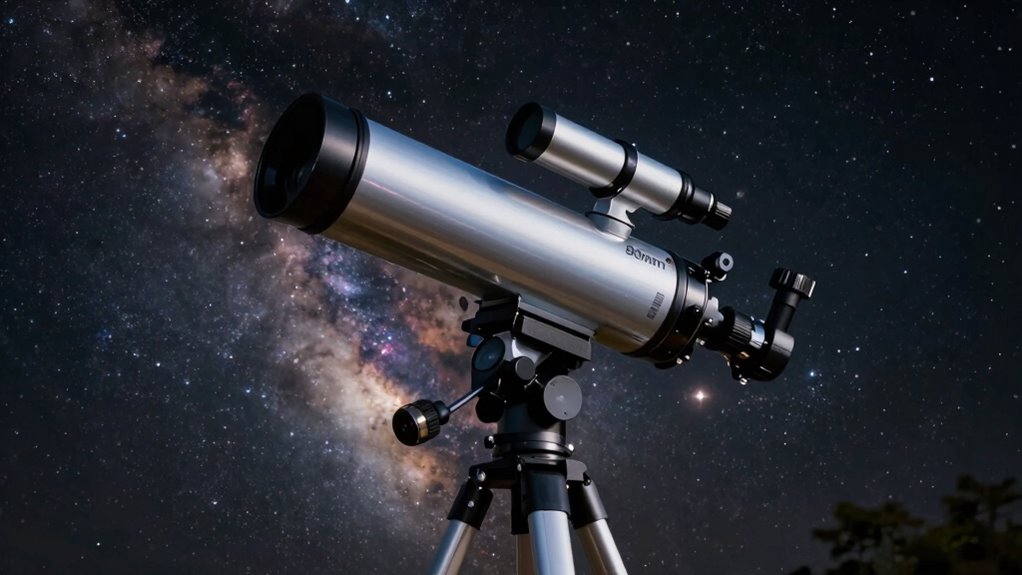

If you’re looking for the best 80mm apo refractors for astrophotography in 2026, I recommend checking out models like the SVBONY SV550 80ED, Sky-Watcher EvoStar 80 APO, and Explore Scientific ED80. These telescopes feature excellent optical designs like triplet and quadruplet lenses, use high-quality low-dispersion glass, and have precise focusers and flatfield systems for sharp, high-contrast images. Continuing with this guide will reveal more about their features and how to pick the perfect one for you.
Key Takeaways
- Prioritize models with triplet or quadruplet apochromatic designs for superior chromatic correction and sharp images.
- Choose refractors featuring low-dispersion ED glass (FPL51, FPL53, FCD100) for minimal chromatic aberration.
- Opt for instruments with high-quality focusers (dual-speed, backlash-free) for precise, stable focusing during astrophotography.
- Select portable, durable designs with included accessories like field flatteners, guide scopes, and protective cases.
- Ensure compatibility with standard mounting systems and accessories to maximize versatility and ease of setup.
| SVBONY SV550 80ED Triplet Refractor Telescope | 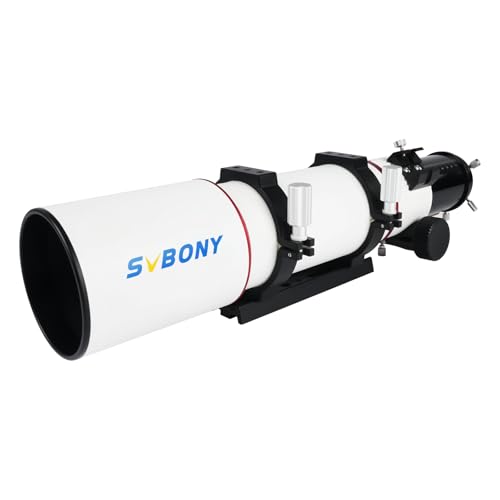 | Best Optical Performance | Optical Design: Triplet apochromatic (APO) | Focal Ratio: F6 | Focusing Mechanism: 2.5″ dual-speed micro-reduction | VIEW LATEST PRICE | See Our Full Breakdown |
| Sky-Watcher EvoStar 100 APO Refractor for Astronomy | 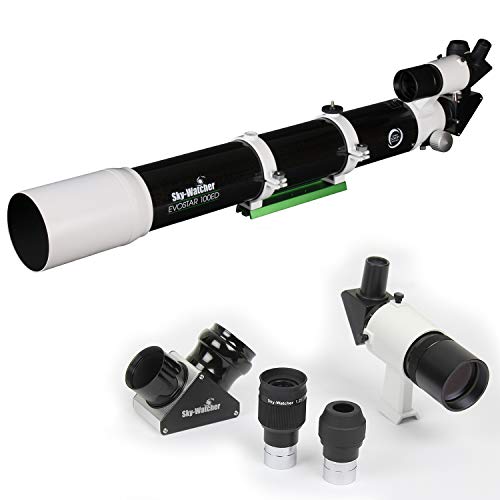 | Beginner-Friendly | Optical Design: Doublet APO | Focal Ratio: F6 | Focusing Mechanism: 10:1 dual-speed Crayford | VIEW LATEST PRICE | See Our Full Breakdown |
| SVBONY SV550 80mm APO Triplet Telescope Bundle |  | Deep-Sky Specialist | Optical Design: Triplet apochromatic (APO) | Focal Ratio: F6 | Focusing Mechanism: Magnesium alloy, internal focusing | VIEW LATEST PRICE | See Our Full Breakdown |
| Sky-Watcher EvoStar 80 APO Refractor Telescope |  | Portable Precision | Optical Design: Doublet APO | Focal Ratio: F6 | Focusing Mechanism: 10:1 dual-speed Crayford | VIEW LATEST PRICE | See Our Full Breakdown |
| Askar 80PHQ Astrograph Telescope for Deep Sky Astronomy |  | High-End Astrograph | Optical Design: Quadruplet super APO | Focal Ratio: F7.5 | Focusing Mechanism: Internal focusing, robust design | VIEW LATEST PRICE | See Our Full Breakdown |
| Askar FMA180 APO Telescope for Deep Sky Astronomy |  | Compact & Light | Optical Design: Sextuplet air-spaced APO | Focal Ratio: F4.5 | Focusing Mechanism: Internal focusing, 360° rotator | VIEW LATEST PRICE | See Our Full Breakdown |
| SVBONY 80ED Triplet Refractor & Astrophotography Kit | 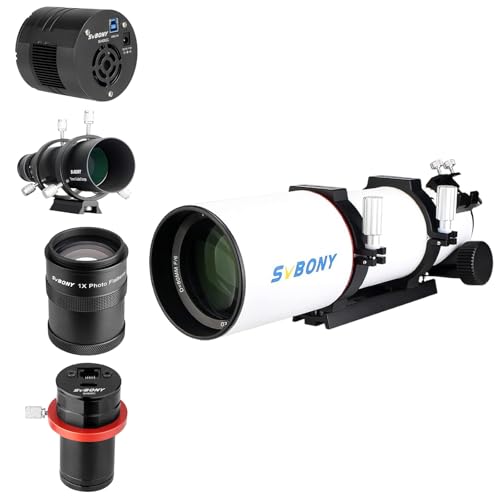 | All-In-One System | Optical Design: Triplet apochromatic (APO) with field flattener | Focal Ratio: F6 | Focusing Mechanism: Helical focuser, adjustable | VIEW LATEST PRICE | See Our Full Breakdown |
| SVBONY SV550 80mm APO Triplet Telescope Bundle |  | Advanced Imaging | Optical Design: Triplet apochromatic (APO) | Focal Ratio: F6 | Focusing Mechanism: 2.5″ dual-speed rack & pinion | VIEW LATEST PRICE | See Our Full Breakdown |
| Explore Scientific ED80 Refractor Telescope for Astronomy | 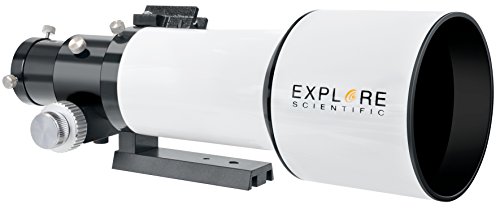 | Reliable Classic | Optical Design: Triplet ED (high-quality ED glass) | Focal Ratio: F6 | Focusing Mechanism: Collimation adjustable with push-pull | VIEW LATEST PRICE | See Our Full Breakdown |
| Explore Scientific FCD100 80mm Apochromatic Refractor Telescope |  | Versatile & Compact | Optical Design: Triplet FCD100 Apochromatic | Focal Ratio: F6 | Focusing Mechanism: 2.5″ rack-and-pinion, dual-speed | VIEW LATEST PRICE | See Our Full Breakdown |
More Details on Our Top Picks
-
Sky-Watcher EvoStar 100 APO Doublet Refractor – Compact and Portable Optical Tube for Affordable Astrophotography and Visual Astronomy
EXPERTLY MATCHED GLASS: The EvoStar series features a matched doublet objective including one synthetic fluorite element, providing excellent...
As an affiliate, we earn on qualifying purchases.
SVBONY SV550 80ED Triplet Refractor Telescope
The SVBONY SV550 80ED Triplet Refractor Telescope stands out as an excellent choice for amateur astronomers who want high-quality astrophotography with minimal chromatic aberration. Its triplet apochromatic design with an F6 configuration uses low-dispersion S-FPL51 ED glass, ensuring bright, high-contrast images. The 2.5-inch dual-speed focuser offers precise control, reducing vignetting and enhancing image sharpness. Its 87mm back focus allows easy attachment of cameras and accessories. Advanced light-blocking measures, including internal barriers and extinction shields, eliminate stray light, making it perfect for capturing detailed deep-sky objects like nebulae and star clusters with clarity.
- Optical Design:Triplet apochromatic (APO)
- Focal Ratio:F6
- Focusing Mechanism:2.5″ dual-speed micro-reduction
- Included Accessories:Micro-focusser, no additional accessories specified
- Construction Material:Magnesium alloy focuser
- Compatibility & Mounting:Supports astrophotography accessories
- Additional Feature:Dual-speed micro-focusser
- Additional Feature:87mm back focus
- Additional Feature:Advanced light-blocking measures
-
SVBONY SV550 Telescope, 80mm F6 APO Triplet Refractor OTA, Bundle with SV209 Field Flattener, 1.0X Flattener Corrects the Field, for Deep Sky Astrophotography
This APO adopts extreme extinction measures; there are multiple light barriers inside the focusing seat and the inner...
As an affiliate, we earn on qualifying purchases.
Sky-Watcher EvoStar 100 APO Refractor for Astronomy
Designed for both beginners and experienced astrophotographers, the Sky-Watcher EvoStar 100 APO Refractor stands out with its expertly matched glass and high-quality coatings, ensuring sharp, color-accurate images with minimal aberrations. Its synthetic fluorite element provides excellent color correction, making it versatile for visual and photographic use. The 10:1 dual-speed Crayford-style focuser offers precise adjustments, while the included accessories—like a finderscope, diagonal, eyepieces, and protective case—make setup straightforward. This telescope’s reliable performance, portability, and upgradeable design make it a versatile choice for users at any skill level seeking high-quality imaging and observing.
- Optical Design:Doublet APO
- Focal Ratio:F6
- Focusing Mechanism:10:1 dual-speed Crayford
- Included Accessories:Finderscope, eyepieces, diagonal, mount rings
- Construction Material:Aluminum hard case, metal optical tube
- Compatibility & Mounting:V-style dovetail, versatile mounting
- Additional Feature:Complete accessory package
- Additional Feature:10:1 dual-speed focuser
- Additional Feature:Portable foam-lined case
-
Sky-Watcher Sky-Watcher EvoStar 80 APO Doublet Refractor – Compact and Portable Optical Tube for Affordable Astrophotography and Visual Astronomy (S11100)
EXPERTLY MATCHED GLASS: The EvoStar series features a matched doublet objective including one synthetic fluorite element, providing excellent...
As an affiliate, we earn on qualifying purchases.
SVBONY SV550 80mm APO Triplet Telescope Bundle
If you’re serious about astrophotography and need a reliable, high-quality refractor, the SVBONY SV550 80mm APO Triplet Telescope Bundle stands out for its exceptional optical correction and portability. It features an 80mm F6 APO triplet lens designed for sharp, deep-sky imaging, complemented by the SV209 Field Flattener that guarantees pristine images across full-frame sensors. The magnesium alloy focusing mechanism reduces weight by over 20%, making setup easier. With a 180mm dovetail plate and versatile mounting options, it supports a wide range of accessories. Lightweight, stable, and highly compatible, this bundle is perfect for advanced astrophotographers seeking excellent image quality on the go.
- Optical Design:Triplet apochromatic (APO)
- Focal Ratio:F6
- Focusing Mechanism:Magnesium alloy, internal focusing
- Included Accessories:Field flattener, M63 extension, M48 ring
- Construction Material:Magnesium alloy focusing seat
- Compatibility & Mounting:180mm dovetail plate, wide compatibility
- Additional Feature:Field flattener included
- Additional Feature:Magnesium alloy focusing seat
- Additional Feature:Versatile mounting options
Sky-Watcher EvoStar 80 APO Refractor Telescope
For amateur astronomers seeking a versatile and portable refractor that delivers exceptional image quality, the Sky-Watcher EvoStar 80 APO stands out as an excellent choice. Its expertly matched glass, including a synthetic fluorite element, ensures superb color correction for both visual observing and astrophotography. The high-quality coatings and minimal aberrations produce sharp, accurate images. The 10:1 dual-speed Crayford focuser allows precise focusing, vital for capturing fine details. Plus, its compact design and included accessories—such as a finderscope, diagonal, eyepieces, and protective case—make setup and transport effortless, making it ideal for both beginners and seasoned astrophotographers.
- Optical Design:Doublet APO
- Focal Ratio:F6
- Focusing Mechanism:10:1 dual-speed Crayford
- Included Accessories:Finderscope, diagonal, eyepieces, mount rings
- Construction Material:Aluminum hard case, durable tube
- Compatibility & Mounting:Vixen-style dovetail, portable
- Additional Feature:Complete accessory set
- Additional Feature:10:1 dual-speed focuser
- Additional Feature:Compact, portable design
Askar 80PHQ Astrograph Telescope for Deep Sky Astronomy
The Askar 80PHQ Astrograph Telescope stands out as an excellent choice for deep sky astrophotographers seeking high image quality without the hassle of extra accessories. Its 80mm aperture and F7.5 focal ratio, combined with a quadruplet lens design, deliver sharp, distortion-free images with minimal chromatic aberration thanks to two ED glass elements. The flatfield optical system eliminates the need for additional flatteners, simplifying setups. Its lightweight, durable construction with a flawless ivory coating guarantees stability and ease of handling during long sessions. Overall, the Askar 80PHQ offers exceptional optical performance and user-friendly features, making it a top contender for astrophotography in 2026.
- Optical Design:Quadruplet super APO
- Focal Ratio:F7.5
- Focusing Mechanism:Internal focusing, robust design
- Included Accessories:Flatfield lens, warranty support
- Construction Material:Painted, lightweight, durable
- Compatibility & Mounting:Supports standard accessories, flatfield correction
- Additional Feature:Flatfield super APO
- Additional Feature:Lightweight, portable design
- Additional Feature:55mm back focus
Askar FMA180 APO Telescope for Deep Sky Astronomy
The Askar FMA180 APO Telescope stands out as an excellent choice for deep sky astrophotography enthusiasts who prioritize image quality and portability. Its sextuplet air-spaced APO design, with two ED glass elements, guarantees superb chromatic aberration correction. Compact at around 167.5mm long and weighing just 2.86 pounds, it’s easy to transport and set up in various locations. The internal focusing focuser, 360° rotator, and M48 adapter provide versatility and precise imaging. Crafted with high-quality CNC materials and matte finishes, it minimizes stray light and enhances durability. Overall, the FMA180 combines optical excellence with portability, making it a top contender for serious astrophotographers.
- Optical Design:Sextuplet air-spaced APO
- Focal Ratio:F4.5
- Focusing Mechanism:Internal focusing, 360° rotator
- Included Accessories:Rotator, finder base
- Construction Material:CNC processed, matte painted
- Compatibility & Mounting:Finder base, rotator compatible
- Additional Feature:360° rotator
- Additional Feature:Internal focusing focuser
- Additional Feature:Versatile finder base
SVBONY 80ED Triplet Refractor & Astrophotography Kit
If you’re looking for an astrophotography setup that combines high-quality optics with versatile imaging capabilities, the SVBONY 80ED Triplet Refractor & Astrophotography Kit is an excellent choice. The 80ED F6 Triplet Apochromatic Refractor minimizes chromatic aberration thanks to its S-FPL51 ED glass, delivering sharp, clear images of nebulae, galaxies, and star clusters. Paired with the cooled SV405CC camera supporting true 4K at 120 fps, it excels in deep-sky imaging while reducing noise. The kit also includes a sensitive guide camera and a guide scope, ensuring precise tracking for long-exposure astrophotography. It’s an accessible, high-performance system for amateur astronomers.
- Optical Design:Triplet apochromatic (APO) with field flattener
- Focal Ratio:F6
- Focusing Mechanism:Helical focuser, adjustable
- Included Accessories:Guide scope, guide camera, rotator
- Construction Material:CNC metal, lightweight design
- Compatibility & Mounting:Vixen dovetail, adaptable to setups
- Additional Feature:Includes guide scope/camera
- Additional Feature:Cooling CMOS sensor
- Additional Feature:Flatfield correction
SVBONY SV550 80mm APO Triplet Telescope Bundle
For astrophographers aiming to capture stunning deep-sky images, the SVBONY SV550 80mm APO Triplet Telescope Bundle stands out as a top choice. Its air-spaced triple optical design, featuring S-FPL51 low-dispersion ED glass, minimizes chromatic aberration for bright, high-contrast images. The included SV209 field flattener guarantees sharp, flat views across the entire field, while the built-in filter thread simplifies filter use. Accessories like the camera angle adjuster and 360-degree rotator enhance framing and stability during imaging sessions. Designed as a versatile OTA, the SV550 offers excellent image quality and compatibility, making it ideal for astrophotographers seeking detailed, crisp deep-sky captures.
- Optical Design:Triplet apochromatic (APO)
- Focal Ratio:F6
- Focusing Mechanism:2.5″ dual-speed rack & pinion
- Included Accessories:Camera angle adjuster, rotator, filters
- Construction Material:Aluminum tube, robust construction
- Compatibility & Mounting:Vixen-style dovetail, filter compatibility
- Additional Feature:Built-in filter thread
- Additional Feature:Camera angle adjuster
- Additional Feature:360-degree rotator
Explore Scientific ED80 Refractor Telescope for Astronomy
Designed with astrophotographers in mind, the Explore Scientific ED80 Refractor Telescope offers exceptional optical quality and portability that make capturing stunning celestial images straightforward. Its genuine FCD1 HOYA ED glass and multi-layer coatings produce high-contrast, detailed views, while the air-spaced triplet design virtually eliminates chromatic aberrations. With an 80mm aperture and 480mm focal length, it’s versatile and perfect for astrophotography of planets, nebulae, and star clusters. Its lightweight, compact build includes a retractable dew shield, making setup easy. Plus, the precision collimation system ensures ideal alignment for sharp, clear images. Customer support from Explore Scientific adds confidence to your investment.
- Optical Design:Triplet ED (high-quality ED glass)
- Focal Ratio:F6
- Focusing Mechanism:Collimation adjustable with push-pull
- Included Accessories:Collimation system, accessories optional
- Construction Material:Durable, high-quality finish
- Compatibility & Mounting:Supports various mounting options
- Additional Feature:Collimation system
- Additional Feature:Compact and lightweight
- Additional Feature:Proprietary multi-layer coatings
Explore Scientific FCD100 80mm Apochromatic Refractor Telescope
The Explore Scientific FCD100 80mm Apochromatic Refractor Telescope stands out as an excellent choice for astrophotographers seeking high-contrast, detailed images of celestial objects. Its design features genuine Hoya FCD100 ED glass and proprietary multi-layer coatings, which eliminate chromatic aberrations and deliver sharp, vibrant views. With an 80mm aperture and 480mm focal length, it offers impressive light-gathering in a portable package. Its versatile f/6 focal ratio and advanced optics make it perfect for capturing stunning shots of the Moon, planets, nebulae, and galaxies. Additional features like a dew shield, hybrid finder scope, and precise focuser enhance its user-friendly experience.
- Optical Design:Triplet FCD100 Apochromatic
- Focal Ratio:F6
- Focusing Mechanism:2.5″ rack-and-pinion, dual-speed
- Included Accessories:Dovetail, included mounting options
- Construction Material:CNC processed, matte finish
- Compatibility & Mounting:Vixen-style dovetail, flexible mounting options
- Additional Feature:Hybrid finder scope base
- Additional Feature:Integrated dew shield
- Additional Feature:2.5-inch two-speed focuser
Factors to Consider When Choosing an 80MM Apo Refractor for Astrophotography
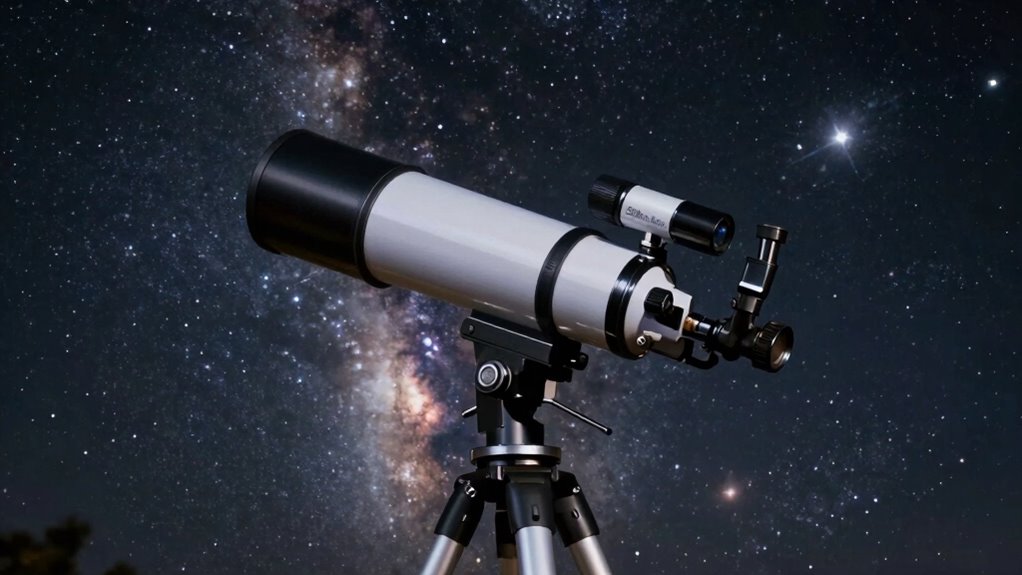
When choosing an 80mm apo refractor for astrophotography, I focus on optical quality and glass type to guarantee sharp images. I also consider focal length and ratio for suitable magnification, along with the focuser’s precision for fine adjustments. Finally, I check mounting options to match my setup and achieve stable, smooth tracking.
Optical Quality and Glass Type
Optical quality and glass type are critical factors that directly influence the performance of an 80mm apo refractor for astrophotography. High-quality refractors typically use low-dispersion ED or FCD100 glass to minimize chromatic aberration and enhance image clarity. The specific glass, like FPL51, FPL53, or FCD100, plays an essential role in producing sharp, high-contrast images with minimal color fringing. Air-spaced triplet or quadruplet designs use multiple glass elements, offering superior color correction compared to doublets. Proprietary multi-layer coatings on these elements boost light transmission and reduce reflections, resulting in brighter, more detailed images. Overall, choosing the right glass type and optical design directly impacts your telescope’s ability to capture fine details, especially in high-contrast objects like planets and nebulae.
Focal Length and Ratio
Focal length and ratio are essential considerations that directly influence an 80mm apo refractor’s suitability for different types of astrophotography. Longer focal lengths, like 480mm, allow for higher magnification, making them ideal for detailed planetary or deep-sky imaging. The focal ratio, calculated by dividing the focal length by the aperture, impacts exposure times and image brightness; lower ratios, such as f/4.5, provide wider fields and faster imaging, while higher ratios, like f/6, offer a good balance for both planetary and deep-sky work. Focal length also determines the field of view—longer focal lengths give narrower views suited for distant objects with more detail. Choosing the right focal ratio helps optimize image brightness and exposure efficiency for your specific astrophotography goals.
Field Flatness and Corrections
Field flatness is essential in astrophotography because it determines whether your images will be sharp and free of distortions across the entire frame. Wide-field shots of deep-sky objects require a flat image plane to avoid comet-like edges and blurred corners. Many high-quality 80mm Apo refractors include built-in or optional field flatteners or reducers to minimize field curvature. These optics help produce a flatter image, reducing the need for post-processing corrections and saving time during data acquisition. Triplet APO refractors often feature integrated field correction elements, which enhance overall sharpness from center to edges. The effectiveness of these corrections is measured by maintaining focus and minimal aberrations across various camera formats, ensuring your astrophotos are crisp and detailed from edge to edge.
Focuser Precision and Speed
When selecting an 80mm Apo refractor for astrophotography, the focuser’s precision and speed play a vital role in capturing sharp, detailed images. A dual-speed focuser, like a 10:1 or 1:10 ratio, allows for fine adjustments essential for pinpoint focus during long exposures. Micro-reduction focus mechanisms enable subtle, backlash-free tuning, improving image stability and clarity. The focusing system should move smoothly and without backlash, ensuring focus remains steady during extended imaging sessions. High-quality focusers often feature internal locking mechanisms that prevent accidental shifts, safeguarding your precise focus. Achieving accurate focus quickly reduces setup time and minimizes frustration, directly contributing to higher image quality. Overall, investing in a precise, fast focuser enhances both the efficiency and success of astrophotography with an 80mm Apo refractor.
Mounting Compatibility Options
Choosing a compatible mounting system is essential because it directly affects how easily you can set up and stabilize your 80mm Apo refractor for astrophotography. I look for refractors with standardized Vixen, Losmandy, or Dovetail mounting plates, guaranteeing broad compatibility with different mounts. Quick-release or modular mounting systems are also a plus—they make setup and disassembly faster and more convenient. I check the back focus distance and mounting interface to confirm compatibility with my existing accessories and camera adapters. Versatility matters too; I prefer mounts that support both EQ (equatorial) and AZ (alt-azimuth) configurations, giving me more flexibility in positioning. Finally, I guarantee the mounting interface can handle additional accessories like guidescopes, rotators, or focusers without requiring extensive modifications.
Portability and Weight
Portability and weight are key factors that can make or break your astrophotography experience with an 80mm Apo refractor. Lighter models, typically under 10 pounds, are much easier to transport and set up, making spontaneous sessions more feasible. Using lightweight materials like magnesium alloy helps reduce weight without sacrificing optical quality, which is a big plus. Compact designs with shorter tube lengths also boost portability, perfect for travel or field use. Heavier models often require sturdier mounts and tripods, adding to the overall weight and making them less convenient to carry around. If you frequently change observing locations or attend astrophotography events, prioritizing a lightweight, portable refractor can save you time and effort, ensuring you’re always ready to capture the night sky.
Accessories and Complements
Selecting an 80mm Apo refractor for astrophotography means paying close attention to its compatibility with essential accessories that can elevate your imaging experience. Guarantee the telescope works well with field flatteners, reducers, and camera adapters to optimize image quality and reduce distortions. Look for models that include or support guide scopes, guide cameras, and rotators for precise tracking and framing, vital for long exposures. A high-quality focusing mechanism, like a dual-speed Crayford focuser, allows fine adjustments during imaging sessions. Check for mounting options, such as Vixen or V-style dovetails, to seamlessly integrate with your existing gear. Additionally, verify filter threading and accessory mounting features to expand your imaging capabilities and enhance overall results.
Price and Brand Reliability
When investing in an 80mm apo refractor for astrophotography, prioritizing brand reliability and price is essential to guarantee you get a durable, high-quality instrument. Established brands with solid reputations generally deliver better build quality and optical components, minimizing issues like aberrations or mechanical failures. Price often reflects reliability; reputable brands usually offer better warranties and customer support, ensuring peace of mind. They also have rigorous quality control, providing consistent performance across their models. Choosing a trusted brand can also protect your long-term investment, as their telescopes tend to hold resale value and have readily available replacement parts. Conversely, lower-priced options from lesser-known brands might save money upfront but could compromise optical quality, durability, and overall astrophotography results.
Frequently Asked Questions
How Does Aperture Size Impact Astrophotography Quality in 80MM Refractors?
Aperture size directly impacts astrophotography quality by determining how much light the telescope collects. With an 80mm refractor, I find that it balances portability and light-gathering ability, allowing me to capture faint details in deep-sky objects. A larger aperture would improve brightness and resolution, but 80mm hits a sweet spot for quality images without being too bulky or expensive, making it ideal for many amateur astronomers like me.
What Accessories Are Essential for Optimal Astrophotography With These Telescopes?
Think of your telescope as a musical instrument—accessories are the tuning pegs that fine-tune your performance. Essential gear includes a sturdy mount for stability, a good equatorial or star tracker to follow celestial objects, a reliable camera adapter, and filters like UV/IR cut for clearer images. Don’t forget a remote shutter release to minimize vibrations and a portable power supply to keep your setup energized during long nights.
How Do Apochromatic Refractors Compare to Doublets for Astrophotography?
Apochromatic refractors generally outperform doublets in astrophotography because they reduce chromatic aberration more effectively, providing sharper, more color-accurate images. I’ve found that apochros deliver crisper details and better contrast, especially when capturing faint objects or wide fields. While doublets are more affordable, apochros make a noticeable difference in image quality, making them my go-to choice for serious astrophotography.
What Is the Typical Learning Curve for Beginners Using These Telescopes?
They say practice makes perfect, and that’s true for beginners using these telescopes. The learning curve is moderate; you’ll quickly grasp focusing and tracking, but mastering image stacking and calibration takes time. Don’t get discouraged by initial frustrations. With patience and steady effort, you’ll improve steadily. I found that joining online forums and watching tutorials really sped up my progress, making the journey enjoyable and rewarding.
How Do These Telescopes Perform in Light-Polluted Skies?
These telescopes handle light pollution surprisingly well, especially when paired with good filters and narrowband imaging techniques. I find that they can still reveal faint details in heavily light-polluted skies, though I need to spend more time stacking images. Their high-quality optics help maximize contrast, making it easier to see celestial objects despite city glow. With patience, you can get impressive results even from less-than-ideal observing environments.
Conclusion
Choosing the right 80mm apo refractor is like finding the perfect brush for a masterpiece—each has its own unique shine. Whether you’re chasing distant galaxies or capturing starry dreams, these telescopes are your gateway to the universe’s secrets. Think of them as your celestial compass, guiding you through the night’s canvas. With the right pick, your astrophotography journey will unfold like a cosmic symphony—beautiful, endless, and uniquely yours.