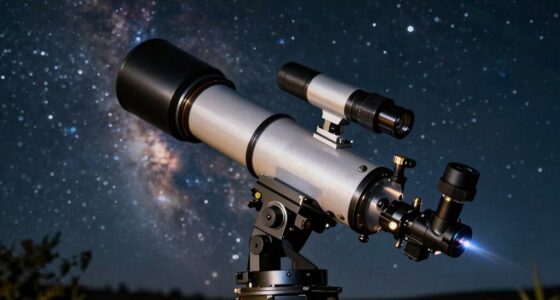

If you’re looking for the best imaging Newtonians for full-frame sensors in 2026, I recommend models like the Sky-Watcher Quattro 300P, 200P, 250P, and 150P. These telescopes prioritize optical quality, high-reflectivity coatings, and oversized secondary mirrors to guarantee even illumination and maximum light gathering. They offer precise focusing, stable mounts, and compatibility with full-frame sensors, making them ideal for detailed astrophotography. Keep exploring for more detailed insights and tips.
Key Takeaways
- Choose Newtonians with large apertures (≥8 inches) for optimal light gathering and high-resolution imaging of full-frame sensors.
- Ensure the optical system has high-reflectivity coatings (up to 94%) and anti-reflective coatings for maximum light transmission.
- Select models with oversized secondary mirrors to prevent vignetting and ensure even illumination across full-frame sensors.
- Prioritize telescopes with precise dual-speed focusers and stable, compatible mounting systems for accurate targeting and long exposures.
- Opt for designs with optimized baffle systems and proper back focus to minimize stray light, vignetting, and support full-frame coverage.
| Sky-Watcher Quattro 300P Reflector for Astrophotography |  | Premium Imaging Power | Aperture: 300mm | Focal Ratio: f/4 | Focuser Type: 2-inch dual-speed Crayford | VIEW LATEST PRICE | See Our Full Breakdown |
| Sky-Watcher Quattro 150P Reflector for Astrophotography |  | Versatile Compact | Aperture: 150mm | Focal Ratio: f/4 | Focuser Type: 2-inch dual-speed Crayford | VIEW LATEST PRICE | See Our Full Breakdown |
| Sky-Watcher Quattro 200P Reflector for Astrophotography |  | Light-Gathering Efficiency | Aperture: 200mm | Focal Ratio: f/4 | Focuser Type: 2-inch dual-speed Crayford | VIEW LATEST PRICE | See Our Full Breakdown |
| Sky-Watcher Quattro 250P Reflector for Astrophotography |  | Largest Aperture | Aperture: 250mm | Focal Ratio: f/4 | Focuser Type: 2-inch dual-speed Crayford | VIEW LATEST PRICE | See Our Full Breakdown |
More Details on Our Top Picks
-
Sky-Watcher Quattro 150P Imaging Newtonian - Large Aperture 6-inch Reflector Optical Tube for Astrophotography and Visual Use
- Aperture: 150mm for detailed views
- Focal Length: 600mm for versatile imaging
- Focal Ratio: Fast f/4 for astrophotography
As an affiliate, we earn on qualifying purchases.
Sky-Watcher Quattro 300P Reflector for Astrophotography
The Sky-Watcher Quattro 300P Reflector is an excellent choice for astrophotographers seeking high detail with full-frame sensors. Its fast f/4 focal ratio allows for capturing sharp, detailed images with shorter exposures. The 1000mm focal length offers versatility for deep-sky imaging. An oversized secondary mirror guarantees full-frame and APS-C sensors are illuminated without vignetting. The 2-inch dual-speed Crayford focuser provides precise adjustments, minimizing focus issues. Equipped with light-reducing baffles and included accessories like tube rings and a finderscope, this telescope simplifies setup and enhances imaging quality. It’s perfect for serious amateurs aiming for high-resolution celestial images.
- Aperture:300mm
- Focal Ratio:f/4
- Focuser Type:2-inch dual-speed Crayford
- Secondary Mirror Size:Oversized secondary
- Included Accessories:Tube rings, Vixen-style dovetail, finderscope, bracket
- Application:Astrophotography
- Additional Feature:Supports APS-C and full-frame
- Additional Feature:Oversized secondary mirror
- Additional Feature:Dual-speed Crayford focuser
-
Sky-Watcher Quattro 200P Imaging Newtonian - Large Aperture 8-inch Reflector Optical Tube for Astrophotography
- Fast f/4 Optics: Bright, detailed astrophotography with short exposures
- Dual-Speed Crayford Focuser: Precise focus control with 2-inch focuser
- Oversized Secondary Mirror: Illuminates APS-C and full-frame cameras
As an affiliate, we earn on qualifying purchases.
Sky-Watcher Quattro 150P Reflector for Astrophotography
For astrophotographers seeking sharp, detailed images of deep-sky objects, the Sky-Watcher Quattro 150P Reflector stands out thanks to its large 150mm aperture and fast f/4 focal ratio. Its 600mm focal length and oversized secondary mirror allow full-frame DSLR and CCD cameras to capture wide, bright images with minimal vignetting. The parabolic borosilicate mirrors coated with Sky-Watcher’s proprietary RAQ coatings achieve 94% reflectivity, ensuring maximum light transmission, brightness, and contrast. The dual-speed, 11:1 Crayford focuser offers precise adjustments, making it versatile for both imaging and visual observing. Overall, it’s an excellent choice for astrophotographers craving high-quality deep-sky images.
- Aperture:150mm
- Focal Ratio:f/4
- Focuser Type:2-inch dual-speed Crayford
- Secondary Mirror Size:Oversized secondary
- Included Accessories:Tube rings, Vixen-style dovetail, finderscope, bracket
- Application:Astrophotography & visual
- Additional Feature:Proprietary RAQ mirror coatings
- Additional Feature:11:1 dual-speed focuser
- Additional Feature:Versatile for imaging and visual
-
Sky-Watcher Quattro 250P Imaging Newtonian - Large Aperture 10-inch Reflector Optical Tube for Astrophotography
- Fast f/4 Optics: Bright, detailed astrophotography in less time
- Dual-Speed Crayford Focuser: Precise focus adjustment
- Oversized Secondary Mirror: Supports APS-C and full-frame cameras
As an affiliate, we earn on qualifying purchases.
Sky-Watcher Quattro 200P Reflector for Astrophotography
Designed with astrophotographers in mind, the Sky-Watcher Quattro 200P Reflector excels thanks to its f/4 focal ratio, producing bright, detailed images with shorter exposures. Its large 8-inch aperture boosts light-gathering, ideal for capturing deep-sky objects. The optical tube’s knife-edge baffles minimize stray light, enhancing clarity. The 2-inch dual-speed Crayford focuser allows precise adjustments, ensuring sharp images. An oversized secondary mirror accommodates full-frame and APS-C DSLR cameras without vignetting. With included accessories like tube rings, a Vixen-style dovetail, and a finderscope, it offers a complete, ready-to-shoot setup suitable for high-quality astrophotography.
- Aperture:200mm
- Focal Ratio:f/4
- Focuser Type:2-inch dual-speed Crayford
- Secondary Mirror Size:Oversized secondary
- Included Accessories:Tube rings, Vixen-style dovetail, finderscope, bracket
- Application:Astrophotography & visual
- Additional Feature:8-inch aperture
- Additional Feature:Knife-edge baffles
- Additional Feature:Dual-speed Crayford focuser
Sky-Watcher Quattro 250P Reflector for Astrophotography
If you’re serious about astrophotography with full-frame sensors, the Sky-Watcher Quattro 250P Reflector is a standout choice thanks to its fast f/4 optics, which deliver brighter images and capture more detail in shorter exposure times. Its large 10-inch aperture with an oversized secondary mirror ensures excellent illumination for both APS-C and full-frame DSLRs without vignetting. The dual-speed crayford focuser offers precise, smooth adjustments essential for astrophotography. Plus, it comes with all necessary accessories—tube rings, dovetail, finderscope—making it a complete, ready-to-shoot setup. Its thoughtful design emphasizes ease of use, optical quality, and versatility for capturing stunning celestial images.
- Aperture:250mm
- Focal Ratio:f/4
- Focuser Type:2-inch dual-speed Crayford
- Secondary Mirror Size:Oversized secondary
- Included Accessories:Tube rings, Vixen-style dovetail, finderscope, bracket
- Application:Astrophotography
- Additional Feature:10-inch large aperture
- Additional Feature:Oversized secondary mirror
- Additional Feature:Complete accessory package
Factors to Consider When Choosing Imaging Newtonian for Full-Frame Sensors
When choosing an imaging Newtonian for full-frame sensors, I concentrate on key factors like aperture size and focal length compatibility to guarantee ideal image quality. I also pay attention to the secondary mirror size and focusing mechanism accuracy, which directly influence astrophotography results. Finally, high-quality optical coatings are essential for minimizing reflections and maximizing light transmission.
Aperture Size Importance
Aperture size is a vital factor to take into account when choosing an imaging Newtonian telescope for full-frame sensors because it directly influences how much light the telescope can gather. Larger apertures, at least 8 inches (200mm), are essential for capturing detailed, high-quality astrophotography images, especially of faint celestial objects. They reduce exposure times and improve image brightness and resolution. Bigger apertures also minimize vignetting, ensuring even illumination across the full-frame sensor. Additionally, the optical quality and light collection efficiency increase with aperture size, directly enhancing imaging performance. Essentially, a larger aperture allows for clearer, brighter, and more detailed images, making it a key consideration for serious astrophotographers aiming to maximize their full-frame sensor’s capabilities.
Focal Length Compatibility
Choosing the right focal length is essential because it directly impacts the field of view and framing flexibility when imaging with a full-frame sensor. Longer focal lengths produce narrower views, which can limit the ability to capture wide celestial objects or larger sections of the sky. Conversely, shorter focal lengths, around 300mm to 600mm, offer wider fields of view that better suit full-frame sensors, making them ideal for wide-field astrophotography. Compatibility also depends on ensuring the telescope’s optical design provides a large enough image circle to cover the entire sensor without vignetting. When selecting a Newtonian, consider how the focal length influences framing and whether it aligns with your astrophotography goals. A properly matched focal length enhances your ability to capture stunning, full-sky images.
Secondary Mirror Size
Selecting the right secondary mirror size is essential for guaranteeing full illumination of a full-frame sensor in an imaging Newtonian telescope. A larger secondary mirror helps prevent vignetting, ensuring even light distribution across the entire sensor. Oversized secondary mirrors are critical for avoiding light falloff at the edges, which is indispensable for capturing detailed astrophotos. The mirror’s size directly affects the telescope’s ability to support wide-field imaging with large sensors, maintaining image quality across the full frame. Conversely, a smaller secondary mirror can cause vignetting and uneven illumination, reducing clarity and detail. Hence, choosing a secondary mirror that’s appropriately sized guarantees maximum light capture, better correction of optical aberrations, and sharp, uniform images across your full-frame sensor.
Focusing Mechanism Precision
Since precise focusing is essential for sharp astrophotography with full-frame sensors, I always look for a focusing mechanism that offers smooth, accurate adjustments. A dual-speed Crayford focuser is ideal, providing both coarse and fine control. The fine adjustment, especially with an 11:1 ratio, lets me make small, sensitive tweaks vital for pinpoint focus in deep-sky imaging. This level of precision helps me counteract atmospheric turbulence and thermal expansion, ensuring sharp images during long exposures. Additionally, quality focusers should operate smoothly with minimal backlash, so I can maintain focus stability over extended sessions. Overall, a reliable focusing mechanism minimizes the risk of image blurring and makes the entire imaging process more precise and enjoyable.
Optical Coatings Quality
High-quality optical coatings are essential for maximizing the performance of an imaging Newtonian telescope with a full-frame sensor. Coatings like Radiant Aluminum Quartz (RAQ) can achieve reflectivity levels up to 94%, ensuring maximum light transmission critical for astrophotography. Superior coatings reduce internal reflections and stray light, which greatly enhances image contrast and clarity. They also protect mirrors from oxidation and environmental damage, preserving performance over time. Uniformity and consistency across the mirror surface are indispensable for achieving sharp, evenly illuminated images on large sensors. High-reflectivity, durable coatings contribute to brighter images and better contrast, especially when capturing faint celestial objects. Investing in high-quality coatings guarantees long-term reliability and peak imaging quality, making them a key factor when selecting an imaging Newtonian for full-frame sensors.
Vignetting Prevention
To prevent vignetting when using an imaging Newtonian with a full-frame sensor, it’s essential to pay close attention to the design of the optical system. An oversized secondary mirror helps guarantee even illumination across the entire sensor, reducing darkening at the edges. Properly designed optical systems with adequate back focus prevent light falloff, maintaining uniform brightness. Optimizing the telescope’s optical tube and baffle system minimizes stray light that can cause vignetting. Be cautious with fast focal ratios, like f/4, as they can increase vignetting risk if not managed with an oversized secondary. Selecting a telescope with a large aperture and an illumination path tailored for full-frame sensors guarantees full sensor coverage, ensuring sharp, evenly illuminated images without vignetting artifacts.
Mounting and Accessories
Choosing the right mounting system and accessories is vital for successful full-frame imaging with a Newtonian telescope. Make certain the telescope includes compatible mounting options like Vixen-style dovetails or tube rings to securely attach it to your mount. Verify that accessories support full-frame sensors, such as oversized secondary mirrors and high-capacity focusers, to prevent vignetting and guarantee sharp images. The mounting system must handle the combined weight and size of your telescope and camera for stable, precise tracking. Additionally, high-quality finderscopes and brackets are essential for accurate alignment and focus adjustments. Consider whether you’ll need adapters or mounting plates to integrate your telescope seamlessly with existing astrophotography gear, ensuring compatibility and ease of use.
Ease of Setup
When selecting an imaging Newtonian for full-frame sensors, ease of setup should be a top priority, as it can considerably impact your overall imaging experience. A telescope with simple assembly reduces setup time and frustration, especially during those early sessions. Clear instructions and included accessories like tube rings and dovetails make attaching and balancing the scope straightforward. A stable, easily adjustable focuser with precise controls helps you achieve accurate focus quickly, saving valuable time. Lightweight or well-balanced optical tubes are easier to handle and position, which is especially helpful on heavier mounts. Features like quick-release mechanisms or minimal adjustments further streamline the setup process, allowing you to start imaging faster and more efficiently.
Frequently Asked Questions
How Do Cooling Requirements Affect Newtonian Telescope Performance for Astrophotography?
Cooling requirements markedly impact Newtonian telescope performance for astrophotography. When I properly manage cooling, it reduces thermal currents inside the tube, resulting in sharper images and less noise. Without adequate cooling, heat builds up, causing air turbulence and degrading image quality. I find that incorporating fans or other cooling methods helps maintain a stable, low-temperature environment, ensuring clearer, more detailed shots of the night sky.
What Are the Best Ways to Prevent Coma in Large Aperture Newtonians?
To prevent coma in large aperture Newtonians, I prioritize using a well-made coma corrector, which considerably sharpens the image across the frame. I also make sure my mirror is precisely paraboloid-shaped and well-aligned, as proper collimation reduces aberrations. Additionally, I avoid overly fast focal ratios, since slower scopes naturally minimize coma. Regular maintenance and careful setup help me achieve crisp, coma-free astrophotography results.
How Does Mirror Shift Impact Long-Exposure Astrophotography?
Mirror shift messes with my measurements, making long exposures look less precise. When the mirror moves during an exposure, it causes slight shifts in the image, creating star trails or blurring details. I’ve found that using a mirror lock-up feature or an off-axis guider minimizes this movement. These tricks help me capture clearer, crisper cosmic images, ensuring my astrophotography remains accurate and amazing despite the mirror’s mischievous movements.
What Maintenance Routines Ensure Optimal Imaging With Newtonian Telescopes?
To keep my Newtonian telescope performing at its best, I regularly check and clean the mirrors with a soft brush and lens cleaner, avoiding harsh chemicals. I guarantee the mount is well lubricated and properly balanced, and I tighten any loose screws or bolts. I also store it in a dust-free, dry place and cover it when not in use. Routine collimation keeps my images sharp and clear.
Are There Specific Filters Recommended for Full-Frame Astrophotography?
If you’re serious about full-frame astrophotography, I recommend using narrowband filters like H-alpha, OIII, and SII, which help you capture specific wavelengths and reduce light pollution. These filters enhance contrast and detail, especially for deep-sky objects. I’ve found that investing in high-quality filters truly transforms images, making even faint nebulae pop with vibrant color. Don’t overlook this gear—it’s essential for stunning full-frame astrophotography results.
Conclusion
Thinking about diving into astrophotography with a Newtonian telescope? These four models are top contenders for full-frame sensors in 2026, each offering impressive performance and versatility. Want to capture stunning, wide-field images of the night sky? Imagine yourself under a clear, star-filled sky, effortlessly framing the Milky Way with one of these telescopes. Your perfect astrophotography setup awaits—are you ready to elevate your stargazing experience?