
TL;DR
Listen free for 30 days with Audible
Thousands of audiobooks and originals — cancel anytime.
Start your free trialAs an affiliate, we earn on qualifying purchases.
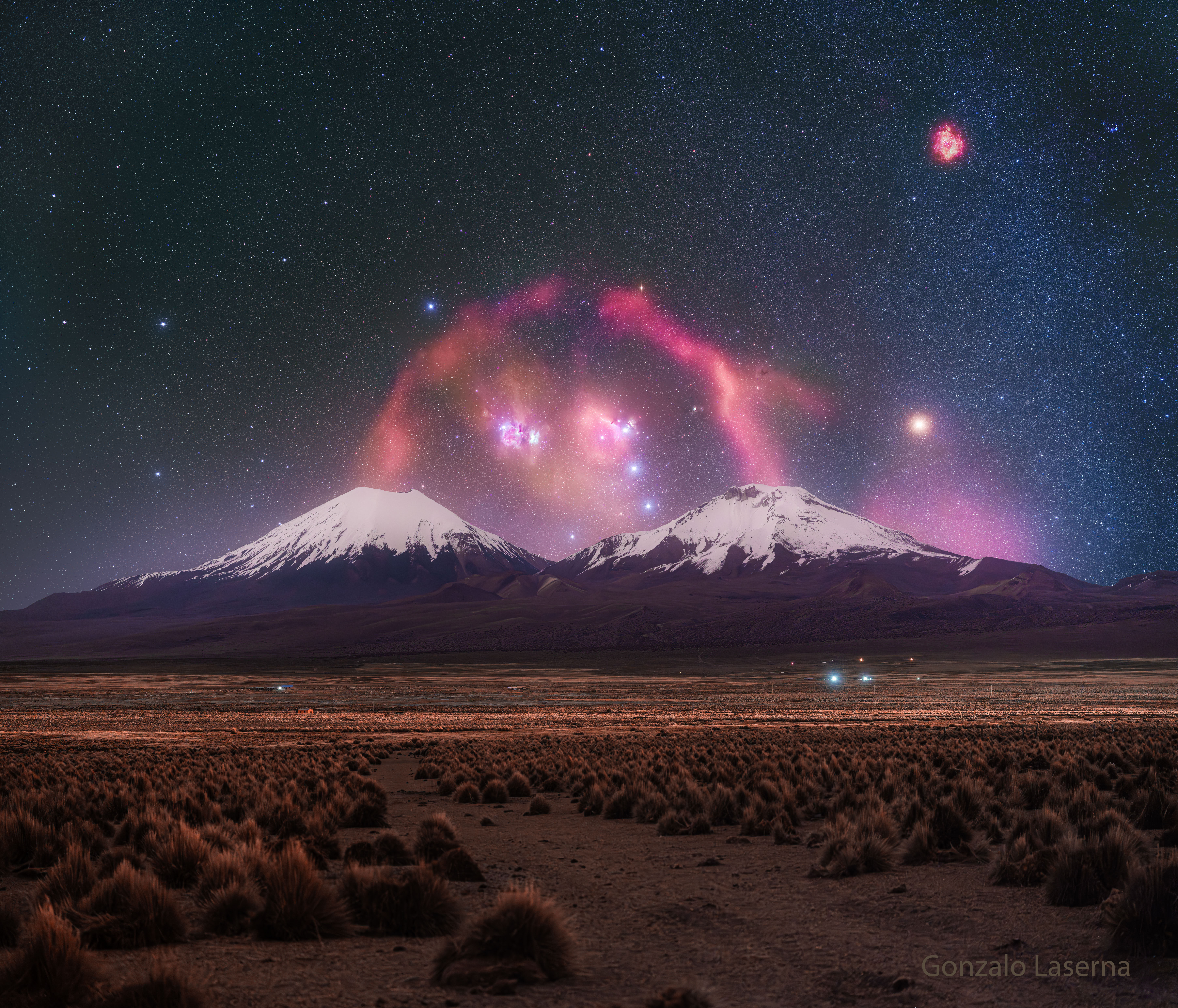
Barnard’s Loop is a giant, glowing nebula in Orion that, under specific conditions, appears to connect two volcanoes in South America. This illusion results from precise timing, perspective, and long-exposure astrophotography, blending Earth and space in a single frame.
Imagine standing under a starry sky and suddenly seeing what looks like a glowing arc connecting two volcanoes on the horizon. It sounds like a scene from a fantasy novel, but it’s an actual astrophotography trick. This is exactly what NASA’s APOD captured—an astonishing alignment where a cosmic nebula appears to link Earth’s volcanic giants with a distant stellar cloud.
Today, we’re unraveling how this surreal image came to be, what it reveals about our universe, and how you can spot similar wonders yourself. Whether you’re a stargazer or a landscape photographer, this story shows how perspective and patience turn ordinary nightscapes into extraordinary stories.
Long-exposure astrophotography can create illusions that connect Earthly features with distant nebulae, like Barnard’s Loop and volcanoes.
Precisely timing and specific viewing angles are essential to capturing these fleeting cosmic alignments.
Barnard’s Loop is a massive hydrogen emission nebula in Orion, visible in wide-field images, and spans about 300 light-years.
The ‘connection’ between volcanoes and nebulae is an optical illusion, not a physical link—your brain joins the dots based on perspective.
Incorporate wide-angle lenses, dark skies, and patience to photograph your own cosmic illusions.
What Makes Barnard’s Loop the Star of the Night Sky Show?
Barnard’s Loop is a massive, glowing arc of hydrogen gas in Orion, stretching about 300 light-years across. It’s part of the Orion Molecular Cloud Complex, a star nursery where new stars ignite and evolve. The nebula shines because nearby hot stars ionize the gas, causing it to glow in a fiery red and orange hue—like a cosmic neon sign.
This feature is a favorite for astrophotographers because its size makes it visible in wide-field shots. Capture it with a camera mounted on a fast lens or a telescope with a wide field of view, especially during winter nights when Orion is high in the sky. The image from Bolivia, taken with carefully planned exposures, demonstrates how Earth’s atmosphere and precise timing can reveal such stunning structures.
As an affiliate, we earn on qualifying purchases.
How the Illusion of Connecting Volcanoes and Nebula Works
Imagine you’re looking at a photograph of a mountain range where distant peaks seem to touch the sky, like the Himalayas seemingly reaching into the clouds. This illusion occurs because of perspective—the further away objects appear closer together when viewed from a specific angle. Similarly, in the astrophotograph, the faint glow of Barnard’s Loop appears to stretch across the sky and align with the volcanoes, Parinacota and Pomerape, in Bolivia.
For example, if you stand at a high vantage point overlooking a city skyline at sunset, distant skyscrapers might seem close together even though they’re miles apart. The same principle applies here, but in the cosmic realm. The long exposure captures the faint nebula light, and from the photographer’s vantage point, the nebula’s position aligns with the volcanoes, creating the illusion of a cosmic bridge connecting Earth and space.
This effect can be compared to a famous optical illusion called the ‘Horizon Illusion,’ where distant objects appear to touch the horizon line, even though they are separated by vast distances. The key is the specific viewing angle and the way our brains interpret the scene, turning a flat image into a seemingly connected scene.
long exposure star photography camera
As an affiliate, we earn on qualifying purchases.
As an affiliate, we earn on qualifying purchases.
Comparison Table: Earth Volcanoes vs. Cosmic Nebulae in Photos
| Feature | Earth Volcanoes | Barnard’s Loop |
|---|---|---|
| Size | Several thousand meters tall (e.g., Mauna Loa > 9 km volume) | 300 light-years across |
| Material | Lava, ash, volcanic rocks | Ionized hydrogen gas |
| Visibility | In landscape photos, during eruptions, or from space | In astrophotography, usually faint and wide |
| Appearance in Photos | Distinct peaks or volcanic craters | Large, glowing arc or nebula |
As an affiliate, we earn on qualifying purchases.
Tips for Capturing Your Own Starry Illusions
- Use a wide-angle lens or camera with a fast aperture to capture large nebulae and landscapes.
- Pick a dark site away from city lights, especially during new moon.
- Plan your shot around the position of Orion, typically in winter for northern hemisphere observers.
- Take multiple long exposures—20 to 30 minutes—stacked together to bring out faint details.
- Be patient: the alignment only appears at specific times and angles. Practice makes perfect.
As an affiliate, we earn on qualifying purchases.
Why This Sky Scene Matters Beyond the Wow Factor
This image is a reminder of how our planet’s landscapes and the universe’s vast structures can align in surprising ways. Think of it like standing at the edge of a vast canyon, where distant mountain peaks seem to touch the sky, or viewing a city skyline at sunset where the tallest buildings appear to merge with the horizon. These are illusions created by perspective—the same principle that makes the nebula seem connected to the volcanoes. They show us that our perception can transform distant, separate features into a single, awe-inspiring scene, whether on Earth or in space.
It’s like looking at a star map and noticing how constellations seem to form recognizable shapes — but those shapes are illusions based on our viewpoint. Recognizing this helps us appreciate the importance of perspective in both photography and understanding our universe.
Frequently Asked Questions
Can I see Barnard’s Loop with my naked eye?
Not quite. Barnard’s Loop is faint and requires long exposure photography through a telescope or camera. To see it visually, you need dark skies, a wide-field setup, and patience.
Are the volcanoes really connected in real life?
No. Parinacota and Pomerape are separate volcanoes, about 10 km apart. The connection seen in the image is an optical illusion caused by perspective and exposure timing.
How do I plan a photo like this?
Choose a dark, high vantage point with a clear view of Orion in winter. Use a wide-angle lens, set long exposures, and wait for the right time when atmospheric conditions and timing align perfectly.
What equipment do I need?
A DSLR or mirrorless camera with a wide-angle lens (f/2.8 or faster), a sturdy tripod, and a remote shutter release help. Post-processing can enhance faint nebula details.
Will this illusion work with other nebulae or landscapes?
Yes. Similar illusions happen when landscapes align with bright stars or nebulae at specific times, especially with long exposures. Each scene depends on perspective and timing.
Conclusion
Next clear night, look up with fresh eyes. The universe offers stories that blend Earth and sky in ways you might never expect. Sometimes, a simple view through your camera lens reveals a universe that’s just a perspective away from connecting the dots.
Remember, the magic isn’t just in the sky—it’s in how you see it. Keep your camera ready—and your curiosity alive.
NFL season / tailgating Picks
team gear
As an affiliate, we earn on qualifying purchases.