
TL;DR

Prime made for students and young adults
- Fast, free delivery for dorm and study essentials
- Prime Video and Amazon Music included
- Member-only deals
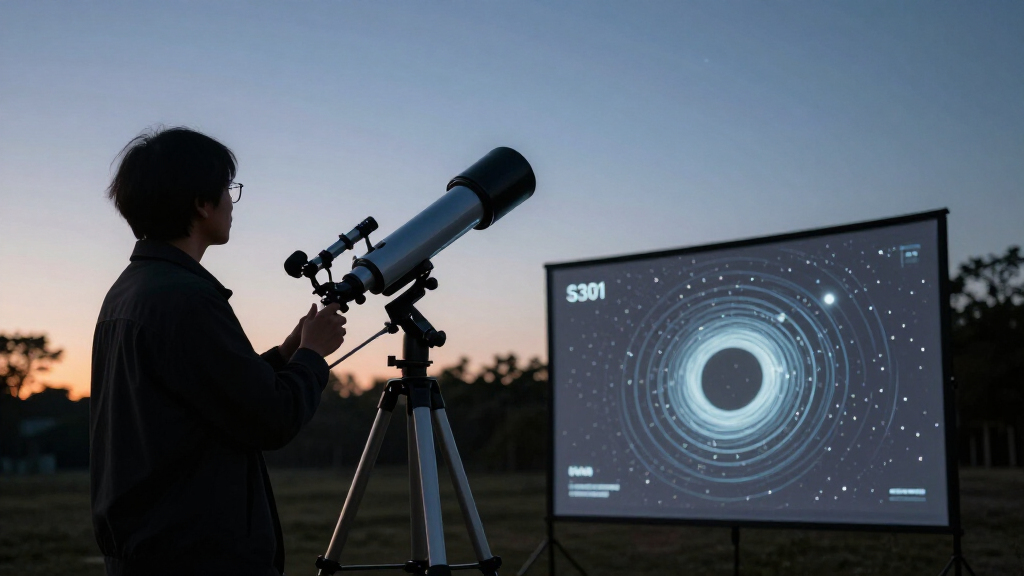
A time-lapse of star S301 orbiting a supermassive black hole showcases the universe’s most extreme gravity. Such visuals, based on real data, help us understand black hole properties and confirm Einstein’s predictions in the darkest galactic corners.
Imagine a star, shimmering like a tiny, fiery jewel, racing around a black hole so dense it warps space itself. Now picture this motion captured in a stunning time-lapse, revealing a cosmic dance spanning years. While we can’t yet film stars like S301 directly in real-time, recent breakthroughs allow us to visualize their elusive orbits, offering a front-row seat to some of the universe’s most extreme physics.
This article takes you inside that visual spectacle—what it shows, how scientists create these images, and what they tell us about black holes, gravity, and the fabric of space itself. You’ll learn how a star like S301 becomes a key to unlocking the secrets of galactic centers—and why this matters for understanding our universe.
Stars like S301 orbit supermassive black holes at speeds exceeding 25,000 km/s, enabling detailed tests of Einstein’s general relativity.
Time-lapse visualizations translate long-term stellar orbits into captivating scenes, making complex physics accessible and engaging.
Observations of stars near the galactic center confirm predictions of relativistic effects—gravitational redshift, orbital precession, and spacetime dragging.
Future telescopes will allow us to see stars even closer to black holes, refining our understanding of black hole spin and growth.
You can participate in black hole astronomy through amateur observations, astrophotography, or simply by appreciating the universe’s grand dance from your back…
Why Stars Like S301 Are the Universe’s Best Black Hole Testers
Stars such as S301 orbit supermassive black holes at the heart of galaxies. Their paths aren’t just simple circles—they warp, precess, and dance under the influence of gravity at its most intense. Observing these stars reveals the black hole’s mass, spin, and even how spacetime itself behaves near the edge of infinity.
Imagine watching a tiny planet whip around a sun so massive that it bends the very light we see. That’s what astronomers do with stars like S301. Their orbits act like a cosmic probe—testing Einstein’s predictions in the universe’s most extreme environment.
For example, recent measurements of S2 orbiting Sagittarius A* confirmed gravitational redshift and relativistic precession, aligning perfectly with Einstein’s theories. Now, imagine a star even closer—like S301—racing around at speeds of up to 25,000 km/s, nearly 9% of the speed of light. These are not just distant points of light—they’re laboratories for physics.
astronomy telescope for astrophotography
As an affiliate, we earn on qualifying purchases.
As an affiliate, we earn on qualifying purchases.
How Time-Lapse Visuals Bring the Black Hole’s Neighborhood to Life
Time-lapse videos condense years of stellar motion into a few seconds, turning complex gravitational choreography into a captivating spectacle. These visuals are based on actual data from telescopes like the Very Large Telescope Interferometer in Chile, which tracks stars near Sagittarius A*.
Picture a slow-motion ballet: stars swooping close, then swinging far out, their paths distorted by gravity. For S301, a simulated 4-year orbit reveals it skimming close enough to the black hole to experience relativistic effects—light bending, orbital precession, and even gravitational redshift—making the dance look almost surreal.
Scientists combine observations with computer modeling to animate these orbits, creating vivid narratives that help scientists and the public visualize phenomena that are otherwise impossible to see directly. It’s like watching a star’s story unfold over years—compressed into a few moments of breathtaking motion.
These animations are crucial because they allow us to interpret the complex gravitational interactions occurring near black holes. By visualizing the orbits, scientists can better understand how gravity operates at these extreme scales, revealing the subtle effects of spacetime curvature and testing Einstein’s predictions. This understanding is essential for refining our models of black hole physics and for identifying any deviations that could point to new physics beyond our current theories.
star tracking mount for astrophotography
As an affiliate, we earn on qualifying purchases.
As an affiliate, we earn on qualifying purchases.
Recent Breakthroughs: Stars, Black Holes, and Einstein Confirmed
In 2018, astronomers watched star S2 complete a full orbit around Sagittarius A*. Its speed peaked at about 8,000 km/s, and observations confirmed Einstein’s predictions about gravitational redshift and orbital precession. That was a major leap in testing black hole physics.
Now, with the discovery of S301, we’re pushing even further. S301 orbits closer and faster—up to 25,000 km/s—at a distance similar to the space between Saturn and the Sun. These extreme conditions allow scientists to measure how fast the black hole spins and how it drags spacetime around itself. Such measurements are vital because they test whether Einstein’s theories hold under the most intense gravitational fields or if new physics might be needed.
Future telescopes like the James Webb Space Telescope (JWST) and the Extremely Large Telescope (ELT) will give us sharper images and more data, helping refine our understanding of these cosmic giants. Each new star orbiting close to the black hole acts like a probe—testing gravity’s limits and revealing the universe’s hidden rules. These observations could also shed light on black hole growth, the dynamics of galaxy centers, and the fundamental nature of spacetime itself, possibly uncovering clues about quantum gravity or other new physics.
As an affiliate, we earn on qualifying purchases.
What Watching S301 Orbit Tells Us About the Universe’s Dark Heart
Stars like S301 aren’t just beautiful—they’re crucial for understanding the universe’s most mysterious object: the black hole. By measuring how close S301 gets and how fast it moves, scientists can determine the black hole’s spin rate and how it warps space and time.
Imagine the black hole as a cosmic whirlpool. The closer a star gets, the faster it whirls around—sometimes at a significant fraction of light speed. These observations help confirm whether black holes spin as fast as some models predict, dragging spacetime with them—a phenomenon known as frame dragging. Confirming this effect is essential because it directly tests a key prediction of Einstein’s general relativity and helps us understand how black holes influence their surroundings.
In practical terms, this means we’re testing Einstein’s general relativity in real-time, in the universe’s most extreme environment. It’s like using a spaceship to test the laws of physics at the edge of a black hole’s event horizon. Understanding these effects also informs us about the evolution of galaxies, as black hole spin impacts accretion processes and jet formation, which in turn shape galaxy growth and activity. The more precisely we can measure these parameters, the better we understand the fundamental physics governing our universe’s most enigmatic objects.
As an affiliate, we earn on qualifying purchases.
How You Can Watch the Cosmic Dance from Your Backyard
While stars like S301 are too faint and close to the galactic core for amateur telescopes, you can still observe brighter stars near the galactic center and learn about black holes indirectly. Using a good-quality telescope with a long focal length helps you see the dense star field around Sagittarius A*.
For a closer look at the universe’s extreme objects, consider astrophotography setups with narrowband filters or even joining local astronomy clubs. Many observatories also host public viewing nights, where you can glimpse the night sky and learn how astronomers track these distant stars.
Remember: the real magic happens when you realize these faint points of light are part of a grand cosmic ballet, spinning around a black hole millions of times more massive than our Sun. The universe is dancing, and you can be part of it—at least in spirit.
The Future of Black Hole Astronomy: More Than Just Pictures
In the coming decades, new telescopes and missions will turn our current visualizations into precise measurements. Instruments like the ELT will resolve stellar orbits with unprecedented detail, possibly capturing the orbit of stars even closer to the black hole.
These advances will help answer big questions: How fast do black holes spin? Do they grow by merging or accretion? Can we detect gravitational waves from stars plunging into black holes? Each discovery will add another piece to the cosmic puzzle.
Meanwhile, the visualizations—like the simulated time-lapse of S301—will keep inspiring us, turning complex physics into stunning stories we can all enjoy. The universe’s most extreme dance is just beginning to reveal its secrets.
Frequently Asked Questions
Are the time-lapse videos of stars orbiting black holes based on real data?
Many are simulations built from actual observations of stars like S2 near Sagittarius A*. They combine real measurements with computer models to visualize how stars would move in these extreme environments.Why do stars like S301 reach such high speeds near black holes?
The intense gravity of the black hole accelerates stars as they swing close, reaching thousands of kilometers per second—sometimes up to 25,000 km/s—making their orbits a natural laboratory for studying relativistic effects.Can I see black holes or their stars with a regular telescope?
Not directly. Black holes are invisible, but their effects on nearby stars are detectable with large, specialized telescopes. You can, however, observe the dense star fields around the galactic center with a good amateur telescope and learn about their fascinating orbits.What’s next for black hole research?
Upcoming telescopes like the ELT and JWST will provide sharper images and more detailed data, helping us understand black hole spins, growth, and the physics of spacetime at its most extreme—pushing the boundaries of what we know.Conclusion
The universe’s most extreme physics are happening right above our heads—hidden in the faint glow of distant stars. Visualizing stars like S301 orbiting black holes turns mind-bending science into a story we can see and feel.
Next time you gaze at the night sky, remember: the cosmic dance is ongoing, and each star’s orbit is a step toward understanding the universe’s deepest secrets. Keep looking up—there’s more to discover than you can imagine.
Columbus Day / Indigenous Peoples' Day Picks
long weekend sales
As an affiliate, we earn on qualifying purchases.