TL;DR

Prime made for students and young adults
- Fast, free delivery for dorm and study essentials
- Prime Video and Amazon Music included
- Member-only deals
Rosetta’s CIVA camera, attached to the Philae lander, captured this image on October 7, 2014, when the spacecraft was about 16 kilometers from comet 67P and 472 million kilometers from Earth. The high-contrast picture combines short and long exposures; it shows Rosetta’s solar array, the comet’s two-lobed nucleus, and dust and gas streaming away. From Earth, 67P is a telescope target under suitable conditions, but it will look like a faint point, not this close-up scene.
A spacecraft selfie can make a comet look close enough to touch, even when Earth sits 472 million kilometers away. In this NASA Astronomy Picture of the Day entry for October 25, 2026, Rosetta appears beside comet 67P/Churyumov-Gerasimenko, its long solar array catching the Sun while dust and gas stream from the oddly shaped nucleus.
The photograph captures a brief moment in a much larger mission. It was taken on October 7, 2014, from just 16 kilometers above the comet, using a camera system carried by the Philae lander while Philae was still attached to Rosetta. You’ll see why the image needs two exposures, what its perspective tells you about the comet, and what an observer on Earth could actually expect to see.
There’s a useful distinction at the heart of this picture: what looks dramatic up close may be nearly invisible from your yard. The spacecraft’s view reveals shape and activity; an Earth-based telescope faces a dim, distant target. Knowing that difference helps you read the image without mistaking it for a view you could reproduce with a backyard camera.
Rosetta’s CIVA camera on the still-attached Philae lander took the selfie on October 7, 2014; NASA APOD featured it on October 25, 2026.
The spacecraft was about 16 kilometers from comet 67P and 472 million kilometers from Earth when it took the picture.
Two exposures were combined to handle the bright solar-array glint and darker surroundings.
From Earth, 67P will appear far smaller than in Rosetta’s close-range image; use current visibility information before planning a session.
The frame documents Philae before its November 12, 2014 separation, but it does not show the lander’s later descent.

What Rosetta’s comet selfie shows at a glance
Rosetta’s selfie shows the spacecraft beside 67P’s two-lobed nucleus, with dust and gas streaming away into space. The orbiter’s bright solar array catches sunlight, while the comet looms beyond it near the top of the frame. The scene is a close-range portrait, not a view from Earth.
The nucleus has a shape that can remind you of two rough rocks pressed together, though the actual surface is far larger and more intricate than that quick comparison suggests. One lobe is smaller; the planned primary landing site for Philae sat on the visible hemisphere of that smaller lobe. In the frame, the comet’s dusty activity gives the background a soft, hazy character against the harder lines of the spacecraft hardware.
The photograph also records a particular moment in the mission. When CIVA took it on October 7, 2014, Philae remained attached to Rosetta. The lander would separate on November 12 and begin its descent to the nucleus. So this is more than an unusual angle: it is a final look from Philae’s camera before separation, with the orbiter and target together in one view.
For a simple reading, start with the bright diagonal structure: that’s part of Rosetta’s solar array. Then look above it for the irregular comet shape, and around the nucleus for the faint veil of escaping material. The bright glint and dark surrounding space make the image feel like a tiny stage lit by a single spotlight.
beginner astronomy telescope for viewing comets and planets
As an affiliate, we earn on qualifying purchases.
As an affiliate, we earn on qualifying purchases.
Why this October 25 sky story is really a 2014 photograph
This NASA APOD entry is a 2026 date-stamped feature about an image made in 2014. The date on an Astronomy Picture of the Day tells you when the image appears in the daily feature, not when the camera captured it. That distinction matters here: Rosetta made this picture on October 7, 2014, near comet 67P, while the APOD presentation is dated October 25, 2026.
Think of it like finding a postcard in a calendar display. The date beside the entry tells you when the postcard is being shown; the date written on the back tells you when the photographer took it. If you’re following mission history, the capture date anchors the image among Rosetta’s operations, while the APOD date helps you locate the page and its accompanying explanation.
The difference also matters for claims about what the comet is doing “tonight.” This image documents a past encounter. It does not show the comet’s current position or activity in October 2026. You’d need an up-to-date ephemeris or observation guide to know where 67P is now and whether it is within reach of your equipment.
NASA APOD credits the image to NASA and explains its context. When sharing it, keep the capture date and the feature date distinct. A caption such as “Rosetta selfie near comet 67P, captured October 7, 2014; featured by NASA APOD on October 25, 2026” gives readers both pieces of information without implying that the spacecraft took it that day.
8 inch Dobsonian telescope with finder scope
As an affiliate, we earn on qualifying purchases.
As an affiliate, we earn on qualifying purchases.
How a two-exposure image holds bright sunlight and dark space
The image combines two exposures, one short and one long, so the camera could record both bright sunlight and darker details in the same high-contrast scene. A single exposure would struggle to show the sunlit solar array clearly while also preserving useful detail around the spacecraft and comet. The blend lets the camera hold more of that visual range in one frame.
You can think of it like photographing someone standing beside a bright window. A short exposure can keep the window from turning into a white sheet, but it may leave the person too dark; a longer one reveals the person while washing out the view. Combining exposures helps balance the scene. Here, the bright glint on Rosetta’s 14-meter solar array and the dimmer surrounding space posed a similar challenge.
The camera system belonged to CIVA on the Philae lander, which was still attached to Rosetta when it took the selfie. That detail is easy to miss: the image is not a photograph taken by a camera mounted on the orbiter itself. The lander’s camera looked back toward the spacecraft, capturing both the machine carrying it and the comet it had traveled to study.
Processing changes how much detail the image can show, but it does not change the basic scene. The two exposures help manage brightness; they don’t mean the comet was painted into the frame or that the solar array was added later. When you inspect a composite like this, ask what the processing helps reveal and what the caption says the camera recorded.
astronomy binoculars 10×50 for stargazing
As an affiliate, we earn on qualifying purchases.
As an affiliate, we earn on qualifying purchases.
What the 16-kilometer view reveals about comet 67P
At about 16 kilometers from the surface, Rosetta could photograph the comet as a shaped landscape rather than a faint dot. The image shows a two-lobed nucleus and material streaming away from it, details that a distant Earth-based view cannot resolve in this same way. Distance changes what a camera can tell you: close in, contours and nearby hardware fill the frame; far away, light from the entire object blends together.
The numbers make the perspective striking. Rosetta was roughly 472 million kilometers from Earth, yet only 16 kilometers from 67P’s surface. It had traveled out to the comet and was working in its immediate environment, so the spacecraft could turn a camera toward the nucleus and capture its irregular outline. An Earth observer, by comparison, would be looking across hundreds of millions of kilometers, where the comet appears tiny even through a telescope.
The streaming dust and gas show that the nucleus was active. Sunlight warms comet material, and escaping gas can carry dust outward, producing a surrounding haze and tail. This frame makes that activity visible around the nucleus, but it is not a full scientific measurement of composition or output by itself. The image tells you what the camera captured from its position; mission data and other instruments supply broader measurements.
That distinction is useful whenever you see a dramatic space image. A photograph can reveal a shape, a plume, or a changing pattern. It can also invite questions that require other observations to answer. Rosetta’s selfie makes the comet’s form tangible, while reminding you that one frame is a window onto a moment, not the entire story of a comet.
telescope smartphone adapter for astrophotography
As an affiliate, we earn on qualifying purchases.
As an affiliate, we earn on qualifying purchases.
How to photograph 67P from Earth without expecting a spacecraft view
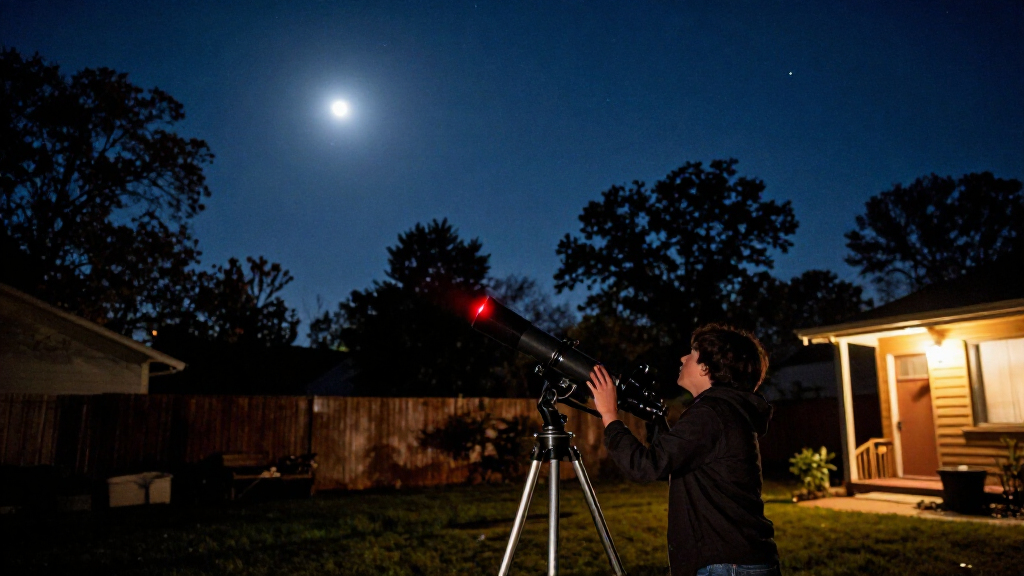
To photograph 67P from Earth, use a long-focal-length telescope or telephoto setup and check a current sky chart for its position and brightness. A wide-field camera can help you find the surrounding star field, but it won’t make the comet’s nucleus look large. From Earth, the comet is so far away that even a well-framed exposure generally records it as a small, faint patch or point rather than a detailed landscape.
- Check current visibility. Look up 67P’s position and predicted brightness for your date and location. The 2014 selfie gives no information about where it sits in the sky tonight.
- Choose your optics. Use binoculars or a small telescope only if the comet is bright enough for your conditions; a longer focal length helps with framing a faint target when it is visible.
- Find a dark, steady sky. Get away from bright streetlights, let your equipment settle outdoors, and avoid nights when haze or a bright Moon washes out faint detail.
- Take several short test exposures. Check focus on nearby stars, then adjust exposure and tracking so stars remain reasonably sharp and the comet shows against the background.
For example, if you set up in a suburban garden and can’t see a fuzzy spot immediately, that doesn’t mean the comet is absent. The Moon, local lights, haze, equipment, and the comet’s changing brightness all matter. The spacecraft image is a scientific close-up; your Earth-based photograph is more like a carefully made record of a moving speck among stars.
Which camera setup fits the view you want?
The right setup depends on whether you want to show the sky around a comet or record the comet as a small target. A wide-field lens captures more stars and gives you a sense of place; a longer focal length puts more pixels on the comet, if the target is bright and well placed. Neither approach can reproduce Rosetta’s close-up selfie from Earth.
| Setup | What it helps you capture | Tradeoff |
|---|---|---|
| Wide-field camera lens | A broad star field, landscape, or sky context | 67P remains very small and may be hard to distinguish |
| Long telephoto lens | A tighter field around the comet and nearby stars | Needs careful focus and steadier tracking |
| Small telescope | A faint target under suitable sky conditions | Visibility depends on current brightness, darkness, and accurate pointing |
| Spacecraft close-range camera | The nucleus shape, spacecraft hardware, and nearby activity | Requires a mission at the comet; backyard gear cannot supply this viewpoint |
Imagine planning an image for a clear, moonless night. A wide lens might make an attractive scene with a foreground tree and a field of stars, but 67P could disappear into the grain of the image. A telescope with tracking can concentrate attention on the comet, though you may lose the scenic sweep. Your choice should follow the story you want the photograph to tell.
These are different photographic jobs, not rival versions of the same image. Rosetta’s camera had the advantage of being close enough to show the comet’s contours. From Earth, your best result may be a subtle dot with stars around it—and that still records a real object moving through the solar system.
What the image can—and cannot—tell you about the mission
The selfie establishes a clear sequence: CIVA photographed Rosetta and 67P on October 7, 2014; Philae was still attached; the lander separated on November 12 and began its descent. It also shows the chosen primary landing site on the visible hemisphere of the smaller lobe. Those are concrete mission details tied to the image and its accompanying NASA APOD explanation.
But one photograph does not show the entire landing or prove every detail of the comet’s behavior. The frame was taken before separation, so it cannot document Philae’s later descent. Nor does its visible dust and gas alone reveal precisely how much material escaped, what every grain contained, or how the activity changed over time. You need additional measurements and images to answer those questions.
This is a good habit for reading space photography: separate what is plainly visible from what you infer. You can point to the array, the nucleus, and the surrounding activity. You can connect the frame to the mission timeline. For a claim about chemistry, internal structure, or long-term change, look for instrument results and mission analysis rather than asking one striking image to carry the whole argument.
NASA APOD provides the caption and credits for this image, which gives you a reliable place to start. If you want the original file or more mission context, follow the APOD page’s image and linked material, checking that the date and credit travel with the image when you share it. The caption is part of the evidence, not just decoration beneath the picture.
Frequently Asked Questions
What am I looking at in Rosetta’s selfie?
You’re seeing the Rosetta spacecraft near comet 67P/Churyumov-Gerasimenko. Its solar array catches bright sunlight, while the comet’s two-lobed nucleus and escaping dust and gas appear beyond it. The image was taken by the CIVA camera system on Philae while the lander remained attached to Rosetta.
Can I see comet 67P tonight?
That depends on your date, location, sky conditions, and the comet’s current position and brightness. The 2014 image does not show where 67P is in the sky now, so check a current ephemeris or astronomy guide before planning an observation. Even when it is observable, it will not look like the close-up spacecraft photograph.
How far away was Rosetta from the comet and Earth?
When the selfie was taken on October 7, 2014, Rosetta was about 16 kilometers from 67P’s surface and roughly 472 million kilometers from Earth. That close spacecraft position let the camera show the comet’s shape at a scale a telescope on Earth cannot reproduce.
Was the image altered or made in visible light?
The NASA APOD explanation says the scene combines two exposures, one short and one long, to record its high contrast. That processing helps show bright sunlight and darker surroundings together. The explanation identifies the CIVA camera system but does not specify a wavelength in the details provided here, so avoid assigning one without checking the original APOD entry.
What camera took the photograph?
The image came from the CIVA camera system on the Philae lander, which was still attached to the Rosetta orbiter. Philae separated from Rosetta on November 12, 2014, a little over a month after the selfie. The camera looked back toward Rosetta and captured the comet in the same frame.
Where can I find the original image and its credit?
Look for NASA’s Astronomy Picture of the Day entry dated October 25, 2026, and follow its image link and caption. The provided credit is NASA. Keep the image’s capture date, October 7, 2014, distinct from the later APOD feature date when you cite or share it.
Conclusion
Remember the two distances: 16 kilometers from the comet, about 472 million kilometers from Earth. They explain why Rosetta could photograph a sculpted nucleus and why your own view, even through a telescope, will be much smaller and fainter. The image is powerful because its camera stood beside the object, not because every observer can reproduce that perspective.
If you want to see 67P yourself, check its current position and brightness, then choose gear that fits the view you can realistically capture. Rosetta’s selfie is a reminder that even a tiny speck in your eyepiece can be a world with cliffs, dust, and a spacecraft passing close enough to wave back.
Halloween Picks
halloween
As an affiliate, we earn on qualifying purchases.