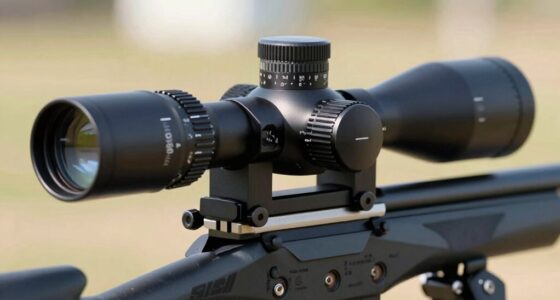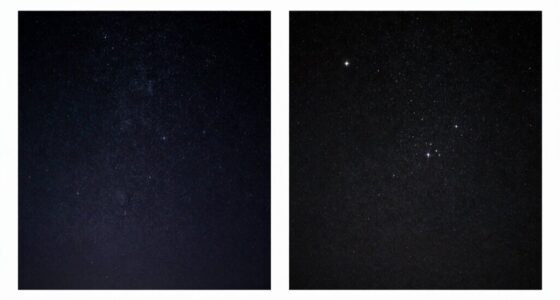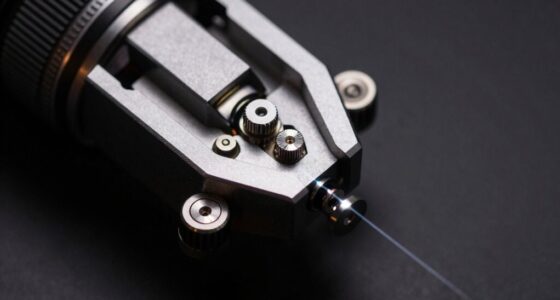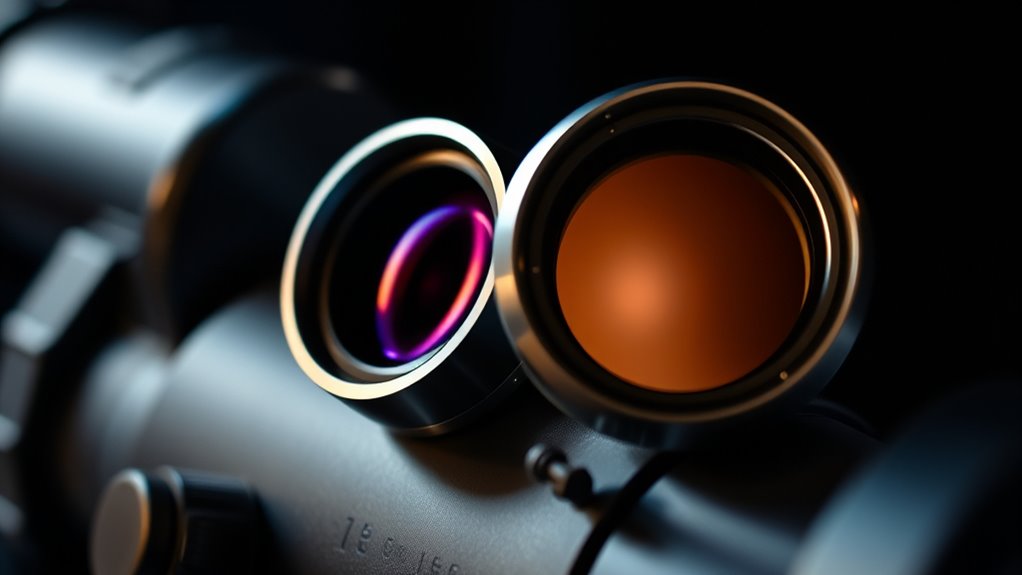

Coma correctors and field flatteners help you achieve sharper, more pinpoint stars across your entire image. They work by fixing common optical issues like coma distortion and focal plane curvature, especially in fast telescopes. This means your edge performance improves considerably, reducing star elongation and blurring. Using these tools allows you to capture clearer, more detailed astrophotos with less post-processing. If you’re curious about how to maximize your image quality, you’ll find helpful details ahead.
Key Takeaways
- Coma correctors reduce off-axis aberrations, producing sharper, more pinpoint stars toward the edges of the frame.
- Field flatteners straighten the focal plane, preventing star distortion and blurring at the image periphery.
- Using both devices together enhances overall image quality by minimizing distortions across the entire field of view.
- These accessories enable longer exposures with fewer post-processing corrections, improving detail and clarity.
- Implementing coma correctors and field flatteners results in more professional, edge-to-edge sharp astrophotography images.

If you’re serious about astrophotography, understanding how coma correctors and field flatteners improve your images is crucial. These tools are designed to tackle common optical issues that can compromise the quality of your astrophotos, especially toward the edges of your images. Coma correctors are specialized accessories that rectify for coma distortion—a common aberration in fast telescopes where stars near the edge appear as elongated or comet-shaped rather than sharp points. By using a coma corrector, you can attain pinpoint stars across the entire field, resulting in cleaner, more professional images. Field flatteners, on the other hand, address the curvature of the focal plane inherent in many telescopes. Without a field flattener, stars at the edges tend to blur or distort, losing the crispness seen at the center. Installing a field flattener ensures that the entire field remains flat and sharp, giving you consistent, high-quality star points across the frame.
Both devices work by modifying the light path within your optical system. A coma corrector typically consists of a lens or set of lenses designed to counteract the off-axis aberrations caused by the telescope’s primary optics. It’s particularly beneficial when working with fast focal ratios, where coma is more pronounced. Field flatteners, meanwhile, are usually attached directly to your camera or telescope and contain a lens element optimized to straighten the curved focal plane. When used together, these tools markedly improve edge performance, allowing you to capture images with minimal aberrations from center to edge.
Modifying the light path with lenses reduces aberrations and sharpens images across the entire field of view.
Using a coma corrector and a field flattener isn’t just about cleaning up the image; it’s about expanding your creative possibilities. With sharper stars across the entire frame, you can confidently capture detailed deep-sky objects without worrying about distortions or elongations skewing your data. This means less time spent post-processing to correct aberrations and more time focusing on capturing stunning images. Additionally, these tools can help you push your equipment to its limits, enabling longer exposures without degrading image quality at the edges.
Ultimately, investing in a good coma corrector and field flattener can elevate your astrophotography to a new level. They’re essential for achieving the crisp, clean images that reveal the true beauty of the night sky. Whether you’re shooting wide-field nebulae or detailed galaxy structures, these accessories ensure your images are sharp from corner to corner, making your astrophotography more precise, vibrant, and rewarding.

Omegon Pro Coma Corrector for Astrograph
As an affiliate, we earn on qualifying purchases.
As an affiliate, we earn on qualifying purchases.
Frequently Asked Questions
Can Coma Correctors Be Used With Any Telescope Type?
Yes, coma correctors can be used with many telescope types, but you need to check compatibility first. Some models work better with fast Newtonians, while others suit SCTs or refractors. Always verify your telescope’s compatibility to guarantee proper accessory integration. Using the right coma corrector will greatly improve your image quality, especially at the edges, so it’s worth confirming that it matches your telescope’s specifications before purchasing.
How Do Field Flatteners Affect Image Contrast?
Field flatteners boost image contrast by reducing lens distortion, especially at the edges of your field of view. This correction minimizes optical aberrations that can cause blurring and reduce contrast, resulting in sharper, more detailed images. By providing a flatter focal plane, your camera captures more consistent brightness and contrast across the entire image, enhancing overall image quality and making your astrophotos look clearer and more professional.
Are There Any Maintenance Tips for Coma Correctors?
Think of your coma corrector like a finely tuned guitar string—you need to keep it in perfect harmony. Regularly check alignment calibration to guarantee ideal correction. Keep it clean by gently removing dust and debris with a soft cloth, avoiding harsh chemicals. I once neglected maintenance, and my images suffered from uneven stars; after proper cleaning and calibration, everything aligned beautifully. Consistent care keeps your optics performing at their best.
Do Field Flatteners Impact Exposure Times?
Yes, field flatteners can impact your exposure times. They help reduce lens distortion and improve optical alignment across the entire image, making your shots sharper from edge to center. Because they optimize the light path, you might find that exposure times become more consistent, especially at the edges. However, in some cases, they may slightly increase the overall light transmission, so you could need to adjust your exposure settings accordingly.
Can I Retrofit My Existing Telescope With Coma Correctors?
Yes, you can retrofit your existing telescope with coma correctors, but it’s like fitting a new suit—each must match perfectly. Check your telescope’s compatibility considerations and explore retrofitting options to guarantee a seamless fit. Some models may require adapters or specific correctors. Always verify that the corrector you choose aligns with your telescope’s optical design to attain ideal edge performance without compromising image quality.

SVBONY SV209 Field Flattener, 1.0X Flattener Corrects The Field, FMC Coating, M63x1 Connection, for SV550 80mm F6 APO OTA Astrophotography
SV209 is a special field flattener for SV550 80F6 OTA; which can effectively improve the image quality problem…
As an affiliate, we earn on qualifying purchases.
As an affiliate, we earn on qualifying purchases.
Conclusion
By using coma correctors and field flatteners, you turn your telescope into a cosmic masterpiece, transforming blurry, distorted edges into crystal-clear, starry perfection. Imagine your images bursting with detail so sharp, it’s like gazing through a window into another universe. With these tools, you don’t just improve your views—you elevate your entire stargazing experience to an awe-inspiring, mind-blowing level, making every night under the stars feel like a journey through the cosmos itself.
Omegon Pro Coma Corrector for Astrograph
As an affiliate, we earn on qualifying purchases.
As an affiliate, we earn on qualifying purchases.
SVBONY SV209 Field Flattener, 1.0X Flattener Corrects The Field, FMC Coating, M63x1 Connection, for SV550 80mm F6 APO OTA Astrophotography
SV209 is a special field flattener for SV550 80F6 OTA; which can effectively improve the image quality problem…
As an affiliate, we earn on qualifying purchases.
As an affiliate, we earn on qualifying purchases.