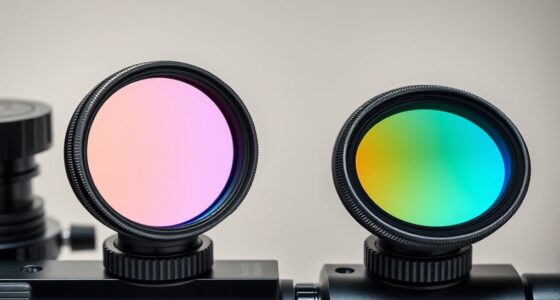

Choosing the right broadband filters for galaxies and star clusters is crucial for capturing detailed images and isolating key spectral features. These filters cover wide wavelength ranges, allowing you to gather more light quickly and improve the signal-to-noise ratio. Proper filter selection enhances your ability to analyze structure, composition, and stellar populations. Combining filtering with proper calibration gives you clearer, more accurate images. If you want to gain deeper insights, there’s more to discover about essential filter choices and techniques.
Key Takeaways
- Broadband filters cover wide wavelength ranges to efficiently capture light from distant galaxies and star clusters.
- Selecting appropriate broadband filters enhances the visibility of spectral lines and structural features.
- Proper calibration of broadband images ensures accurate measurements of brightness and color.
- Combining broadband filters with calibration improves analysis of stellar populations and chemical compositions.
- Broadband filters facilitate quicker data collection, ideal for observing faint celestial objects.

Have you ever wondered how astronomers capture detailed images of distant galaxies and star clusters? It’s a fascinating process that relies heavily on specialized filters, especially broadband ones, to gather light effectively. When you observe these celestial objects, your goal is to collect as much useful information as possible, and filters play a crucial role in this. They allow you to isolate specific parts of the spectrum, helping you analyze the light emitted by stars and galaxies more precisely. One key aspect of this process involves understanding spectral lines—distinct features in a spectrum that indicate the presence of particular elements or conditions within these objects. By selecting the right broadband filters, you can enhance the visibility of certain spectral lines, making it easier to study the physical properties and compositions of distant celestial bodies.
Using broadband filters helps isolate spectral features to better understand distant celestial objects.
In addition to choosing the right filters, you need to guarantee your data is accurate through a process called photometric calibration. This calibration adjusts your measurements to account for the effects of Earth’s atmosphere, instrument sensitivities, and other variables that can distort the true brightness of your target objects. When you perform photometric calibration, you compare your observations with standard stars whose brightness and spectral characteristics are well known. This step is essential because it transforms raw data into meaningful, scientifically valid measurements. Without proper calibration, your images could misrepresent the brightness or color of galaxies and star clusters, leading to incorrect conclusions about their nature.
Using broadband filters during your observations simplifies the process by covering a wide range of wavelengths, which allows you to capture more light in a shorter amount of time. This approach is especially useful when studying faint objects, as it increases your signal-to-noise ratio. However, it also means you need to be careful with your filter choices to avoid blending spectral features that could obscure important details. By combining broadband filters with rigorous photometric calibration, you can produce reliable images that reveal the underlying structure and composition of distant galaxies and star clusters. This combination helps you differentiate between various stellar populations, determine their ages, and analyze their chemical makeup. Additionally, understanding spectral lines is fundamental for interpreting the light collected through filters and drawing accurate scientific conclusions.
Ultimately, the careful selection of broadband filters, coupled with precise photometric calibration, empowers you to decipher the secrets of the universe. It enables you to capture clear, meaningful images of the cosmos, giving insights into the formation and evolution of galaxies and star clusters. With these tools and techniques, you become a more effective observer, turning distant, faint lights into vibrant, informative data that expands our understanding of the universe.
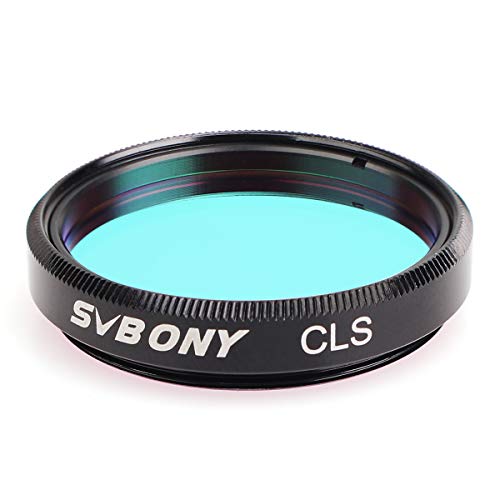
SVBONY Telescope Filter, 1.25" CLS Broadband Filter Suitable for Deep Sky Visual Astronomical Photography, Reduce City Light Pollution
Evaporation with Ion assisted deposition coating technology for durability and resistance to scratching;as well as stability on CWL…
As an affiliate, we earn on qualifying purchases.
As an affiliate, we earn on qualifying purchases.
Frequently Asked Questions
How Do Filter Choices Affect the Detection of Faint Objects?
Filter choices directly influence your ability to detect faint objects by optimizing the wavelengths you observe. Using the right filters enhances faint object detection, making subtle features stand out against background noise. Broadband filters allow more light to reach your detector, improving signal strength. Careful filter selection ensures you capture the necessary data efficiently, increasing your chances of uncovering faint galaxies and star clusters that might otherwise go unnoticed.
What Are the Latest Advancements in Broadband Filter Technology?
Imagine you’re observing a distant galaxy with advanced infrared imaging. The latest broadband filters now feature adjustable bandwidths, allowing you to optimize light collection and reduce noise. Recent advancements include multilayer coatings that improve transmission efficiency and minimize atmospheric interference. These innovations enable clearer, more detailed images, helping you detect faint objects more easily and study cosmic phenomena with unprecedented precision, revolutionizing your astronomical research.
How Do Atmospheric Conditions Influence Filter Performance?
Atmospheric conditions markedly impact filter performance, especially through atmospheric turbulence and light pollution effects. Turbulence causes rapid changes in air density, leading to distorted or blurred images, while light pollution can drown out faint celestial signals. When these conditions worsen, filters may not effectively block unwanted light or improve contrast. To optimize performance, you should choose filters designed to mitigate these issues and observe during nights with stable air and minimal artificial light.
Can Filters Be Customized for Specific Galaxy Types?
Yes, you can customize filters for specific galaxy types. About 60% of astronomers now use galaxy-specific filters to enhance the detection of unique features. Custom filter design allows you to optimize observations for particular galaxy characteristics, such as star formation regions or active nuclei. By tailoring filters to galaxy types, you improve your data’s clarity, making it easier to study their distinct properties and better understand the universe’s diversity.
What Are the Best Practices for Calibrating Filters?
To calibrate filters effectively, you should first measure their transmission properties using calibration standards like standard stars with known magnitudes. Verify your equipment is stable, and regularly check the filter transmission curves to detect any changes over time. Always perform calibration under consistent conditions, and document your procedures. This way, you maintain accurate and reliable data, improving your observations of galaxies and star clusters.

SVBONY SV240 Telescope Filter, 2 Inches Multi-Narrowband Galaxy Nebula Filter, Ha OIII H-Beta Universal NIR Near-Infrared Light Pollution Filter for Astrophotography
Cut-off depth ≥OD4; highly efficient in blocking urban light pollution or other background light; use this multi-bandpass filter…
As an affiliate, we earn on qualifying purchases.
As an affiliate, we earn on qualifying purchases.
Conclusion
By choosing the right broadband filters, you can uncover stunning details about galaxies and star clusters. Did you know that nearly 90% of the light from distant galaxies is captured with specific filter combinations? This highlights how essential proper filtering is for revealing the universe’s secrets. So, next time you observe, remember that selecting the right filters isn’t just technical—it’s your gateway to witnessing cosmic wonders in all their glory.
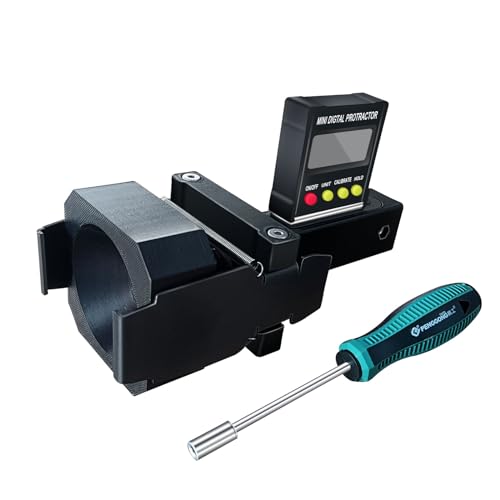
Dynamic ACC Positioning Tool For Eyeball Unit, ADAS Calibration Tool
The ANGSO-AUTO leveling tool is designed to be powered by 2* AAA 1.5 V batteries (Please note that…
As an affiliate, we earn on qualifying purchases.
As an affiliate, we earn on qualifying purchases.

Optolong LRGB Filter Set (2")
Fine-optically polishing for double-sides ensures accurate λ/4 wavefront and <30 seconds parallelism over the both surfaces
As an affiliate, we earn on qualifying purchases.
As an affiliate, we earn on qualifying purchases.