To capture vivid star colors, use longer exposures to let more light reach your camera sensor, resulting in saturated hues. Keep your settings balanced; typically, 15 to 30 seconds works well without causing star trails, unless that’s your artistic choice. Shooting in a dark location and using a wider aperture will enhance color richness. Adjust your ISO to avoid noise. If these tips sound helpful, discover more ways to perfect your astrophotography approach.
Key Takeaways
- Longer exposures allow more light from stars to reach the sensor, enhancing color saturation and richness.
- Use exposure times between 15–30 seconds to balance star hue saturation and minimize star trail formation.
- Adjust shutter speed based on your equipment and conditions to achieve maximum star color without unwanted trails.
- Proper camera settings (wide aperture, moderate ISO) combined with longer exposures improve hue saturation.
- Be mindful of noise and star trails; consider stacking multiple shorter exposures if longer ones introduce artifacts.
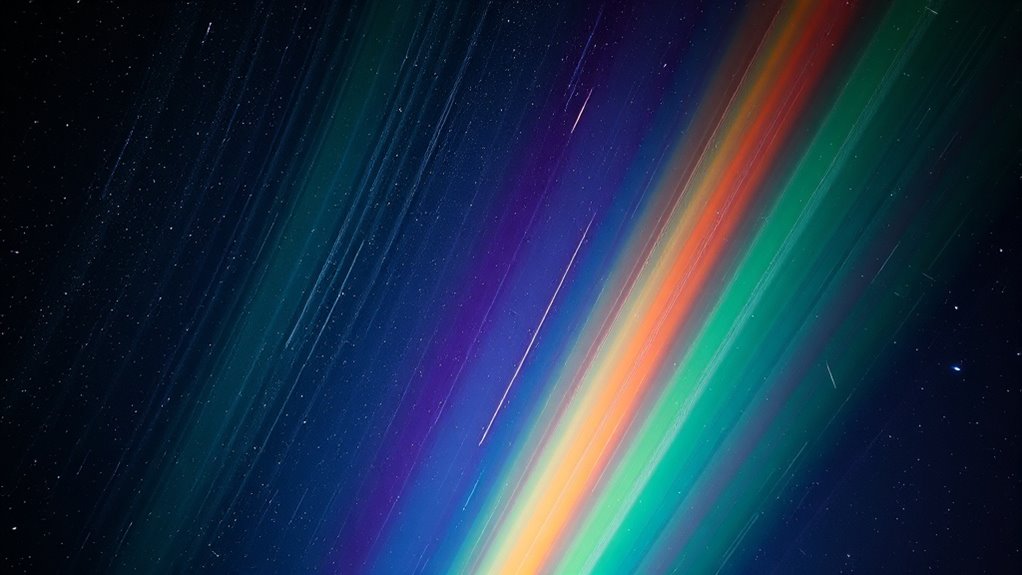
Capturing the vibrant colors of stars requires more than just a good camera; it demands understanding how light travels through space and how your equipment can detect it. Light pollution from city lights and other artificial sources can wash out the subtle hues of stars, making it harder to capture their true colors. To get around this, you should seek out dark sky locations far from urban centers. Once you’re in a suitable environment, your camera settings become vital. Adjusting your exposure time is key to revealing saturated hues; longer exposures allow more light from distant stars to reach your sensor, intensifying their natural colors. However, too long an exposure can introduce noise or cause star trails, so finding the right balance is essential. Additionally, understanding the importance of contrast ratio can help you optimize your camera’s dynamic range to better capture the full spectrum of star colors.
Begin by setting your camera to manual mode, giving you full control over exposure, aperture, and ISO. Use a wide aperture to gather as much light as possible—typically between f/2.8 and f/4.0. Keep your ISO at a moderate level, around 800 to 1600, to prevent excessive noise while still capturing enough light. The real magic happens with your shutter speed. For star photography, exposure times between 15 and 30 seconds often work well, but you might go longer if your equipment and conditions allow. The goal is to let your camera accumulate enough light to reveal the saturated hues of stars without creating trails unless that’s your artistic intent.

DWARFLAB Dwarf 3 Smart Telescope, App-Controlled Astrophotography Camera
- Ultra-Lightweight Design: Only 3lb for portability and travel
- Dual Imaging System: Day and night dual lens for versatile imaging
- 4K Auto-Tracking: Professional auto-tracking for clear shots
As an affiliate, we earn on qualifying purchases.
As an affiliate, we earn on qualifying purchases.
Frequently Asked Questions
How Does Atmospheric Pollution Affect Star Color Saturation?
Atmospheric pollution, like air pollution and light pollution, reduces star color saturation by scattering and diffusing light. When you shoot through polluted air, the colors appear duller and less vibrant. Light pollution from artificial sources creates a glow that washes out star hues, making it harder to capture saturated colors. To get the best results, choose dark, clear nights away from city lights and pollution.
Can Astrophotography Gear Enhance Star Hue Accuracy?
Think of your gear as a painter’s palette—proper equipment optimization can turn dull stars into vibrant masterpieces. Yes, astrophotography gear can enhance star hue accuracy by incorporating advanced filters and sensitive sensors. Pair this with diligent color calibration, and you’ll capture celestial hues with precision, making your images as true to life as the stars themselves. Investing in quality gear guarantees your stars shine with the rich colors they truly possess.
What Role Does Camera Sensor Type Play in Capturing Star Colors?
Your camera sensor type profoundly impacts how you capture star colors. Sensors with higher sensitivity improve color accuracy in low-light conditions, making hues more vibrant. Additionally, larger pixel sizes gather more light, enhancing color saturation and detail. Choosing a sensor with these features helps you accurately record the true colors of stars, especially during longer exposures. So, investing in a high-quality sensor directly boosts the richness and precision of your astrophotography results.
How Do Lens Filters Impact Star Color Saturation During Long Exposures?
You might think lens filters dull star colors, but they actually enhance color saturation by reducing unwanted light pollution and glare. By filtering specific wavelengths, filters can boost the richness of star hues during long exposures. Don’t worry—using the right filter means your star colors stay vibrant and true, giving your photos a more saturated, striking look. Just choose filters designed for astrophotography to see the best effects on color saturation.
Are There Post-Processing Techniques to Improve Star Hue Vibrancy?
Yes, you can improve star hue vibrancy through post-processing with color grading and saturation enhancement. Use editing software like Adobe Lightroom or Photoshop to selectively boost saturation on star hues, making their colors pop without oversaturating the background. Adjust hue sliders to refine star colors, and apply localized edits to maintain natural-looking vibrancy. This technique helps accentuate star hues, creating more vivid and appealing astrophotography images.

ZWO Seestar S30 Pro Smart Telescope, App-Controlled Astrophotography
- Easy Setup for Beginners: Connect app and start exploring
- Automatic GOTO Tracking: Find and follow celestial objects
- 4K Dual-Camera Imaging: Capture sharp deep-sky and landscape photos
As an affiliate, we earn on qualifying purchases.
As an affiliate, we earn on qualifying purchases.
Conclusion
By using longer exposures, you can beautifully capture the saturated hues of star colors, revealing details often missed in shorter shots. Did you know that some of the brightest stars can shine for thousands of years, each with unique colors that tell their story? So, next time you aim your camera at the night sky, remember that patience and longer exposures unseal a stunning palette of celestial colors, turning your photos into vibrant cosmic masterpieces.

Celestron SkyMaster 20×80 Binoculars for Deep-Sky Astronomy – 80mm Aperture
- Magnification Power: 20x magnification for detailed viewing
- Objective Lens Size: 80mm aperture for bright images
- Tripod Compatibility: Includes ¼”-20 adapter for tripod mounting
As an affiliate, we earn on qualifying purchases.
As an affiliate, we earn on qualifying purchases.

Sky Watcher Star Adventurer Tripod – Star Adventurer Accessory – Compatible with AZGT Series and AZ5 Mounts (S20555)
- Compatible with Star Adventurer GTi: Fits GTi, AZ-GT, and AZ5 mounts
As an affiliate, we earn on qualifying purchases.
As an affiliate, we earn on qualifying purchases.