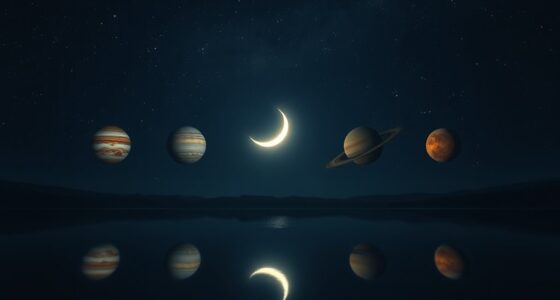
To photograph Jupiter’s moons during transits and capture the Red Spot, you need to track their orbits precisely using astronomy software or ephemerides. Planning your shots guarantees you time the transits accurately and don’t miss those fleeting moments when moons pass in front of or behind Jupiter. Proper calibration of your telescope and real-time monitoring help keep the moons in focus. Keep exploring for detailed tips that will elevate your planetary imaging skills.

Prime made for students and young adults
- Fast, free delivery for dorm and study essentials
- Prime Video and Amazon Music included
- Member-only deals
Key Takeaways
- Use astronomy software or ephemerides to predict moon transits and align your telescope accordingly.
- Calibrate and focus your telescope for sharp images, ensuring accurate tracking during dynamic events.
- Employ real-time monitoring tools to capture moons as they pass in front of or behind Jupiter.
- Plan your shots to include features like the Red Spot, enhancing context and visual interest.
- Timing and precise positioning are key for successful images of moon transits and the Red Spot.

Capturing images of Jupiter’s moons can be a rewarding challenge for amateur astronomers, offering a glimpse into the dynamic nature of our solar system. As you prepare to photograph these distant worlds, it’s essential to understand the importance of tracking Jupiter’s moon orbits accurately. These orbits aren’t static; they shift over hours and days, causing the moons to appear and disappear in your field of view at different times. To capture precise images of transits—when a moon crosses in front of Jupiter or passes behind it—you need to plan your session carefully, using planetary ephemerides or astronomy software to predict the timing. This ensures you don’t miss critical moments and helps you anticipate the position of each moon at a given time.
Tracking Jupiter’s moons accurately is essential for capturing precise transits and dynamic planetary views.
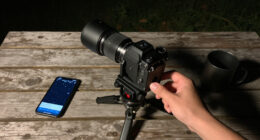
Before you start, take the time to properly calibrate your telescope. Telescope calibration involves aligning your equipment so that the images you capture are sharp and true to scale. This process usually includes focusing your telescope and performing a star alignment to ensure your mount tracks celestial objects accurately. Accurate calibration minimizes image distortion, which is crucial when photographing the subtle movements of Jupiter’s moons. If your telescope has a tracking error, even slight, it could cause the moons to drift out of your frame during long exposures, ruining your shot. Regular calibration not only improves image quality but also makes it easier to follow Jupiter and its moons as they move across the sky.
Once your telescope is calibrated and your camera is set up, you’ll want to monitor the moons’ positions closely. Use software to overlay the predicted orbits directly onto your live view, which can help you frame each shot precisely. For transits, timing is everything—being ready at the right moment allows you to capture the moment a moon begins to obscure Jupiter’s surface or re-emerges on the other side. The red spot, a massive storm on Jupiter, also offers a fascinating target; capturing it along with the moons can add context and depth to your images. Additionally, understanding the stages in commercial juice production can inspire you to experiment with different techniques or ingredients to enhance your astrophotography setup or post-processing.
Incorporating these practices, like paying attention to Jupiter’s moon orbits and ensuring proper telescope calibration, elevates your planetary astrophotography. It turns a simple observation into a precise, well-timed capture of one of our solar system’s most engaging phenomena. With patience and attention to detail, you’ll be able to produce stunning images that showcase the dynamic dance of Jupiter’s moons and the iconic red spot, revealing the fascinating complexity of our celestial neighbor.
Frequently Asked Questions
What Equipment Is Best for Capturing Jupiter’s Moons?
You should use a sturdy telescope with high-quality telescope mounts for stability, ensuring clear, steady images of Jupiter’s moons. Pair it with a good imaging sensor—like a CMOS or CCD camera—that can capture detailed, high-resolution photos. Make sure your setup includes a motorized mount for tracking Jupiter’s movement across the sky, which helps you take longer exposures and get sharper images of the moons and the planet’s red spot.
How Can I Predict Moon Transits for Timing Photos?
Imagine you’re a cosmic detective tracking celestial alignments. To predict moon transits, follow the lunar cycle and consult astronomical software or ephemerides that chart Jupiter’s moons’ positions. These tools act like a celestial map, revealing when moons will transit across Jupiter’s face. Keep an eye on planetary calendars and observatory updates, so you can time your photos perfectly when the moons dance across Jupiter’s grand stage.
What Software Helps Analyze Jupiter’s Atmospheric Features?
You can use software like WinJUPOS or JUPOS to analyze Jupiter’s atmospheric features. These tools facilitate spectral analysis and feature tracking, allowing you to monitor storms, the Red Spot, and cloud movements over time. They help you predict the evolution of atmospheric features, making your photography more precise. With these programs, you’ll gain detailed insights into Jupiter’s dynamic atmosphere, improving your ability to capture striking images of its changing weather patterns.
Are There Optimal Times of Year for Observing Jupiter’s Moons?
You should plan your observations during seasonal viewing periods when Jupiter’s visibility is best from your location. The most favorable times are when the planet is high in the sky, typically during specific months depending on your hemisphere. Keep an eye on planetary alignment events, as these often bring Jupiter’s moons into clear, dramatic transits. These periods enhance your chances of capturing detailed images of the moons and their transits.
How Do Atmospheric Conditions Affect Images of Jupiter’s Red Spot?
Ironically, your chances of capturing Jupiter’s Red Spot clearly depend on unpredictable weather variability. Poor seeing conditions caused by atmospheric turbulence distort images, making details blurry or ghost-like. Clear, stable skies with minimal atmospheric disturbances are essential for sharp, vivid photos. So, while you might hope for perfect weather, it’s the calm, steady atmospheric conditions that truly allow you to reveal the Red Spot’s striking details through your lens.
Conclusion
Capturing Jupiter’s moons and its iconic Red Spot offers a thrilling glimpse into our solar system’s giants. Did you know that Jupiter’s four largest moons—Io, Europa, Ganymede, and Callisto—are collectively called the Galilean moons, named after Galileo? With patience and the right gear, you can document their mesmerizing dance across the planet’s face. Keep practicing, and you’ll uncover stunning images that reveal the dynamic beauty of our cosmic neighborhood.
Fall Picks
fall essentials
As an affiliate, we earn on qualifying purchases.