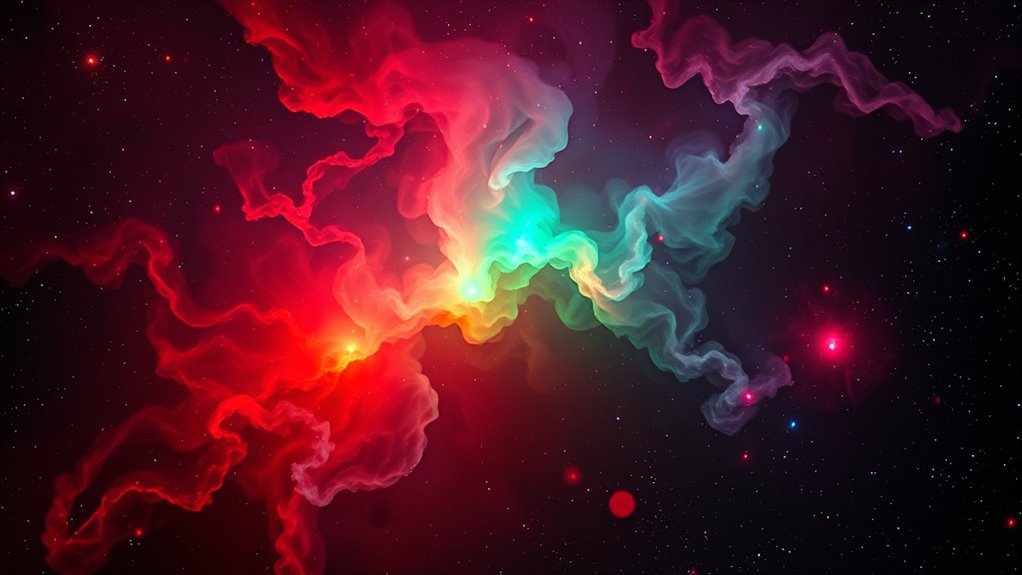
Hydrogen-alpha, oxygen-iii, and sulfur-ii are specific emission lines with wavelengths of 656.3, 500.7, and 672.4 nanometers respectively. You use these lines in astrophotography to highlight different nebula features: hydrogen-alpha shows red regions, oxygen-iii reveals bluish-green areas, and sulfur-ii highlights deep red or orange hues. Understanding these wavelengths helps you choose the right filters and techniques, so exploring further will deepen your grasp of capturing stunning cosmic images.
Key Takeaways
- Hydrogen-Alpha emits at 656.3 nm, highlighting red regions in nebulae for astrophotography.
- Oxygen-III has a wavelength of 500.7 nm, revealing bluish-green structures and details.
- Sulfur-II occurs at 672.4 nm, appearing as deep red or orange to add contrast in images.
- These specific wavelengths are used to select narrowband filters for isolating emission lines.
- Understanding these wavelengths enhances imaging techniques and the analysis of celestial objects.
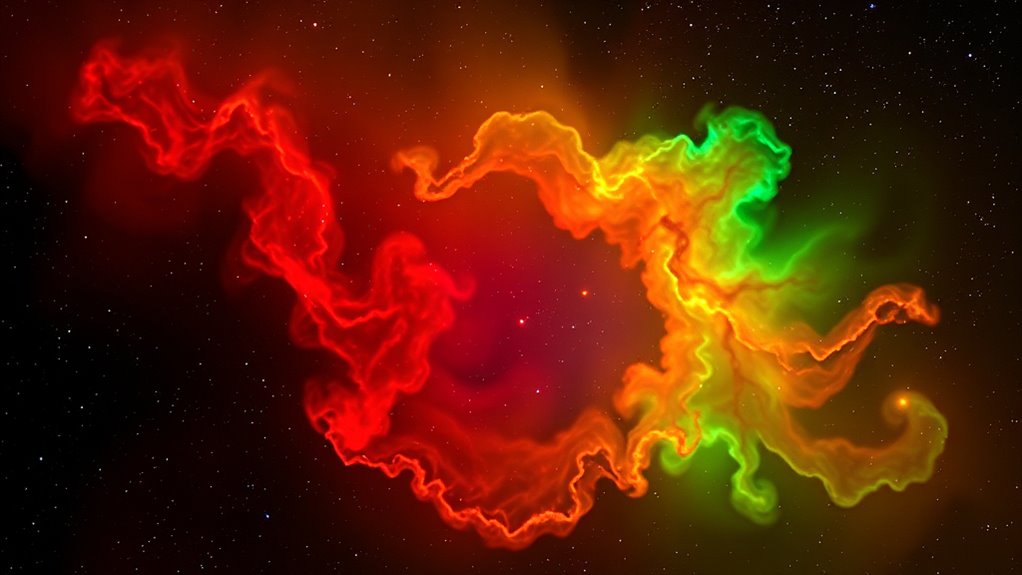
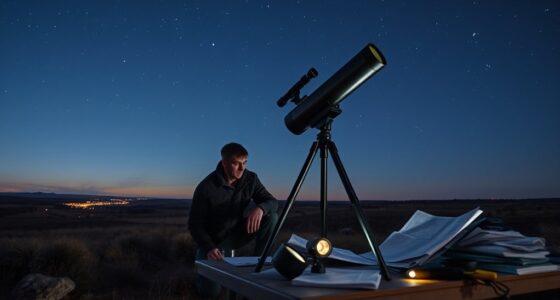
Understanding the wavelengths and applications of Hydrogen-Alpha, Oxygen-III, and Sulfur-II is essential for astronomers and astrophotographers. These emission lines serve as crucial tools for capturing stunning images and gaining insights into celestial objects. To do this effectively, you need to master spectral line identification, which involves recognizing specific wavelengths associated with each element. Spectral line identification helps you select the right filters and settings, ensuring you highlight the features of nebulae or galaxies that emit these wavelengths. Knowing these wavelengths allows you to optimize your astrophotography techniques, such as choosing narrowband filters that precisely isolate each emission line. For example, Hydrogen-Alpha, at 656.3 nanometers, is prominent in many nebulae, providing rich reds in your images. Oxygen-III, at 500.7 nanometers, reveals structures with a bluish-green hue, often exposing details invisible in broadband images. Sulfur-II, at 672.4 nanometers, appears as deep red or orange, adding depth and contrast to your astrophotos. When you understand the specific wavelengths, you can better plan your imaging sessions, selecting the appropriate filters to maximize signal-to-noise ratios and minimize light pollution effects. Using narrowband imaging techniques, you can combine these lines to produce detailed, high-contrast images that showcase the intricate structures within nebulae. These techniques involve capturing separate images through different filters and then combining them in post-processing, emphasizing each element’s emission. Your ability to distinguish these spectral lines also helps in troubleshooting issues, such as identifying if a particular emission line is weak or contaminated by light pollution. By honing your spectral line identification skills, you become more precise in your astrophotography, capturing nebulae in their true colors and revealing features that broad-spectrum cameras miss. Furthermore, understanding the unique characteristics of each wavelength informs your choice of camera settings, exposure times, and stacking methods. This knowledge boosts your confidence in planning sessions, ensuring you get the best possible data for your astrophotography projects. Ultimately, mastering the wavelengths and their applications empowers you to create more compelling and scientifically valuable images, deepening your appreciation for the universe’s complexity. Whether you’re a seasoned astrophotographer or a dedicated amateur, grasping these spectral lines and refining your astrophotography techniques will elevate your work and open new avenues for exploring the cosmos. Additionally, spectral line identification is fundamental for differentiating between various celestial phenomena and understanding their physical properties.

Astromania Telescope Filter, 1.25 Inches Narrowband Hydrogen Alpha Filter, Galaxy Night Sky H-Alpha Nebula Filters for Astronomy Telescope, Telescope Accessories Light Pollution Filter
A filter with incredible light pollution cut off characteristics
As an affiliate, we earn on qualifying purchases.
As an affiliate, we earn on qualifying purchases.
Frequently Asked Questions
How Do Atmospheric Conditions Affect These Emission Lines?
Atmospheric conditions can considerably impact these emission lines through atmospheric absorption and weather variability. When the atmosphere is humid or cloudy, it absorbs more light, reducing the clarity of the emission lines you observe. Wind, temperature changes, or storms can cause fluctuations in atmospheric density, further affecting how well you can detect these lines. To get accurate readings, you need to account for these atmospheric effects and choose ideal weather conditions.
Can These Wavelengths Be Used for Medical Imaging?
Yes, these wavelengths can be used for medical imaging through spectral analysis and emission line diagnostics. You can leverage specific emission lines to identify and analyze biological tissues or detect abnormalities. By applying this technology, you enable precise imaging that highlights differences in tissue composition. This approach enhances diagnostic accuracy, allowing for non-invasive, detailed examinations, making it a promising tool in modern medical diagnostics.
Are There Any Environmental Impacts From Observing These Wavelengths?
Sure, observing these wavelengths might not cause a cosmic meltdown, but they do have environmental impacts. You could be unintentionally fueling air pollution by increasing light pollution, which disrupts wildlife and obscures our night skies. While these wavelengths are fascinating for astronomy, their bright emissions can contribute to light pollution, making it harder to see stars, and possibly affecting local ecosystems. So, yes, your stargazing has some environmental footprints.
How Do These Emissions Help in Studying Galaxy Formations?
You use these emissions to perform spectral analysis, which reveals details about galaxy formation and evolution. By studying the specific wavelengths emitted by hydrogen, oxygen, and sulfur, you can identify star-forming regions, gas composition, and movement within galaxies. This information helps you understand how galaxies grow and change over time, providing insights into the processes driving galaxy evolution and the lifecycle of cosmic structures.
What Technological Advancements Are Improving Detection of These Lines?
Detecting these emission lines is like tuning a finely crafted radio; advances in spectroscopic sensors and adaptive optics markedly sharpen your view. Modern sensors offer higher sensitivity, letting you catch faint signals more precisely. Adaptive optics corrects atmospheric distortions in real-time, giving you clearer images. Together, these innovations enable you to study galaxy formations more accurately, revealing the universe’s secrets with unprecedented detail and clarity.

Celestron 93623 Narrowband Oxygen III 1.25" Filter – Isolates Oxygen Lines Emitted by Planetary and Emission Nebulae, Eliminates Un-Natural Coloured Halos Surrounding Bright Stars, Black
The 1-1/4" OIII narrowband filter isolates just the two doubly-ionized oxygen lines (496 and 501nm lines) emitted by…
As an affiliate, we earn on qualifying purchases.
As an affiliate, we earn on qualifying purchases.
Conclusion
Now that you know the wavelengths and uses of Hydrogen-Alpha, Oxygen-III, and Sulfur-II, you’re practically a cosmic superhero! With this knowledge, you can reveal the secrets of the universe like a detective wielding a stellar magnifying glass. Imagine gazing at the stars and understanding their deepest secrets—it’s almost like having a superpower! So go ahead, explore into the cosmos and let these wavelengths guide your incredible journey through the universe’s greatest mysteries!
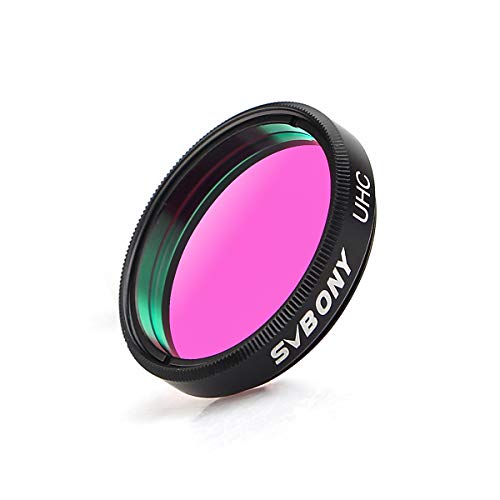
SVBONY Telescope Filter 1.25" UHC Filter Astrophotography to Improve The Image Contrast Reduces Light Pollution (1.25 inch)
UHC filters or light pollution reduction filters are designed to selectively reduce the transmission of certain wavelengths of…
As an affiliate, we earn on qualifying purchases.
As an affiliate, we earn on qualifying purchases.

Astromania 1.25" O-III Filter – Enhances Contrast During Visual Observation of Gaseous and Planetary Nebulae in All Sky Conditions, The Veil, Ring, Dumbbell and Orion Nebula, Among Many Other Objects
1.25 inch O-III Filter greatly enhances contrast during visual observation of gaseous and planetary nebulae in all sky…
As an affiliate, we earn on qualifying purchases.
As an affiliate, we earn on qualifying purchases.