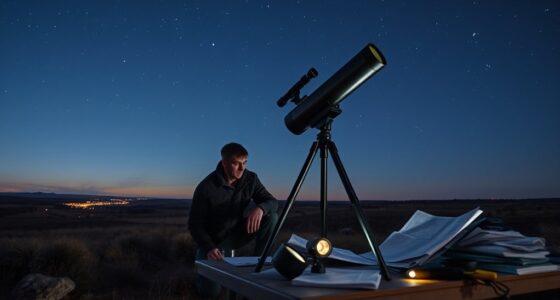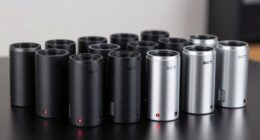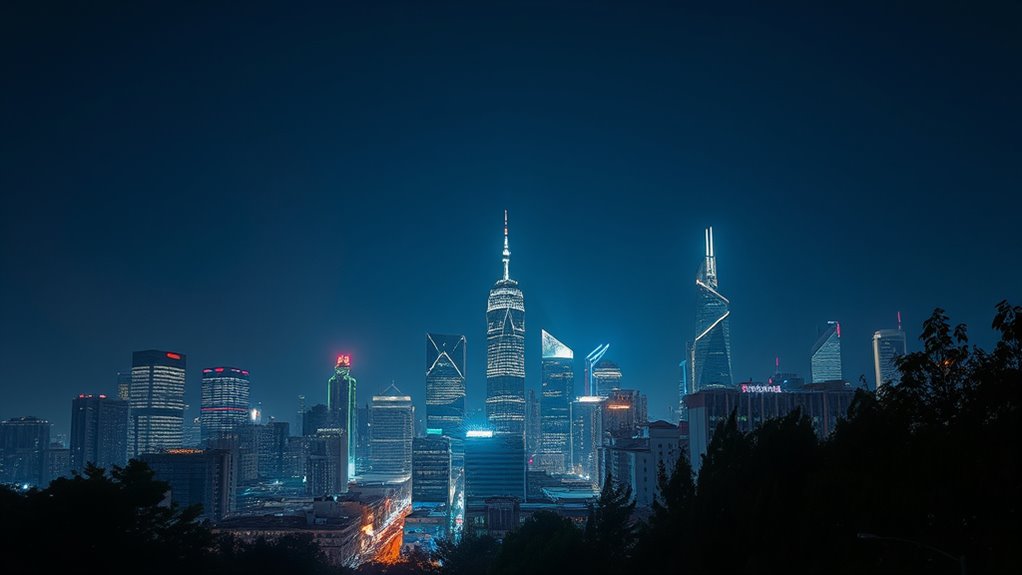

Light-pollution filters are essential for your one-shot color camera, helping you capture clearer and more detailed astrophotos in urban skies. These filters block artificial lights from sources like streetlights and city glow, while letting through key wavelengths like hydrogen-alpha and oxygen-III. High-quality filters improve contrast, reduce post-processing time, and reveal faint celestial features. To get the best results, choosing a filter that matches your camera’s needs is key—if you keep exploring, you’ll find more tips on making the most of your setup.
Key Takeaways
- Light-pollution filters improve contrast by blocking artificial wavelengths, enhancing detail in one-shot color astrophotography.
- Select filters with spectral transmission curves that target celestial signals like hydrogen-alpha, oxygen-III, and sulfur-II.
- High-quality filters with precise coatings effectively block urban light sources while transmitting essential astronomical wavelengths.
- Proper filters reduce the need for post-processing, resulting in clearer, more vibrant images under light-polluted skies.
- Investing in durable, well-manufactured filters ensures long-lasting performance and better capture of true colors and details.
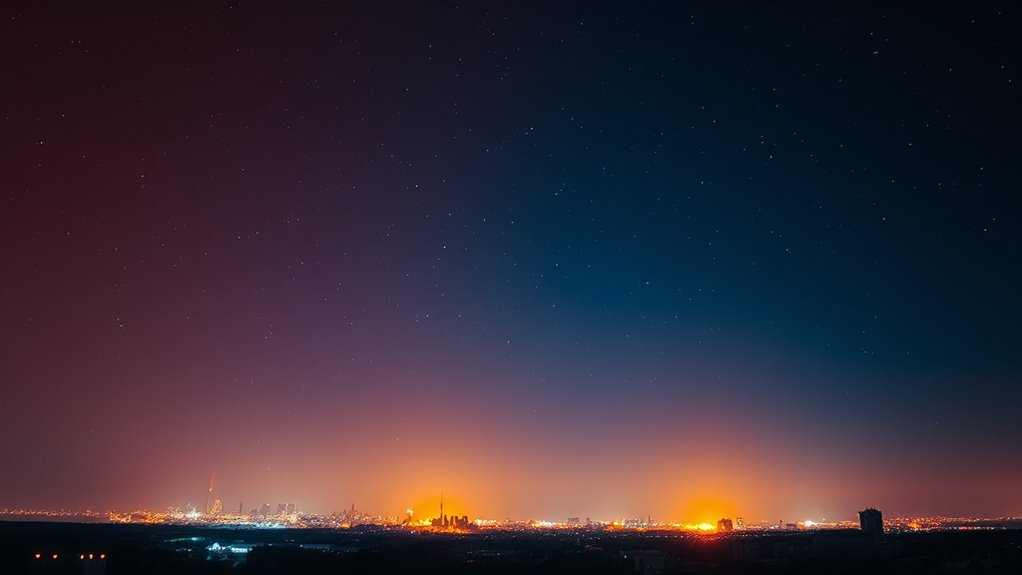
Light pollution considerably hampers astrophotography, especially when using one-shot color cameras that capture the entire spectrum in a single shot. These cameras are convenient, but they also make you more vulnerable to the glow of urban lights, which can wash out the faint details of celestial objects. To combat this, light-pollution filters are essential tools that help you improve image clarity and contrast. When selecting a filter, understanding spectral transmission becomes vital. Spectral transmission refers to the specific wavelengths of light that a filter allows through while blocking others. Good filter manufacturing ensures that these filters selectively transmit the ideal wavelengths associated with celestial signals—such as hydrogen-alpha, oxygen-III, and sulfur-II—while blocking common sources of light pollution like mercury vapor or LED streetlights.
Light pollution hampers astrophotography; filters improve contrast by blocking unwanted light while transmitting celestial wavelengths.
In filter manufacturing, precision is key. Manufacturers design filters with specific spectral transmission characteristics to maximize the amount of useful signal reaching your camera. These filters are crafted using advanced coatings and layered materials that target particular wavelengths. When you choose a filter with ideal spectral transmission, you’re effectively reducing the unwanted glow from artificial lights, allowing your camera to record more accurate and detailed images of nebulae, galaxies, and star clusters. The quality of filter manufacturing directly impacts how well these filters perform; poorly manufactured filters may let through unwanted light or cut off critical parts of the spectrum, resulting in subpar images.
Using these filters in your astrophotography setup means you can capture more of the true colors and details of distant objects, even under light-polluted skies. Since one-shot color cameras record the entire spectrum in a single shot, they benefit greatly from filters that selectively block interference while transmitting the necessary wavelengths. This selective transmission improves contrast and reduces the need for extensive post-processing. When you consider filter options, look into the spectral transmission curves provided by manufacturers. These curves show exactly which wavelengths will pass through your filter, giving you insight into how well it will work in your specific environment.
Furthermore, understanding filter manufacturing processes helps you identify high-quality options that will last through many sessions. In essence, understanding spectral transmission and how filters are manufactured allows you to make smarter choices for your astrophotography gear. It guarantees you select filters that are precisely tuned to enhance your images by blocking pollution and transmitting celestial signals effectively. Investing in high-quality filters designed with meticulous filter manufacturing processes pays off by giving you clearer, more vibrant astrophotos, even from light-polluted locations. With the right filter, you’ll find capturing stunning images of the night sky becomes not just possible but notably more rewarding.
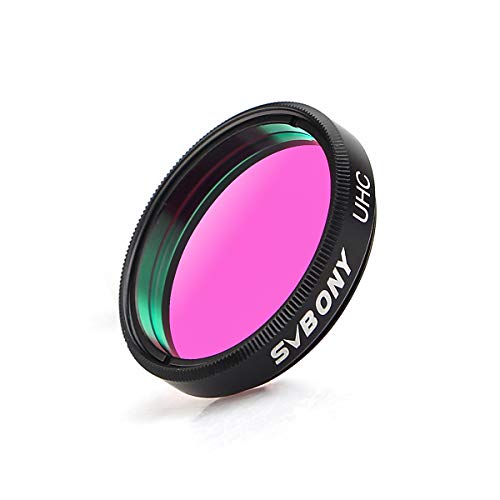
SVBONY Telescope Filter 1.25" UHC Filter Astrophotography to Improve The Image Contrast Reduces Light Pollution (1.25 inch)
UHC filters or light pollution reduction filters are designed to selectively reduce the transmission of certain wavelengths of…
As an affiliate, we earn on qualifying purchases.
As an affiliate, we earn on qualifying purchases.
Frequently Asked Questions
Can Light-Pollution Filters Damage My Camera Sensor?
Light-pollution filters won’t damage your camera sensor if they’re compatible and durable. Make sure the filter fits your camera’s sensor size and isn’t cheaply made, as low-quality filters may scratch or degrade over time. Properly handling and cleaning the filter also reduces risk. When used correctly, these filters protect your sensor from harmful light pollution without causing damage, ensuring clearer astrophotography results.
Are These Filters Compatible With Smartphone Cameras?
Think of light-pollution filters as a tailor-made suit for your camera’s eye. They’re generally compatible with smartphones if your device allows for filter attachment, often via clip-on or adapter rings. Check your smartphone’s compatibility and attachment options first. If your phone supports add-ons, you can easily slip the filter over your camera lens, transforming your smartphone into a powerful tool for capturing clearer, cleaner night skies.
How Do Filters Affect Image Exposure Times?
Filters can affect your image exposure times by requiring you to adjust your camera’s settings for ideal results. The filter’s effectiveness in blocking unwanted light means you might need longer exposure times to gather enough light for a clear shot. Keep in mind that some filters may demand more exposure adjustment than others, so test different settings to find the perfect balance between filter effectiveness and image quality.
Can They Be Used for Astrophotography During the Day?
Daytime astrophotography with filters is like capturing stars through a shimmering curtain—you can, but the filter’s effectiveness dims in sunlight. These filters cut through light pollution, helping you see celestial details, but daylight’s brightness overwhelms their capacity. If you want to chase the cosmos during the day, use specialized filters designed for bright conditions, knowing they’ll only partially mimic nighttime clarity.
What Maintenance Is Required for Long-Term Filter Use?
You should regularly clean your light-pollution filter with a gentle lens cleaner and microfiber cloth to keep it free of dust and smudges. Store it in a protective case when not in use, ideally in a cool, dry place to prevent damage or warping. Avoid touching the glass directly, and inspect it periodically for scratches or residue to guarantee peak performance over time.

Astromania Telescope Filter, 1.25 Inches Narrowband Hydrogen Alpha Filter, Galaxy Night Sky H-Alpha Nebula Filters for Astronomy Telescope, Telescope Accessories Light Pollution Filter
A filter with incredible light pollution cut off characteristics
As an affiliate, we earn on qualifying purchases.
As an affiliate, we earn on qualifying purchases.
Conclusion
With the right light-pollution filter, you can transform a dull, washed-out night into a vibrant canvas of stars and colors. Imagine your camera piercing through the haze, revealing distant galaxies and shimmering nebulae that once faded into darkness. These filters sharpen your view, turning ordinary nightscapes into breathtaking scenes. So, equip your camera wisely, and let the night disclose its hidden wonders, painting the sky with clarity and brilliance you never thought possible.

Celestron 93623 Narrowband Oxygen III 1.25" Filter – Isolates Oxygen Lines Emitted by Planetary and Emission Nebulae, Eliminates Un-Natural Coloured Halos Surrounding Bright Stars, Black
The 1-1/4" OIII narrowband filter isolates just the two doubly-ionized oxygen lines (496 and 501nm lines) emitted by…
As an affiliate, we earn on qualifying purchases.
As an affiliate, we earn on qualifying purchases.

SVBONY SV220 Telescope Filter, 2" 7nm Dual-Band Nebula Filter, Reduce Stray Light, H-Alpha&O-III Narrowband Filter for One-Shot Color Camera, Telescope Accessories for Deep Sky Astrophotography
Capture Purer Nebula Light: SV220 2" Dual-Band Filter allows high transmission of OIII (500.7nm) and H-Alpha (656.3nm) nebula…
As an affiliate, we earn on qualifying purchases.
As an affiliate, we earn on qualifying purchases.