
TL;DR

Prime made for students and young adults
- Fast, free delivery for dorm and study essentials
- Prime Video and Amazon Music included
- Member-only deals
Hubble’s recent images hint at a ten-sided pattern around Saturn’s south pole, similar to the North Pole’s famous hexagon. This could reflect stable atmospheric waves, offering insights into Saturn’s jet streams and fluid dynamics, but confirmation requires careful analysis and repeated observations.
Imagine peering into the night sky and catching a glimpse of a perfect ten-sided shape swirling around Saturn’s south pole. It sounds like a cosmic optical illusion, but recent Hubble images suggest something extraordinary. These geometric patterns aren’t just artistic strokes—they’re clues to the deep, turbulent dance of gases high above Saturn’s cloud tops.
In this post, you’ll learn what makes these shapes so intriguing, why they matter for planetary science, and how they challenge our ideas about the atmospheres of giant planets. You’ll also get practical tips on how astronomers capture these fleeting features and what they reveal about the hidden forces shaping Saturn’s weather.
Saturn’s atmospheric polygons, like the north-polar hexagon, form from stable jet stream waves, potentially creating other shapes like a decagon.
Hubble’s multi-wavelength imaging helps distinguish between cloud layers, haze, and auroras, but confirmation of polygonal shapes needs repeated observations.
A south-polar decagon, if confirmed, could challenge current models and reveal new insights into atmospheric wave stability and jet stream behavior.
Seasonal changes and vertical wind shear significantly influence the formation and longevity of planetary polygons.
Amateur astronomers can observe Saturn’s broad atmospheric features, but resolving detailed polar polygons requires space-based telescopes or spacecraft.
What’s Really Going On When Saturn Forms These Geometric Shapes?
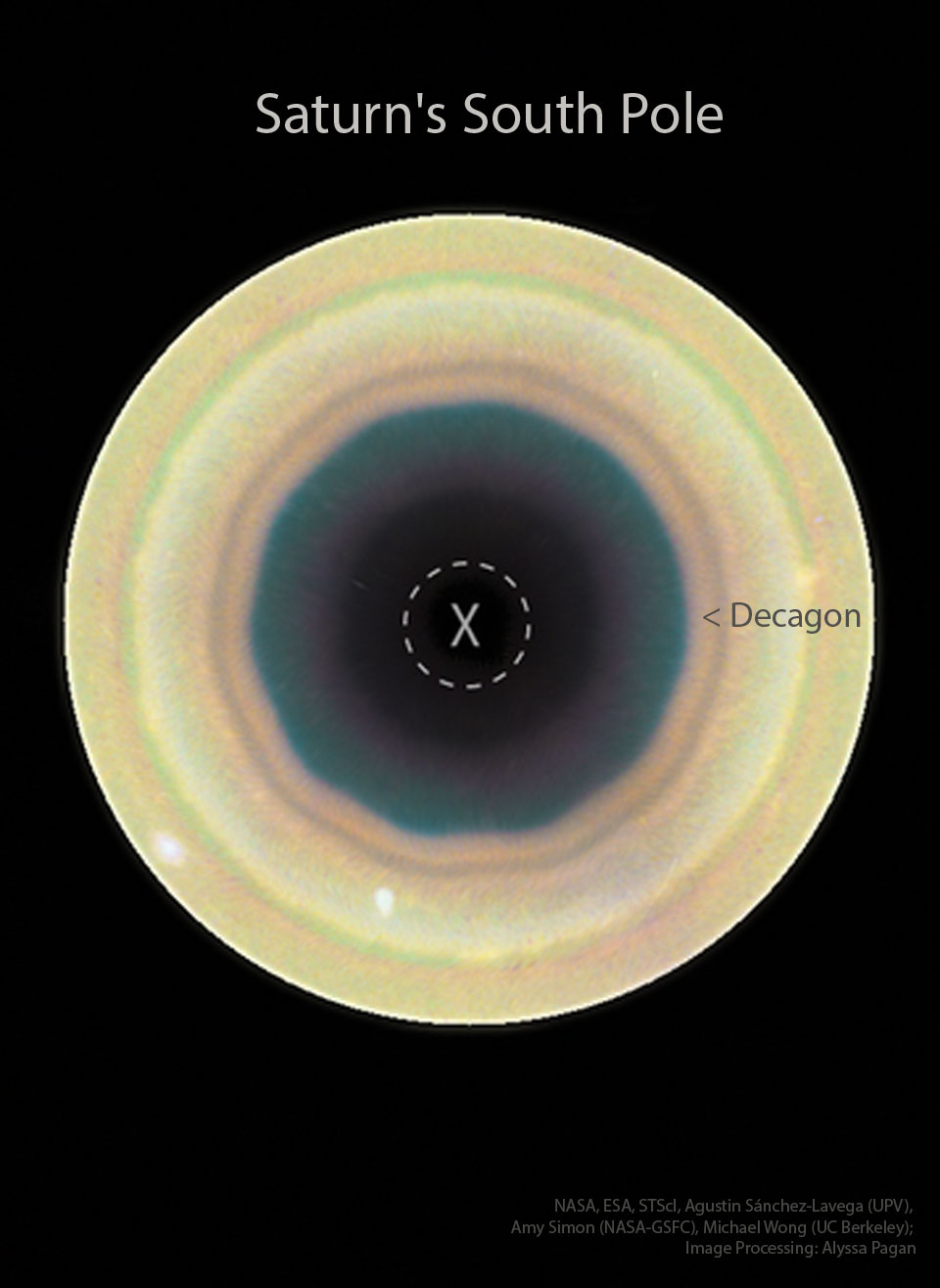
Saturn’s poles are like giant weather laboratories. The north pole hosts the famous hexagon—a stable, six-sided jet stream pattern that’s been there for over 40 years. The south pole, however, has traditionally been known for a swirling, hurricane-like vortex and complex cloud formations. Now, Hubble’s latest images suggest there might be a ten-sided pattern—a decagon—around the south pole.
This isn’t solid metal or a crystal shape. Instead, it’s a pattern in the swirling clouds and high-altitude haze. Think of it like the ripples on a pond, but on a planetary scale. These patterns arise when powerful east-west jet streams develop waves that lock into the atmosphere, creating stable boundaries that resemble polygons.
Why does this happen? Fast-moving jet streams can generate standing waves—think of the ripples on a guitar string when plucked just right. When conditions are just right, these waves settle into a shape with multiple lobes. On Saturn, the north-polar hexagon is believed to be one such wave—an atmospheric ‘standing wave’ locked into the jet’s flow. Recognizing these patterns is crucial because they reveal the underlying stability and structure of Saturn’s atmospheric dynamics, providing clues about the energy transfer processes and the fluid behavior of gases at extreme conditions. If the decagon is confirmed, it could indicate that the planet’s atmospheric waves are more versatile than previously thought, hinting at complex interactions that could influence weather patterns across different latitudes and seasons.
telescope for planetary observation
As an affiliate, we earn on qualifying purchases.
As an affiliate, we earn on qualifying purchases.
How Hubble’s Sharp Eyes Capture These Mysteries From Earth
Hubble’s ability to image Saturn at multiple wavelengths makes it a powerhouse for spotting these subtle atmospheric features. It can see in visible, ultraviolet, and near-infrared light, revealing different layers of clouds, haze, and auroras. The recent decagon appears most prominent in the darker, inner regions of the planet’s south pole, highlighted by contrasting colors and textures.
Imagine a giant, shimmering snow globe—except the snow is swirling clouds, and the globe is Saturn. Using filters, scientists can enhance specific features, like methane absorption bands or ultraviolet auroras, to make these geometric patterns stand out. The image’s vivid colors aren’t just pretty—they’re clues about what’s happening high in Saturn’s atmosphere.
But beware: image processing can sometimes create illusions. Brightness adjustments or contrast enhancements might emphasize certain shapes. Confirming a true polygon requires measuring the cloud boundaries over multiple observations and checking if the pattern persists over time. This process is essential because atmospheric features are dynamic; what looks like a decagon in one image might be a transient formation or an artifact of processing. Repeated observations allow scientists to differentiate between real, stable structures and temporary or visual artifacts, deepening our understanding of the atmospheric physics involved.
As an affiliate, we earn on qualifying purchases.
Why Would Saturn’s South Pole Support a 10-Sided Pattern? The Science Explained
If the decagon is real, it could be a window into the dynamics of Saturn’s atmosphere. Unlike the north pole’s stable hexagon, a ten-sided pattern suggests different jet speeds, depths, or vertical wind shear at the south pole. These features could be tied to seasonal changes, as Saturn takes nearly 30 years to orbit the Sun—meaning each pole gets months of continuous daylight or darkness.
Imagine a dance floor where some dancers form perfect circles, while others strike intricate geometric shapes. The formation depends on how fast they spin, how they interact, and the rhythm of the music—in this case, the jet streams and atmospheric waves. A decagon might form when a particular jet stream at the south pole develops a stable wave with ten peaks.
Understanding why such a pattern would form involves considering the delicate balance of forces at play. Variations in jet speeds, the depth of the jet streams, and the vertical wind shear all influence the shape’s stability and longevity. For example, a stronger or more layered jet stream could support a higher-order wave pattern, resulting in a decagon. Seasonal heating and cooling also modulate the atmospheric stability, potentially triggering or disrupting these patterns. If confirmed, the presence of a decagon could imply that Saturn’s atmospheric waves are sensitive to seasonal and internal variations, offering a new perspective on how energy propagates and dissipates within gas giants. This knowledge could help refine models predicting atmospheric behavior not only on Saturn but on other planets with dynamic atmospheres, revealing the interplay between internal heat, rotation, and wave phenomena.
As an affiliate, we earn on qualifying purchases.
What Could a Confirmed Decagon Teach Us About Giant Planets?
A confirmed ten-sided pattern wouldn’t just be a planetary curiosity; it could be a scientific breakthrough. It would challenge current models that mainly explain the north-polar hexagon with a single, stable wave. A south-polar decagon would suggest that multiple stable wave patterns can coexist at different latitudes and hemispheres.
Imagine if a single jet stream can support ten peaks instead of six. That would mean our understanding of fluid dynamics—how gases flow and organize—needs to account for more complex wave interactions. It could also shed light on why some planets, like Jupiter and Neptune, show different atmospheric patterns.
Studying how long such a pattern lasts, how it interacts with other atmospheric features, and whether it shifts with seasons could help improve climate models for other planets—including Earth. It’s like discovering a new piece of the cosmic weather puzzle. The implications extend beyond Saturn: understanding these stable wave patterns could revolutionize how scientists interpret atmospheric phenomena across the solar system and even exoplanets, opening new avenues for comparative planetology and climate prediction.
As an affiliate, we earn on qualifying purchases.
Saturn’s Dynamic Atmosphere: The Bigger Picture
Saturn is a roiling, restless world—its rapid rotation, layered clouds, and powerful jet streams create a constantly shifting landscape. The north-polar hexagon has been a stable fixture since the 1980s, thanks to a delicate balance of wind speeds and wave patterns. The south pole, with its swirling storms and vortexes, is a more chaotic place—until now.
The possibility of a decagon adds a new layer to our understanding. It hints that Saturn’s atmosphere is capable of supporting multiple stable wave patterns, each with its own geometry and lifespan. These features are like atmospheric fingerprints—signatures of the planet’s internal rotation, heat flow, and wind shear.
As we gather more data, the big picture emerges: Saturn’s weather is a complex orchestra, with waves, jets, and storms all interacting in ways we’re just beginning to understand. Each new geometric pattern might be a clue to unlocking the deeper secrets of gas giant atmospheres, revealing how internal heat, rotation, and wave interactions shape their climate systems over time.
Practical Tips for Amateur Astronomers Wanting a Glimpse
While capturing a decagon around Saturn’s south pole may be out of reach with backyard equipment, amateurs can still observe Saturn’s broad features. Use a telescope with at least a 6-inch aperture—larger is better. A high-quality mount and steady viewing conditions are essential.
Focus on Saturn’s polar regions during a good opposition or when the planet is near its closest approach. Use filters—like a red or infrared filter—to enhance cloud details and reduce glare. Patience is key; the finer the details, the more it helps to take multiple images and stack them.
One tip: try to observe when Saturn’s south pole is well-positioned in the sky—near the meridian—that’s when atmospheric features are least distorted by Earth’s atmosphere. While you won’t see the geometric shapes directly, broad cloud bands and polar storms are visible indicators of the planet’s dynamic weather.
Frequently Asked Questions
Is the decagon a solid structure or just a visual pattern?
It’s a pattern in Saturn’s atmosphere, not a solid object. The shapes result from stable atmospheric waves and jet streams, not physical boundaries.Why would Saturn’s atmosphere form a geometric shape like a decagon?
Fast, stable jet streams can develop standing waves, which create regular boundaries resembling polygons—like ripples that lock into specific patterns.Could image processing create or exaggerate these shapes?
Processing can emphasize certain features, but confirming a shape requires measuring actual cloud boundaries across multiple observations, not just image tweaks.How large would a polar polygon be?
Such features can span tens of thousands of kilometers—imagine a boundary that encircles a significant fraction of Saturn’s pole, easily visible in high-resolution images.Will I ever see this through a backyard telescope?
Unlikely. Detecting these polygons requires very detailed images from space or large observatories. Amateur scopes can see rings and broad bands, but not the subtle polar shapes.Conclusion
The swirling clouds around Saturn’s poles are like cosmic fingerprints—each shape telling a story about the planet’s hidden winds and waves. While a ten-sided pattern is tantalizing, science demands patience and verification before celebrating a new planetary geometry.
Next time you look up at Saturn through a telescope or a vivid Hubble image, remember: these geometric mysteries are more than just pretty shapes. They’re clues to understanding the turbulent, dynamic dance of gases that make Saturn a giant, spinning puzzle box.
Halloween Picks
halloween
As an affiliate, we earn on qualifying purchases.