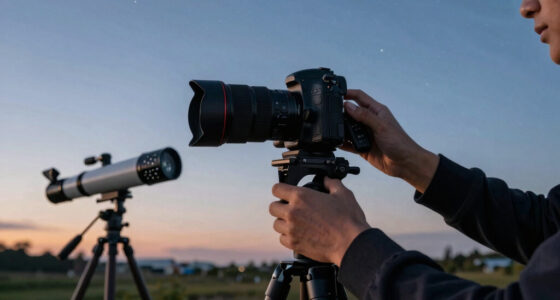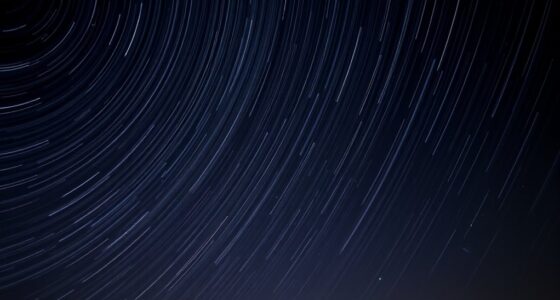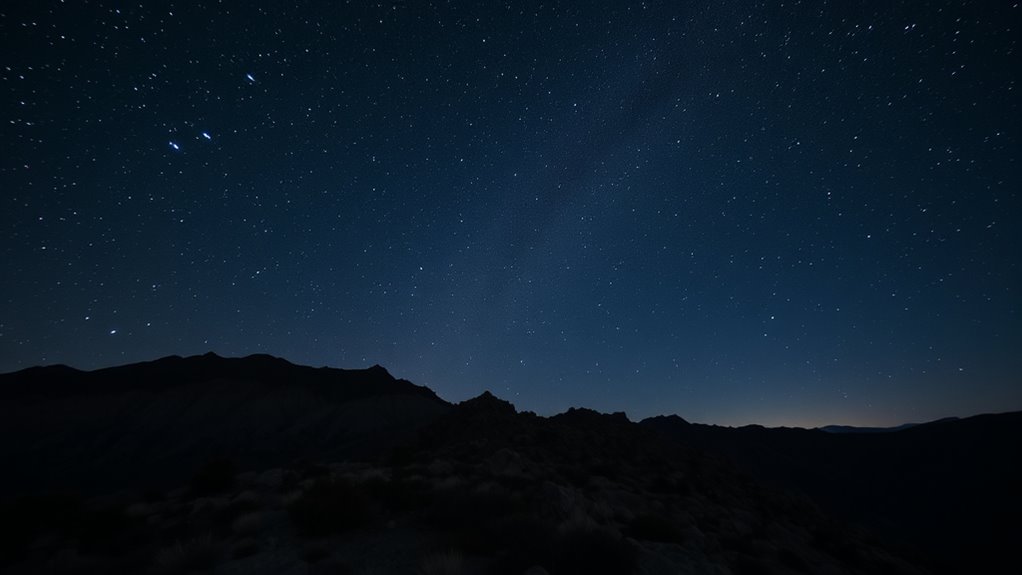

To avoid star trails with DSLR lenses, apply the 500 Rule by dividing 500 by your lens’s focal length to find the maximum exposure time in seconds. For example, with a 24mm lens, you should shoot no longer than about 21 seconds. Keep in mind, factors like sensor size and atmospheric conditions may require adjustments. If you want to perfect your shots, there’s more to learn on optimizing settings for clearer night sky images.

Prime made for students and young adults
- Fast, free delivery for dorm and study essentials
- Prime Video and Amazon Music included
- Member-only deals
Key Takeaways
- Divide 500 by your lens’s focal length to determine the maximum exposure time in seconds to prevent star trails.
- Use wide-angle lenses (e.g., 20mm) for longer exposures, as they allow more time before star movement causes trails.
- Shorter focal lengths require longer exposures; longer focal lengths need shorter exposures to avoid trailing.
- Adjust the exposure time based on sensor size and atmospheric conditions, since the 500 Rule is a guideline.
- Consider stacking multiple short exposures to enhance brightness while maintaining trail-free star points.
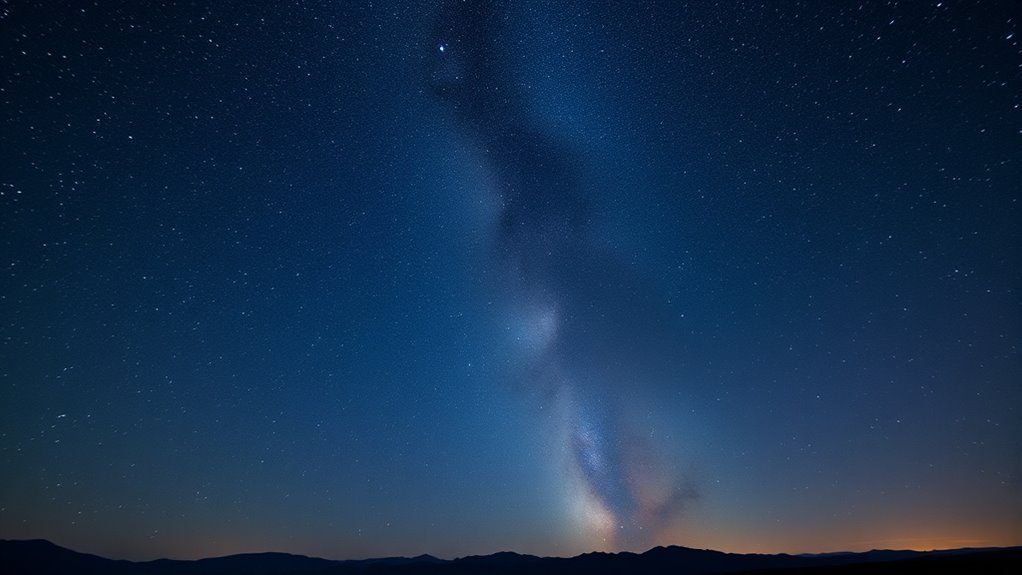
Capturing sharp night sky photos with your DSLR lens can be challenging because stars tend to trail across the sky during long exposures. To prevent this, understanding the relationship between exposure time and focal length is essential. The 500 Rule offers a straightforward way to determine your maximum exposure time before star trails become noticeable. It works on the principle that the longer your exposure, the more stars will appear to move across the sky, creating trails rather than points. By keeping your exposure time within the limits set by this rule, you can achieve crisp, trail-free images of the night sky.
Use the 500 Rule to prevent star trails and capture sharp night sky photos with your DSLR.
The core idea behind the 500 Rule is to divide 500 by your lens’s focal length. For example, if you’re using a 20mm lens, your maximum exposure time should be around 25 seconds (500 ÷ 20 = 25). If you shoot with a longer focal length, like 50mm, your maximum exposure drops to about 10 seconds. This calculation helps you avoid star trails, but it’s not a hard and fast rule; factors like your camera’s sensor size and the level of detail you want can influence the ideal exposure time.
Focal length plays a vital role because it determines the field of view and how much of the sky you capture. A wide-angle lens, with a shorter focal length, allows for longer exposures without star trails because the stars’ apparent movement is less pronounced over a wider area. Conversely, telephoto lenses with longer focal lengths magnify the movement of stars, meaning you need shorter exposure times to keep stars point-like. Always remember, the longer the focal length, the quicker the stars will trail, so adjusting your exposure time accordingly is key.
While the 500 Rule is a helpful guideline, it’s good to experiment and adjust based on your specific gear and conditions. For instance, if you notice slight trails, you can shorten your exposure time slightly. Alternatively, if your images are sharp but you want more light, you might consider stacking multiple shorter exposures instead of one long shot. Also, keep in mind that factors like atmospheric conditions and your camera’s sensor size can influence star movement and exposure limits. Additionally, understanding your camera’s sensor size can help you better tailor exposure times for optimal results.
As an affiliate, we earn on qualifying purchases.
Frequently Asked Questions
How Does the 500 Rule Compare to Other Star Trail Avoidance Methods?
The 500 Rule is simple and effective for limiting exposure time to prevent star trail length, keeping stars sharp. Compared to other methods like the 600 or 600+ Rule, it offers a quick calculation, but may not be as precise in areas with different focal lengths or atmospheric conditions. Other techniques, like stacking multiple shorter exposures, help eliminate star trails but require more post-processing, whereas the 500 Rule provides immediate, straightforward results.
Can the 500 Rule Be Used With Mirrorless Cameras Effectively?
Yes, you can effectively use the 500 rule with mirrorless cameras. They typically offer good mirrorless compatibility and manual controls, making it easy to set the correct shutter speed. However, autofocus challenges may arise in low light, so switch to manual focus for sharp stars. With these adjustments, the 500 rule remains a reliable guide to avoid star trails when shooting with your mirrorless camera.
What Adjustments Are Needed for Different Focal Lengths Beyond 500?
Did you know that doubling your focal length halves your recommended exposure time? For longer lenses, you need to make focal length adjustments by dividing 500 by your actual focal length. Also, consider aperture considerations, as wider apertures gather more light but can cause star trails if exposure times are too long. Always adjust your shutter speed accordingly to keep your shots sharp and free of trails.
How Does Sensor Size Influence the 500 Rule’s Effectiveness?
Sensor size and pixel density impact the 500 Rule‘s effectiveness because larger sensors with higher pixel density need shorter exposure times to prevent star trails. If you have a full-frame sensor, you can usually use the rule more accurately, but for smaller sensors like APS-C or micro four-thirds, you should reduce your exposure time. Adjust accordingly to account for these factors, ensuring sharp stars without trails.
Are There Software Tools That Automate the 500 Rule Calculations?
Yes, there are software tools that automate the 500 rule calculations for you. These tools help you quickly determine the ideal shutter speed based on your camera’s sensor size and lens focal length, reducing guesswork. By using automated calculations, you can plan your night shots more efficiently, ensuring you avoid star trails and capture sharp images. Popular options include astrophotography apps and dedicated star-trail calculators.
wide angle lens for astrophotography
As an affiliate, we earn on qualifying purchases.
As an affiliate, we earn on qualifying purchases.
Conclusion
Don’t let fear of star trails hold you back. The 500 Rule is a simple, effective way to capture stunning night skies without trails. Some worry it’s too technical, but once you get the hang of it, you’ll see how easy it is to get sharp, beautiful shots. Just remember: experiment, adjust as needed, and enjoy the magic of astrophotography. With a little practice, you’ll be amazed at what you can achieve under the stars.
star trail prevention camera accessories
As an affiliate, we earn on qualifying purchases.
As an affiliate, we earn on qualifying purchases.
camera lens for astrophotography
As an affiliate, we earn on qualifying purchases.
As an affiliate, we earn on qualifying purchases.
Halloween Picks
halloween
As an affiliate, we earn on qualifying purchases.