Prime made for students and young adults
- Fast, free delivery for dorm and study essentials
- Prime Video and Amazon Music included
- Member-only deals
Two different ways to start photographing the night sky
Astrophotography starter kits often bundle gear around one of two approaches: a beginner telescope kit or a camera and star-tracker kit. They are compared because both promise an accessible entry into photographing space, but they solve different problems. A telescope gives you a direct view of the Moon and planets and can support close-up imaging; a tracker lets a camera follow the sky’s motion for longer exposures of broad targets such as nebulae and the Milky Way.
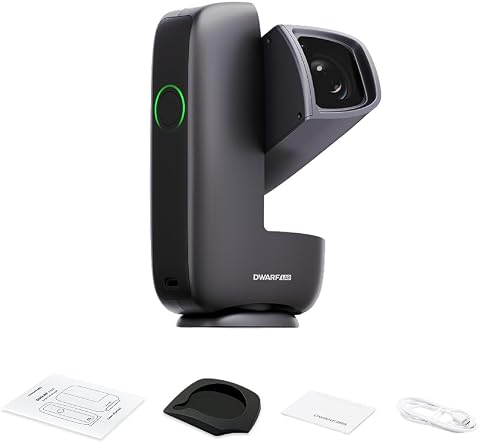
DWARF Mini Smart Telescope
- ✔ Objective: 30 mm
- ✔ Sensor: Sony IMX662, 1/2.8-inch
- ✔ Focal length: 150 mm

Celestron Travel Scope 80mm Refractor Telescope Kit
- ✔ Telescope type: Refractor
- ✔ Aperture: 80 mm
- ✔ Focal length: 457 mm

FEICOSKY 80mm Portable Refractor Telescope Kit with Pop-Up Tent
- ✔ Telescope type: Refractor
- ✔ Aperture: 80 mm
- ✔ Focal length: 500 mm
The practical choice is whether you want to point an instrument at a bright object and observe it, or build photographs by combining camera exposures over time. The telescope kit is generally easier to understand for lunar and planetary targets. The camera-and-tracker kit has a steeper photography learning curve, but it offers a more flexible path into wide-field deep-sky imaging. Kit quality varies, so check what is actually included: a mount, eyepieces, adapters, power, and a usable camera lens can matter as much as the headline instrument.
DWARF Mini Smart Telescope
The DWARF Mini is the clearest fit for buyers whose main goal is imaging rather than traditional eyepiece observing. Its app pairs an interactive sky atlas with automated targeting, so beginners can spend less of the session searching manually and more time learning how to frame celestial subjects. Exposure support up to 90 seconds, equatorial mode, built-in light pollution filtering, and cloud image processing give it an imaging workflow that the two refractor kits do not describe.That convenience comes with a different kind of dependence: this is a smartphone-controlled system, and the phone is part of the operating setup. Its 30mm objective is also substantially smaller than the 80mm apertures on the FEICOSKY and Celestron refractors, so those instruments gather light through a larger aperture for conventional viewing. The DWARF Mini instead emphasizes compact sensor-based imaging and automation. Its 1.85-pound body is far easier to carry than a long-tube telescope kit, but manual focus is supported too, meaning the process may still involve user adjustment. For a first kit centered on guided imaging, it offers the most purpose-built path in this group.
Pros:
- Automated targeting and an interactive sky atlas simplify finding objects.
- Equatorial mode and exposures up to 90 seconds support a more imaging-focused workflow.
- Built-in filtering and cloud image processing reduce some early technical steps.
- About 1.85 pounds makes it the easiest option here to carry.
Cons:
- Requires a compatible smartphone for app control.
- Its 30mm objective is smaller than the 80mm refractors in this comparison.
- Manual focusing may require adjustment rather than fully hands-off operation.
Best for: Beginners who want a lightweight, app-guided imaging setup with automated target finding and longer exposure support.
Not ideal for: Buyers who want a conventional eyepiece telescope, a larger refractor aperture, or an experience independent of a compatible smartphone.
Bottom line: For a first kit that prioritizes guided digital imaging over classic telescope observing, the DWARF Mini is the most complete match in this lineup.
“For a first kit that prioritizes guided digital imaging over classic telescope observing, the DWARF Mini is the most complete match in this lineup.”
Celestron Travel Scope 80mm Refractor Telescope Kit
Where the DWARF Mini automates much of the imaging journey, the Celestron Travel Scope 80 gives us a more familiar telescope to point, focus, and explore. Its 80mm aperture and fully coated optics suit Moon viewing and general celestial observation, while the two eyepieces offer a wider view and a closer view without requiring a separate purchase. A smartphone adapter makes it possible to experiment with phone photography, though the supplied details do not describe automated capture, sensor processing, or long-exposure tracking.The kit’s strength is its manageable, tool-free setup: a full-height tripod, padded backpack, finderscope, and star diagonal make it a practical take-along refractor. Compared with the FEICOSKY kit, it has a somewhat shorter 457mm focal length and a narrower listed field of view, and it skips the pop-up tent and 3x Barlow. That simpler package may be easier to understand as a starter, but manual focus and a 5×24 finderscope mean we still need to locate targets and make adjustments ourselves. Buyers primarily interested in deep-sky imaging should be realistic: a phone adapter is useful for experiments, but the provided specifications do not establish this as a tracking astrophotography system.
Pros:
- 80mm aperture supports a versatile first telescope for celestial and daytime subjects.
- Tool-free setup and the included backpack suit travel and family use.
- Two eyepieces and a smartphone adapter let beginners try different views and capture methods.
- Includes a finderscope, star diagonal, and astronomy software download.
Cons:
- Manual focus and aiming require hands-on learning.
- The 5×24 finderscope may take practice to align and use.
- Phone adapter is not equivalent to the DWARF Mini’s app-guided, processed imaging workflow.
Best for: Families and first-time telescope owners who want a portable 80mm refractor for learning the sky and trying phone capture.
Not ideal for: Buyers seeking automated target acquisition, long-exposure tracking, or a dedicated digital imaging workflow.
Bottom line: The Celestron is our balanced choice for learning with a traditional refractor and making early phone-capture attempts without a complex setup.
“The Celestron is our balanced choice for learning with a traditional refractor and making early phone-capture attempts without a complex setup.”
FEICOSKY 80mm Portable Refractor Telescope Kit with Pop-Up Tent
The FEICOSKY 80mm kit stands apart through its bundle: an adjustable tripod, travel backpack, pop-up tent, phone adapter, two eyepieces, a 3x Barlow, finder scope, and 45-degree zenith mirror. For a beginner planning an outdoor observing session, that breadth makes it feel ready to travel as a group of useful pieces rather than a bare optical tube. Its 80mm aperture and fully multi-coated optics also place it in the same broad refractor class as the Celestron, with a longer 500mm focal length.For astrophoto use, however, accessories are not the same as imaging automation. The FEICOSKY uses a manual-focus altazimuth mount, and its smartphone adapter still leaves us responsible for focusing, framing, and managing the phone. Compared with the Celestron, it includes more outdoor gear and a 3x Barlow, while the Celestron package emphasizes a full-height tripod and tool-free setup. Compared with the DWARF Mini, FEICOSKY is a more conventional viewing telescope with a much larger aperture, but lacks the listed equatorial mode, automated targeting, and image processing. We would choose it for a mixed observing and outdoor kit, not because its tent or accessory count guarantees better astrophotography.
Pros:
- 80mm aperture and fully multi-coated optics provide a capable general-purpose refractor foundation.
- Includes 25mm and 10mm eyepieces plus a 3x Barlow for varied magnification choices.
- Backpack and pop-up tent make the bundle distinct for outdoor sessions.
- Phone adapter supports introductory smartphone photography experiments.
Cons:
- Manual focus and altazimuth operation leave aiming and adjustments to the user.
- The straight-through 5×24 finder may take practice, as with the Celestron’s finder.
- The broad accessory bundle does not provide the DWARF Mini’s automated imaging workflow.
Best for: New observers who want an 80mm refractor plus a bundled backpack, tent, phone adapter, and eyepiece accessories for outdoor outings.
Not ideal for: Imagers who want app-led target finding, automated exposures, or a tracking-oriented setup with less manual work.
Bottom line: FEICOSKY is the accessory-rich pick for outdoor observing, while buyers focused on producing images should favor the DWARF Mini’s integrated imaging tools.
“FEICOSKY is the accessory-rich pick for outdoor observing, while buyers focused on producing images should favor the DWARF Mini’s integrated imaging tools.”
As an Amazon Associate we earn from qualifying purchases.
At a Glance
| Criteria | Beginner telescope kit | Camera and star-tracker kit | Winner |
|---|---|---|---|
| Best suited targets | Moon, planets, and visual observing | Wide star fields, Milky Way, and large nebulae | Depends |
| Getting started | Often quick to use for viewing; imaging may need extra adapters | Requires camera settings, focus, alignment, and image processing | A |
| Tracking and exposure | Depends heavily on mount; entry kits may not track automatically | Tracker compensates for Earth’s rotation, allowing longer exposures within its limits | B |
| Image detail | Higher apparent scale for bright objects, but limited by aperture, atmosphere, and mount | Broad, detailed fields; not designed for close planetary views | Depends |
| Portability | Varies; telescope and tripod can be bulky | Usually compact, though tripod and camera add weight | B |
| Upgrade path | Eyepieces, mount, camera adapter, and telescope upgrades | Lenses, camera body, guiding, and processing workflow | Tie |
| Value for beginners | Strong if observing is part of the goal | Strong if the buyer already owns a compatible camera and lens | Depends |
Key Differences
What separates these starter kits
The biggest distinction is the kind of image each setup can produce. A telescope brings distant objects closer in the field of view, making the Moon and planets natural first targets. But magnification alone does not create a good photograph: the mount must keep the target steady, and planetary imaging often involves recording video and selecting sharp frames. Low-cost telescope kits may be fine for looking through an eyepiece yet frustrating for attaching a camera or tracking a target.
A camera and tracker takes the opposite approach. It keeps a camera pointed at the same patch of sky as the stars appear to move, allowing exposures longer than a stationary tripod typically permits. Wide lenses capture large sections of the sky, and stacking multiple exposures can reveal faint structures. This works well for wide nebulae and star fields, but a tracker does not make small planets larger or remove the need to focus carefully and process images.
For value, existing equipment changes the calculation. A photographer with a suitable camera, lens, and sturdy tripod may need only a tracker and accessories. Someone starting from scratch could find that a telescope kit looks more complete, though the included mount may limit future imaging. Decide based on targets and what you already own, not the word “starter” on the box.
Detailed Comparison
Best suited targets (major difference)
A telescope kit wins for the Moon and planets because its focal length gives those small, bright objects more presence in the frame. A camera-and-tracker kit wins for broad star fields, Milky Way scenes, and large nebulae, where a wide lens can capture the surrounding sky. This is a major difference: choose by your first targets, since neither setup is a satisfying substitute for the other.
Getting started (Beginner telescope kit wins — moderate)
A beginner telescope kit usually wins for immediate visual use: set it up, align the finder, and look through the eyepiece. Turning that view into a strong image can take additional adapters and technique. The tracker kit requires camera setup from the outset—manual focus, exposure, alignment, and often post-processing. The gap is moderate; the telescope feels simpler if observing counts as success, while the camera kit suits someone keen to learn photography.
Tracking and exposure (Camera and star-tracker kit wins — major)
The camera-and-tracker kit wins for wide-field long exposures because tracking counteracts the apparent motion of the sky. The result still depends on alignment, focal length, payload, and exposure length. Many entry telescope kits use a basic mount that does not track, so stars can trail in longer exposures. This is a major practical gap for deep-sky photos; check mount specifications before buying either kit.
Image detail (major difference)
Neither setup wins across all subjects. A telescope can show more apparent detail on bright, compact targets, but atmosphere, aperture, focus, and mount stability set the real limit. A tracked camera captures a wider view and can collect faint detail across a large area, especially through stacking. The difference is major only when the target is clear: close-up planetary detail favors the telescope, while expansive sky scenes favor the camera kit.
Portability (Camera and star-tracker kit wins — moderate)
A camera and tracker kit is usually more portable, particularly when paired with a small lens and travel tripod. A telescope, mount, and tripod can take more space and may be awkward to carry to a dark-sky location. The gap is moderate and depends on the telescope’s size and tracker capacity. If you drive to observing sites, this may matter less than it does for hiking or air travel.
Upgrade path (minor difference)
Both have useful upgrade routes, so this is broadly a tie. Telescope owners can add eyepieces, a camera adapter, or a more capable mount. Tracker owners can add longer lenses, a different camera, or more advanced guiding and processing. The main constraint differs: telescope imaging may require a mount upgrade before the optical tube can reach its potential, while camera setups depend on lens compatibility and tracker payload limits. The gap is minor at purchase but can shape later costs.
Value for beginners (moderate difference)
Value depends on what the buyer already owns and wants to do. A telescope kit can provide both visual observing and a route to lunar imaging, which makes it worthwhile for someone who wants to use an eyepiece too. A tracker can be the better value for a camera owner who already has a lens, because it adds tracking without duplicating equipment. This is a moderate difference: compare the full working setup, including mount, tripod, adapters, and power, rather than kit prices alone.
Beginner telescope kit: Pros and Cons
Pros:
- Good fit for lunar and planetary viewing
- Can provide an engaging visual experience alongside photography
- Eyepieces make observing possible without a camera or computer
Cons:
- Entry-level mounts may not track smoothly or at all
- Camera adapters and stable tracking may cost extra
- Narrow field makes large nebulae and Milky Way scenes difficult
Camera and star-tracker kit: Pros and Cons
Pros:
- Tracking supports longer wide-field exposures
- Compact setup can travel well
- Makes good use of camera and lens gear the buyer already owns
Cons:
- Does not provide the same close view of planets
- Needs careful focus, polar alignment, and exposure control
- Image processing is part of the learning curve
Who Should Choose What
Choose Beginner telescope kit if:
- You want to look at the Moon and planets through an eyepiece as well as photograph them.
- Your main goal is lunar or planetary imaging and you have a stable mount or plan to upgrade one.
- You value visual observing as much as the photos.
Choose Camera and star-tracker kit if:
- You already own a compatible camera and lens and want to photograph wide areas of sky.
- You want to image star fields, large nebulae, or the Milky Way with longer exposures.
- Portability and making use of existing photography gear matter more than close-up planetary views.
Skip both if: You expect a complete kit to produce finished deep-sky images without learning alignment, focusing, exposure, and processing; consider starting with visual observing or a fixed-tripod Milky Way setup before investing.
Value for Money
Is the higher-cost setup worth it?
Pay more for the camera-and-tracker route if wide-field deep-sky images are your priority and you have compatible camera gear. The tracker addresses a core limit of stationary photography, and using an existing camera can keep the total cost reasonable. If you must buy the camera, lens, tripod, tracker, and accessories together, calculate the complete cost before treating a bundled kit as a bargain.
A telescope kit is better value when you want visual observing and bright-target imaging from one purchase. Pay more for a sturdier tracking mount when astrophotography is central; a low-cost optical tube on an inadequate mount can limit results. If close planetary images are the goal, spend on stability and imaging compatibility rather than extra eyepieces you will rarely use. The better value is the setup that matches your targets and can support the next step you plan to take.
Final Verdict
Choose a beginner telescope kit if your first priority is observing the Moon and planets, and you want the option to image them. Choose a camera-and-tracker kit if you want wide-field deep-sky photographs and already own a compatible camera and lens. For most beginners whose goal is recognizable nebulae and star fields, the tracker is the stronger imaging start; for someone who wants to see objects directly through an eyepiece, the telescope is the clear fit. The deciding factor is target size: close and bright favors the telescope, broad and faint favors the tracker.
Frequently Asked Questions
Which starter kit is easier for a complete beginner?
A telescope is usually easier for immediate visual observing. For photography, both require practice: the telescope brings alignment and mount stability challenges, while the tracker adds camera focus, exposure, and processing skills.
Can I photograph planets with a star tracker?
You can point a camera at planets, but a tracker and wide lens will not give them the apparent size that a telescope can. Choose a telescope-based setup if close planetary detail is the goal.
Do I need a telescope for deep-sky astrophotography?
No. Many large nebulae and star fields suit a camera and tracked lens. A telescope becomes useful for smaller targets, but it also calls for a mount capable of handling its focal length and weight.
Is a bundled starter kit always the best value?
No. Check whether the bundle includes a suitable mount, tripod, camera adapters, power, and compatible optics. A kit that cannot track or hold focus for your intended targets may cost more after the needed upgrades.