
TL;DR

Prime made for students and young adults
- Fast, free delivery for dorm and study essentials
- Prime Video and Amazon Music included
- Member-only deals
Saturn’s B ring hosts fleeting, dark spokes caused by electrostatic charging and magnetic interactions. Recent high-res images shed light on their formation, making them a fascinating feature of our solar system’s most iconic ring system.
Imagine staring up at a night sky and glimpsing ghostly streaks across a distant, shimmering ring. That’s the mystery of Saturn’s spokes — dark, fleeting features that seem to dance across its brightest ring, the B ring. These features are more than just visual quirks; they’re clues to a complex electromagnetic ballet happening right above Saturn’s icy particles.
In this story, you’ll learn what makes these spokes so intriguing, how recent research peels back their secrets, and how you might catch a glimpse of them—if you know when and where to look. Buckle up, because Saturn’s mesmerizing rings hide a lively, electric world that continues to surprise scientists.
Saturn’s spokes are caused by electrostatic forces acting on tiny icy dust particles, influenced by the planet’s magnetic field.
Recent spacecraft data and simulations confirm that electromagnetic interactions and solar activity trigger spoke formation and dissipation.
Spokes are most visible during Saturn’s equinoxes when the Sun’s angle enhances their shadows, making them easier to observe with suitable gear.
These features reveal how dynamic and electrically active Saturn’s environment is, providing clues to the planet’s magnetic behavior.
Amateur astronomers can potentially glimpse spokes with large telescopes during the right season and under dark, clear skies.
What Are Saturn’s Spokes and Why Do They Look So Mysterious?
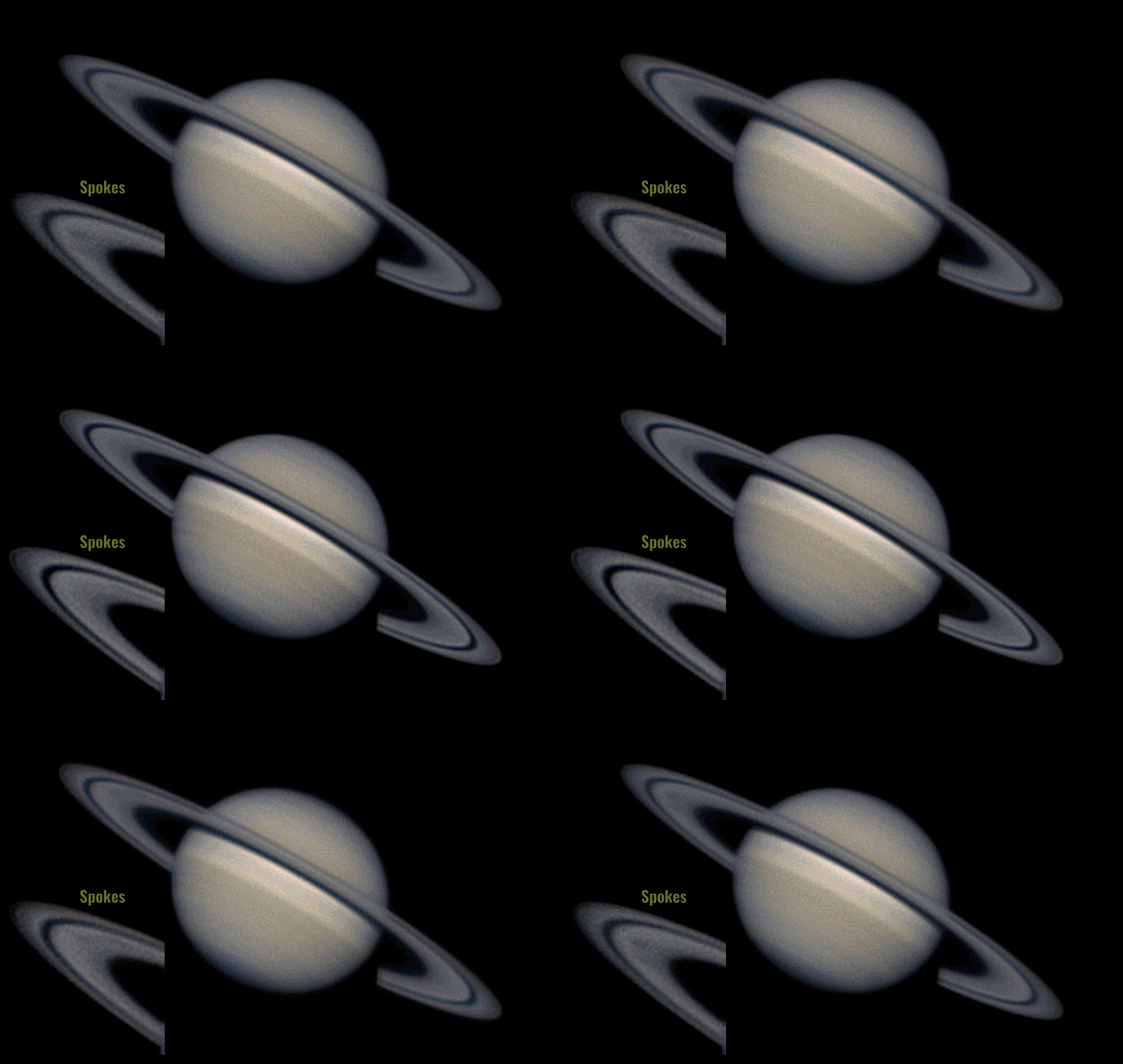
Saturn’s spokes are temporary, dark streaks that stretch across the B ring, which is the brightest and most massive of Saturn’s rings. They appear like ghostly lines, often radiating outward, and can vanish just as quickly as they form. These features are made of tiny icy particles that are lofted above the ring’s main plane by electrostatic forces.
Think of it like dust particles on a sunny day, but here, electrostatic charges—similar to static cling—cause particles to levitate, creating visible spokes. They’re most vivid when the Sun’s angle hits the rings at a low tilt, casting shadows and highlighting the dust’s suspension. The appearance of these spokes varies with Saturn’s seasons, influenced by changes in the magnetic field and solar activity.
Understanding these features is crucial because they reveal how Saturn’s magnetic environment interacts with its rings, which can influence everything from ring stability to the planet’s electromagnetic emissions. These transient structures are a direct manifestation of the complex electromagnetic forces at play, offering insight into planetary magnetospheres that extend beyond Earth and hint at processes that could occur on other magnetized celestial bodies.
large amateur telescope for planetary observation
As an affiliate, we earn on qualifying purchases.
As an affiliate, we earn on qualifying purchases.
How Recent Spacecraft Data Helps Us Understand These Spokes Better
Thanks to high-resolution images from the Cassini spacecraft and other observations, scientists now have a clearer picture of how spokes form and dissipate. Computer models suggest that electromagnetic interactions between Saturn’s magnetic field and charged dust particles are key players.
Recent studies show that spoke activity correlates with variations in Saturn’s magnetic field and even the solar wind. During periods of increased solar activity, the magnetic environment becomes more dynamic, sparking more pronounced spokes. This link helps scientists understand the electromagnetic forces shaping the rings.
For example, in 2026, researchers used advanced simulations to replicate spoke patterns, confirming that micrometeoroid impacts and magnetic fluctuations trigger the levitation of dust, creating these moving streaks. These findings imply that the rings are not static but are constantly influenced by external and internal electromagnetic forces, which can change rapidly. This dynamic environment affects how we interpret ring stability and evolution, providing clues about how planetary rings interact with magnetic fields in general. Understanding these processes also informs models of other planetary systems, especially those with magnetic bodies and ring structures, expanding our knowledge of planetary magnetism and dust dynamics across the cosmos.
high-powered astrophotography telescope
As an affiliate, we earn on qualifying purchases.
As an affiliate, we earn on qualifying purchases.
What Do Spokes Tell Us About Saturn’s Magnetic and Electric Environment?
Spokes are like tiny lightning bolts—evidence of a complex electromagnetic dance above Saturn’s icy dust. Their transient appearance indicates that Saturn’s magnetic field is not just a silent force but actively interacts with ring particles, lifting them into suspension.
Imagine a planet with a magnetic field as powerful as Saturn’s, which is about 20 times stronger than Earth’s at the surface. This magnetic environment influences charged particles, creating regions of intense electrical activity. Spokes are the visible signs of this unseen electrical storm, revealing how the planet’s magnetosphere extends far into the ring system.
Studying these interactions is vital because they help us understand the broader implications of planetary magnetism. For instance, they shed light on how magnetic fields can influence particle behavior and ring stability over long timescales. This knowledge might also be applicable to understanding ring systems around other planets, or even exoplanets, where magnetic fields could similarly shape the environment. Recognizing how electromagnetic forces manifest visually through spokes allows scientists to decode the complex magnetic interactions that govern planetary environments, giving us a deeper appreciation of the electromagnetic universe we live in.
planetarium star projector for home
As an affiliate, we earn on qualifying purchases.
As an affiliate, we earn on qualifying purchases.
When and How to Spot Spokes from Your Backyard Telescope
Spotting spokes with a telescope is tricky—they’re faint, fleeting, and best seen under specific conditions. To have a chance, you’ll need a large telescope (at least 8 inches in diameter), a clear, dark sky, and the right viewing angle.
Saturn’s spokes are most visible when the Sun is low relative to the ring plane — during Saturn’s equinoxes, which happen roughly every 15 years. During these periods, the angle of sunlight accentuates the dust’s shadows, making the spokes more prominent and easier to detect. Observers should aim for times when the Sun’s position creates the optimal contrast—typically in the early morning or late afternoon, when the low angle of sunlight casts long shadows across the rings.
Pro tip: Use a narrow-band filter designed for planetary observation to enhance contrast and reduce atmospheric glare. Set your telescope to track Saturn’s rotation, and spend a few minutes observing patiently. Because spokes are transient, they can appear and disappear within minutes, so consistent observation increases your chances. While not guaranteed, with the right equipment and conditions, you might witness these ghostly streaks firsthand, connecting with the dynamic electromagnetic dance happening light-years away.
As an affiliate, we earn on qualifying purchases.
Comparison: Spokes vs. Other Ring Features — What Makes Them Unique?
| Feature | Spokes | Ring Particles (General) | Ring Gaps & Divisions |
|---|---|---|---|
| Appearance | Dark, streak-like, transient | Bright, icy, stable | Clear gaps, less visible in detail |
| Formation Cause | Electrostatic, magnetic interactions | Gravity, collisions | Resonances, gravitational clearing |
| Visibility Period | Hours to days, seasonal | Always present | Always present, defined by resonances |
| Location | Primarily in B ring, sometimes elsewhere | Throughout the rings | Between main ring divisions |
Frequently Asked Questions
Can I see Saturn’s spokes with a backyard telescope?
Spokes are faint and transient, making them difficult for amateur telescopes. They’re best observed with a large, high-quality telescope during Saturn’s equinoxes and under dark skies.Why do spokes only appear in certain seasons?
Spokes are influenced by the angle of sunlight and Saturn’s magnetic activity. During equinoxes, the conditions align to make spokes more visible, as the Sun’s low angle highlights the dust’s shadows.Are spokes dangerous for spacecraft or satellites?
No, spokes are made of tiny icy dust particles levitated by electromagnetic forces. They pose no threat to spacecraft or Earth-based observers.What makes Saturn’s spokes different from other planetary ring features?
Spokes are temporary, dark streaks caused by electromagnetic forces, unlike the stable, bright particles that make up the main rings or the gravitationally cleared gaps.Will future missions continue to study Saturn’s spokes?
Yes, ongoing observations and new spacecraft technologies aim to deepen our understanding of these ephemeral features and what they reveal about Saturn’s magnetic environment.Conclusion
Saturn’s spokes are fleeting yet revealing features—tiny windows into the planet’s electromagnetic heartbeat. They remind us that even in the silent beauty of planetary rings, dynamic forces are at play, shaping what we see from afar.
Next time you gaze at Saturn through a telescope, remember: those ghostly streaks are signs of a lively, electrically charged world that’s still full of surprises. Keep your eyes peeled during the right season, and you might just witness a whisper of Saturn’s electric dance.
Fall Picks
fall essentials
As an affiliate, we earn on qualifying purchases.