
TL;DR

Prime made for students and young adults
- Fast, free delivery for dorm and study essentials
- Prime Video and Amazon Music included
- Member-only deals
NASA APOD’s October 18, 2026 feature presents the Eagle Nebula, or M16, as a stellar nursery about 6,500 light-years away, where massive young stars shape towering columns of cold gas and dust. The image combines visible-light Hubble observations with Chandra X-ray data, while its video turns image position into sound; from Earth, M16 is a challenging deep-sky target best photographed with a tracking mount, a long focal length, and a dark, clear sky.
M16 is about 6,500 light-years away toward Serpens, and its gas-and-dust pillars stretch for light-years.
Massive stars shape and erode the pillars with ultraviolet light and powerful winds.
NASA APOD combines Hubble visible-light observations and Chandra X-ray data; the sonification maps image position to pitch rather than recording sound from spa…
A tracking mount, dark sky, careful focus, and a longer focal length help you photograph the nebula’s central structures.
Check a current sky chart for your location because M16’s visibility depends on your horizon, season, and hemisphere.

What the Eagle Nebula’s pillars reveal about star birth
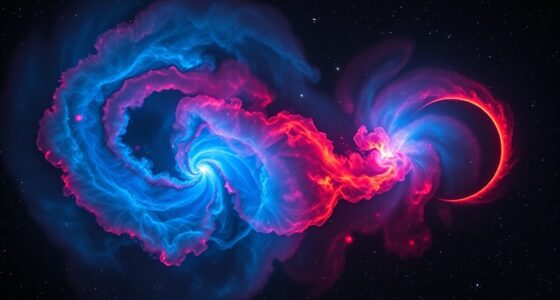
The Eagle Nebula, also called M16, is a star-forming region about 6,500 light-years away, where cold gas and dust gather into towering columns beside young stars. Those pillars are not solid stone; they are immense clouds sculpted by radiation and winds from massive stars. NASA APOD’s feature shows a stellar nursery in the direction of the constellation Serpens. The contrast gives the scene its force. Dense material forms dark silhouettes, while brighter areas mark gas lit by energetic stars. Imagine a campfire glowing through smoke: the smoke has shape because light catches its edges, but the cosmic version spans distances so large that the pillars measure light-years from end to end. The comparison helps you read the image, though no campfire could reproduce its scale. Massive stars in M16 send out ultraviolet light and powerful winds. These forces erode the nearby columns, changing the clouds as stars form within the turbulent region. That process is a reminder that a nursery can be both a birthplace and a harsh neighborhood. The stars help shape the structures around them even as those structures change. For instance, when you look at a dark finger of material rising against a bright background, you are seeing contrast created by clouds and starlight, not a photograph of a solid object floating in space. The image offers a useful lesson in astronomy: shape can reveal where matter gathers and where radiation pushes back, even when you cannot see the gas and dust directly with your eyes.astronomy camera for deep sky astrophotography
As an affiliate, we earn on qualifying purchases.
As an affiliate, we earn on qualifying purchases.
Why the NASA APOD image combines Hubble and Chandra views
The NASA APOD feature combines visible-light Hubble observations with X-ray observations from Chandra to show different parts of M16’s story. Visible light brings out familiar structures in the gas and dust, while X-ray data adds information associated with energetic sources in the scene. Together, the views give you more context than either could provide alone. A composite image is a little like a map that layers roads over terrain. One layer answers where the hills and valleys sit; another helps you follow the routes across them. In M16, each observing band records a different kind of light. When combined for display, the result lets you compare structures and sources that would be harder to understand in a single view. That does not mean the colors are exactly what your eyes would see if you could travel there. Astronomical images often assign visible display colors to data so viewers can distinguish features. NASA’s explanation identifies Hubble visible data and Chandra X-ray data, but the caption does not supply a full color key or exposure recipe. You should avoid guessing those details from the appearance alone. Consider a backyard photographer comparing a red, green, and blue landscape image with a narrowband astrophotograph: both may depict the same sky, but they encode light differently. The combined M16 image is a scientific visualization as well as a compelling picture. Its value lies in the distinct observations it brings together, not in pretending that a telescope sees exactly as a human eye does.telescope with long focal length for nebulae
As an affiliate, we earn on qualifying purchases.
As an affiliate, we earn on qualifying purchases.
How the sonification turns the picture into sound
The sonification video maps a moving line across the image into sound: the line travels from left to right, and vertical position determines pitch. NASA APOD invites you to listen for stars and dust as the scan moves through the scene. The audio is a way to explore image data, not a recording of nebular gas making noise in space. That distinction matters. Space is not broadcasting the Eagle Nebula’s picture as an audible soundtrack for a microphone to capture. Sonification assigns sound to visual information so you can notice patterns in a different way. A region that sits higher in the image may correspond to a different pitch than one lower down, according to the mapping described in the feature. For example, imagine dragging a ruler across a printed image while a musical tone changes with the ruler’s height. The resulting sound can make transitions feel vivid: one moment may be bright and high, another lower and quieter. But the sound depends on the chosen rules. Change the mapping and you could create a different audio experience from the same underlying image. If you listen while watching, follow the scan line and notice when the sound changes near bright stars or dark columns. Treat that as an invitation to compare image and audio, not as proof that each object has a natural pitch. The video makes the data accessible through another sense, while the image remains the record of light collected by telescopes.equatorial tracking mount for astrophotography
As an affiliate, we earn on qualifying purchases.
As an affiliate, we earn on qualifying purchases.
M16’s turbulent star-forming environment may be similar to the setting that formed our own Sun, according to NASA APOD’s explanation. That does not mean the Sun formed inside these exact pillars or that astronomers have traced its birthplace to M16. The connection is about the kind of environment: gas, dust, young stars, and energetic forces interacting during star formation. This gives the image a personal scale. The Sun is about 4.6 billion years old, while M16 is a distant region where stars are forming now; the APOD feature does not give a precise age for the pictured stars. Still, looking at M16 offers a glimpse of processes that help astronomers think about how solar systems begin. It is a snapshot of a setting, not a family photograph of our Sun’s ancestors. Picture a reader comparing a baby photo of a relative with a photograph of a modern nursery. They are not the same room, but the second scene can suggest what early life looks like. In a similar way, M16 gives scientists a place to study active star formation and ask which conditions might also have existed in the Sun’s early surroundings. There are limits to the analogy. The Sun’s exact birthplace and the details of its formation are not established by this one image. M16 is useful because it lets researchers observe stars forming amid gas and dust at a distance. The careful takeaway is both modest and fascinating: this nebula may resemble the type of environment that helped produce our star.
star finder app for M16 Eagle Nebula
As an affiliate, we earn on qualifying purchases.
As an affiliate, we earn on qualifying purchases.
How to photograph the Eagle Nebula from Earth
To photograph M16 from Earth, use a long-focal-length telescope or telephoto setup, a tracking mount, and a dark, clear sky; the nebula is a faint deep-sky target about 6,500 light-years away. A wide-field lens can frame the region with surrounding stars, but a longer focal length gives the pillars more room in the frame. Your practical result depends on your location, season, sky brightness, and equipment.- Check visibility and framing. Find out whether Serpens and M16 are above your horizon during the hours you can observe. A planetarium app can help you plan the framing, but confirm the target’s position for your location and date.
- Choose your field of view. Start wide if you want the nebula within a star-rich sky. Use a longer focal length when you want to emphasize the central structure, while remembering that tighter framing makes tracking errors more obvious.
- Track and focus carefully. A motorized equatorial mount follows the sky’s rotation, keeping stars from drawing short streaks during longer exposures. Focus on a bright star before aiming at M16, then check the image at high magnification.
- Take several exposures. Multiple shorter frames can be combined later to bring out faint detail. Begin with a modest exposure and inspect the stars; if they stretch, shorten the exposure or improve tracking.
- Keep a simple observing log. Note lens or telescope, exposure time, sky conditions, and location. That makes it easier to learn why one night’s image looks sharper or richer than another.
Which camera setup suits the picture you want
A wide-field setup shows M16 in its surrounding star field, while a long-focal-length setup gives the nebula’s central structures more space in the frame. Neither choice is universally better. Pick based on whether you want to tell a broad sky story or draw attention to the pillars, and match that choice to your mount and observing conditions.| Setup | What it emphasizes | Tradeoff |
|---|---|---|
| Wide-field lens | M16 among surrounding stars | The nebula appears smaller |
| Telephoto lens | A tighter view of the region | Tracking and focus matter more |
| Telescope with camera | Fine structure in the nebula | Needs stable tracking and careful setup |
What changes the result on a night outside
The darkness and steadiness of your sky shape an M16 photograph as much as your camera does. City light brightens the background, haze softens contrast, and poor tracking turns stars into streaks. A clear night with M16 well above the horizon gives your optics a cleaner view, but conditions vary by location and date. M16 is in the direction of Serpens, so when and how well you can see it depends on your hemisphere, latitude, season, and local horizon. The APOD description gives its direction and distance, not a universal observing schedule. Check a current sky chart for your location rather than assuming that “tonight” means the nebula is visible from every yard on Earth. For example, if the target sits low above rooftops, you are looking through more atmosphere than when it climbs higher. Warm air rising from pavement can shimmer; nearby streetlights can wash the background gray. Waiting until M16 clears a roofline, moving away from direct lights, and letting your gear reach outdoor temperature can improve the session without buying anything. A practical comparison helps: a bright Moon is easy to find and photograph with a phone, while M16 asks for patience and usually a tracking mount. If the sky is hazy or the target is low, use the night to practice focus and alignment on brighter stars. Then return to the nebula when conditions improve. Astronomy rewards preparation, but it also leaves room for a useful session even when the final image is modest.Frequently Asked Questions
Can I see the Eagle Nebula with my unaided eyes?
M16 is a deep-sky target, and how much you can see depends on sky darkness, your eyesight, and observing conditions. Under dark skies, binoculars or a telescope can help you locate the region, while photography can reveal faint detail that is difficult to see by eye.How far away is M16?
The Eagle Nebula is about 6,500 light-years away, in the direction of the constellation Serpens. That means its light began traveling toward us roughly 6,500 years ago.Are the colors in the NASA APOD image what the nebula really looks like?
The feature combines visible-light Hubble data with X-ray observations from Chandra. Such composite images can use display colors to distinguish data, so you should not assume every hue matches what your eyes would see in space.Does the sonification video record sound coming from M16?
No. The video maps a scan line moving left to right across the image into sound, with vertical position determining pitch. It is an audio interpretation of image data, not a microphone recording of the nebula.What equipment should I use to photograph the Eagle Nebula?
A tracking mount and a telephoto lens or telescope help keep stars sharp during longer exposures. A wide-field lens can show M16 among surrounding stars; choose a darker site and check focus before extending exposure time.Conclusion
Remember the Eagle Nebula as a place where stars are born while their light and winds reshape the clouds around them. If you want to photograph M16, plan for a dark sky, use tracking, and start with careful focus and framing; a small, sharp image is a better first step than a long, blurry exposure. When you next see a photograph of those pillars, look for the tug-of-war: cold dust holding its shape, young stars pressing outward, and a scene changing across light-years. Then ask what your own camera could catch from beneath the same night sky.Halloween Picks
halloween
As an affiliate, we earn on qualifying purchases.