

To find Polaris using the Big Dipper, locate the two pointer stars, Dubhe and Merak, on the bowl’s outer edge. Draw an imaginary line through these stars, extending it outward and away from the handle of the Big Dipper. This line will lead you directly to Polaris, the North Star, at the end of the Little Dipper’s handle. Keep exploring to discover more tips for steering the night sky.
Key Takeaways
- Identify the Big Dipper’s bowl as it forms the prominent part of Ursa Major.
- Locate the two pointer stars, Dubhe and Merak, on the outer edge of the bowl.
- Draw an imaginary line through Dubhe and Merak, extending outward from the bowl’s edge.
- Follow this line away from the bowl to find Polaris at the end of the Little Dipper’s handle.
- Polaris marks the North Celestial Pole, indicating true north for navigation.
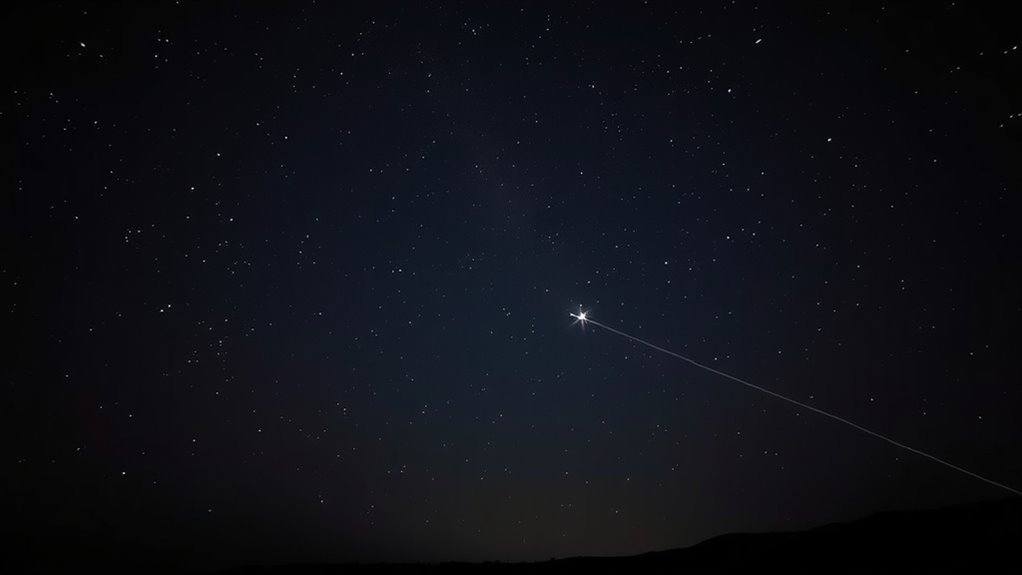
Have you ever wondered how sailors and travelers in the night sky find their way? Long before GPS or modern navigation tools, they relied on the stars, especially Polaris, the North Star, to guide them. Finding Polaris is a straightforward process once you understand the key navigational techniques. The Big Dipper, part of the constellation Ursa Major, plays an essential role in this. Its distinctive shape acts as a celestial pointer, making it easier to locate Polaris, which marks the exact position of the North Celestial Pole.
To find Polaris using the Big Dipper, start by identifying the ‘bowl’ of the constellation. Focus on the two stars that form the outer edge of the bowl’s side, often called the ‘pointer stars.’ These stars, Dubhe and Merak, are almost aligned in a line. Draw an imaginary line through them, extending outward from the bowl in the direction away from the handle of the Big Dipper. This line will lead you directly to Polaris, which sits at the end of the ‘Little Dipper’s’ handle. The process of using these pointer stars is a classic example of a navigational technique that has been passed down through generations, helping travelers find their way in the darkness.
In addition to its practical use, Polaris holds mythological significance in many cultures. It’s often seen as a symbol of steadfastness and guidance, representing a constant point in the sky that doesn’t move much as the Earth rotates. Many ancient civilizations, like the Greeks and Chinese, associated Polaris with divine guidance or celestial guardianship. For sailors, it was more than just a navigational aid; it was a beacon of hope and stability amid the vast, unpredictable ocean of the night sky. The mythological significance of Polaris underscores its importance not only in navigation but also in cultural stories and legends, emphasizing its role as a celestial anchor in the night sky. Additionally, understanding the use of pointer stars enhances both navigation skills and appreciation for the starry sky.

Prepper's Survival Navigation: Find Your Way with Map and Compass as well as Stars, Mountains, Rivers and other Wilderness Signs
As an affiliate, we earn on qualifying purchases.
As an affiliate, we earn on qualifying purchases.
Frequently Asked Questions
Can Polaris Be Seen From the Southern Hemisphere?
No, Polaris isn’t visible from the southern hemisphere. When you’re doing celestial navigation, you rely on star visibility to find your way, and Polaris helps you locate north in the northern hemisphere. Since Polaris is near the North Celestial Pole, it appears low or not at all from southern latitudes. If you’re in the south, you’ll need to use other stars and techniques for navigation.
How Accurate Is Polaris as a Navigation Point?
Polaris is quite accurate for celestial navigation because its star alignment makes it a reliable North Star. You can trust its position to find true north, especially when using the Big Dipper to locate it. While it’s not perfectly precise due to slight shifts, Polaris generally provides a dependable reference point for navigation in the Northern Hemisphere, helping you confirm your direction with confidence during your journey.
Do All Stars in the Big Dipper Point to Polaris?
Not all stars in the Big Dipper point directly to Polaris, but most of the pointer stars, Dubhe and Merak, align to guide you. During celestial navigation, you use these stars’ alignment to locate Polaris, which marks the North Celestial Pole. While other stars may seem to point in similar directions, only Dubhe and Merak reliably help you find Polaris, making them essential in star alignment for navigation.
How Has Polaris’s Position Changed Over Centuries?
Polaris’s position has shifted due to stellar drift and pole star evolution. Over centuries, it has moved slightly away from the true North Celestial Pole, making it less precise for navigation. This gradual change happens because Earth’s axis wobbles over time, altering the pole star. You’ll notice that while Polaris remains close to the pole, it’s not fixed, highlighting the dynamic nature of our night sky.
Is Polaris Visible Year-Round From All Locations?
Polaris’s visibility varies with your location and the season. You can see it year-round if you’re in the Northern Hemisphere, but at lower latitudes, it’s often more prominent. In the Southern Hemisphere, Polaris isn’t visible at all. Seasonal changes also affect how high it appears in the sky. Your latitude determines how much of the sky you see, so Polaris’s seasonal visibility depends on where you’re standing.

Telescope for Adults & Kids, 70mm Aperture Refractor (15X-150X) Portable Travel Telescope with Phone Adapter & Wireless Remote, Astronomy Beginners Gifts, Black
【Great Telescope for Kids& Beginners!】 The telescope meets all the needs of astronomy beginners, the adults & kids’…
As an affiliate, we earn on qualifying purchases.
As an affiliate, we earn on qualifying purchases.
Conclusion
Now that you’ve mastered locating Polaris, you hold the power to navigate the night sky like a legendary explorer. Imagine the thrill of always finding true north, guiding you through endless darkness with unwavering confidence. With just a few simple steps, you’ve discovered the secret that ancient sailors and explorers dreamed of. Feel unstoppable, knowing you can find Polaris anytime, anywhere—your personal compass in the vast, mysterious universe. The stars are now yours to command!

24" Digital Calendar Picture-Frame for-Wall-Planner – Touchcreen Interactive Electronic Calendar Display, Chore Chart, Star Reward, Sync Google iCloud Outlook Via APP, Wall Mount, Gifts for Mom Dad
【All-In-One Smart Digital Frame Calendar】: This smart electronic calendar combines digital calendar, smart chore chart, digital picture frame,…
As an affiliate, we earn on qualifying purchases.
As an affiliate, we earn on qualifying purchases.

Celestron 51630 Star Telescope Finderscope, Black
FIND TARGETS WITH YOUR TELESCOPE QUICKLY AND ACCURATELY: The StarPointer red dot finderscope adds “point & look” functionality…
As an affiliate, we earn on qualifying purchases.
As an affiliate, we earn on qualifying purchases.