Finding the right portable telescope dew heaters can mean the difference between a clear night of observation and a fogged-up lens ruining your session. My top recommendation is the NEEWER HW-29B for its balance of adjustable heat levels and USB compatibility, making it versatile for both small scopes and camera lenses. For those with larger apertures, the SVBONY SV192 offers extended coverage that many compact strips cannot match. The primary tradeoff in this category lies between power consumption and heat distribution; higher wattage clears dew faster but drains battery packs quicker, while lower wattage preserves power but may struggle in humid conditions. Continue reading to see how these models stack up against each other in performance and usability.

Prime made for students and young adults
- Fast, free delivery for dorm and study essentials
- Prime Video and Amazon Music included
- Member-only deals
Key Takeaways
- USB-powered models like the NEEWER series offer superior portability for astrophotographers using power banks, whereas 12V DC models are better suited for stationary setups with dedicated batteries.
- PWM (Pulse Width Modulation) control, found in higher-end SVBONY models, allows for finer temperature adjustments than simple three-level switches, reducing the risk of overheating sensitive optics.
- Length is not just about fit; shorter strips on large scopes create cold spots that lead to uneven dew formation, making the SVBONY SV192 a critical choice for 8-inch or larger apertures.
- Integrated controllers like the Celestron Smart DewHeater reduce cable clutter and prevent accidental power loss, a feature absent in budget-friendly passive strips.
- Build quality varies widely, with silicone-backed strips offering better moisture resistance and durability compared to bare fabric or plastic-wrapped alternatives in humid environments.
| NEEWER HW-29B 16-Inch USB Lens Heater |  | Best Compact USB Option | Length: 16 in / 400 mm | Max Diameter: 3.39 in / 86 mm | Power Source: 5V USB | VIEW LATEST PRICE | See Our Full Breakdown |
| SVBONY SV172 430mm USB Lens Warmer with PWM |  | Best for Precision Control | Effective Length: 430 mm | Overall Length: 500 mm | Temp Range: 25°C to 70°C | VIEW LATEST PRICE | See Our Full Breakdown |
| SVBONY SV172 240 mm Dew Heater Lens Warmer |  | Best for Small Lenses | Length: 240 mm | Width: 50 mm | Max Diameter: Below 76 mm | VIEW LATEST PRICE | See Our Full Breakdown |
| SVBONY SV172 320 mm USB Dew Heater Strip |  | Best Value for Mid-Sized Optics | Length: 320 mm | Width: 50 mm | Power Connection: USB | VIEW LATEST PRICE | See Our Full Breakdown |
| SVBONY SV192 560 mm Telescope Dew Heater |  | Best for Large Aperture Telescopes | Heating Length: 560 mm | Max Diameter: 178 mm | Input Voltage: 12 V | VIEW LATEST PRICE | See Our Full Breakdown |
| SVBONY SV172 USB Dew Heater Strip for Telescopes and Camera Lenses, 400 mm |  | Best Plug-and-Play Convenience | Strip Length: 400 mm | Band Width: 50 mm | Max Lens Diameter: Under 127 mm | VIEW LATEST PRICE | See Our Full Breakdown |
| R-Sky Astro Instruments 12V RCA Telescope Dew Heater Strip, 6-Inch |  | Best for Serious Cold-Weather Astronomy | Size: 6 inches | Power Requirement: 12V | Connector Type: RCA | VIEW LATEST PRICE | See Our Full Breakdown |
| Astromania 400 mm Telescope Dew Heater Strap |  | Best for Precise Temperature Control | Length: 400 mm | Max Lens Diameter: 125 mm (4.95 in) | Control Type: Stepless Adjustment | VIEW LATEST PRICE | See Our Full Breakdown |
| NEEWER HW-20B USB Lens Heater, 20 in / 500 mm, 3 Temperature Settings |  | Best for Large Optics | Total Length: 500 mm (20 in) | Effective Heating Length: 400 mm (15.7 in) | Max Circumference: 375 mm (15 in) | VIEW LATEST PRICE | See Our Full Breakdown |
| NEEWER HW-17B USB Lens Heater, 16 in / 400 mm, 3 Temperature Settings | | Best Lightweight Option | Total Length: 400 mm (16 in) | Effective Heating Length: 300 mm (11.8 in) | Max Diameter: 86 mm | VIEW LATEST PRICE | See Our Full Breakdown |
| Celestron Smart DewHeater Controller 2X |  | Best for Automated Multi-Heater Control | Dew Heater Ports: 2 | Additional Output: 1 × 12V DC | Input Voltage: 12V DC | VIEW LATEST PRICE | See Our Full Breakdown |
| portable telescope dew heater | Weight |
|---|---|
| NEEWER HW-29B 16-Inch USB Lens | 100 g |
| SVBONY SV172 430mm USB Lens Wa | 160 g |
| SVBONY SV172 240 mm Dew Heater | 66 g |
| SVBONY SV172 320 mm USB Dew He | 6.3 ounces |
| SVBONY SV192 560 mm Telescope | 5.6 ounces |
| SVBONY SV172 USB Dew Heater St | 4.3 ounces |
| R-Sky Astro Instruments 12V RC | — |
| Astromania 400 mm Telescope De | 3.2 oz |
| NEEWER HW-20B USB Lens Heater | 5.3 oz |
| NEEWER HW-17B USB Lens Heater | 2.6 oz (75 g) |
| Celestron Smart DewHeater Cont | — |
More Details on Our Top Picks
NEEWER HW-29B 16-Inch USB Lens Heater
This NEEWER HW-29B stands out for its simplicity and direct USB power delivery. Unlike the more complex SVBONY SV172 with PWM control, this model relies on three fixed temperature levels, making it easier for users who do not want to manage variable outputs manually. The 400 mm length is sufficient for most small to medium refractors and camera lenses up to 86 mm in diameter. However, the fixed heat settings mean you lack the fine-grained control needed for extreme temperature shifts. It is a reliable, no-fuss solution for casual observers who prioritize ease of use over precision.
Pros:- Three distinct temperature levels allow quick adjustment based on ambient humidity.
- Direct 5V USB power works with any standard power bank or laptop.
- Compact 16-inch length is ideal for smaller optical tubes.
- Touch fasteners provide a secure fit without complex straps.
Cons:- Limited to 86 mm diameter, excluding many popular mid-size telescopes.
- Fixed heat levels lack the precision of PWM-controlled alternatives.
- Requires an external USB power source, adding to field gear.
Best for: Casual astrophotographers and birdwatchers with small refractors or lenses under 86 mm who want a simple, plug-and-play solution.
Not ideal for: Users with larger telescopes or those needing precise temperature regulation for long-exposure imaging.
- Length:16 in / 400 mm
- Max Diameter:3.39 in / 86 mm
- Power Source:5V USB
- Temperature Levels:3 (35-65°C)
- Cable Length:1.5 m
- Weight:100 g
- Attachment Type:Touch Fasteners
Our verdict“A straightforward, reliable choice for small optics where simplicity trumps advanced control.”
SVBONY SV172 430mm USB Lens Warmer with PWM
The SVBONY SV172 with PWM differentiates itself from the NEEWER HW-29B by offering Pulse Width Modulation (PWM) control and a real-time temperature display. This allows users to dial in a specific temperature between 25°C and 70°C, which is critical for preventing over-heating that can distort optics or under-heating that fails to stop dew. While the 430 mm effective length is versatile, the added complexity and weight (160 g) make it bulkier than simpler strips. It is the superior choice for serious astrophotographers who need to maintain a precise thermal balance during long sessions.
Pros:- Adjustable PWM control allows for precise temperature setting.
- Integrated digital display provides real-time temperature feedback.
- Wide temperature range (25°C to 70°C) suits various climates.
- Higher weight indicates robust construction and insulation.
Cons:- Higher weight may unbalance smaller or lighter telescope mounts.
- More complex setup than fixed-setting alternatives.
- Requires a separate USB power adapter for field use.
Best for: Serious astrophotographers and technical observers who require precise temperature management to protect optics and improve image quality.
Not ideal for: Beginners or casual users who find temperature displays and PWM controls unnecessary for quick viewing sessions.
- Effective Length:430 mm
- Overall Length:500 mm
- Temp Range:25°C to 70°C
- Control Type:PWM with Display
- Power Supply:USB
- Weight:160 g
- Accuracy:2°C
Our verdict“The definitive choice for users who value temperature accuracy over simplicity and minimal weight.”
SVBONY SV172 240 mm Dew Heater Lens Warmer
This 240 mm SVBONY strip is designed specifically for smaller optics, such as camera lenses and spotting scopes, distinguishing it from the longer NEEWER HW-29B and SV172 320 mm models. Its narrow 50 mm width is a key feature, ensuring it does not interfere with focus rings or lens hoods on compact gear. While it lacks the diameter capacity of the SV192, its lightweight design and short length make it less obtrusive on handheld or tripod-mounted small lenses. It is an excellent fit for wildlife photographers and casual stargazers using small refractors.
Pros:- Short 240 mm length minimizes clutter on small optical tubes.
- Narrow 50 mm width avoids interference with focus mechanisms.
- Lightweight design adds negligible weight to handheld gear.
- Three heat settings offer basic flexibility for varying conditions.
Cons:- Limited diameter capacity (under 76 mm) restricts telescope compatibility.
- Shorter length may not cover the entire dew zone on some lenses.
- Requires a high-current USB source (1.9-2.0 A) for optimal performance.
Best for: Wildlife photographers and casual stargazers using small camera lenses, binoculars, or spotting scopes under 76 mm in diameter.
Not ideal for: Owners of medium-to-large telescopes or long telephoto lenses who need longer heating coverage.
- Length:240 mm
- Width:50 mm
- Max Diameter:Below 76 mm
- Input Current:1.9–2.0 A
- Cable Length:1.8 m
- Weight:66 g
- Heat Modes:3 (Strong, Medium, Weak)
Our verdict“A specialized, low-profile heater ideal for small lenses where space and weight are critical constraints.”
SVBONY SV172 320 mm USB Dew Heater Strip
The SVBONY SV172 320 mm strikes a balance between the compactness of the 240 mm model and the reach of the NEEWER HW-29B. At 320 mm, it covers more surface area than the shorter SVBONY option without the bulk of larger units. The aluminum film construction helps distribute heat evenly, a feature shared with the premium SV192, though this model uses USB power rather than 12V DC. It is a solid mid-range choice for users with small-to-medium refractors who want consistent heating without the complexity of PWM controllers.
Pros:- 320 mm length provides broader coverage than compact 240 mm models.
- Aluminum film ensures even heat distribution across the lens surface.
- USB compatibility allows use with power banks and car chargers.
- Narrow profile reduces risk of blocking access to focus knobs.
Cons:- Still requires an external USB power source, adding to field logistics.
- May be too short for larger telescope dew caps or extended lenses.
- Fixed heat settings lack the precision of PWM-controlled alternatives.
Best for: Owners of small-to-medium refractors and telephoto lenses who need reliable, even heating without advanced controls.
Not ideal for: Users with large aperture telescopes or those requiring 12V DC power integration for observatory setups.
- Length:320 mm
- Width:50 mm
- Power Connection:USB
- Heat Modes:3
- Weight:6.3 ounces
- Dimensions:5.9 x 4.7 x 1.7 inches
- Material:Aluminum Film
Our verdict“A well-rounded, cost-effective heater for mid-sized optics that balances coverage with ease of use.”
SVBONY SV192 560 mm Telescope Dew Heater
The SVBONY SV192 is the heavyweight in this lineup, designed for telescopes with diameters up to 178 mm. Unlike the USB-powered NEEWER HW-29B and other SV172 variants, this model uses a 12V DC input, making it suitable for observatory setups or larger power banks with DC outputs. The 560 mm heating length provides extensive coverage for large dew caps, ensuring the entire front element stays clear. While less portable than USB options, its power and size make it the only viable choice for serious large-aperture observers who cannot rely on smaller strips.
Pros:- 560 mm length accommodates large dew shields and wide lenses.
- 178 mm max diameter covers most amateur telescope apertures.
- 12V power input suits dedicated observatory power systems.
- Aluminum layer ensures consistent heat distribution on large surfaces.
Cons:- Requires 12V DC power, limiting compatibility with standard USB chargers.
- Bulkier and heavier than compact USB alternatives.
- Not suitable for small camera lenses or spotting scopes.
Best for: Owners of large refractors, SCTs, or Maksutovs with diameters up to 178 mm who have access to 12V power sources.
Not ideal for: Casual users with small scopes or those relying solely on standard USB power banks without DC adapters.
- Heating Length:560 mm
- Max Diameter:178 mm
- Input Voltage:12 V
- Power Interface:DC 5.5 × 2.1 mm
- Cable Length:120 cm
- Weight:5.6 ounces
- Width:50 mm
Our verdict“A robust, high-capacity heater for large telescopes where coverage and power stability are paramount.”
SVBONY SV172 USB Dew Heater Strip for Telescopes and Camera Lenses, 400 mm
This strip stands out for its simple USB integration, making it a strong choice for users who want to avoid managing separate 12V battery packs. Compared to the R-Sky Astro Instruments 12V strip, which demands a dedicated controller and power source, the SVBONY works directly with common power banks. The three-layer insulation helps retain heat efficiently, meaning you can run it longer on a single charge. However, its 127 mm diameter limit restricts it to smaller refractors or camera lenses, so larger telescope owners will need to look elsewhere. While it lacks the granular control of stepless dimmers, the three heat settings are sufficient for most mild dew conditions.
Pros:- USB power compatibility eliminates the need for dedicated 12V batteries
- Three distinct heat settings simplify operation without complex controllers
- Built-in aluminum and insulation improve thermal efficiency and battery life
Cons:- Strict 127 mm diameter limit excludes larger telescope optics
- Requires a high-amperage USB source (1.9–2.0 A) to function correctly
Best for: Astrophotographers using small refractors or camera lenses who want to power their dew heater from a standard USB power bank.
Not ideal for: Users with telescopes having objective lenses larger than 127 mm, or those requiring precise, stepless temperature control for extreme conditions.
- Strip Length:400 mm
- Band Width:50 mm
- Max Lens Diameter:Under 127 mm
- Power Input:5 V USB
- Heat Settings:3 (Strong, Medium, Weak)
- Cable Length:1.8 m
- Weight:4.3 ounces
Our verdict“Choose this if you prioritize plug-and-play simplicity with existing USB power banks over advanced temperature control.”
R-Sky Astro Instruments 12V RCA Telescope Dew Heater Strip, 6-Inch
This hand-assembled strip is built for the demands of sub-zero environments, featuring a cold-resistant RCA cord that remains flexible when plastic alternatives stiffen. Unlike the SVBONY SV172, which relies on USB, this 12V system pairs with dedicated controllers like the Celestron Smart DewHeater for precise, automated power management. The even heat distribution design minimizes hot spots that could distort optics, a critical factor for high-resolution imaging. The tradeoff is complexity: you must purchase a compatible controller separately, adding to the setup time and cost. It is overkill for casual star parties but essential for dedicated observers in harsh climates.
Pros:- Cold-resistant RCA power cord maintains flexibility in freezing conditions
- Hand-assembled construction with premium components for durability
- Even heat distribution reduces the risk of optical distortion from hot spots
Cons:- Does not include a power source or controller, requiring additional purchases
- Fixed 6-inch size limits versatility across different telescope models
Best for: Serious amateur astronomers who own 12V dew heater controllers and observe in freezing temperatures where standard cords fail.
Not ideal for: Beginners or casual users who do not own a 12V power supply or compatible controller, as this is a component, not a kit.
- Size:6 inches
- Power Requirement:12V
- Connector Type:RCA
- Cord Feature:Cold-resistant and flexible
- Controller Included:No (Sold Separately)
- Warranty:2 Years
- Compatibility:Refractor, SCT, Mak, Newtonian, RASA
Our verdict“This is a specialized component for those already invested in a 12V ecosystem who need reliability in extreme cold.”
Astromania 400 mm Telescope Dew Heater Strap
The stepless sliding controller is the defining feature here, allowing you to dial in the exact wattage needed rather than guessing between fixed levels. This offers a significant advantage over the NEEWER HW-20B, which locks you into three pre-set temperatures that might be too hot or too cool for subtle dew prevention. At just 3.2 ounces, it is lighter than the SVBONY, reducing strain on smaller mount heads. It fits lenses up to 125 mm, similar to the SVBONY, but the ability to fine-tune heat means you can run it at lower power to save battery life. The downside is the need for a specific DC power source, which may require carrying an adapter if you only have USB banks on hand.
Pros:- Stepless adjustment allows for precise power management and battery savings
- Lightweight 3.2 oz design minimizes impact on telescope balance
- Quick-fit design facilitates easy attachment and removal in the field
Cons:- Requires a DC power source rather than standard USB
- Maximum diameter of 125 mm limits compatibility with larger optics
Best for: Detail-oriented users who want to minimize power consumption by precisely matching heat output to current humidity levels.
Not ideal for: Those who prefer simple plug-and-play operation without fiddling with sliders, or users with lenses larger than 125 mm.
- Length:400 mm
- Max Lens Diameter:125 mm (4.95 in)
- Control Type:Stepless Adjustment
- Power Source:DC
- Connector Size:5.5 mm OD / 2.1 mm ID
- Weight:3.2 oz
- Color:Orange
Our verdict“Select this if you value granular control over heat output to optimize battery life and prevent overheating.”
NEEWER HW-20B USB Lens Heater, 20 in / 500 mm, 3 Temperature Settings
With a maximum circumference of 375 mm, this heater accommodates significantly larger equipment than the SVBONY SV172 or Astromania models, making it ideal for big binoculars or camera lenses with hoods attached. The touch-fastener closure provides a secure fit that won’t slip during transport, addressing a common complaint with elastic straps. While it shares the USB convenience of the SVBONY, its 500 mm total length ensures coverage even when the heater is wrapped loosely. The tradeoff is bulk; at 5.3 ounces, it is heavier than the smaller alternatives. If your gear falls within the 120 mm diameter limit, this is the most robust option for ensuring full coverage without gaps.
Pros:- Extended 500 mm length accommodates larger circumferences and bulky gear
- Secure touch-fastener closure prevents slipping during setup and transport
- USB power compatibility allows use with various portable power sources
Cons:- Heavier at 5.3 ounces compared to lighter 400 mm alternatives
- Fixed temperature settings lack the fine-tuning of stepless controllers
Best for: Users with larger camera lenses, binoculars, or telescope accessories that require a longer wrap to secure properly.
Not ideal for: Minimalists who want the lightest possible weight, or users with very small lenses where the extra length becomes cumbersome.
- Total Length:500 mm (20 in)
- Effective Heating Length:400 mm (15.7 in)
- Max Circumference:375 mm (15 in)
- Max Diameter:120 mm
- Power:5V USB
- Temperature Settings:3 Levels (35–65°C)
- Weight:5.3 oz
Our verdict“This is the go-to choice when standard 400 mm straps are too short to securely wrap around your equipment.”
NEEWER HW-17B USB Lens Heater, 16 in / 400 mm, 3 Temperature Settings
At just 2.6 ounces, this is the lightest option in the lineup, making it perfect for users concerned about adding weight to delicate spotting scopes or small refractors. It is a more compact version of the NEEWER HW-20B, sharing the same three-level USB convenience but with a smaller footprint. The 86 mm maximum diameter is notably restrictive compared to the 120–127 mm limits of competitors, so it fits only small lenses or binocular eyepieces. However, for those specific items, the touch-fastener design ensures a snug fit without bulk. If you have a large telescope, this is not the right tool, but for pocket-sized optics, it offers the least intrusive dew prevention available.
Pros:- Ultra-lightweight 2.6 oz design minimizes impact on small optics
- Compact 400 mm form factor is easy to store and deploy
- USB power source simplifies setup for portable devices
Cons:- Strict 86 mm diameter limit restricts compatibility to small gear
- Effective heating length is only 300 mm, requiring careful positioning
Best for: Owners of small spotting scopes, compact binoculars, or camera lenses under 86 mm who prioritize minimal weight.
Not ideal for: Users with standard telescope objective lenses, as the 86 mm diameter limit excludes most common astronomical equipment.
- Total Length:400 mm (16 in)
- Effective Heating Length:300 mm (11.8 in)
- Max Diameter:86 mm
- Max Circumference:275 mm (10.8 in)
- Power:5V USB
- Temperature Settings:3 Levels
- Weight:2.6 oz (75 g)
Our verdict“Buy this only if your equipment is small enough to fit within its 86 mm diameter constraint and you need the lightest possible heater.”
Celestron Smart DewHeater Controller 2X
This controller stands out as the most intelligent option in the lineup by automating heat output based on real-time environmental data. Unlike the NEEWER HW-29B, which requires manual temperature adjustments, this unit uses internal sensors to modulate power, preventing lens fogging without user intervention. It supports two independent dew heater ports and adds a third 12V output for accessories like cameras or fans, making it a central hub for serious setups. The heavy-duty metal housing offers superior durability compared to the plastic enclosures found on budget USB strips. However, this sophistication comes with complexity; it is not a plug-and-play solution for casual users. While it integrates seamlessly with Celestron hand controls, it demands a 12V power source, unlike the USB-powered SVBONY models. This makes it ideal for astronomers who already own 12V power banks and want to reduce manual fiddling during long imaging sessions.
Pros:- Automatically adjusts heat based on ambient temperature and humidity
- Controls two dew heaters plus an additional 12V accessory simultaneously
- Durable metal housing withstands field conditions better than plastic
- Integrates with Celestron hand controls and CPWI software for monitoring
Cons:- Requires a separate thermistor accessory for third-party heater bands
- Demands a 12V power source, incompatible with standard USB power banks
- Higher power draw may strain smaller batteries during heavy dew conditions
Best for: Serious astrophotographers using 12V power banks who want to automate dew prevention for multiple optical tubes.
Not ideal for: Beginners with simple USB-powered setups who find manual 3-level dials on NEEWER or SVBONY strips sufficient.
- Dew Heater Ports:2
- Additional Output:1 × 12V DC
- Input Voltage:12V DC
- Maximum Power:120W
- Maximum Current:10A
- Housing Material:Heavy-duty metal
- Control Options:Standalone, NexStar+/StarSense hand controls, CPWI software
- Protection Features:Resettable electronic fuses
Our verdict“Choose this if you want hands-off, automated dew control for multiple heaters and already have a 12V power setup.”
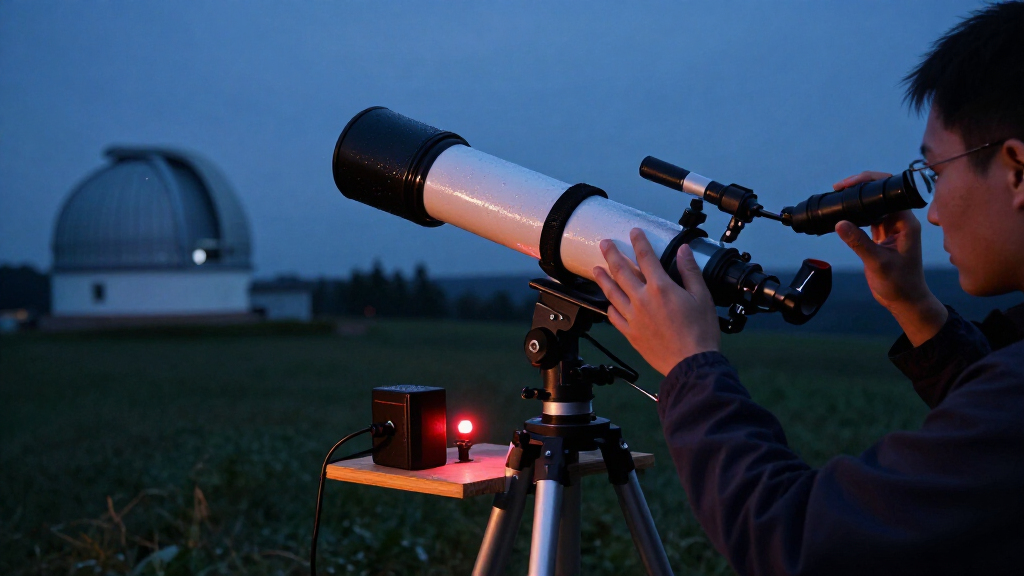
How We Picked
I evaluated these eleven dew heaters based on their ability to maintain clear optics in varying humidity levels without causing thermal turbulence. The ranking logic prioritized temperature control precision and power efficiency first, as these directly impact image quality and session length. I also assessed physical compatibility, noting which models fit standard eyepiece holders and dew shields versus those requiring specific tube diameters. Durability and ease of setup were secondary but significant factors, especially for users who transport their gear frequently. Products that offered clear differentiation in size or control method were ranked higher than redundant entries with similar specs.
Factors to Consider When Choosing Portable Telescope Dew Heaters
Choosing a dew heater involves more than just picking the longest strip. You need to match the heater’s power output and physical dimensions to your specific telescope setup and observing environment. Here are the critical factors to weigh before making your purchase.
Power Source and Portability Constraints
Most modern portable setups rely on USB power banks, making voltage compatibility a primary concern. USB models are ideal for astrophotographers who need to minimize weight and cable bulk, but they often have lower maximum wattage limits compared to dedicated 12V systems. If you observe in extremely humid conditions, a 12V DC unit might clear dew more aggressively, but it requires a heavier battery pack or a connection to a mains power supply. Consider your typical session length; USB heaters are efficient for short sessions, while larger scopes in cold, damp nights may drain standard power banks too quickly for extended imaging runs.
Length and Diameter Fit Accuracy
A common mistake is buying a heater that is too short for the dew shield or lens housing. If the strip does not cover the entire circumference, the uncovered section will cool faster and attract dew, rendering the heater largely ineffective. Measure your dew shield’s inner diameter and outer circumference precisely before ordering. For larger apertures, such as 8-inch or 10-inch reflectors, the SVBONY SV192 or similar long strips are necessary to prevent cold spots. Conversely, using an excessively long strip on a small refractor can lead to wasted power and difficult cable management.
Temperature Control and Thermal Turbulence
Simple on/off or three-level heaters lack the precision needed for high-quality astrophotography. Excessive heat creates thermal turbulence in the air column above the lens, which blurs fine details in stars and planets. Models with PWM control, like certain SVBONY versions, allow you to dial in the exact amount of heat needed to keep the glass just above the dew point. This precision is vital for maintaining sharp images. If you primarily do visual observing, basic three-level switches are often sufficient, but imaging enthusiasts should prioritize variable control to protect image integrity.
Material Durability and Moisture Resistance
The environment inside a dew shield is wet and cold, so the heater’s construction matters. Strips with silicone coating or waterproof fabric covers resist moisture ingress better than bare resistive wires or plastic-wrapped units. Over time, humidity can corrode cheap connections or degrade insulation, leading to hot spots or complete failure. Check the connector type as well; robust RCA or dedicated DC connectors are less prone to loosening from vibration than flimsy USB ports during transport. Investing in a well-sealed unit saves you from replacing it after a single wet season.
Integration with Automated Systems
For those moving toward computerized setups, standalone strips may become a bottleneck. Heaters that can be controlled via software or integrated controllers, such as the Celestron Smart DewHeater, allow for automation based on ambient humidity sensors or scheduled timing. This reduces manual intervention during long exposures. If you plan to expand your rig with motorized mounts and guiding cameras, choosing a heater that supports digital control or has a standardized connector for controllers future-proofs your investment. Standalone units are simpler but lack this scalability.
Frequently Asked Questions
How do I know if my dew heater is set to the right temperature?
There is no universal temperature setting because dew point changes with ambient humidity and wind. The goal is to keep the corrector plate or lens just warm enough to prevent condensation, typically 3 to 5 degrees Celsius above the ambient temperature. Start with the lowest setting and gradually increase the heat until the glass remains clear. If you see shimmering air or blurred stars, you are applying too much heat, causing thermal turbulence. Adjust downward until the image stabilizes. This trial-and-error process is normal and varies nightly based on weather conditions.
Can I use a USB dew heater with any power bank?
Most USB dew heaters require a standard 5V output, which is compatible with the vast majority of power banks. However, some high-wattage heaters may draw more current than a small or older power bank can supply, leading to inconsistent heating or the power bank shutting down. Check the amp rating of your heater; if it requires 2A or more, use a power bank with a high-capacity output port. Avoid using cheap, low-amperage phone chargers or power banks, as they may not sustain the load for long observing sessions, resulting in dew forming midway through your activity.
Is PWM control really necessary for visual observing?
For pure visual observing, PWM control is not strictly necessary, but it does offer a level of convenience and protection. Three-level switches provide a range of options, but they may not hit the exact sweet spot for mild humidity, leading to either insufficient heating or excessive turbulence. PWM allows for fine-tuning, which can be helpful if you switch between different eyepieces or observe in varying microclimates. If you are on a tight budget, a simple three-level heater works well for most visual tasks, but enthusiasts who demand consistent clarity across different nights will appreciate the precision of variable control.
How do I clean and store my dew heater to prevent damage?
Never submerge the heater or the connector ends in water. After use, allow the strip to cool completely before coiling it loosely to avoid kinking the internal resistive wires. Store it in a dry, cool place away from direct sunlight, which can degrade the insulation material over time. If the fabric or silicone cover gets dirty, wipe it gently with a damp cloth and let it air dry fully before packing it away. Inspect the connectors periodically for corrosion or loose pins, as these are the most common points of failure in portable astronomy gear.
What is the risk of leaving a dew heater on all night?
Leaving a dew heater on all night is generally safe if the temperature is controlled correctly, but excessive heat can be problematic. High temperatures can cause air currents that degrade image quality and may potentially damage anti-reflective coatings on eyepieces or lenses if they get too hot. Additionally, running a heater at maximum power drains your battery unnecessarily. It is better to monitor the conditions or use an automated controller that adjusts output based on humidity levels. If you must leave it unattended, use the lowest effective setting to minimize power consumption and thermal impact on your optics.
Conclusion
Choosing the right portable telescope dew heaters depends largely on your equipment size and whether you prioritize portability or automated control. For the best overall balance of performance and ease of use, the NEEWER HW-29B stands out as a reliable choice for most users. If you need to cover larger apertures without creating cold spots, the SVBONY SV192 is the superior option due to its extended length and robust construction. Beginners on a budget will find great value in the SVBONY SV172 series, which offers solid performance at a lower price point. For those looking to integrate into a smart rig, the Celestron Smart DewHeater provides the necessary control features. Select the model that matches your scope’s dimensions and power constraints to keep your views clear all night.