Deep sky astrophotography telescopes range from phone-guided visual scopes to dedicated imaging systems, and my best overall pick is the Celestron Origin Mark II for its integrated, observatory-style approach. The SVBONY SV550 80mm triplet is a strong choice for buyers building a traditional imaging rig, while the DWARFLAB Dwarf 3 suits those who value a compact, automated setup over hands-on control. The main tradeoffs are portability versus aperture, all-in-one convenience versus upgrade flexibility, and a telescope’s optics versus the mount and camera needed to capture long exposures. Many beginner-friendly models are better for visual observing than serious deep sky imaging. Read on for the full breakdown of all 14 options and how I’d match them to different imaging goals.

Prime made for students and young adults
- Fast, free delivery for dorm and study essentials
- Prime Video and Amazon Music included
- Member-only deals
Key Takeaways
- The Celestron Origin Mark II stands apart as an integrated imaging system; it reduces the need to assemble a separate telescope, mount, and camera, but offers less component-by-component flexibility than a traditional rig.
- The SVBONY SV550 80mm triplet is a more specialized imaging foundation than the consumer-oriented Celestron StarSense and AstroMaster scopes, but it needs a compatible mount, camera, and supporting gear.
- Smart telescopes such as the Dwarf 3, Dwarf Mini, and Seestar S30 Pro prioritize compact automation over the upgrade paths and manual control available with conventional optical tube assemblies.
- Aperture alone does not settle the choice: the 122mm SV550 and 8-inch NexStar 8SE gather more light than small refractors, while field of view, tracking, optical correction, and mount suitability also shape imaging results.
- Several listed Newtonian and beginner scopes are better entry points for visual astronomy than long-exposure imaging; their inclusion does not make them direct substitutes for a purpose-built imaging system.
| Celestron StarSense Explorer LT 114AZ Newtonian Telescope |  | Best for App-Guided Visual Learning | Optical design: Newtonian reflector | Aperture: 114 mm (4.5 in) | Focal length: 1000 mm | VIEW LATEST PRICE | See Our Full Breakdown |
| DWARFLAB Dwarf Mini Smart Telescope |  | Best Compact Smart Imaging Pick | Objective lens diameter: 30 mm | Focal length: 150 mm | Sensor: Sony IMX662, 1/2.8-inch, 2.9 μm pixels | VIEW LATEST PRICE | See Our Full Breakdown |
| Celestron StarSense Explorer 150mm App-Enabled Tabletop Dobsonian Telescope | 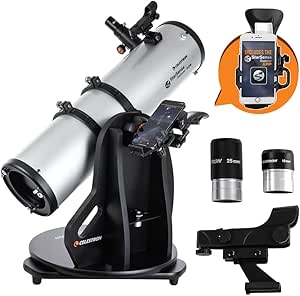 | Best Aperture for Visual Deep-Sky Exploring | Optical design: Newtonian reflector | Aperture: 150 mm (6 in) | Focal length: 650 mm | VIEW LATEST PRICE | See Our Full Breakdown |
| SVBONY SV503 102mm f/7 ED Refractor Telescope |  | Best for Camera-Ready Optical Control | Aperture: 102 mm | Focal length: 714 mm | Focal ratio: f/7 | VIEW LATEST PRICE | See Our Full Breakdown |
| Celestron StarSense Explorer DX 130AZ Smartphone-Guided Newtonian Telescope |  | Best Tripod-Mounted Beginner Pick | Optical design: 130 mm Newtonian reflector | Focal length: 650 mm | Mount: Manual altazimuth with dual-axis slow-motion controls | VIEW LATEST PRICE | See Our Full Breakdown |
| SVBONY SV550 80mm f/6 Triplet Apochromatic Refractor Telescope OTA |  | Best Triplet Refractor for a Compact Imaging Rig | Aperture: 80 mm | Optical design: Air-spaced triplet apochromatic refractor | Objective glass: S-FPL51 ED glass with two correction elements | VIEW LATEST PRICE | See Our Full Breakdown |
| Celestron NexStar 8SE Computerized Schmidt-Cassegrain Telescope |  | Best for Visual Deep-Sky Reach | Optical design: Schmidt-Cassegrain | Aperture: 8 inches | Mount: Computerized single-arm GoTo | VIEW LATEST PRICE | See Our Full Breakdown |
| ZWO Seestar S30 Pro Smart Telescope |  | Best Beginner-Friendly Deep-Sky Imager | Mount: Alt-azimuth; supports equatorial mode | Focus: Autofocus and manual focus | Power source: Battery powered; 1 battery included | VIEW LATEST PRICE | See Our Full Breakdown |
| DWARFLAB Dwarf 3 Smart Telescope |  | Best Compact Multi-Use Smart Telescope | Objective lens diameter: 35 mm | Weight: 2.28 kg | Dimensions: 2.56 × 8.74 × 5.59 in | VIEW LATEST PRICE | See Our Full Breakdown |
| SVBONY SV503 80mm f/7 ED Refractor Telescope with 0.8x Field Flattener |  | Best Value Refractor Imaging Package | Optical design: ED refractor | Objective lens diameter: 80 mm | Focal ratio: f/7 | VIEW LATEST PRICE | See Our Full Breakdown |
| SVBONY SV550 122mm f/7 Triplet APO Refractor Telescope |  | Best Dedicated Refractor for Detailed Deep-Sky Imaging | Aperture: 122 mm | Focal ratio: f/7 | Focal length: 854 mm | VIEW LATEST PRICE | See Our Full Breakdown |
| MEEZAA 150EQ Newtonian Reflector Telescope with Equatorial Mount |  | Best Accessory-Packed Entry Point | Optical design: Newtonian reflector | Aperture: 150 mm | Focal length: 650 mm | VIEW LATEST PRICE | See Our Full Breakdown |
| Celestron Origin Mark II Intelligent Home Observatory |  | Best Automated Deep-Sky Imaging System | Optical design: Rowe-Ackermann Schmidt Astrograph (RASA) | Aperture: 152 mm (6 in) | Focal ratio: f/2.2 | VIEW LATEST PRICE | See Our Full Breakdown |
| Celestron AstroMaster 130EQ Beginner Telescope |  | Best for Learning Manual Equatorial Mounting | Optical design: Newtonian reflector | Aperture: 130 mm (5.1 in) | Focal length: 650 mm | VIEW LATEST PRICE | See Our Full Breakdown |
| deep sky astrophotography telescope | Focal length | Optical design | Aperture | Mount |
|---|---|---|---|---|
| Celestron StarSense Explorer L | 1000 mm | Newtonian reflector | 114 mm (4.5 in) | Manual altazimuth |
| DWARFLAB Dwarf Mini Smart Tele | 150 mm | — | — | Altazimuth and equatorial |
| Celestron StarSense Explorer 1 | 650 mm | Newtonian reflector | 150 mm (6 in) | Manual altazimuth tabletop Dobsonian base |
| SVBONY SV503 102mm f/7 ED Refr | 714 mm | — | 102 mm | — |
| Celestron StarSense Explorer D | 650 mm | 130 mm Newtonian reflector | — | Manual altazimuth with dual-axis slow-motion controls |
| SVBONY SV550 80mm f/6 Triplet | 480 mm | Air-spaced triplet apochromatic refractor | 80 mm | — |
| Celestron NexStar 8SE Computer | — | Schmidt-Cassegrain | 8 inches | Computerized single-arm GoTo |
| ZWO Seestar S30 Pro Smart Tele | 160 mm | — | — | Alt-azimuth; supports equatorial mode |
| DWARFLAB Dwarf 3 Smart Telesco | — | — | — | Altazimuth |
| SVBONY SV503 80mm f/7 ED Refra | 560 mm | ED refractor | — | — |
| SVBONY SV550 122mm f/7 Triplet | 854 mm | FPL-51 triplet APO with ED glass | 122 mm | — |
| MEEZAA 150EQ Newtonian Reflect | 650 mm | Newtonian reflector | 150 mm | German equatorial |
| Celestron Origin Mark II Intel | — | Rowe-Ackermann Schmidt Astrograph (RASA) | 152 mm (6 in) | — |
| Celestron AstroMaster 130EQ Be | 650 mm | Newtonian reflector | 130 mm (5.1 in) | German equatorial mount |
More Details on Our Top Picks
Celestron StarSense Explorer LT 114AZ Newtonian Telescope
I’d choose the StarSense Explorer LT 114AZ for a beginner whose first hurdle is finding deep-sky targets, not capturing them. Its phone-guided sky recognition helps locate objects, while the 114 mm Newtonian mirror gathers more light than the Dwarf Mini’s 30 mm lens for visual observing. That makes it a more natural fit for learning the sky by looking through an eyepiece, rather than collecting app-processed images.
The tradeoff is that this is a manual altazimuth telescope, not a deep-sky imaging rig: you must aim and track targets yourself, and the included eyepieces are for visual use. Compared with the larger StarSense Explorer DX 130AZ, this model has less aperture and lacks dual-axis slow-motion controls, but its 1000 mm focal length provides a narrower, higher-magnification approach. Choose it to learn and observe; skip it if camera-ready tracking is your priority.
Pros:- StarSense app guidance helps beginners locate objects without relying only on star-hopping.
- 114 mm aperture is better suited to visual deep-sky observing than the Dwarf Mini’s 30 mm objective.
- Includes two eyepieces, a red-dot finderscope, tripod, and smartphone dock.
- 1000 mm focal length supports higher-magnification views than the shorter-focal-length DX 130AZ.
Cons:- Manual altazimuth tracking is not suited to long-exposure deep-sky imaging.
- The 114 mm aperture collects less light than the lineup’s 150 mm tabletop Dobsonian.
- Guided navigation requires a compatible smartphone.
Best for: New observers who want smartphone help locating galaxies and nebulae visually, and who are comfortable learning manual aiming and tracking.
Not ideal for: Buyers focused on long-exposure deep-sky imaging or anyone without a compatible smartphone; the mount is manual and the app-guided navigation depends on a supported phone.
- Optical design:Newtonian reflector
- Aperture:114 mm (4.5 in)
- Focal length:1000 mm
- Mount:Manual altazimuth
- Eyepieces:10 mm and 25 mm
- Field of view:2.04 degrees
- Finderscope:Reflex red dot
- Smartphone compatibility:Android 12 and later; iOS 18 and newer, including iPhone XR and newer
Our verdict“Pick this for app-assisted visual learning, not for a setup intended to track long exposures for deep-sky photographs.”
DWARFLAB Dwarf Mini Smart Telescope
For buyers who want the simplest route to capturing deep-sky targets, I’d put the DWARFLAB Dwarf Mini ahead of the manual Celestron StarSense scopes. It pairs app control and automated target tracking with equatorial mode and exposures up to 90 seconds, features that suit imaging better than a telescope you must push by hand. Its 1.85 lb weight also makes it the most travel-friendly option in this group.
That portability comes with a clear optical limit: the 30 mm objective and 150 mm focal length are far smaller and shorter than the 150 mm Celestron tabletop reflector, so this is not the pick for gathering as much visual detail through an eyepiece. Instead, it is a phone-dependent imaging system with light-pollution filters and cloud processing. Manual focusing is also listed alongside automatic focus, so it offers less of a fully hands-off promise than the app-led concept may suggest.
Pros:- At 1.85 lb, it is substantially easier to pack and carry than the reflector telescopes in this group.
- Automated target tracking and equatorial mode support imaging rather than only manual visual observing.
- Exposure time reaches 90 seconds per frame.
- Includes light-pollution filters and cloud image processing.
Cons:- The 30 mm objective gathers far less light than the 114 mm and 150 mm Newtonian reflectors.
- Smartphone control is required for operation.
- Manual focusing is listed as an option, so focusing may not always be fully automated.
Best for: Traveling beginners who want a lightweight, smartphone-controlled system for automated deep-sky imaging and are willing to rely on app-based capture.
Not ideal for: Visual observers seeking a large aperture, or buyers who want standalone controls and a conventional eyepiece telescope; the Mini is phone-controlled and has a 30 mm objective.
- Objective lens diameter:30 mm
- Focal length:150 mm
- Sensor:Sony IMX662, 1/2.8-inch, 2.9 μm pixels
- Mount:Altazimuth and equatorial
- Maximum single-frame exposure:90 seconds
- Weight:1.85 lbs (840 g)
- Focus type:Manual and automatic
- Field of view:2.45 degrees
Our verdict“Choose the Dwarf Mini for portable, app-controlled imaging, but choose a larger reflector if visual aperture matters more than convenience.”
Celestron StarSense Explorer 150mm App-Enabled Tabletop Dobsonian Telescope
The StarSense Explorer 150mm tabletop Dobsonian is my choice here for observers who want the strongest visual deep-sky reach among the manual StarSense reflectors. Its 150 mm aperture gives it a light-gathering advantage over the LT 114AZ and DX 130AZ, helping make faint objects easier to observe. App-guided sky recognition lowers the learning curve, while the compact tabletop base keeps the package more transportable than a full-height tripod setup.
This remains a visual-first telescope, not a long-exposure imaging platform: the altazimuth base is manual, so targets need hand tracking. Its 650 mm focal length is shorter than the LT 114AZ’s 1000 mm, favoring broader views over the same high-magnification framing. You’ll also need a stable table or similar support, unlike the DX 130AZ’s included tripod. I’d pick it for aperture and portability, and skip it if tracking automation is central to your imaging plan.
Pros:- 150 mm aperture provides more light-gathering capacity than the LT 114AZ and DX 130AZ.
- StarSense smartphone guidance helps users find targets without relying entirely on star charts.
- Compact tabletop Dobsonian base is easier to transport than a full-height tripod arrangement.
- Includes 10 mm and 25 mm eyepieces and a red-dot finderscope.
Cons:- Manual altazimuth movement requires the observer to track targets by hand.
- A stable table or equivalent support is needed for observing.
- Its visual eyepiece setup does not provide the automated long-exposure tracking offered by the Dwarf Mini.
Best for: Visual observers who want more aperture for galaxies and nebulae than the smaller StarSense reflectors provide, in a compact setup they can carry to darker skies.
Not ideal for: Deep-sky imagers seeking motorized tracking, or observers who lack a stable surface for a tabletop mount.
- Optical design:Newtonian reflector
- Aperture:150 mm (6 in)
- Focal length:650 mm
- Mount:Manual altazimuth tabletop Dobsonian base
- Eyepieces:10 mm and 25 mm Kellner
- Field of view:1.15 degrees
- Finderscope:StarPointer red-dot finderscope
- Phone compatibility:Android 12 or later; iOS 18 or later, including iPhone XR and newer
Our verdict“Choose this tabletop Dobsonian for the strongest visual aperture among the StarSense reflectors, not for automated deep-sky imaging.”
SVBONY SV503 102mm f/7 ED Refractor Telescope
Among these five, I’d favor the SVBONY SV503 102mm f/7 ED refractor for a buyer building a camera-based setup around a conventional optical tube. Its S-FPL51 ED glass helps reduce color fringing, a useful advantage for imaging bright stars against dark backgrounds. The dual-speed 1:10 focuser supports finer focus adjustments than the basic visual-focused StarSense reflectors, and the 360° rotator makes it easier to align a camera without turning the whole telescope.
The tradeoff is that this is an optical tube, not a complete guided imaging system: the supplied data lists manual focus and no finderscope, and it does not specify a mount. Unlike the Dwarf Mini, it won’t automate target acquisition or tracking. Its 102 mm aperture is also smaller than the 150 mm tabletop Dobsonian, though the refractor’s ED optics and camera-oriented fittings make it the more relevant imaging foundation. I’d choose it when optical control matters more than all-in-one convenience.
Pros:- S-FPL51 ED glass helps reduce chromatic aberration in recorded images.
- Dual-speed 1:10 focuser allows finer focus adjustments than the manual StarSense setups.
- 360° field rotator aids camera framing without rotating the optical tube.
- Fully multi-coated optics and retractable dew shield support light transmission and stray-light control.
Cons:- Manual focus and no included finderscope mean additional setup and operation are required.
- No mount is specified in the supplied product data, so the buyer must plan a tracking platform separately.
- Its 102 mm aperture is smaller than the Celestron 150 mm tabletop reflector.
Best for: Astrophotographers who already have, or plan to select, a suitable mount and camera and want an ED refractor with precise focusing and camera rotation.
Not ideal for: Beginners seeking an all-in-one telescope with a supplied mount, automated target tracking, or an included finderscope.
- Aperture:102 mm
- Focal length:714 mm
- Focal ratio:f/7
- Objective glass:S-FPL51 ED
- Focuser:Dual-speed, 1:10
- Focus travel:90 mm
- Field rotator:360°
- Weight:3.95 kg
Our verdict“Pick the SV503 if you want an ED refractor to build around a camera and mount, rather than a complete automated imaging package.”
Celestron StarSense Explorer DX 130AZ Smartphone-Guided Newtonian Telescope
The StarSense Explorer DX 130AZ is the more capable beginner choice than the LT 114AZ when a stable tripod and easier manual tracking matter. Its 130 mm aperture gathers more light than the LT’s 114 mm mirror, while dual-axis slow-motion controls let you make finer adjustments as a target moves. StarSense guidance still helps locate objects, so the owner gets an approachable route to observing nebulae and galaxies without turning the telescope into a fully automated system.
For deep-sky photography, that distinction matters: the mount remains manual altazimuth, so it does not replace the Dwarf Mini’s automated tracking or the SV503’s camera-oriented focuser and rotator. The 650 mm focal length is shorter than the LT 114AZ’s 1000 mm, which favors wider framing rather than the LT’s narrower, higher-magnification views. I’d choose the DX for learning visual observing on a tripod, not for long exposures.
Pros:- 130 mm aperture offers more light gathering than the LT 114AZ.
- Dual-axis slow-motion controls make manual pointing and tracking more controlled than basic hand movement.
- StarSense app guidance helps beginners locate celestial targets.
- Includes a tripod, smartphone dock, two eyepieces, and a red-dot finderscope.
Cons:- Manual altazimuth tracking is not a substitute for a motorized imaging mount.
- Requires a compatible smartphone for app-guided navigation.
- Its shorter 650 mm focal length gives a different, wider-field emphasis than the LT 114AZ’s 1000 mm.
Best for: Beginners who want smartphone-guided target finding, a full-height tripod, and finer manual tracking controls for visual observing.
Not ideal for: Buyers seeking motorized deep-sky tracking or a telescope optimized for long exposures; the mount is manual and altazimuth.
- Optical design:130 mm Newtonian reflector
- Focal length:650 mm
- Mount:Manual altazimuth with dual-axis slow-motion controls
- Eyepieces:10 mm and 25 mm
- Finderscope:StarPointer red dot
- Field of view:2 degrees
- Dawes limit:0.89 arcsec
- Smartphone compatibility:Android 12 and later; iOS 18 and later, including iPhone XR and newer
Our verdict“Choose the DX 130AZ for guided visual observing with more aperture and finer manual controls, but not for tracked deep-sky exposures.”
SVBONY SV550 80mm f/6 Triplet Apochromatic Refractor Telescope OTA
The SV550 pairs an 80mm triplet objective with a 480mm focal length, a useful balance for framing larger nebulae and star fields without moving to a bulky long-focus tube. Its S-FPL51 ED element and two correction elements are designed to limit color fringing, while the 1:10 dual-speed focuser gives finer manual control than a single-speed focuser when bringing stars to focus. Compared with the SVBONY SV503 80mm, this is a triplet rather than an ED doublet and has a shorter native focal length, but it does not include the SV503 package’s 0.8x reducer and field flattener. The SV550 is a strong OTA choice for someone building an imaging setup around separate mount and camera gear. Its manual focusing and 2.86kg tube add hands-on work and mounting load, so it is less turnkey than either smart telescope here.
Pros:- Triplet optics with S-FPL51 ED glass are designed to reduce chromatic aberration.
- 480mm focal length and f/6 ratio suit relatively wide deep-sky framing.
- 1:10 dual-speed focuser allows fine manual focus adjustments.
- Fully multi-coated optics and stated suitability for astrophotography and visual observing.
Cons:- The OTA requires a separate mount and imaging equipment; it is not a complete telescope system.
- Manual focus requires adjustment at the telescope rather than app-based focusing.
- At 2,860g, the tube adds a meaningful load to the mount and support setup.
Best for: Deep-sky imagers who already own a tracking equatorial mount and want a compact 80mm triplet OTA with fine manual focus control.
Not ideal for: Buyers seeking an all-in-one imaging system, or mount setups with little payload capacity; this is an OTA with manual focus and weighs 2,860g.
- Aperture:80 mm
- Optical design:Air-spaced triplet apochromatic refractor
- Objective glass:S-FPL51 ED glass with two correction elements
- Focal ratio:f/6
- Focal length:480 mm
- Focuser:2.5-inch dual-speed manual focuser, 1:10
- Back focus distance:87 mm
- Optical tube weight:2,860 g
Our verdict“Choose the SV550 if you want a short-focal-length 80mm triplet OTA for a custom imaging rig and can supply a capable mount and camera.”
Celestron NexStar 8SE Computerized Schmidt-Cassegrain Telescope
The NexStar 8SE’s 8-inch aperture gives it a clear advantage in light gathering for visual deep-sky observing over the 80mm refractors in this group. Its computerized single-arm GoTo mount can locate and track targets from a database of over 40,000 objects, making it easier to spend observing time on the object rather than searching manually. That setup is particularly useful for viewing galaxies and clusters, but this roundup focuses on imaging: the 8SE is not an imaging-first choice beside the SVBONY SV550 or SV503, which are refractor OTAs aimed more directly at deep-sky camera setups. The Schmidt-Cassegrain design offers a compact optical tube for its aperture, while the included mount and alignment process bring more system complexity. SkyAlign reduces the need to identify alignment stars, though learning the computerized setup and adding optional accessories can still take time.
Pros:- 8-inch aperture gathers more light for visual views of deep-sky objects than the 80mm refractors listed here.
- GoTo mount locates and tracks targets from a database of over 40,000 celestial objects.
- SkyAlign supports alignment using three bright stars or planets without requiring their identification.
- StarBright XLT coatings and a portable Schmidt-Cassegrain design support an all-in-one observing setup.
Cons:- The computerized system takes time to learn and align.
- Its GoTo setup is less directly tailored to wide-field deep-sky imaging than the SVBONY refractor OTAs.
- Wireless control or hands-free alignment may require additional compatible accessories.
Best for: Visual observers who want substantial aperture and computerized object finding, with deep-sky viewing as a priority and imaging as a secondary interest.
Not ideal for: Buyers whose main goal is wide-field deep-sky astrophotography; the refractor OTAs in this roundup are more directly suited to that imaging approach.
- Optical design:Schmidt-Cassegrain
- Aperture:8 inches
- Mount:Computerized single-arm GoTo
- Hand control:NexStar+
- Object database:Over 40,000 celestial objects
- Alignment technology:SkyAlign
- Coatings:StarBright XLT
- Warranty:2 years
Our verdict“Pick the NexStar 8SE for GoTo-assisted visual observing and aperture, not as the first choice for a dedicated deep-sky imaging rig.”
ZWO Seestar S30 Pro Smart Telescope
The Seestar S30 Pro is the most guided path into deep-sky imaging in this group: app control, automatic GoTo and tracking, autofocus, and one-tap capture reduce the need to assemble a separate camera-and-mount system. Its 160mm focal length and 4.6-degree field of view favor broad targets, while light-pollution filters and AI processing are intended to help produce usable images with a simple workflow. Against the DWARFLAB Dwarf 3, the Seestar lists a wider field of view and explicit mosaic stitching, making it a more clearly specified option for broad framing. Neither smart telescope offers the interchangeable imaging setup of the SVBONY SV550 or SV503. The tradeoff is a fixed, app-dependent system: it must remain stationary during deep-sky imaging, and its design is not intended for planetary observation. That makes it approachable, but less flexible for experienced imagers.
Pros:- Automatic GoTo, tracking, and autofocus simplify target acquisition and capture.
- 4.6-degree field of view and 160mm focal length suit wide-field deep-sky targets.
- Light-pollution filters, AI processing, and mosaic stitching support a guided imaging workflow.
- Battery-powered portable design weighs 3.64 lb.
Cons:- Not intended for planetary observation.
- Must remain stationary during deep-sky imaging for stable tracking.
- App-based automation offers less equipment flexibility than the SV550 or SV503 OTA setups.
Best for: First-time deep-sky imagers who want app-guided targeting, tracking, and capture in a portable self-contained telescope.
Not ideal for: Planetary imagers or experienced astrophotographers who want to choose and upgrade a separate camera, mount, and optical tube.
- Mount:Alt-azimuth; supports equatorial mode
- Focus:Autofocus and manual focus
- Power source:Battery powered; 1 battery included
- Focal length:160 mm
- Field of view:4.6 degrees
- Weight:3.64 lb
- Imaging:Dual-camera 4K
- Features:App control, automatic tracking and GoTo, one-tap imaging, mosaic stitching, AI image processing, anti-dew protection
Our verdict“Choose the Seestar S30 Pro if you want a portable, highly automated entry into wide-field deep-sky imaging rather than a modular telescope rig.”
DWARFLAB Dwarf 3 Smart Telescope
At 2.28kg, the Dwarf 3 is the lightest clearly specified imaging system in this set, and its dual imaging setup gives it uses beyond astronomy: a 4K telephoto camera with auto-tracking sits alongside a wide-angle lens for daytime scenes and broader framing. For deep-sky work, app-based Auto GOTO and EQ mode make it more accessible than the manual-focus SVBONY SV550, which needs a separate mount and camera. The Dwarf 3’s 35mm objective, however, marks it as a compact smart instrument rather than a substitute for the larger 80mm refractors when building a more flexible imaging rig. Its cloud-powered processing removes the need to run a computer, but ties the workflow to the app and cloud service. Buyers should choose it for portability and mixed-use convenience, not maximum optical aperture or hands-on system control.
Pros:- 2.28kg weight and compact dimensions make it easy to transport.
- Dual imaging system combines a 4K telephoto camera with a wide-angle lens.
- Auto GOTO, auto-tracking, autofocus, and EQ mode support app-guided astronomy.
- Cloud-powered image processing does not require a separate computer.
Cons:- The 35mm objective is much smaller than the 80mm apertures of the SVBONY refractors.
- Image processing relies on the dedicated app and cloud computing.
- The compact smart-telescope format offers less component choice than an OTA-based imaging rig.
Best for: Travelers and casual astrophotographers who want a lightweight app-controlled telescope for both night-sky and daytime imaging.
Not ideal for: Imagers seeking larger-aperture optics, a modular camera-and-mount setup, or processing that does not depend on a dedicated app and cloud computing.
- Objective lens diameter:35 mm
- Weight:2.28 kg
- Dimensions:2.56 × 8.74 × 5.59 in
- Mount:Altazimuth
- Focus type:Autofocus
- Imaging:4K telephoto tracking and wide-angle imaging
- Modes:Auto GOTO and EQ mode
- Battery:1 lithium-ion battery included
Our verdict“Pick the Dwarf 3 if portability and day-to-night versatility matter more than larger aperture or a customizable deep-sky imaging system.”
SVBONY SV503 80mm f/7 ED Refractor Telescope with 0.8x Field Flattener
The SV503 stands out for including the part many refractor imagers need for edge-to-edge star shape: a 0.8x reducer and field flattener. That accessory both widens the field and speeds the system, while its stated purpose is to keep stars sharp toward the image edges. The native 80mm, 560mm f/7 ED refractor is longer and slower than the SVBONY SV550 80mm f/6 triplet; the SV550 offers triplet optics and a shorter focal length, but this SV503 bundle arrives with its reducer-flattener rather than requiring that component to be sourced separately. Its 1:10 dual-speed focuser supports precise manual adjustment, and ED glass is designed to reduce chromatic aberration. This is a practical choice for an imaging setup, though the manual focus, absent finderscope, and 2.5kg tube mean it is not a self-contained or fully automated option.
Pros:- Included 0.8x reducer and field flattener provide a faster, wider imaging configuration.
- Field flattener is designed to keep stars sharp from the center to the edge.
- 80mm ED optics help reduce chromatic aberration.
- 1:10 dual-speed focuser supports precise manual focus adjustments.
Cons:- Manual focus requires direct adjustment rather than automated focusing.
- No finderscope is included.
- The 2.5kg OTA still needs a suitable mount and separate imaging equipment.
Best for: Deep-sky imagers who want an 80mm ED refractor bundled with a reducer-flattener to widen the field and address edge sharpness.
Not ideal for: Buyers who want automatic target finding and imaging, or who specifically want a triplet design like the SV550 rather than an ED refractor.
- Optical design:ED refractor
- Objective lens diameter:80 mm
- Focal ratio:f/7
- Focal length:560 mm
- Focal reducer:0.8x reducer and field flattener
- Focuser:2-inch dual-speed manual, 1:10 micro-adjustment
- Field of view:1.9 degrees
- Weight:2.5 kg (5.51 lb)
Our verdict“Choose the SV503 if you want an 80mm refractor package with a reducer-flattener included and are prepared to supply the mount and imaging gear.”
SVBONY SV550 122mm f/7 Triplet APO Refractor Telescope
The SV550 suits imagers who want a dedicated refractor with more aperture than the SVBONY SV503 102mm f/7 ED Refractor. Its 122mm FPL-51 triplet optics gather more light while ED glass helps limit color fringing around bright stars, a useful advantage when recording star fields and nebulae. The 854mm focal length gives a tighter view than the fast Celestron Origin Mark II, so smaller targets can occupy more of the frame, though framing broad nebulae may call for additional camera-side equipment. A 1:10 dual-speed focuser gives fine manual adjustment for critical focus, but it is not an automated imaging setup. At 6.44 kg, this OTA also asks more of a mount and travel kit than the smaller SVBONY SV550 80mm. I’d choose it for controlled, mount-based imaging, not grab-and-go sessions.
Pros:- 122mm aperture gathers more light than the SVBONY SV503 102mm
- FPL-51 triplet APO design with ED glass helps control chromatic aberration
- 1:10 dual-speed focuser supports precise manual focusing
- 854mm focal length offers tighter framing than fast, wide-field systems
Cons:- 6.44 kg OTA places a greater load on the mount than smaller refractors
- Manual focusing requires user adjustment during imaging
- Longer focal length is less suited to very wide nebula framing than the Celestron Origin Mark II
Best for: Astrophotographers who already have a sturdy equatorial mount and want a larger-aperture refractor for tighter deep-sky framing.
Not ideal for: Travel-focused imagers or buyers seeking an automated, camera-and-app imaging system; the OTA is relatively heavy and focusing is manual.
- Aperture:122 mm
- Focal ratio:f/7
- Focal length:854 mm
- Optical design:FPL-51 triplet APO with ED glass
- Focuser:2.5-inch dual-speed, 1:10 gear ratio
- Focus travel:87 mm
- Field of view:1.67 degrees
- Weight:6.44 kg (14.18 lb)
- Optical tube length:28.1 inches
Our verdict“Choose the SV550 122mm if you want a substantial refractor for detailed deep-sky imaging and already have a mount that can carry it.”
MEEZAA 150EQ Newtonian Reflector Telescope with Equatorial Mount
The MEEZAA 150EQ offers a 150mm aperture and a broad starter kit, making it a lower-barrier route into observing and basic experiments with celestial imaging than the OTA-only SVBONY SV550 122mm. Its 650mm focal length gives a wider view than the longer SV550, which can help with larger targets, while the included smartphone adapter offers a simple way to try capturing what you see. But this is still a manually focused telescope on a manually tracked German equatorial mount—not a dedicated deep-sky imaging package. Slow-motion controls help keep a target in view, yet they do not provide automated tracking for long exposures. The eyepieces, Barlow, Moon filter, and carry bag add versatility for visual use, though the listed 130× maximum magnification and manual operation set modest expectations for imaging.
Pros:- 150mm aperture provides substantial light gathering for a beginner package
- 650mm focal length gives wider framing than the SVBONY SV550 122mm
- Includes 25mm and 10mm eyepieces, a 2× Barlow, Moon filter, and smartphone adapter
- German equatorial mount has slow-motion controls for manual tracking
Cons:- Manual focusing and tracking make long-exposure deep-sky imaging difficult
- Listed maximum magnification is 130×, limiting high-power viewing flexibility
- Accessory bundle does not replace a dedicated imaging camera or automated tracking system
Best for: Beginners who want one accessory-rich Newtonian for visual astronomy and introductory smartphone imaging, and are willing to learn manual tracking.
Not ideal for: Deep-sky imagers seeking automated tracking or a purpose-built astrograph; the mount and manual controls require hands-on operation.
- Optical design:Newtonian reflector
- Aperture:150 mm
- Focal length:650 mm
- Magnification:26× to 130×
- Eyepieces:25 mm and 10 mm
- Barlow lens:2×
- Mount:German equatorial
- Focusing:Manual
- Tripod:Adjustable stainless steel
Our verdict“Pick the MEEZAA 150EQ for broad beginner use and first smartphone experiments, not for sustained, tracked deep-sky exposures.”
Celestron Origin Mark II Intelligent Home Observatory
The Origin Mark II is the clearest choice here for buyers who want imaging to be the telescope’s main job without assembling a separate optical tube, camera, and app workflow. Its 6-inch RASA optics at f/2.2 are built for fast, wide-field imaging, unlike the longer-focal-length SVBONY SV550 122mm, which favors tighter framing and manual focusing. The included Origin 678C camera and companion app support live viewing, saving, and sharing, shifting the experience toward an integrated home observatory rather than a traditional telescope setup. That convenience comes with less flexibility: the supplied system is centered on its own camera and software, not interchangeable eyepiece viewing or a conventional refractor workflow. The product details provided are also limited, so buyers have less information here about the full feature set than they do for the more conventional AstroMaster 130EQ.
Pros:- Fast f/2.2 optics are designed for wide-field celestial imaging
- Integrated 6-inch RASA optical system and Origin 678C camera reduce separate component choices
- Sony Starvis 2 CMOS sensor has 8.4-megapixel resolution and 2.0-micron pixels
- App supports live viewing, image saving, sharing, and smart TV casting
Cons:- Integrated camera-and-app approach offers less component flexibility than a conventional OTA such as the SVBONY SV550 122mm
- Wide-field f/2.2 design is less suited to tight framing than a longer-focal-length refractor
- Available product information is incomplete, leaving some system details unspecified
Best for: Home observers who prioritize app-guided, wide-field deep-sky imaging and live sharing over hands-on telescope operation.
Not ideal for: Buyers who want to choose their own camera, use a traditional eyepiece-led setup, or need more complete published product details before choosing.
- Optical design:Rowe-Ackermann Schmidt Astrograph (RASA)
- Aperture:152 mm (6 in)
- Focal ratio:f/2.2
- Camera:Origin 678C
- Sensor:Sony Starvis 2 CMOS
- Resolution:8.4 megapixels
- Pixel size:2.0 microns
- Aspect ratio:16:9
- Connectivity and viewing:Companion app; simultaneous live viewing and smart TV casting
Our verdict“Choose the Origin Mark II if you want a fast, integrated imaging observatory with app-based viewing rather than a traditional telescope kit.”
Celestron AstroMaster 130EQ Beginner Telescope
The AstroMaster 130EQ is a visual-first Newtonian for beginners who want to learn how an equatorial mount works before moving toward more demanding imaging. Its 130mm aperture and 650mm focal length offer a useful starting point for viewing bright deep-sky targets, but the manual mount makes it a less direct imaging choice than the app-operated Celestron Origin Mark II. Compared with the MEEZAA 150EQ, it has a smaller aperture and a narrower listed field of view, while its included eyepieces, red dot finder, and astronomy software support a straightforward learning setup. Slow-motion controls help with hand-guided tracking, but they do not provide the consistent automated motion needed for long exposures. I’d treat this as a stepping stone for observing and basic camera experiments, not a ready-made deep-sky imaging rig.
Pros:- 130mm Newtonian aperture supports viewing planets and brighter deep-sky objects
- Manual slow-motion controls help users follow targets and learn equatorial movement
- Includes 20mm and 10mm eyepieces, a StarPointer red dot finder, and astronomy software
- Tool-free assembly and an adjustable tripod suit beginner setup
Cons:- Manual tracking is a poor fit for long deep-sky exposures compared with the Celestron Origin Mark II
- Smaller aperture than the MEEZAA 150EQ
- The listed lithium metal battery requirement adds a setup detail for buyers to check
Best for: New astronomers who want a conventional Newtonian for visual learning, bright deep-sky targets, and practice using a German equatorial mount.
Not ideal for: Imagers who need automated tracking, a supplied astrophotography camera, or a ready-to-use deep-sky workflow.
- Optical design:Newtonian reflector
- Aperture:130 mm (5.1 in)
- Focal length:650 mm
- Mount:German equatorial mount
- Eyepieces:20 mm and 10 mm
- Magnification:33× and 65× with included eyepieces
- Finderscope:StarPointer red dot
- Field of view:0.67°
- Weight:17 lb (7.71 kg)
Our verdict“Choose the AstroMaster 130EQ to learn visual astronomy and manual equatorial tracking, but look to an automated imaging system for serious deep-sky photography.”
How We Picked
I ranked these deep sky astrophotography telescopes by how well their complete designs support capturing faint, extended objects—not by aperture alone or by how many features appear on a product page. I weighed imaging suitability of the optics, tracking and control approach, likely setup complexity, portability, upgrade flexibility, and the amount of additional equipment a buyer may need. A scope with good optics can still be a poor deep sky choice if its mount is not suited to accurate tracking, so I treated the imaging system as a whole.
The order favors options with a clearer path to repeatable deep sky imaging, then distinguishes integrated convenience from traditional, expandable rigs. Smart telescopes rank well for ease and portability, while dedicated refractor optical tube assemblies are stronger for buyers prepared to supply a mount and camera. Visual-first Dobsonians, phone-guided Newtonians, and beginner equatorial packages rank lower for this specific use because their strengths do not automatically translate to long-exposure tracking. I also considered the differences within each product family, such as aperture, focal ratio, and whether a field flattener is included.
Factors to Consider When Choosing Deep Sky Astrophotography Telescopes
Before choosing among these deep sky imaging options, decide how much of the imaging system you want the telescope to handle for you. The optical tube is only one part of the setup; tracking, camera compatibility, field coverage, power, and image-processing workflow all affect what you can capture. These factors can help you avoid paying for capability you will not use—or buying a scope that leaves key imaging needs unresolved.
Match the mount to long exposures
For deep sky imaging, a mount must follow the sky accurately enough to keep stars from streaking during exposures. A smartphone guide or computerized pointing system can help locate targets, but finding an object is not the same as tracking it with imaging-grade precision. Buyers choosing a traditional optical tube should check whether the mount is included, whether it can accept a suitable camera load, and whether guiding can be added if needed. A light telescope on a capable equatorial mount may produce more useful imaging sessions than a larger tube on a mount designed mainly for visual use. The common mistake is to spend the whole budget on aperture and leave too little for tracking. If a listing is for an optical tube assembly only, plan the mount as a separate major purchase.
Choose focal length for the objects you want
Large nebulae and broad star fields often suit shorter focal lengths, while smaller galaxies and compact targets benefit from a narrower field. A longer focal length also magnifies tracking errors, making mount precision and setup more demanding. Before buying, compare the telescope’s focal length with the camera sensor you expect to use; together, they determine how much sky fits in each frame. Beginners often assume that a more powerful or longer telescope will show more detail in every image, but a target that does not fit the frame can be difficult to compose. A faster focal ratio can help collect light more quickly, though optical correction and focus quality still matter. Choose for a realistic list of targets rather than for maximum magnification.
Understand what optical correction you may need
Stars near the edges of a photograph can appear distorted when the telescope’s image field does not match a camera sensor’s flat frame. Some refractors are sold with a compatible field flattener, while other configurations require an additional corrector or reducer. This accessory affects more than image appearance: it can change effective focal length, framing, and sometimes the spacing required between camera and telescope. Check whether a corrector is included, optional, or specific to one optical tube before comparing system completeness. A triplet refractor may offer strong color correction, but that does not mean every camera will receive a well-corrected field without the right spacing and accessories. Budget for the full optical path, not only the main tube.
Decide how much automation you want
Smart telescopes combine several imaging tasks in a compact package, which can reduce setup choices and make casual sessions easier to start. That convenience comes with limits: camera, control software, and much of the upgrade path are tied to the system’s design. A traditional telescope and separate camera take more planning, but let you replace or upgrade individual components over time. Think about whether you want to learn exposure control, focusing, calibration, and processing, or would rather let software manage much of the capture workflow. Automation does not remove the need for clear skies, sensible target selection, or image review. Choose an integrated system for a simpler path to capture; choose separate components when control and expandability matter more.
Count the full setup, not just the telescope
A complete deep sky rig may also need a tracking mount, camera, power source, cables, dew control, adapters, and software. Those items affect portability and setup time as much as the telescope’s dimensions do. A compact smart instrument can be easier to take outside, while a larger aperture system may require more room, power, and careful balancing. Check the weight of the assembled imaging train rather than just the optical tube, especially if you plan to travel or set up on a small patio. Buyers who already own a camera or mount should confirm compatibility before paying for overlapping equipment. The best fit is the system you can set up consistently, not merely the one with the largest specification.
Separate visual convenience from imaging readiness
Many beginner telescopes are designed to make it easier to point at objects and observe through an eyepiece. Those features can make astronomy more approachable, but they do not by themselves provide the tracking stability or camera compatibility needed for deep sky exposures. Phone guidance helps with target location; it does not turn an alt-azimuth mount into a purpose-built imaging mount. Reflectors can offer substantial aperture, though buyers should account for collimation and the practical demands of their mount. If deep sky photography is the main goal, prioritize tracking and a supported camera setup before visual accessories. If you want to observe as well as experiment with short captures, a beginner package may still suit you—just set expectations for its imaging role.
Frequently Asked Questions
Can I start deep sky astrophotography with a telescope that includes a mount?
Yes, but an included mount is not automatically suitable for long exposures. Check its tracking method, payload capacity with a camera attached, and whether it supports accurate alignment or guiding. Many beginner packages are useful for learning the sky and taking short captures, yet they may limit exposure length or consistency. If imaging is your main goal, compare the cost of a capable mount plus a modest optical tube against a bundled telescope that may need replacing later. Plan for the camera and accessories as part of the system, too.
Is a smart telescope a better first choice than a refractor and separate camera?
A smart telescope can be the easier starting point when compact setup and automated capture matter more than choosing each component. Its integrated design reduces compatibility decisions, but it also limits how freely you can upgrade the optics or camera. A refractor with a separate camera and mount takes more setup and learning, yet provides more control over framing and future changes. Think about whether the goal is to collect images quickly or to learn the full imaging workflow. Neither route removes the need to manage focus, sky conditions, and image processing.
Should I choose a larger aperture for galaxies and nebulae?
A larger aperture gathers more light, which can help reveal faint targets, but it is not a standalone guarantee of better deep sky images. A larger or longer telescope can demand a sturdier mount, make tracking errors more visible, and frame broad nebulae poorly. For many extended targets, a shorter focal length and well-corrected field may be more useful than a bigger mirror or lens. Consider the target size, camera sensor, tracking system, and your available setup space together. If mount capacity is limited, a smaller, lighter telescope may produce more consistent results.
What should I budget for when a telescope is sold as an optical tube only?
An optical tube assembly is only the starting point for a complete imaging system. You may need a tracking mount, camera, corrector or field flattener, camera adapters, power, dew control, and software suited to your workflow. Check the tube’s weight and camera-side spacing requirements before choosing a mount, since accessories add load and can affect balance. Also confirm that the intended camera sensor is well matched to the telescope’s corrected field. Compare the cost and complexity of the finished system, not just the tube’s listed contents.
Are phone-guided Newtonian or Dobsonian telescopes suitable for long-exposure deep sky photos?
Phone guidance can help you locate objects, but it does not provide the precise, continuous tracking needed for long exposures. A Dobsonian mount is generally intended for visual observing rather than tracking a target through long camera exposures, and many phone-guided Newtonians are sold primarily as beginner visual systems. Short exposures or simple experiments may be possible, depending on the mount and camera setup, but results should not be confused with those from a dedicated tracking rig. If deep sky photography is the priority, verify the mount’s tracking capability before choosing a visually appealing telescope. These models make more sense when observing and learning the night sky are also central goals.
Conclusion
For a single recommendation, I’d choose the Celestron Origin Mark II as best overall for buyers who want an integrated deep sky imaging system. My best value direction is the SVBONY SV503 80mm ED with its 0.8x field flattener for a buyer who already has—or is ready to build—a compatible mount and camera setup; it is not a complete imaging rig on its own. The best premium traditional option is the SVBONY SV550 122mm triplet for experienced imagers who can support its larger optical tube with suitable equipment. For beginners who want a compact, automated starting point, I’d look at the DWARFLAB Dwarf 3, while the Seestar S30 Pro and Dwarf Mini suit buyers prioritizing portable smart imaging. Choose the SV550 80mm triplet for a flexible refractor-based imaging build, and treat the StarSense, Dobsonian, NexStar, and AstroMaster models primarily as visual-first or mixed-use choices unless their mount and camera arrangements meet your specific exposure goals.
Halloween Picks

ELAMAS 11ft Animatronic Flying Witch Halloween Decoration

Panefright Halloween Window Projector – Scary Projector for Spooky Decor

Halloween Inflatable Haunted House Maze – 20×20 ft with Removable Roof and Blower
As an affiliate, we earn on qualifying purchases.