
TL;DR
Researchers have confirmed the detection of a four-carbon sugar molecule in interstellar space, expanding knowledge of complex organic compounds in the cosmos. This discovery highlights the potential for prebiotic chemistry beyond Earth.
Scientists have confirmed the detection of a four-carbon sugar molecule in interstellar space, a discovery that broadens understanding of complex organic compounds beyond Earth. This finding, announced in March 2024, was made through spectroscopic analysis of a molecular cloud, marking a significant advancement in astrochemistry and the study of prebiotic molecules in the universe.
The molecule identified is a four-carbon sugar, known as erythrose, which is a key component in biological processes on Earth. The detection was achieved using radio telescopes that analyzed spectral lines from a dense molecular cloud located in the constellation Taurus. According to the research team from the Max Planck Institute for Radio Astronomy, this is the first confirmed observation of such a complex sugar in interstellar space.
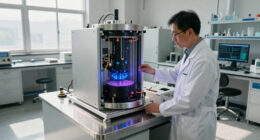
Researchers employed advanced spectroscopic techniques to distinguish erythrose’s unique spectral signature from other molecules. The detection supports the hypothesis that complex organic molecules, including sugars, can form in space environments prior to planetary formation. The findings were published in the journal Nature and have been subjected to peer review.
Implications for Cosmic Organic Chemistry
This discovery is significant because it suggests that the building blocks of life—complex organic molecules like sugars—can form naturally in space. The presence of erythrose in interstellar clouds indicates that prebiotic chemistry may be more widespread than previously thought, potentially seeding planets with essential organic compounds. Such molecules are fundamental to biological processes on Earth, and their existence in space raises questions about the origins of life and the distribution of organic materials across the galaxy.

Astronomical Spectroscopy: An Introduction To The Atomic And Molecular Physics Of Astronomical Spectra (2Nd Edition)
- Condition: Used Book in Good Condition
As an affiliate, we earn on qualifying purchases.
As an affiliate, we earn on qualifying purchases.
Previous Discoveries of Organic Molecules in Space
Prior to this, astronomers have detected simpler organic molecules such as amino acids, formaldehyde, and methanol in various interstellar environments. However, the identification of sugars, especially a four-carbon sugar like erythrose, marks a new level of complexity in cosmic organic chemistry. The detection aligns with theories that complex molecules can assemble in cold, dense molecular clouds before planetary systems form, providing raw materials for potential prebiotic chemistry on emerging planets.
Researchers have long hypothesized that sugars could form through chemical reactions in space, but direct observational evidence has been limited. This detection provides concrete data supporting these theories and encourages further investigation into the prevalence of such molecules in different cosmic regions.
“This is the first confirmed detection of a four-carbon sugar in interstellar space, which significantly advances our understanding of prebiotic chemistry beyond Earth.”
— Dr. Maria Jensen, lead researcher at Max Planck Institute

Atomic Adventures Lab Educational Molecule Model Kit for Kids – Organic Chemistry Molecular Model Kit with Guide & STEM Learning Activity Cards for Teens & Adults to Build 3D Molecules, Atoms, Bonds
- 3D Molecule Construction: Build real molecular structures in 3D
- Interactive Learning Cards: Explore chemistry concepts with easy-to-follow cards
- Complete STEM Kit: Includes color-coded atoms and flexible bonds for accurate models
As an affiliate, we earn on qualifying purchases.
As an affiliate, we earn on qualifying purchases.
Unanswered Questions About Sugar Formation in Space
It is still unclear how exactly erythrose forms in interstellar environments. The specific chemical pathways and conditions necessary for its synthesis remain to be fully understood. Additionally, the abundance and distribution of similar sugars across different regions of space are not yet known, and further observations are needed to determine whether this is an isolated case or part of a widespread phenomenon.

LINKTOR Chemistry Molecular Model Kit (444 Pieces), Student or Teacher Set for Organic and Inorganic Chemistry Learning, Motivate Enthusiasm for Learning and Raising Space Imagination, A Fullerene Set
- Suitable for All Education Levels: 444-piece kit for students from Grade 7 to graduate
- Includes Fullerene Model: Features Carbon-60 (Fullerene) parts
- Two Types of Models: Ball-and-stick and space-filling models
As an affiliate, we earn on qualifying purchases.
As an affiliate, we earn on qualifying purchases.
Next Steps in Interstellar Organic Chemistry Research
Researchers plan to conduct more targeted spectroscopic surveys of molecular clouds to identify additional complex sugars and organic molecules. Laboratory simulations of space conditions will also be undertaken to better understand the chemical pathways leading to sugar formation. Future missions may include sending probes to study planetary systems where these molecules could be incorporated into forming planets, potentially setting the stage for prebiotic chemistry on a planetary scale.
The Everything Kids' Science Experiments Book: Boil Ice, Float Water, Measure Gravity-Challenge the World Around You! (Everything® Kids Series)
- Product ID: 2305901
- Barcode: 045079205574
As an affiliate, we earn on qualifying purchases.
As an affiliate, we earn on qualifying purchases.
Key Questions
Why is the detection of a four-carbon sugar important?
It demonstrates that complex organic molecules like sugars can form in space, which are essential components in biological processes. This supports theories that life’s building blocks originate in the cosmos before reaching planets.
How was erythrose detected in interstellar space?
Scientists used radio telescopes to analyze spectral lines from a molecular cloud, identifying the unique spectral signature of erythrose through advanced spectroscopic techniques.
Does this mean life exists elsewhere in the universe?
The detection of sugars alone does not confirm extraterrestrial life, but it suggests that the chemical ingredients for life are more widespread than previously thought, increasing the possibility of life elsewhere.
What are the implications for planetary systems?
If complex organic molecules like erythrose are common in space, they could be incorporated into forming planets, potentially contributing to prebiotic chemistry and the emergence of life.
What remains to be studied about these molecules?
Researchers need to understand how these molecules form chemically in space, their abundance, and whether similar molecules are present in different cosmic environments.
Source: google-trends