TL;DR

Prime made for students and young adults
- Fast, free delivery for dorm and study essentials
- Prime Video and Amazon Music included
- Member-only deals
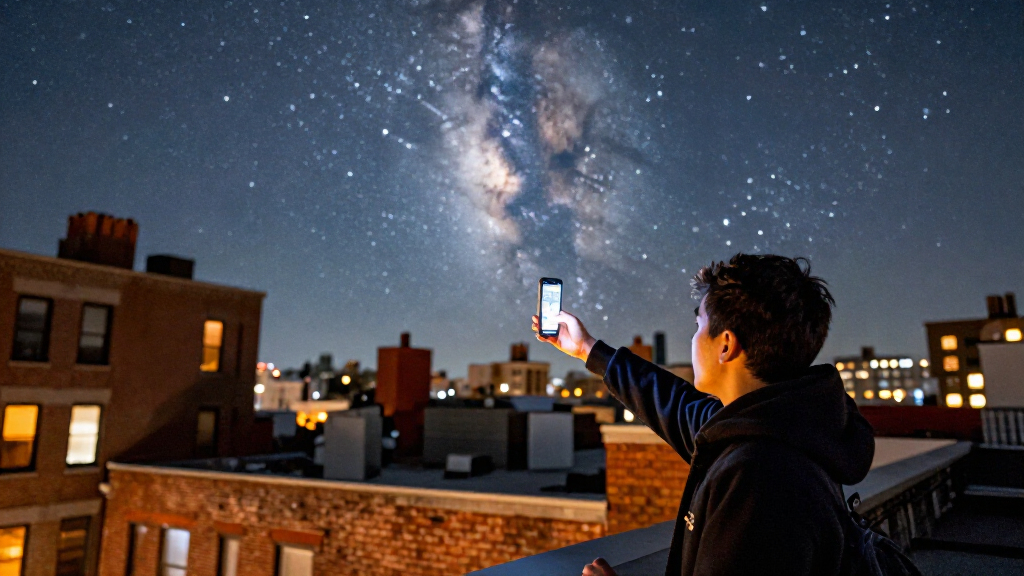
NASA’s Astronomy Picture of the Day for Oct. 15, 2026, features an image of the Milky Way above Manhattan by astrophotographers Jason Kurth and Ty Buckley. NASA says a filter that blocks most visible light and records near-infrared light helped reduce the effects of city lighting.
NASA’s Astronomy Picture of the Day on Oct. 15, 2026, features the Milky Way above Manhattan, captured in a photograph credited to Jason Kurth and Ty Buckley. The image uses a filter that blocks most visible light and records near-infrared light, a technique NASA says reduces the contribution of some city lights and makes the stars visible in the photograph.
NASA explains that the image was made using a filter that blocks most visible light and captures light in the near-infrared part of the spectrum, which has lower energy than visible light. The agency says this approach helps block much of the light pollution from the city, rather than showing how Manhattan would appear to the unaided eye.
According to NASA, fluorescent and LED bulbs do not appear bright in the near-infrared in the same way that some older incandescent bulbs and neon lights do. Those older sources can still contribute near-infrared light, the explanation says. Stars also emit near-infrared light, allowing them to show up in the image despite the city setting.
The APOD entry credits Jason Kurth and Ty Buckley for the image. Its explanation was written and edited by Cecilia Chirenti, Robert Nemiroff, Jerry Bonnell and Keighley Rockcliffe. NASA presents the daily feature as a photograph or image accompanied by an explanation written by a professional astronomer.
How Near-Infrared Reveals City Skies
The image offers a specific example of how the light reaching a camera can be selected to reveal features that ordinary visible-light photography in a bright city might obscure. By filtering out most visible light, the photographers reduced the effect of some urban illumination and recorded a view in which the Milky Way is visible. This is a photographic technique, not evidence that the city’s light pollution has disappeared or that the galaxy is readily visible to the naked eye from the same location.
For readers, the distinction matters because the image is not simply a conventional night-sky photograph. It records a portion of the electromagnetic spectrum beyond visible light, so its appearance depends on the filter and imaging method. NASA’s description also points to how different types of lighting affect observations differently: not every light source is blocked equally by this setup.
The picture also serves the APOD feature’s educational purpose. NASA describes it as a reminder that people share the same sky and that astronomy can help explain humanity’s place in the cosmos. The image connects that broad idea to a recognizable urban landscape without implying that a camera’s filtered view is identical to human vision.
As an affiliate, we earn on qualifying purchases.
The Daily APOD Feature
NASA’s Astronomy Picture of the Day publishes one image or photograph each day with a short explanation. The Oct. 15 entry is titled “The Milky Way over Manhattan.” NASA credits the service to the Astrophysics Science Division at NASA’s Goddard Space Flight Center, NASA Science Activation and Michigan Technological University.
The item’s explanation focuses on the contrast between Manhattan’s bright city lights and the stars, then describes the near-infrared filter used for the photograph. It does not provide technical camera settings, the precise location or time of the exposure, or a detailed account of the image processing. The source identifies the image makers as Jason Kurth and Ty Buckley, but does not elaborate on their equipment or the circumstances of the shoot.
NASA’s page lists “Chasing the ISS” as the picture scheduled for the following day. That listing is the next item in the APOD sequence; it does not add further information about how the Manhattan photograph was made.
As an affiliate, we earn on qualifying purchases.
Details Behind the Manhattan Exposure
NASA’s published explanation does not specify the exact exposure date, time or location, nor does it state which camera or filter model was used. It also provides no exposure settings or processing details. Those omissions mean the source supports a general description of the near-infrared method, but not a fuller reconstruction of how the image was produced.
The description says the filter blocks most visible light and that certain lighting types remain bright in near-infrared, while fluorescent and LED bulbs do not. It does not quantify how much city light was reduced or identify the specific light sources in the photographed scene. The APOD entry also does not say that the Milky Way would be visible to someone looking up without specialized imaging equipment.
light pollution filter for cameras
As an affiliate, we earn on qualifying purchases.
As an affiliate, we earn on qualifying purchases.
The Next APOD Is Scheduled
NASA’s page lists “Chasing the ISS” as the Astronomy Picture of the Day for Oct. 16, 2026. The Oct. 15 entry does not announce further reporting or new measurements related to the Manhattan image. Readers seeking additional technical details would need information from the photographers or a more detailed account of the image’s capture and processing.
astrophotography camera for night sky
As an affiliate, we earn on qualifying purchases.
As an affiliate, we earn on qualifying purchases.
Key Questions
What does NASA’s Oct. 15 APOD show?
It features a photograph of the Milky Way above Manhattan, credited to Jason Kurth and Ty Buckley.
How was the Milky Way captured above the city?
NASA says the photograph used a filter that blocks most visible light and records near-infrared light. The agency says this reduces the contribution from some city lighting while allowing stars to be captured.
Can the Milky Way be seen this way with the naked eye?
The APOD description explains a filtered photographic method; it does not say that the Milky Way is visible to the unaided eye from the photographed location.
Which city lights can still show up in near-infrared?
NASA says older incandescent bulbs and some neon lights can remain bright in near-infrared, while fluorescent and LED bulbs do not appear bright in the same way.
What image is scheduled after this APOD?
NASA lists “Chasing the ISS” as the picture for Oct. 16, 2026.
Source: primary
Fall Picks
fall essentials
As an affiliate, we earn on qualifying purchases.